China Digital Printing Market Size, Share & Growth Rate
The China Digital Printing Market was estimated at USD 150 Million in 2025 and is projected to reach USD 172 Million by 2032, growing at a CAGR of 2.0% from 2026 to 2032. This growth trajectory is primarily driven by the surge in demand for customized and personalized products, alongside the acceleration of technological advancements within the digital printing domain. Additionally, the flourishing e-commerce sector continues to catalyze the market by driving the need for innovative packaging and labeling solutions.
China Digital Printing Market Year-wise Growth Rate and Key Drivers
This graph highlights how the China Digital Printing Market has steadily grown over the years, supported by major growth factors.
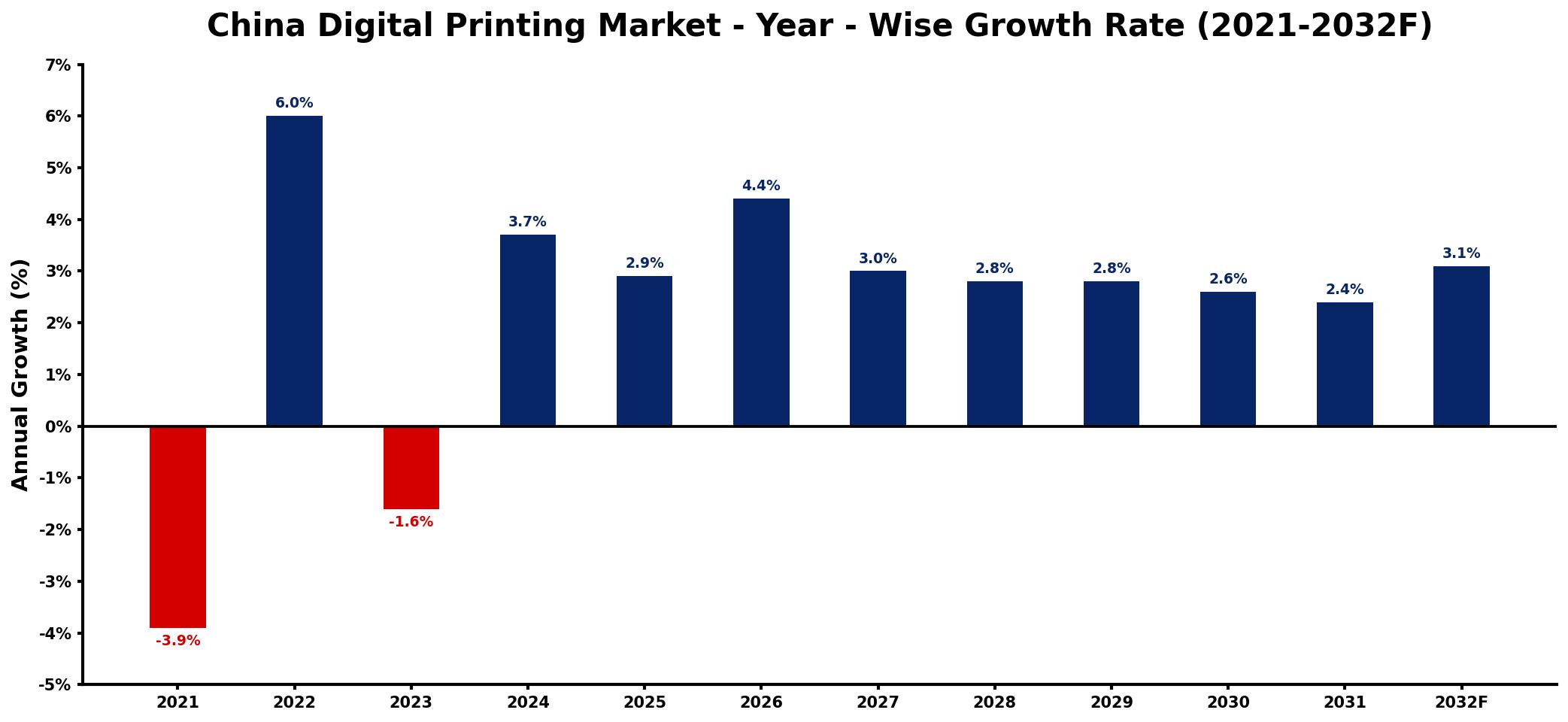
The table below presents the year‑wise growth rates along with the key drivers influencing the market
| Year | Growth Rate | Major Drivers |
| 2021 | -3.9% | decreased investment in technology |
| 2022 | 6.0% | rising demand for customization |
| 2023 | -1.6% | decline in consumer spending |
| 2024 | 3.7% | expansion of e-commerce platforms |
| 2025 | 2.9% | growth in packaging applications |
| 2026 | 4.4% | increased focus on sustainability |
| 2027 | 3.0% | rise in advertising expenditures |
| 2028 | 2.8% | development of innovative materials |
| 2029 | 2.8% | growing need for short runs |
| 2030 | 2.6% | advancements in automation solutions |
| 2031 | 2.4% | increased adoption of personalization |
| 2032 | 3.1% | growing automotive sector requirements |
Note: Market size estimations and growth projections presented in this report are based on 6Wresearch's proprietary forecasting methodology, utilizing the latest available industry data, government publications, and primary research inputs.
China Digital Printing Market Synopsis
Recent momentum in the China Digital Printing Market has been characterized by rapid adoption of digital technologies, enabling businesses to meet the evolving consumer demands for personalization. However, as the market heads towards 2032, there is a greater emphasis on sustainability and eco-friendly practices, which are becoming critical to competitive positioning.
With the shift towards digital textile printing spurred by the fast fashion industry, combined with a rise in personalized printing services, the market is set to expand. Companies that successfully adapt to these changing demands will likely seize significant market share as they innovate and diversify their offerings.
China Digital Printing Market Key Takeaways
- The market is experiencing strong growth fueled by demand for personalized and customized products.
- Technological advancements and eco-friendly printing practices are reshaping market dynamics.
- Investment opportunities are concentrated in digital textile printing and sustainable packaging solutions.
- The government's supportive policies aim to enhance digital printing capabilities and promote sustainability.
- Intense competition among key players is driving innovation but may compress profit margins.
Evaluation of Restraints in China Digital Printing Market
The China Digital Printing Market faces notable restraints, primarily stemming from fierce competition, which has precipitated price wars and subsequent margin pressures among participants. Additionally, intellectual property protection remains a significant concern, as businesses strive to secure their innovations in an environment susceptible to counterfeiting. The rapid pace of technological change necessitates continual investment in research and development, putting pressure on companies to innovate consistently. Compounding these challenges are the complex regulatory frameworks that can hinder market entry and expansion, making navigation for new entrants particularly daunting.
China Digital Printing Market Trends
Key trends influencing the China Digital Printing Market include the adoption of UV printing technology, which enhances print quality and durability. Concurrently, there is an escalating demand for sustainable printing practices, as consumers increasingly prefer environmentally friendly options. The rise of e-commerce has also resulted in greater demand for digitally printed packaging and labeling, further propelling market growth. Additionally, the fashion industry's growing inclination towards digital textile printing is reshaping traditional printing methods, aligning with the rising emphasis on rapid production cycles.
China Digital Printing Market Opportunities
The digital printing landscape in China is ripe with opportunities for savvy investors. High demand for customized and short-run printing solutions presents a fertile ground for innovation, particularly in sectors such as textiles and packaging. Digital textile printing, in particular, is gaining traction due to the increasing popularity of fast fashion and personalized garments. Furthermore, the proliferation of e-commerce continues to drive the need for high-quality printed products that cater to a diverse consumer base, opening up numerous channels for business expansion.
Government Initiatives in the China Digital Printing Market
The Chinese government is actively implementing policies to bolster the digital printing sector, focusing on advancing technologies that enhance manufacturing capabilities. Initiatives aimed at promoting innovation and environmentally sustainable practices are guiding the industry towards more responsible production methods. Furthermore, government support for digital printing in key sectors such as packaging and textiles is intended to strengthen competitiveness and drive economic growth within the industry.
Future Insights of the China Digital Printing Market
Looking ahead to 2026-2032, the China Digital Printing Market is expected to undergo substantial growth driven by a continued shift towards personalized products and technological enhancements. The increasing importance of sustainability will likely catalyze the adoption of eco-friendly materials and practices. With government initiatives promoting digital transformation and innovation across various sectors, the market is poised for a period of significant expansion, catering to an increasingly diverse array of consumer and business needs.
China Digital Printing Market Latest Developments (2025 - 2026)
Recent developments in the China Digital Printing Market highlight a focused trend towards innovative applications, particularly in the realms of textile and packaging printing. Companies are increasingly investing in advanced technologies to enhance product quality and sustainability. There is also a noticeable pivot towards collaboration among industry stakeholders to promote eco-friendly practices and innovations that align with evolving consumer preferences. Additionally, partnerships aimed at integrating digital printing solutions within the e-commerce landscape are emerging as a key focus area.
China Digital Printing Market - Key Attractiveness of the Report
- 10 Years of Market Numbers
- Historical Data Starting from 2022 to 2025
- Base Year: 2025
- Forecast Data until 2032
- Key Performance Indicators Impacting the Market
- Major Upcoming Developments and Projects
Key Highlights of the Report:
- China DigitalPrinting Market Outlook
- Market Size of China DigitalPrinting Market, 2025
- Forecast of China DigitalPrinting Market, 2032
- Historical Data and Forecast of China DigitalPrinting Revenues & Volume for the Period 2022-2032F
- China DigitalPrinting Market Trend Evolution
- China DigitalPrinting Market Drivers and Challenges
- China DigitalPrinting Price Trends
- China DigitalPrinting Porter's Five Forces
- China DigitalPrinting Industry Life Cycle
- Historical Data and Forecast of China DigitalPrinting Market Revenues & Volume By Printing Process for the Period 2022-2032F
- Historical Data and Forecast of China DigitalPrinting Market Revenues & Volume By Electrophotography for the Period 2022-2032F
- Historical Data and Forecast of China DigitalPrinting Market Revenues & Volume By Inkjet for the Period 2022-2032F
- Historical Data and Forecast of China DigitalPrinting Market Revenues & Volume By Application for the Period 2022-2032F
- Historical Data and Forecast of China DigitalPrinting Market Revenues & Volume By Books for the Period 2022-2032F
- Historical Data and Forecast of China DigitalPrinting Market Revenues & Volume By Commercial Printing for the Period 2022-2032F
- Historical Data and Forecast of China DigitalPrinting Market Revenues & Volume By Packaging for the Period 2022-2032F
- Historical Data and Forecast of China DigitalPrinting Market Revenues & Volume By Labels for the Period 2022-2032F
- Historical Data and Forecast of China DigitalPrinting Market Revenues & Volume By Corrugated Packaging for the Period 2022-2032F
- Historical Data and Forecast of China DigitalPrinting Market Revenues & Volume By Cartons for the Period 2022-2032F
- Historical Data and Forecast of China DigitalPrinting Market Revenues & Volume By Flexible Packaging for the Period 2022-2032F
- Historical Data and Forecast of China DigitalPrinting Market Revenues & Volume By Rigid Plastic Packaging for the Period 2022-2032F
- Historical Data and Forecast of China DigitalPrinting Market Revenues & Volume By Metal Packaging for the Period 2022-2032F
- China DigitalPrinting Import Export Trade Statistics
- Market Opportunity Assessment By Printing Process
- Market Opportunity Assessment By Application
- Market Opportunity Assessment By Packaging
- China DigitalPrinting Top Companies Market Share
- China DigitalPrinting Competitive Benchmarking By Technical and Operational Parameters
- China DigitalPrinting Company Profiles
- China DigitalPrinting Key Strategic Recommendations






































