China Enterprise Firewall Market Size & Growth Rate (2026-2032)
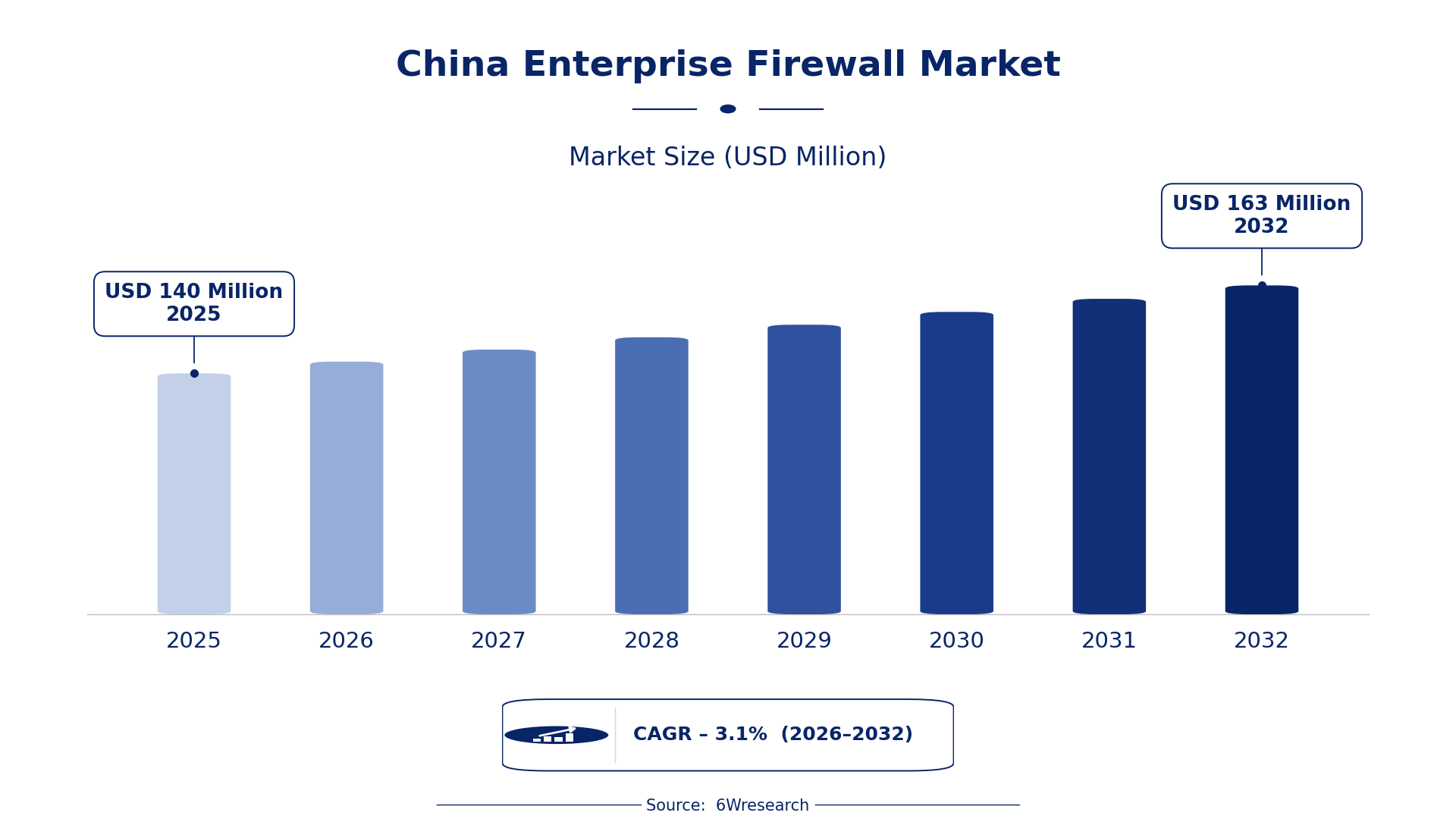
The China Enterprise Firewall Market was estimated at USD 140 Million in 2025 and is projected to reach USD 163 Million by 2032, growing at a CAGR of 3.1% from 2026 to 2032.
China Enterprise Firewall Market Synopsis
The China Enterprise Firewall Market is at a pivotal juncture, characterized by an accelerating need for cybersecurity solutions. As businesses intensify their digital transformation efforts, the call for robust firewalls to shield sensitive data from mounting cyber threats becomes imperative.
With increasing regulatory scrutiny on data protection, organizations are compelled to invest in advanced firewall technologies. The landscape is shifting towards cloud-based solutions, reflecting the surge in remote work and the growing reliance on digital platforms across sectors.
China Enterprise Firewall Market Year-wise Growth Rate and Key Drivers
This graph illustrates the annual growth rates of the China Enterprise Firewall Market from 2021 to 2032, highlighting a steady upward trajectory and projected expansion over the forecast period.
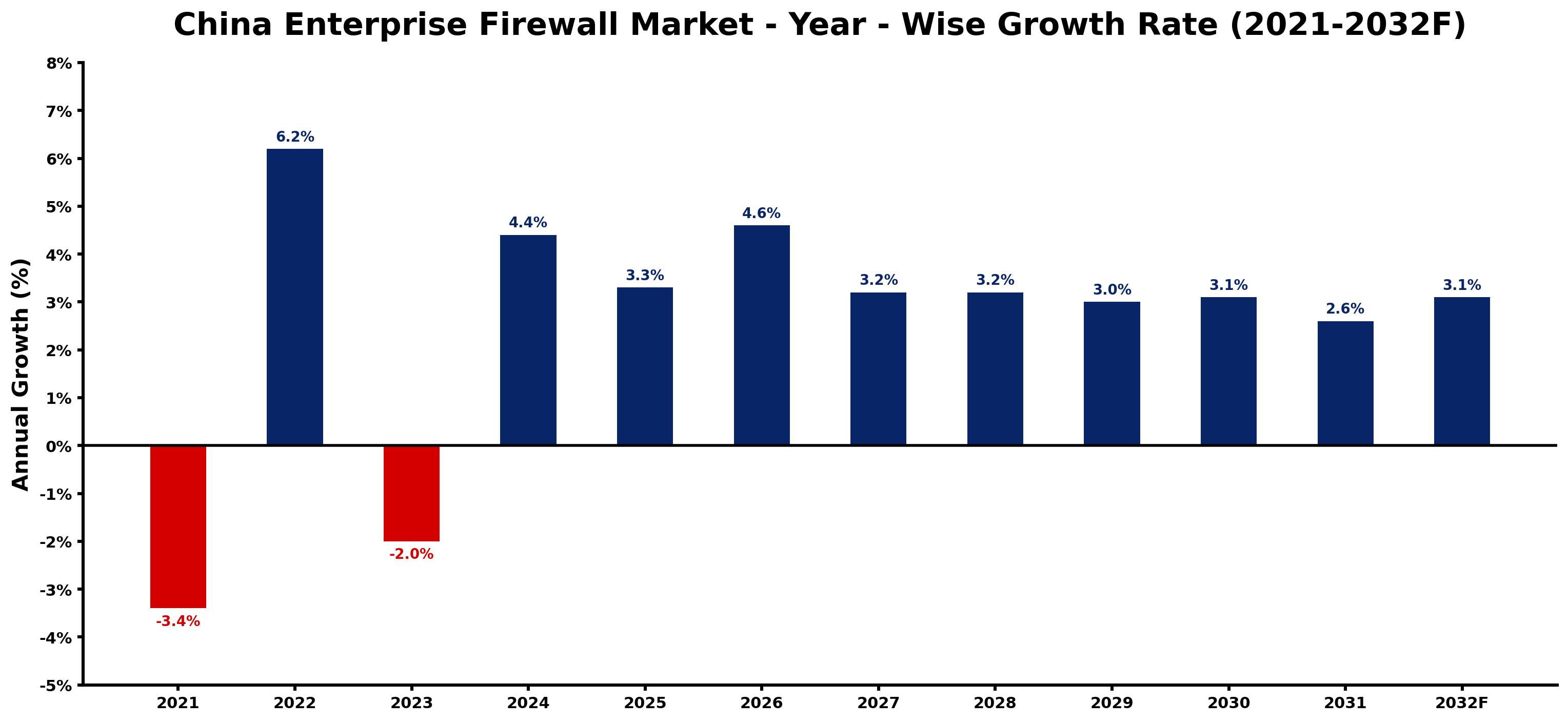
The table below presents the year‑wise growth rates along with the key drivers influencing the market
| Year | Growth Rate | Major Drivers |
| 2021 | -3.4% | Tightened cybersecurity regulations by China's Cyberspace Administration |
| 2022 | 6.2% | Implementation of China’s Cybersecurity Law regulations |
| 2023 | -2.0% | Increased preference for cloud-based security solutions in China |
| 2024 | 4.4% | Rising number of cyberattacks on enterprises in China |
| 2025 | 3.3% | Government push for improved data protection initiatives |
| 2026 | 4.6% | Increased digitization in China's banking sector drives demand |
| 2027 | 3.2% | Shift towards remote work fueling cybersecurity investments |
| 2028 | 3.2% | Growing concerns over data privacy among Chinese enterprises |
| 2029 | 3.0% | Adoption of cloud computing heightens need for firewalls |
| 2030 | 3.1% | Emergence of 5G technology requires enhanced security protocols |
| 2031 | 2.6% | Supporting policies for cybersecurity startups boost innovation |
| 2032 | 3.1% | Increased industrial automation leads to higher security needs |
Note: Market size estimations and growth projections presented in this report are based on 6Wresearch's proprietary forecasting methodology, utilizing the latest available industry data, government publications, and primary research inputs.
China Enterprise Firewall Market Key Takeaways
Below are some of the specific key takeaways from the market, including:
- Rising cybersecurity threats are driving enterprises to enhance their firewall solutions.
- Cloud adoption is steering a significant demand for cloud-based firewall technologies.
- Regulatory compliance is pushing for advanced features in firewall solutions.
- Organizations are increasingly seeking integrated security solutions for comprehensive protection.
- The competitive landscape is fostering innovation among vendors in the firewall space.
Evaluation of Restraints in China Enterprise Firewall Market
The China Enterprise Firewall Market faces notable challenges that could impede growth. Stricter regulatory requirements surrounding data protection require organizations to constantly adapt, which can be resource-intensive. on top of that, intense competition between domestic and international vendors often results in aggressive pricing strategies, which can compress profit margins.
Additionally, the fast pace of cyber threat evolution demands continual updates to firewall technologies. This necessity for constant innovation can strain resources, especially for smaller vendors. The complexity of integrating firewalls with existing security infrastructures also poses a significant barrier for enterprises aiming to implement effective solutions.
China Enterprise Firewall Market Trends
Emerging trends in the China Enterprise Firewall Market highlight a noticeable shift towards next-generation firewalls that incorporate advanced threat detection and response capabilities. Enterprises are increasingly prioritizing solutions that not only filter malicious traffic but also provide actionable insights into potential vulnerabilities.
on top of that, there is a growing emphasis on integrated security platforms that combine firewall functionalities with intrusion detection and prevention systems. This integration facilitates a more comprehensive approach to cybersecurity, effectively addressing the multifaceted threat landscape organizations face today.
China Enterprise Firewall Market Opportunities
Investment opportunities abound in the China Enterprise Firewall Market, particularly in next-generation firewall technologies that emphasize advanced threat detection. The increasing number of cyber threats creates fertile ground for innovation, especially for solutions that protect cloud-based resources.
Organizations are actively seeking integrated security solutions that can streamline protection across various threat vectors. Companies that invest in tailoring products to comply with local regulations and support Chinese language interfaces will likely see substantial demand. The convergence of digital transformation efforts with stringent security requirements presents a lucrative opportunity for savvy investors.
Government Initiatives in the China Enterprise Firewall Market
Government policy plays a critical role in shaping the China Enterprise Firewall Market. The Chinese government imposes stringent regulations on internet use and data protection, which directly affects how enterprises implement firewall solutions. Compliance with these regulations is not merely a business advantage but a necessity for operational continuity.
- A regulatory framework introduced in 2025 mandates that companies must utilize government-approved firewalls to enhance online security.
- The Cybersecurity Law, which requires local data storage and regular security audits, is currently being enforced, escalating the demand for compliant firewall solutions.
- Ongoing initiatives focus on promoting "cyber sovereignty" to bolster national cybersecurity efforts, further influencing firewall adoption among businesses.
- Upcoming plans for national cybersecurity infrastructure upgrades are expected to enhance the performance of firewall technologies across sectors.
- Current public-private partnerships aim to facilitate knowledge-sharing and development of advanced cybersecurity measures, impacting the firewall market positively.
Future Insights of the China Enterprise Firewall Market
Looking ahead to 2026-2032, the China Enterprise Firewall Market is set for considerable growth, driven by rising cyber threats and compliance requirements. The integration of advanced security technologies will be crucial for enterprises aiming to protect their digital assets and critical infrastructure.
Digital transformation, combined with the expansion of IoT devices and the rise of e-commerce, will further bolster the need for comprehensive firewall solutions. Vendors that focus on innovative product development and scalability will be best positioned to meet the evolving security demands of organizations across China.
China Enterprise Firewall Market Latest Developments
In the last year, the China Enterprise Firewall Market has seen a flurry of activity, with numerous initiatives focusing on enhancing cybersecurity protocols. The increasing prevalence of cyberattacks has prompted organizations to adopt more robust firewall solutions, spurring technological advancements and partnerships across the sector.
- A major technology vendor launched a next-generation firewall solution in early 2025, designed specifically for cloud environments, catering to the rising demand for remote work solutions.
- In mid-2025, a collaborative initiative between leading cybersecurity firms began, aiming to develop standardized compliance protocols for firewall products across the industry.
- By late 2025, a public-private partnership was established to improve cybersecurity awareness and training programs, enhancing the overall security posture of organizations.
- Upcoming in 2026, a national initiative is expected to focus on upgrading firewall capabilities as part of a broader digital infrastructure project.
- Currently underway is a pilot program that tests integrated security solutions combining firewalls with AI-based threat detection, which began in Q3 2025 and shows promising results.
China Enterprise Firewall Market - Key Attractiveness of the Report
- 10 Years of Market Numbers
- Historical Data Starting from 2022 to 2025
- Base Year: 2025
- Forecast Data until 2032
- Key Performance Indicators Impacting the Market
- Major Upcoming Developments and Projects
Key Highlights of the Report:
- China Enterprise Firewall Market Outlook
- Market Size of China Enterprise Firewall Market, 2025
- Forecast of China Enterprise Firewall Market, 2032
- Historical Data and Forecast of China Enterprise Firewall Revenues & Volume for the Period 2022-2032F
- China Enterprise Firewall Market Trend Evolution
- China Enterprise Firewall Market Drivers and Challenges
- China Enterprise Firewall Price Trends
- China Enterprise Firewall Porter's Five Forces
- China Enterprise Firewall Industry Life Cycle
- Historical Data and Forecast of China Enterprise Firewall Market Revenues & Volume By Types for the Period 2022-2032F
- Historical Data and Forecast of China Enterprise Firewall Market Revenues & Volume By Next Generation for the Period 2022-2032F
- Historical Data and Forecast of China Enterprise Firewall Market Revenues & Volume By Application for the Period 2022-2032F
- Historical Data and Forecast of China Enterprise Firewall Market Revenues & Volume By Conventional for the Period 2022-2032F
- Historical Data and Forecast of China Enterprise Firewall Market Revenues & Volume By Industry vertical for the Period 2022-2032F
- Historical Data and Forecast of China Enterprise Firewall Market Revenues & Volume By Government & Public Utilities for the Period 2022-2032F
- Historical Data and Forecast of China Enterprise Firewall Market Revenues & Volume By Healthcare for the Period 2022-2032F
- Historical Data and Forecast of China Enterprise Firewall Market Revenues & Volume By Telecommunication for the Period 2022-2032F
- Historical Data and Forecast of China Enterprise Firewall Market Revenues & Volume By Education for the Period 2022-2032F
- Historical Data and Forecast of China Enterprise Firewall Market Revenues & Volume By Retail for the Period 2022-2032F
- Historical Data and Forecast of China Enterprise Firewall Market Revenues & Volume By Entertainment & Media for the Period 2022-2032F
- Historical Data and Forecast of China Enterprise Firewall Market Revenues & Volume By Manufacturing for the Period 2022-2032F
- Historical Data and Forecast of China Enterprise Firewall Market Revenues & Volume By Education for the Period 2022-2032F
- Historical Data and Forecast of China Enterprise Firewall Market Revenues & Volume By Organization Size for the Period 2022-2032F
- Historical Data and Forecast of China Enterprise Firewall Market Revenues & Volume By Small and Medium Sized Enterprises (SMBs) for the Period 2022-2032F
- Historical Data and Forecast of China Enterprise Firewall Market Revenues & Volume By Large Enterprises for the Period 2022-2032F
- China Enterprise Firewall Import Export Trade Statistics
- Market Opportunity Assessment By Types
- Market Opportunity Assessment By Industry vertical
- Market Opportunity Assessment By Organization Size
- China Enterprise Firewall Top Companies Market Share
- China Enterprise Firewall Competitive Benchmarking By Technical and Operational Parameters
- China Enterprise Firewall Company Profiles
- China Enterprise Firewall Key Strategic Recommendations






































