China Food Blenders and Mixers Market Top 5 Importing Countries and Market Competition (HHI) Analysis
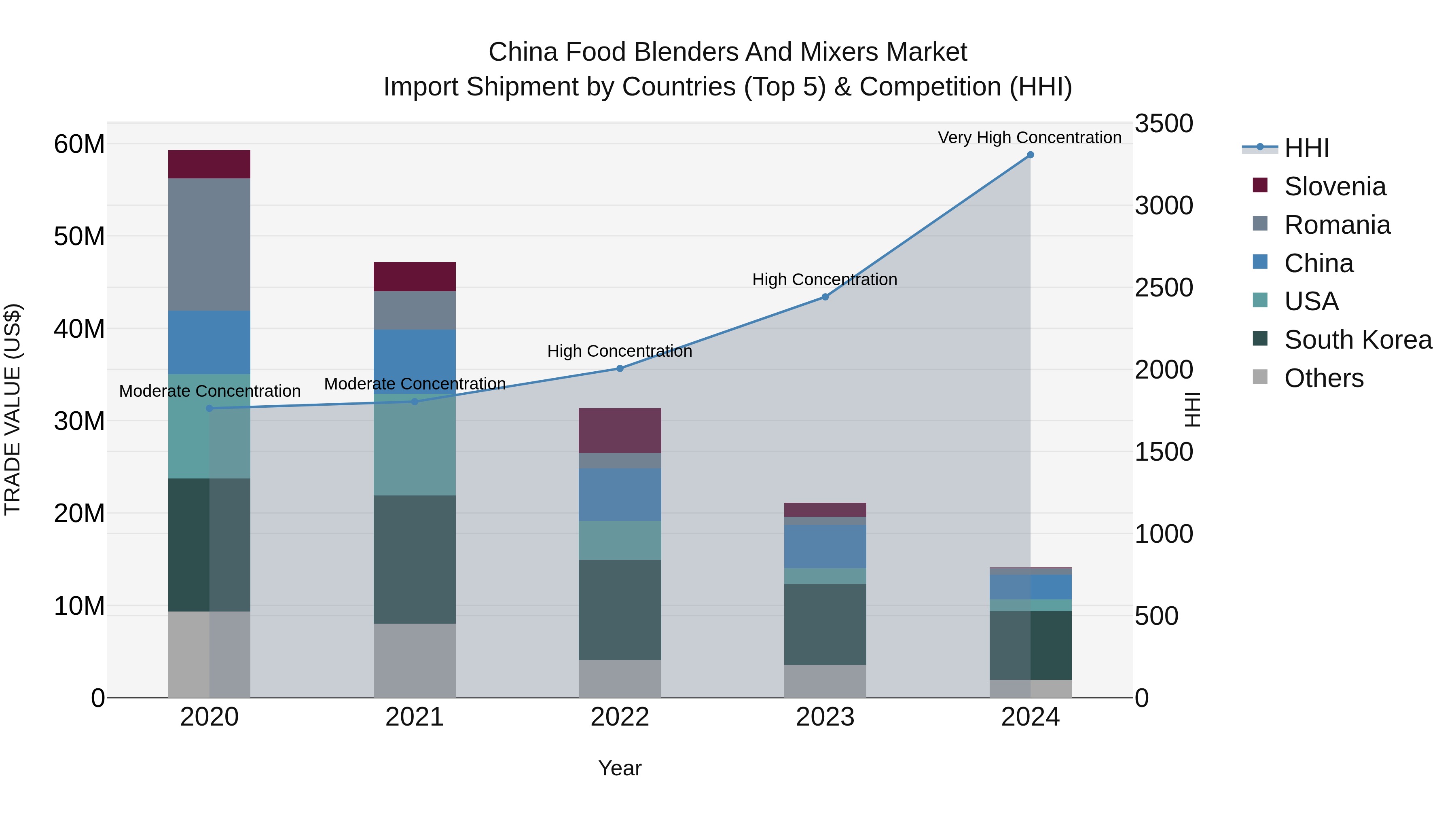
China food blenders and mixers import market continues to be dominated by key players from South Korea, China, USA, Italy, and Romania. The market concentration, as measured by the Herfindahl-Hirschman Index (HHI), significantly increased from 2023 to 2024, indicating a very high level of concentration. Despite a negative Compound Annual Growth Rate (CAGR) of -30.14% from 2020 to 2024, the market experienced a further decline with a growth rate of -33.12% in 2024 compared to the previous year. This data suggests a challenging landscape for importers and underscores the intense competition within the industry.
China Food Blenders and Mixers Market Synopsis
The China Food Blenders and Mixers Market is experiencing steady growth driven by increasing consumer demand for convenience and advanced kitchen appliances. The market is characterized by a wide range of products, including traditional blenders, immersion blenders, stand mixers, and hand mixers. Key trends in the market include the rising popularity of multifunctional blenders with advanced features such as variable speed settings, preset programs, and high-capacity jars. Domestic brands are gaining traction due to their competitive pricing and product innovation. E-commerce platforms are playing a significant role in driving sales by offering a wide selection of products and convenient delivery options. Overall, the China Food Blenders and Mixers Market is set to continue its growth trajectory as consumers prioritize efficient cooking solutions in their daily lives.
China Food Blenders and Mixers Market Trends
The China Food Blenders and Mixers market is experiencing significant growth driven by the increasing demand for convenience foods, rising disposable incomes, and changing consumer preferences towards healthier and more diverse food options. Key trends in the market include the adoption of advanced technologies such as automation and smart features in blending and mixing equipment, the expansion of product portfolios by manufacturers to cater to evolving consumer needs, and the emphasis on sustainable and eco-friendly practices. Opportunities in the market lie in the development of innovative products to meet the demand for functional and customized blending and mixing solutions, as well as expanding distribution channels to reach a wider consumer base, particularly in online retail. Additionally, collaborations and partnerships with local suppliers and producers can help companies tap into the growing Chinese market efficiently.
China Food Blenders and Mixers Market Challenges
In the China Food Blenders and Mixers Market, some key challenges include intense competition among both domestic and international players, price sensitivity of consumers leading to pressure on profit margins, and the need for continuous innovation to meet evolving consumer preferences and regulatory requirements. Additionally, supply chain disruptions, fluctuating raw material costs, and the need for efficient distribution channels pose challenges for companies operating in this market. Furthermore, ensuring product quality and safety standards, as well as building brand loyalty in a crowded market, are important factors that companies need to address to succeed in the competitive landscape of the China Food Blenders and Mixers Market.
China Food Blenders and Mixers Market Investment Opportunities
The China Food Blenders and Mixers market is primarily driven by factors such as increasing urbanization, changing consumer preferences towards convenience foods, and the growing trend of healthy eating. The rising disposable income of the middle-class population in China has led to a higher demand for kitchen appliances, including food blenders and mixers, as consumers seek to replicate restaurant-quality dishes at home. Additionally, the influence of Western cuisines and baking trends has fueled the popularity of food blenders and mixers among Chinese consumers. Manufacturers in the market are focusing on product innovation, such as introducing smart features and energy-efficient models, to cater to the evolving needs and preferences of consumers, further driving the growth of the China Food Blenders and Mixers market.
China Food Blenders and Mixers Market Government Polices
The Chinese government has implemented various policies to regulate and promote the Food Blenders and Mixers Market in China. These policies include strict quality control measures to ensure the safety and standards of food blenders and mixers, as well as regulations on labeling and packaging. Additionally, the government has introduced incentives and subsidies to encourage innovation and technological advancements in the industry, aiming to enhance product quality and competitiveness. Furthermore, there are also policies in place to support the sustainable development of the market, such as promoting energy efficiency and environmental protection practices among manufacturers. Overall, the government`s policies play a crucial role in shaping the China Food Blenders and Mixers Market by ensuring compliance with standards, fostering innovation, and promoting sustainable growth.
China Food Blenders and Mixers Market Future Outlook
The China Food Blenders and Mixers Market is poised for significant growth in the coming years due to increasing urbanization, changing consumer lifestyles, and a growing demand for convenience foods. The market is expected to be driven by advancements in technology leading to more efficient and versatile blender and mixer products. Additionally, rising disposable incomes and a burgeoning food and beverage industry in China will further fuel market expansion. Manufacturers are likely to focus on product innovation, such as smart features and eco-friendly materials, to cater to evolving consumer preferences. Overall, the China Food Blenders and Mixers Market is forecasted to experience steady growth as consumers seek convenient and efficient solutions for food preparation.
Key Highlights of the Report:
- China Food Blenders and Mixers Market Outlook
- Market Size of China Food Blenders and Mixers Market, 2024
- Forecast of China Food Blenders and Mixers Market, 2031
- Historical Data and Forecast of China Food Blenders and Mixers Revenues & Volume for the Period 2021 - 2031
- China Food Blenders and Mixers Market Trend Evolution
- China Food Blenders and Mixers Market Drivers and Challenges
- China Food Blenders and Mixers Price Trends
- China Food Blenders and Mixers Porter's Five Forces
- China Food Blenders and Mixers Industry Life Cycle
- Historical Data and Forecast of China Food Blenders and Mixers Market Revenues & Volume By Type for the Period 2021 - 2031
- Historical Data and Forecast of China Food Blenders and Mixers Market Revenues & Volume By High Shear for the Period 2021 - 2031
- Historical Data and Forecast of China Food Blenders and Mixers Market Revenues & Volume By Shaft for the Period 2021 - 2031
- Historical Data and Forecast of China Food Blenders and Mixers Market Revenues & Volume By Ribbon Mixer for the Period 2021 - 2031
- Historical Data and Forecast of China Food Blenders and Mixers Market Revenues & Volume By Double Cone for the Period 2021 - 2031
- Historical Data and Forecast of China Food Blenders and Mixers Market Revenues & Volume By Planetary Mixer for the Period 2021 - 2031
- Historical Data and Forecast of China Food Blenders and Mixers Market Revenues & Volume By Screw Mixers & Blenders for the Period 2021 - 2031
- Historical Data and Forecast of China Food Blenders and Mixers Market Revenues & Volume By Application for the Period 2021 - 2031
- Historical Data and Forecast of China Food Blenders and Mixers Market Revenues & Volume By Bakery for the Period 2021 - 2031
- Historical Data and Forecast of China Food Blenders and Mixers Market Revenues & Volume By Dairy for the Period 2021 - 2031
- Historical Data and Forecast of China Food Blenders and Mixers Market Revenues & Volume By Beverages for the Period 2021 - 2031
- Historical Data and Forecast of China Food Blenders and Mixers Market Revenues & Volume By Confectionery for the Period 2021 - 2031
- China Food Blenders and Mixers Import Export Trade Statistics
- Market Opportunity Assessment By Type
- Market Opportunity Assessment By Application
- China Food Blenders and Mixers Top Companies Market Share
- China Food Blenders and Mixers Competitive Benchmarking By Technical and Operational Parameters
- China Food Blenders and Mixers Company Profiles
- China Food Blenders and Mixers Key Strategic Recommendations






































