China Food Dehydrators Market Size, Share & Growth Rate
The China Food Dehydrators Market was estimated at USD 108 Million in 2025 and is projected to reach USD 124 Million by 2032, growing at a CAGR of 2.0% from 2026 to 2032. This growth trajectory is primarily fueled by rising health consciousness among consumers, who are increasingly seeking out natural and additive-free food preservation methods. The burgeoning trend towards homemade snacks, alongside the demand for convenience and longer shelf-life food options, further amplifies this market's potential.
China Food Dehydrators Market Year-wise Growth Rate and Key Drivers
This graph highlights how the China Food Dehydrators Market has steadily grown over the years, supported by major growth factors.
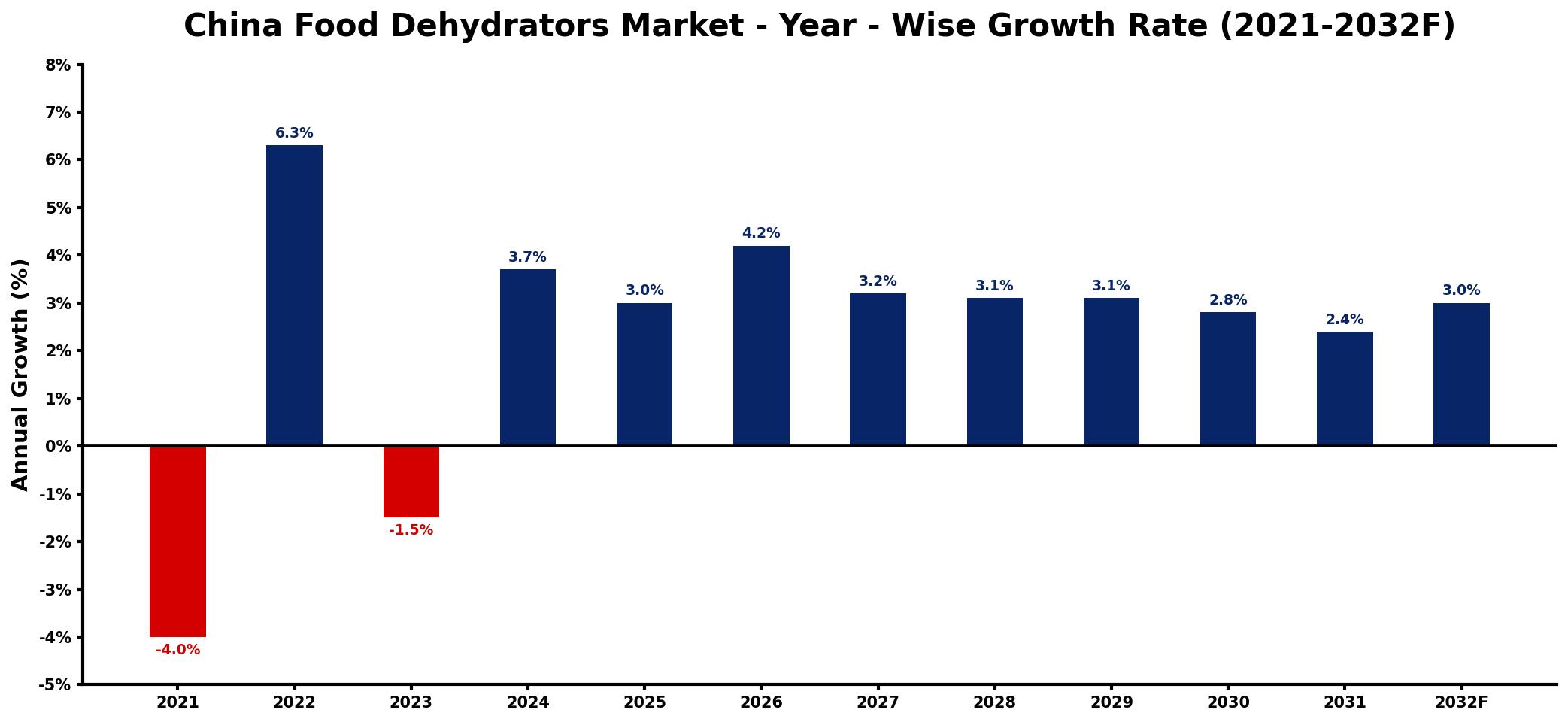
The table below presents the year‑wise growth rates along with the key drivers influencing the market
| Year | Growth Rate | Major Drivers |
| 2021 | -4.0% | decrease in consumer spending habits |
| 2022 | 6.3% | rise in home cooking trends |
| 2023 | -1.5% | drop in retail investments |
| 2024 | 3.7% | growth in health consciousness |
| 2025 | 3.0% | increase in e-commerce sales |
| 2026 | 4.2% | expansion of sustainable practices |
| 2027 | 3.2% | surge in outdoor activities |
| 2028 | 3.1% | development of smart appliances |
| 2029 | 3.1% | expanding healthcare application demand |
| 2030 | 2.8% | enhanced product quality standards |
| 2031 | 2.4% | improved raw material availability |
| 2032 | 3.0% | expanding industrial usage applications |
Note: Market size estimations and growth projections presented in this report are based on 6Wresearch's proprietary forecasting methodology, utilizing the latest available industry data, government publications, and primary research inputs.
China Food Dehydrators Market Synopsis
The strongest force currently shaping the China Food Dehydrators Market is the consumer shift towards health-conscious eating. As urban dwellers seek healthier dietary options, food dehydrators have become a popular choice for preserving fruits, vegetables, and proteins without preservatives or additives.
In addition to health considerations, convenience plays a crucial role in this market's growth. Consumers appreciate the ease of use and efficiency offered by modern food dehydrators, which allow them to prepare a variety of dried snacks at home. This confluence of health and convenience is driving sales and innovation in the sector.
China Food Dehydrators Market Key Takeaways
- The market is bolstered by increasing consumer health consciousness and demand for homemade snacks.
- Product innovation is focusing on multifunctional dehydrators with advanced technology features.
- Smart dehydrators with connectivity options are gaining popularity among tech-savvy consumers.
- Intense competition in the market poses challenges in pricing and product quality.
- Government initiatives are supporting sustainable practices and food safety compliance in manufacturing.
Evaluation of Restraints in China Food Dehydrators Market
Despite the promising growth, the China Food Dehydrators Market faces real limitations. Intense competition among brands results in aggressive pricing strategies, which can erode profit margins. Furthermore, increasing consumer awareness regarding product quality heightens the scrutiny that brands must face, necessitating stringent adherence to safety standards. Distribution challenges, particularly in rural and remote areas, also hinder market penetration, as accessing these consumers can be logistically complex and costly. The regulatory landscape is another hurdle, with companies needing to navigate various food safety regulations and quality standards imposed by the government.
China Food Dehydrators Market Trends
Current trends in the China Food Dehydrators Market indicate a shift towards multifunctional models that cater to diverse consumer needs. These include options with multiple temperature settings, larger drying capacities, and the ability to dehydrate various food types simultaneously. Additionally, smart food dehydrators equipped with Wi-Fi connectivity and mobile app compatibility are gaining traction. This technological advancement allows users to control and monitor the dehydrating process remotely, adding an extra layer of convenience for busy consumers.
China Food Dehydrators Market Opportunities
The China Food Dehydrators Market is rife with investment opportunities. The increasing appetite for healthy, convenient food products among consumers presents a ripe environment for both domestic and international players. Companies that focus on innovative product development—such as energy-efficient models or those tailored for specific dietary needs—can capture significant market share. Furthermore, leveraging e-commerce platforms provides a valuable channel to reach a broader audience. Collaborations with local distributors could also enable more effective market penetration, allowing brands to tap into the growing demand.
Government Initiatives in the China Food Dehydrators Market
The Chinese government has put various initiatives in place to promote food safety and support the food dehydrators market. Regulations concerning product quality standards, labeling requirements, and hygiene practices are designed to protect consumer health and safety. Additionally, the government encourages companies to adopt energy-efficient production practices through incentives and subsidies. Strict import and export regulations also exist to control the quality of dehydrators in the market, ensuring that consumer health remains a top priority.
Future Insights of the China Food Dehydrators Market
Looking ahead to 2026-2032, the China Food Dehydrators Market is expected to flourish as consumer awareness of health and wellness continues to rise. A growing middle class with increased disposable incomes will likely fuel the demand for convenient food preservation methods. Additionally, continued advancements in technology will foster innovation, further enhancing product efficiency and consumer appeal. The e-commerce boom will facilitate easier access to a wider variety of dehydrators, ensuring robust market growth well into the future.
China Food Dehydrators Market Latest Developments (2025 - 2026)
Recent industry trends show a marked focus on developing smarter dehydrators that cater to the needs of tech-savvy consumers. Innovations in product design and features have resulted in devices that combine efficiency with ease of use. Meanwhile, many manufacturers are exploring sustainable materials and energy-efficient manufacturing processes in response to consumer preferences for eco-friendly options. Market players are also enhancing their online presence to meet the growing demand for e-commerce transactions.
China Food Dehydrators Market - Key Attractiveness of the Report
- 10 Years of Market Numbers
- Historical Data Starting from 2022 to 2025
- Base Year: 2025
- Forecast Data until 2032
- Key Performance Indicators Impacting the Market
- Major Upcoming Developments and Projects
Key Highlights of the Report:
- China Food Dehydrators Market Outlook
- Market Size of China Food Dehydrators Market, 2025
- Forecast of China Food Dehydrators Market, 2032
- Historical Data and Forecast of China Food Dehydrators Revenues & Volume for the Period 2022-2032F
- China Food Dehydrators Market Trend Evolution
- China Food Dehydrators Market Drivers and Challenges
- China Food Dehydrators Price Trends
- China Food Dehydrators Porter's Five Forces
- China Food Dehydrators Industry Life Cycle
- Historical Data and Forecast of China Food Dehydrators Market Revenues & Volume By Technology for the Period 2022-2032F
- Historical Data and Forecast of China Food Dehydrators Market Revenues & Volume By Vertical Flow for the Period 2022-2032F
- Historical Data and Forecast of China Food Dehydrators Market Revenues & Volume By Horizontal Flow for the Period 2022-2032F
- Historical Data and Forecast of China Food Dehydrators Market Revenues & Volume By End-Use for the Period 2022-2032F
- Historical Data and Forecast of China Food Dehydrators Market Revenues & Volume By Industrial for the Period 2022-2032F
- Historical Data and Forecast of China Food Dehydrators Market Revenues & Volume By Commercial for the Period 2022-2032F
- Historical Data and Forecast of China Food Dehydrators Market Revenues & Volume By Residential for the Period 2022-2032F
- Historical Data and Forecast of China Food Dehydrators Market Revenues & Volume By Others for the Period 2022-2032F
- Historical Data and Forecast of China Food Dehydrators Market Revenues & Volume By Energy Source for the Period 2022-2032F
- Historical Data and Forecast of China Food Dehydrators Market Revenues & Volume By Electricity for the Period 2022-2032F
- Historical Data and Forecast of China Food Dehydrators Market Revenues & Volume By Biofuel for the Period 2022-2032F
- Historical Data and Forecast of China Food Dehydrators Market Revenues & Volume By Solar for the Period 2022-2032F
- Historical Data and Forecast of China Food Dehydrators Market Revenues & Volume By Others for the Period 2022-2032F
- China Food Dehydrators Import Export Trade Statistics
- Market Opportunity Assessment By Technology
- Market Opportunity Assessment By End-Use
- Market Opportunity Assessment By Energy Source
- China Food Dehydrators Top Companies Market Share
- China Food Dehydrators Competitive Benchmarking By Technical and Operational Parameters
- China Food Dehydrators Company Profiles
- China Food Dehydrators Key Strategic Recommendations






































