China Food Products Machinery Market Growth Rate Analysis (2025 - 2031)
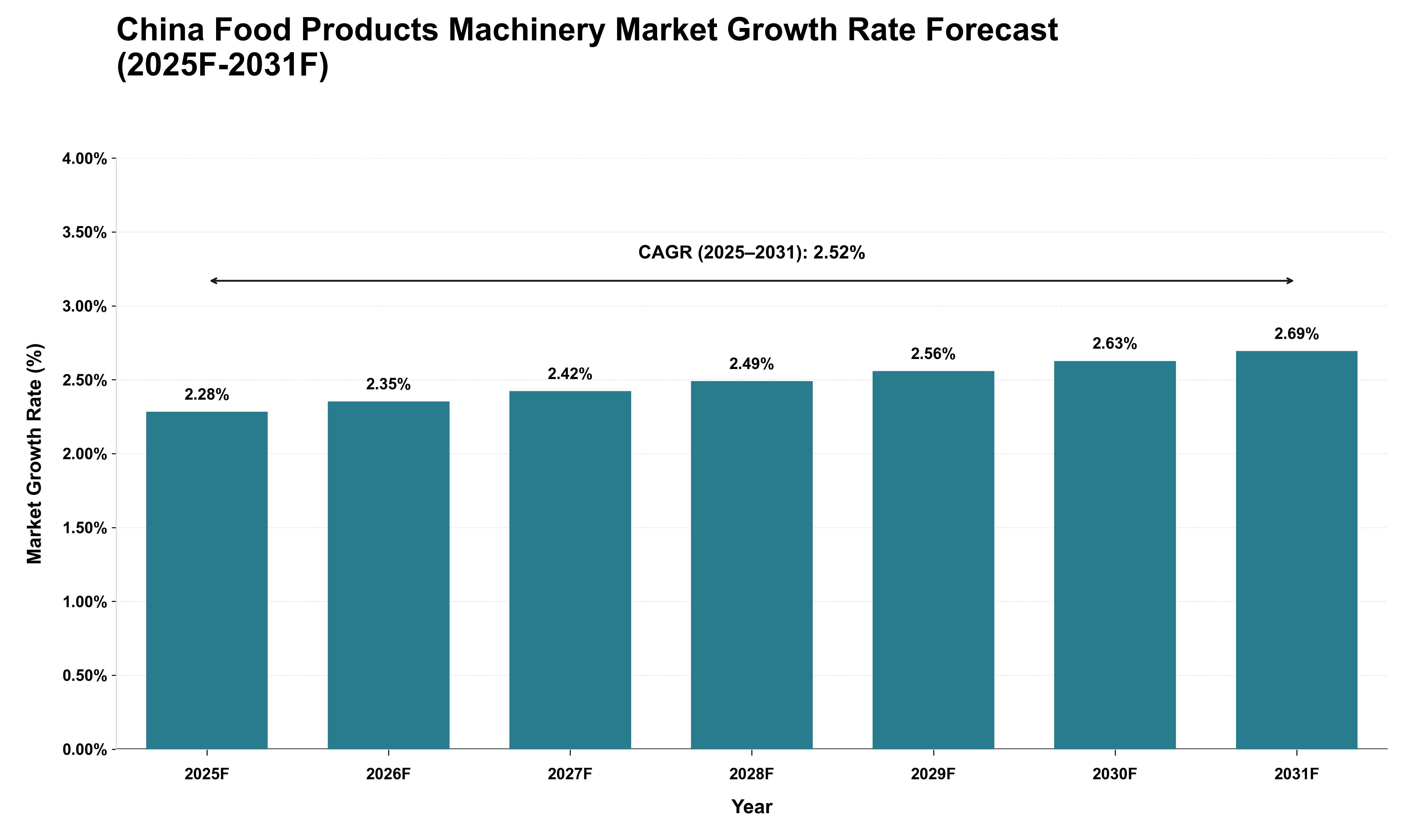
The China food products machinery market is projected to experience a compound annual growth rate of 2.52% from 2025 to 2031, reflecting a steady increase in demand driven by evolving consumer preferences and the need for enhanced food processing efficiency. As import dependencies shift, domestic manufacturers are likely to adapt by integrating advanced technologies, which will facilitate improved production capabilities and competitiveness in export markets. The annual growth rates indicate a gradual acceleration, with 2029-2031 showing the most significant increases, suggesting that cyclical trends in global food consumption patterns will favor machinery that supports higher output and quality standards. Additionally, as international trade agreements evolve and logistics improve, China's position as both an importer of specialized machinery and an exporter of processed food products will strengthen, further propelling market growth during this forecast period.
Key Highlights of the Report:
- China Food products machinery Market Outlook
- Market Size of China Food products machinery Market, 2024
- Forecast of China Food products machinery Market, 2026
- Historical Data and Forecast of China Food products machinery Revenues & Volume for the Period 2021 - 2031
- China Food products machinery Market Trend Evolution
- China Food products machinery Market Drivers and Challenges
- China Food products machinery Price Trends
- China Food products machinery Porter's Five Forces
- China Food products machinery Industry Life Cycle
- Historical Data and Forecast of China Food products machinery Market Revenues & Volume By Type for the Period 2021 - 2031
- Historical Data and Forecast of China Food products machinery Market Revenues & Volume By Dairy Product Plant Machinery and Equipment for the Period 2021 - 2031
- Historical Data and Forecast of China Food products machinery Market Revenues & Volume By Bakery Machinery and Equipment for the Period 2021 - 2031
- Historical Data and Forecast of China Food products machinery Market Revenues & Volume By Meat and Poultry Processing And Preparation Machinery for the Period 2021 - 2031
- Historical Data and Forecast of China Food products machinery Market Revenues & Volume By Other Commercial Food Products Machinery for the Period 2021 - 2031
- Historical Data and Forecast of China Food products machinery Market Revenues & Volume By Applications for the Period 2021 - 2031
- Historical Data and Forecast of China Food products machinery Market Revenues & Volume By Bakery & Confectionery for the Period 2021 - 2031
- Historical Data and Forecast of China Food products machinery Market Revenues & Volume By Meat, Poultry, and Seafood for the Period 2021 - 2031
- Historical Data and Forecast of China Food products machinery Market Revenues & Volume By Dairy for the Period 2021 - 2031
- Historical Data and Forecast of China Food products machinery Market Revenues & Volume By Beverages for the Period 2021 - 2031
- Historical Data and Forecast of China Food products machinery Market Revenues & Volume By Others for the Period 2021 - 2031
- China Food products machinery Import Export Trade Statistics
- Market Opportunity Assessment By Type
- Market Opportunity Assessment By Applications
- China Food products machinery Top Companies Market Share
- China Food products machinery Competitive Benchmarking By Technical and Operational Parameters
- China Food products machinery Company Profiles
- China Food products machinery Key Strategic Recommendations






































