China Gamification Market Size, Share & Growth Rate
The China Gamification Market was estimated at USD 92 Million in 2025 and is projected to reach USD 106 Million by 2032, growing at a CAGR of 2.0% from 2026 to 2032. This steady growth trajectory is primarily driven by the increasing integration of gamification techniques in sectors such as education, healthcare, and marketing. As the demand for innovative user engagement strategies expands, companies are increasingly adopting gamified solutions to enhance productivity and drive behavioral change.
China Gamification Market Year-wise Growth Rate and Key Drivers
This graph highlights how the China Gamification Market has steadily grown over the years, supported by major growth factors.
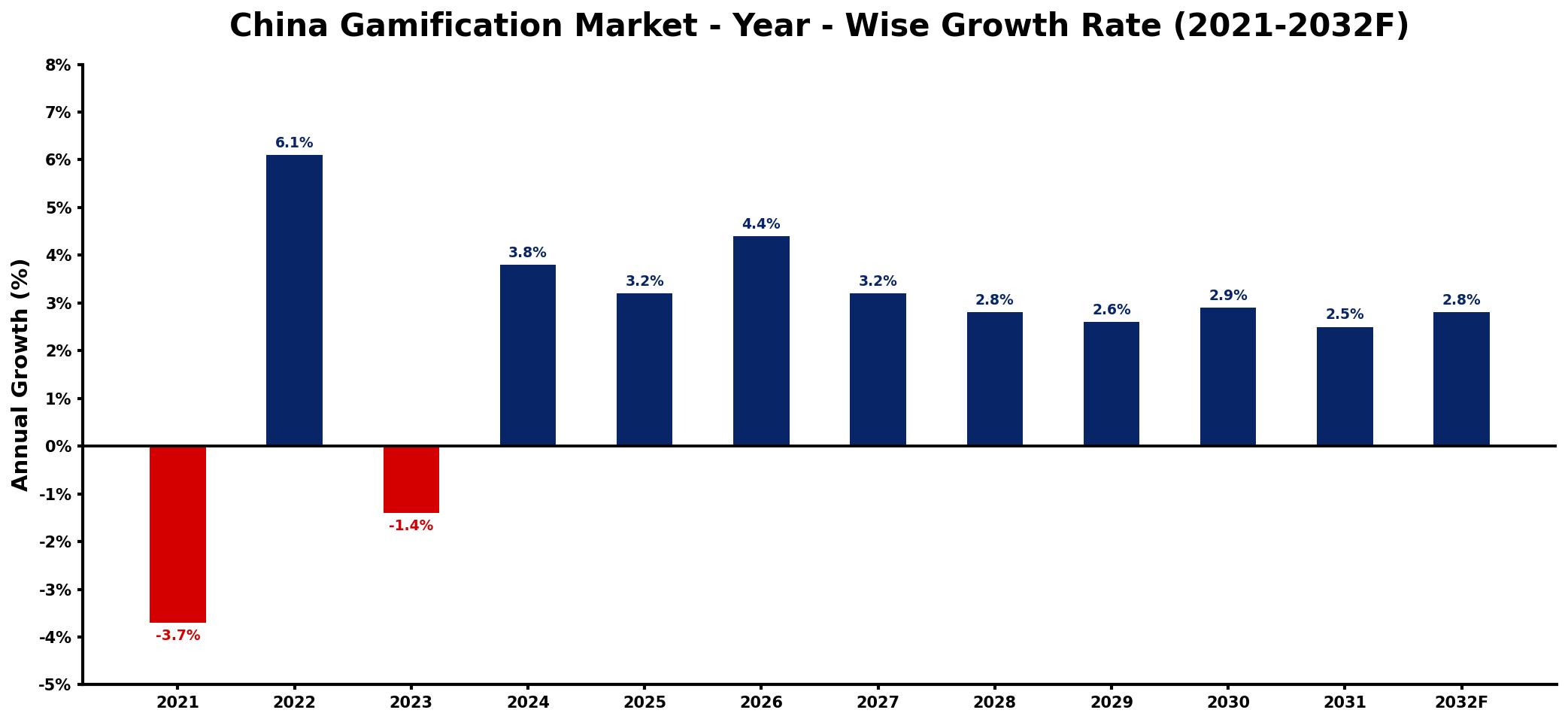
The table below presents the year‑wise growth rates along with the key drivers influencing the market
| Year | Growth Rate | Major Drivers |
| 2021 | -3.7% | decrease in corporate training investments |
| 2022 | 6.1% | rise in educational technology adoption |
| 2023 | -1.4% | fall in entertainment sector engagement |
| 2024 | 3.8% | growth of mobile app usage |
| 2025 | 3.2% | increased capital investment inflows |
| 2026 | 4.4% | increased interest in learning solutions |
| 2027 | 3.2% | development of social interaction platforms |
| 2028 | 2.8% | enhancement of user experience design |
| 2029 | 2.6% | growth in remote work applications |
| 2030 | 2.9% | expansion of loyalty program initiatives |
| 2031 | 2.5% | increase in youth engagement strategies |
| 2032 | 2.8% | expanding healthcare application demand |
Note: Market size estimations and growth projections presented in this report are based on 6Wresearch's proprietary forecasting methodology, utilizing the latest available industry data, government publications, and primary research inputs.
China Gamification Market Synopsis
Currently, the China Gamification Market is experiencing unprecedented growth, fueled by a tech-savvy consumer base and a burgeoning digital economy. Various sectors, including education and healthcare, are adopting gamified approaches to foster engagement and improve outcomes, underscoring a shift towards more interactive user experiences.
In this competitive landscape, companies are increasingly leveraging advanced technologies such as artificial intelligence (AI) and virtual reality (VR) to create immersive experiences. Moreover, government initiatives aimed at promoting gamification in education and training are further catalyzing the market's expansion, highlighting its importance in contemporary Chinese society.
China Gamification Market Key Takeaways
- The market is witnessing rapid adoption across sectors like education, healthcare, and marketing, enhancing user engagement.
- Emerging technologies, including AR and VR, are becoming integral to gamification solutions, providing users with immersive experiences.
- Government policies aimed at regulating gamification practices are shaping the market landscape, fostering responsible engagement.
- Investment opportunities are particularly promising in the education and healthcare sectors, where gamified solutions are increasingly sought after.
- As smartphone penetration grows, mobile gamification is poised to reshape user engagement strategies across industries.
Evaluation of Restraints in China Gamification Market
Despite its robust growth potential, the China Gamification Market faces several hurdles. Cultural differences significantly impact the acceptance of gamification strategies, as preferences vary widely among consumers. Moreover, concerns regarding data privacy and security remain prevalent, creating apprehension among potential users. The market's competitiveness is further heightened by a multitude of players offering similar services, leading to saturation in certain areas. A lack of standardized regulations also introduces uncertainty, complicating compliance efforts and potentially stifling innovation.
China Gamification Market Trends
Key trends in the China Gamification Market include a shift towards personalization and interactivity in gamified solutions. As consumers seek more tailored experiences, companies are evolving their approaches to meet these demands. Mobile gamification is gaining significant traction, driven by increasing smartphone adoption, which opens new avenues for e-learning, marketing, and consumer loyalty initiatives. The incorporation of AI and data analytics further allows businesses to deliver more compelling and effective gamified experiences.
China Gamification Market Opportunities
Opportunities for growth in the China Gamification Market are abundant, especially in education and healthcare. Educational institutions and online platforms are rapidly integrating gamified elements to enhance engagement and learning outcomes. In healthcare, gamification is being leveraged to promote healthier lifestyles and improve treatment adherence among patients. Companies that specialize in developing customized gamified solutions tailored to the nuances of the Chinese market stand to benefit significantly as the demand for innovative engagement strategies continues to escalate.
Government Initiatives in the China Gamification Market
The Chinese government has taken proactive measures to regulate the gamification market, with a focus on promoting responsible usage, particularly among minors. Guidelines have been established to limit addictive behaviors associated with gamification in online platforms. Additionally, game developers are required to secure licenses and comply with content regulations and data protection laws, thereby fostering a safer and more regulated market environment. These initiatives are essential for cultivating a healthy gaming ecosystem while encouraging innovation within the industry.
Future Insights of the China Gamification Market
Looking ahead to 2026-2032, the China Gamification Market is set for continued expansion. As the integration of gamification strategies becomes more prevalent across diverse industries, the demand for engaging user experiences will only grow stronger. Moreover, advances in technology will enable more sophisticated gamification solutions, allowing companies to push the boundaries of user engagement. The ongoing support from the government and the rising trend of gamified marketing campaigns will further enhance the market's trajectory, presenting extensive opportunities for growth.
China Gamification Market Latest Developments (2025 - 2026)
In recent months, the China Gamification Market has seen a notable shift towards integrating emerging technologies into gamified solutions. Companies are experimenting with innovative approaches that incorporate elements of virtual reality and augmented reality, enhancing the overall user experience. Additionally, educational institutions are increasingly exploring gamification to enrich curricula and engage students more effectively. Regulatory developments continue to shape the landscape, with increased emphasis on compliance and responsible practices across the industry.
China Gamification Market - Key Attractiveness of the Report
- 10 Years of Market Numbers
- Historical Data Starting from 2022 to 2025
- Base Year: 2025
- Forecast Data until 2032
- Key Performance Indicators Impacting the Market
- Major Upcoming Developments and Projects
Key Highlights of the Report:
- China Gamification Market Outlook
- Market Size of China Gamification Market, 2025
- Forecast of China Gamification Market, 2032
- Historical Data and Forecast of China Gamification Revenues & Volume for the Period 2022-2032F
- China Gamification Market Trend Evolution
- China Gamification Market Drivers and Challenges
- China Gamification Price Trends
- China Gamification Porter's Five Forces
- China Gamification Industry Life Cycle
- Historical Data and Forecast of China Gamification Market Revenues & Volume By Component for the Period 2022-2032F
- Historical Data and Forecast of China Gamification Market Revenues & Volume By Solution for the Period 2022-2032F
- Historical Data and Forecast of China Gamification Market Revenues & Volume By Services for the Period 2022-2032F
- Historical Data and Forecast of China Gamification Market Revenues & Volume By Deployment for the Period 2022-2032F
- Historical Data and Forecast of China Gamification Market Revenues & Volume By Cloud for the Period 2022-2032F
- Historical Data and Forecast of China Gamification Market Revenues & Volume By On-premises for the Period 2022-2032F
- Historical Data and Forecast of China Gamification Market Revenues & Volume By Organization Size for the Period 2022-2032F
- Historical Data and Forecast of China Gamification Market Revenues & Volume By SMEs for the Period 2022-2032F
- Historical Data and Forecast of China Gamification Market Revenues & Volume By Large Enterprises for the Period 2022-2032F
- Historical Data and Forecast of China Gamification Market Revenues & Volume By End-User for the Period 2022-2032F
- Historical Data and Forecast of China Gamification Market Revenues & Volume By Enterprise-Driven for the Period 2022-2032F
- Historical Data and Forecast of China Gamification Market Revenues & Volume By Consumer-Driven for the Period 2022-2032F
- China Gamification Import Export Trade Statistics
- Market Opportunity Assessment By Component
- Market Opportunity Assessment By Deployment
- Market Opportunity Assessment By Organization Size
- Market Opportunity Assessment By End-User
- China Gamification Top Companies Market Share
- China Gamification Competitive Benchmarking By Technical and Operational Parameters
- China Gamification Company Profiles
- China Gamification Key Strategic Recommendations






































