China General Merchandise Market Summary
The china general merchandise market was estimated at USD 178 Million in 2025 and is projected to reach USD 206 Million by 2032, growing at a CAGR of 4.3% from 2026 to 2032.
China General Merchandise Market Year-wise Growth Rate and Key Drivers
This graph highlights how the China General Merchandise Market has steadily grown over the past five years, supported by major growth factors.
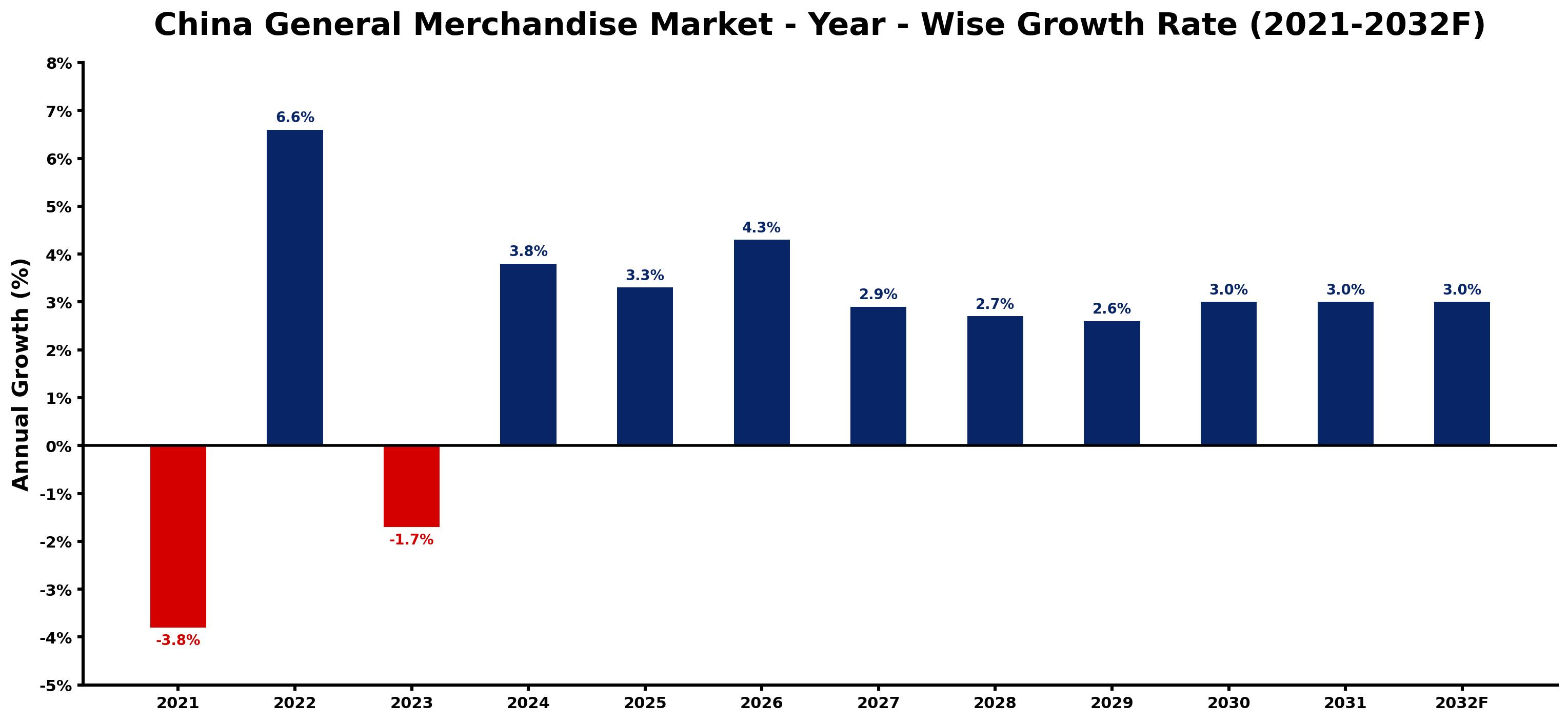
The table below presents the year wise growth rates along with the key drivers influencing the market
| Year | Growth Rate | Major Drivers |
| 2021 | -3.8% | Pandemicrelated supply chain disruptions led to inventory shortages, dampening sales in the general merchandise sector. |
| 2022 | 6.6% | E-commerce platforms gained momentum, capturing a significant share of consumer spending. |
| 2023 | -1.7% | Increased competition from online platforms eroded traditional retail sales and decreased foot traffic in stores. |
| 2024 | 3.8% | Technological innovations reshaped shopping experiences, enhancing customer engagement and loyalty. |
| 2025 | 3.3% | Sustainability trends influenced purchasing decisions, prompting brands to adopt eco-friendly practices. |
| 2026 | 4.3% | Rural markets expanded, driven by improved logistics and distribution networks throughout the country. |
| 2027 | 2.9% | Investment in supply chain infrastructure improved efficiency, reducing delivery times significantly. |
| 2028 | 2.7% | Cross-border e-commerce flourished, allowing local brands to access international markets easily. |
| 2029 | 2.6% | Digital payment solutions proliferated, facilitating seamless transactions for consumers nationwide. |
| 2030 | 3.0% | Consumer demographics shifted, with younger generations driving demand for trendy merchandise. |
| 2031 | 3.0% | Customizable products gained popularity, catering to individual tastes and preferences effectively. |
| 2032 | 3.0% | Health and wellness products dominated shelves, reflecting a growing focus on personal well-being. |
Note - Market size estimations and growth projections presented in this report are based on 6Wresearch's advanced forecasting approach, validated with industry datasets as of June 2026.
China General Merchandise Market Synopsis
The China General Merchandise Market is projected to reach 4.3% and witness significant growth during the forecast period (2026-2032). This multifaceted market encompasses a broad array of products, including clothing, household goods, electronics, and more. The rapid expansion of the middle class in China, alongside increasing disposable income, positions this market as a favorable environment for both domestic and global retailers. E-commerce platforms have emerged as a critical driver of sales, as consumer preference shifts towards online shopping due to its convenience and product variety. As competition intensifies, both local and international brands are devising innovative marketing strategies and product offerings to capture market share. Moreover, with a growing segment of discerning and value-conscious consumers, there is escalating demand for high-quality and affordable products across various categories, underscoring the dynamic nature of the China General Merchandise Market.
China General Merchandise Market Trends
The current trends shaping the China General Merchandise Market reflect the evolving preferences of consumers. One prominent trend is the significant rise in online shopping, with an increasing number of consumers turning to e-commerce platforms for their general merchandise needs. This shift is driven by factors such as convenience, a wider selection of products, and often more competitive pricing. Additionally, consumers are exhibiting a growing inclination towards high-quality and innovative products. Chinese shoppers are becoming more discerning, willing to invest in items that boast unique features or superior design. There is also a marked interest in sustainable and eco-friendly products, reflecting an increasing awareness of environmental issues among the populace. Furthermore, the market is adapting to consumer demands by enhancing the overall shopping experience, with retailers focusing on seamless integration between online and offline channels. As a result, convenience, quality, and sustainability are emerging as pivotal drivers of market growth.
China General Merchandise Market Challenges and Restraints
The landscape of the China General Merchandise Market is fraught with challenges. One of the most pressing issues is the intense competition among both domestic and international brands, which necessitates continuous innovation to maintain market relevance. Rapid shifts in consumer preferences pose another significant challenge, requiring companies to be agile and responsive in their offerings. Counterfeiting and issues surrounding intellectual property protection remain critical concerns, as they can lead to substantial revenue losses and damage brand reputation. Furthermore, the market's fragmentation, characterized by numerous small and medium-sized enterprises, complicates efforts to establish brand loyalty and maintain consistent quality standards. Additionally, supply chain disruptions, stringent regulatory requirements, and rising production and distribution costs further complicate operations within this market. To thrive, companies must prioritize adaptability, invest in robust brand protection strategies, and cultivate strong relationships with suppliers and distributors.
China General Merchandise Market Investment Opportunities
Investment opportunities within the China General Merchandise Market are abundant, particularly across various sectors such as retail, e-commerce, and logistics. The expanding middle-class demographic and increasing consumer spending create heightened demand for diverse products, ranging from household essentials to electronics and apparel. Investing in well-established retail chains or cutting-edge e-commerce platforms that cater specifically to the needs of Chinese consumers can yield lucrative returns. Furthermore, there is a growing need for efficient supply chain logistics solutions to manage the increasing pressure for timely delivery and inventory management, presenting a ripe avenue for investment. Companies that focus on technological advancements and innovation within the general merchandise sphere are well-positioned to capitalize on market evolution. As the market continues to expand and diversify, investment strategies that emphasize quality and customer experience will be crucial to success.
China General Merchandise Market Government Investment and Initiatives
The Chinese government plays a significant role in regulating the General Merchandise Market, implementing a range of policies aimed at ensuring product quality and safety. These policies include strict quality control regulations, licensing requirements for vendors, and efforts to combat counterfeit goods and intellectual property violations. The government prioritizes fair competition through measures such as anti-monopoly regulations and price controls to maintain a healthy market environment. Additionally, sustainability is a focal point of governmental initiatives, with strategies in place to reduce waste and promote environmentally friendly practices within the sector. Public investment in infrastructure and development plans that enhance logistical capabilities also contribute to the overall efficiency of the market. These government policies not only enhance consumer protection but also stimulate market competitiveness and support sustainable development.
China General Merchandise Market Latest Developments (May 2025 - June 2026)
Recent developments within the China General Merchandise Market from May 2025 to June 2026 indicate a significant pivot towards digital transformation and sustainability. Many retailers have accelerated their investment in e-commerce capabilities, adopting advanced technologies to enhance user experience and streamline operations. The focus on sustainability has led to increased collaboration between manufacturers and eco-conscious brands, resulting in new product lines that prioritize environmental responsibility. Additionally, regulatory changes have been introduced aimed at bolstering consumer protection and addressing counterfeit concerns more effectively. The rise of social commerce has also been notable during this time, with brands leveraging social media platforms to engage consumers directly. Overall, these developments highlight the market's adaptability and its response to emerging consumer trends and regulatory landscapes.
China General Merchandise Market - Key Attractiveness of the Report
- 10 Years of Market Numbers
- Historical Data Starting from 2022 to 2025
- Base Year: 2025
- Forecast Data until 2032
- Key Performance Indicators Impacting the Market
- Major Upcoming Developments and Projects
Key Highlights of the Report:
- China General Merchandise Market Outlook
- Market Size of China General Merchandise Market, 2025
- Forecast of China General Merchandise Market, 2032F
- Historical Data and Forecast of China General Merchandise Revenues & Volume for the Period 2022-2032F
- China General Merchandise Market Trend Evolution
- China General Merchandise Market Drivers and Challenges
- China General Merchandise Price Trends
- China General Merchandise Porter's Five Forces
- China General Merchandise Industry Life Cycle
- Historical Data and Forecast of China General Merchandise Market Revenues & Volume By Types for the Period 2022-2032F
- Historical Data and Forecast of China General Merchandise Market Revenues & Volume By Home and Furniture for the Period 2022-2032F
- Historical Data and Forecast of China General Merchandise Market Revenues & Volume By Garden for the Period 2022-2032F
- Historical Data and Forecast of China General Merchandise Market Revenues & Volume By Electrical for the Period 2022-2032F
- Historical Data and Forecast of China General Merchandise Market Revenues & Volume By Food and Drink for the Period 2022-2032F
- Historical Data and Forecast of China General Merchandise Market Revenues & Volume By Others for the Period 2022-2032F
- Historical Data and Forecast of China General Merchandise Market Revenues & Volume By Applications for the Period 2022-2032F
- Historical Data and Forecast of China General Merchandise Market Revenues & Volume By Supermarket for the Period 2022-2032F
- Historical Data and Forecast of China General Merchandise Market Revenues & Volume By Retail market for the Period 2022-2032F
- Historical Data and Forecast of China General Merchandise Market Revenues & Volume By Specialty store for the Period 2022-2032F
- Historical Data and Forecast of China General Merchandise Market Revenues & Volume By E-tailer for the Period 2022-2032F
- Historical Data and Forecast of China General Merchandise Market Revenues & Volume By Others for the Period 2022-2032F
- China General Merchandise Import Export Trade Statistics
- Market Opportunity Assessment By Types
- Market Opportunity Assessment By Applications
- China General Merchandise Top Companies Market Share
- China General Merchandise Competitive Benchmarking By Technical and Operational Parameters
- China General Merchandise Company Profiles
- China General Merchandise Key Strategic Recommendations






































