China Greenhouse Horticulture Market Size, Share & Growth Rate
The China Greenhouse Horticulture Market was estimated at USD 190 Million in 2025 and is projected to reach USD 219 Million by 2032, growing at a CAGR of 2.0% from 2026 to 2032. This growth trajectory is primarily fueled by the surging demand for safe, high-quality agricultural products, as well as government initiatives aimed at modernizing agricultural practices. Furthermore, the increasing shift towards urbanization and a growing consumer preference for fresh produce underscores the need for efficient greenhouse horticulture solutions.
China Greenhouse Horticulture Market Year-wise Growth Rate and Key Drivers
This graph highlights how the China Greenhouse Horticulture Market has steadily grown over the years, supported by major growth factors.
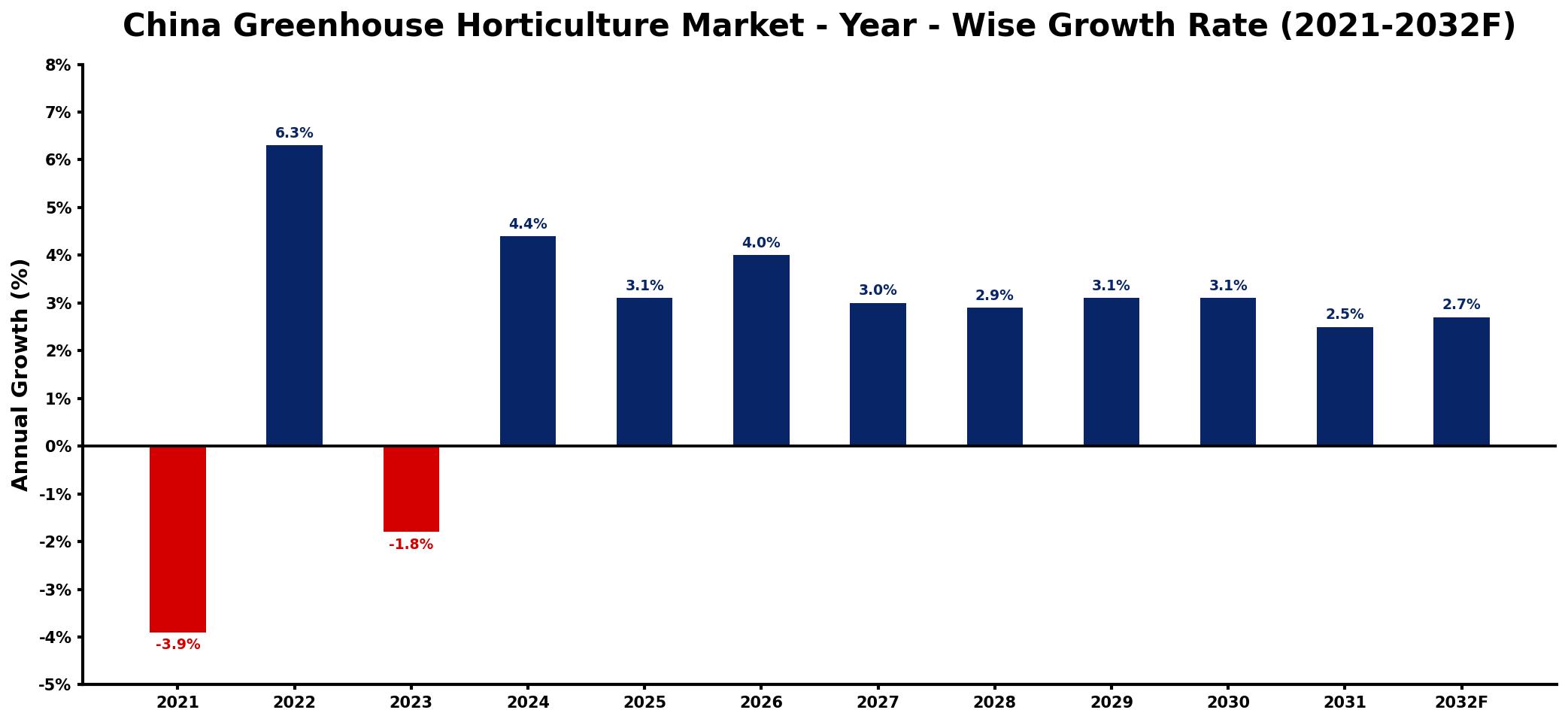
The table below presents the year‑wise growth rates along with the key drivers influencing the market
| Year | Growth Rate | Major Drivers |
| 2021 | -3.9% | decrease in consumer spending patterns |
| 2022 | 6.3% | rise in sustainable farming practices |
| 2023 | -1.8% | slowdown in investment activities |
| 2024 | 4.4% | expansion of urban agriculture initiatives |
| 2025 | 3.1% | growth in organic produce demand |
| 2026 | 4.0% | increased focus on renewable energy |
| 2027 | 3.0% | enhancement of local supply chains |
| 2028 | 2.9% | development of advanced technologies |
| 2029 | 3.1% | increased awareness of health benefits |
| 2030 | 3.1% | growing popularity of eco-friendly solutions |
| 2031 | 2.5% | strengthening of export opportunities |
| 2032 | 2.7% | emphasis on climate resilience strategies |
Note: Market size estimations and growth projections presented in this report are based on 6Wresearch's proprietary forecasting methodology, utilizing the latest available industry data, government publications, and primary research inputs.
China Greenhouse Horticulture Market Synopsis
The strongest force shaping the China Greenhouse Horticulture Market today is the increasing demand for sustainable agricultural practices. As urbanization accelerates and dietary preferences evolve, there is a pronounced shift towards high-quality produce, which greenhouse facilities are uniquely positioned to provide.
Additionally, the integration of advanced technologies in greenhouse operations is further enhancing productivity and crop quality. From climate control systems to hydroponics, these innovations are making it feasible for producers to yield high-quality fruits, vegetables, and flowers, catering to both domestic and international markets.
China Greenhouse Horticulture Market Key Takeaways
- Significant growth projected in the China Greenhouse Horticulture Market, driven by increasing food safety concerns.
- Advanced technologies are essential for optimizing greenhouse operations and enhancing crop yields.
- Government policies are actively promoting sustainable practices and modernization in agriculture.
- Urban agriculture and vertical farming are becoming key strategies for addressing food security challenges.
- The market is characterized by a mix of traditional and modern greenhouse facilities, catering to diverse agricultural needs.
Evaluation of Restraints in China Greenhouse Horticulture Market
Despite the promising outlook, several restraints are impeding the growth of the China Greenhouse Horticulture Market. A significant barrier is the high initial capital required for establishing advanced greenhouse facilities, which can deter small-scale farmers from upgrading their operations. Additionally, there is a notable shortage of skilled labor familiar with advanced greenhouse technologies, which can hamper operational efficiency. Other factors include climate variability, which may lead to unpredictable yields, and the prevalence of counterfeit agricultural inputs that compromise crop quality. Navigating these challenges requires strategic investments and partnerships in research, training, and reliable supply chains.
China Greenhouse Horticulture Market Trends
A number of current and emerging trends are shaping the demand and technology landscape in the China Greenhouse Horticulture Market. The adoption of high-tech solutions such as automation, climate control systems, and hydroponics is rapidly increasing. Farmers are increasingly focusing on organic and sustainable practices as consumers show a preference for environmentally friendly products. Furthermore, the trend towards urban agriculture and vertical farming is gaining traction as cities seek innovative ways to enhance food security while minimizing environmental impact. Overall, these trends signal a robust shift towards more efficient and sustainable horticultural practices.
China Greenhouse Horticulture Market Opportunities
The China Greenhouse Horticulture Market presents a wealth of investment opportunities. Key areas include the construction of advanced greenhouse facilities and the provision of technological solutions for climate control and automation. There is also a rising demand for high-value crops, particularly organic fruits and vegetables, where investors can maximize yields and quality. Additionally, establishing integrated agri-tech parks or greenhouse clusters could enhance supply chain efficiencies and market accessibility. The ongoing government support for agricultural modernization and sustainability adds a favorable context for these investments.
Government Initiatives in the China Greenhouse Horticulture Market
The Chinese government has implemented various initiatives to bolster the greenhouse horticulture sector. Financial subsidies aimed at supporting the construction and operational costs of greenhouse facilities are a key component of these efforts. Additionally, tax incentives and funding for research and development are being offered to foster innovation and technological advancement in the industry. By promoting regulations that ensure sustainable practices and environmental protection, the government is not only aiming to enhance domestic food production but also to reduce the ecological footprint of agricultural activities.
Future Insights of the China Greenhouse Horticulture Market
Looking ahead to 2026-2032, the China Greenhouse Horticulture Market is expected to continue its growth trajectory. The rising demand for year-round, high-quality produce and a shift toward sustainable farming practices will be significant drivers. Technological advancements in automation and climate control will further increase operational efficiency and productivity in greenhouse facilities. As awareness of food safety and environmental issues grows among consumers, the adoption of greenhouse horticulture will likely accelerate, positioning the sector favorably to meet China's burgeoning demand for fresh produce.
China Greenhouse Horticulture Market Latest Developments (2025 - 2026)
Recent developments in the China Greenhouse Horticulture Market reflect a shift towards innovation and sustainability. There has been a notable increase in collaborations between technology providers and agricultural producers to implement state-of-the-art automation and climate control systems. Additionally, new initiatives aimed at promoting urban agriculture and vertical farming have gained traction, as local governments seek to enhance food security within densely populated areas. The ongoing focus on research and development underscores the sectors commitment to advancing sustainable practices while addressing the complexities of modern agricultural demands.
China Greenhouse Horticulture Market - Key Attractiveness of the Report
- 10 Years of Market Numbers
- Historical Data Starting from 2022 to 2025
- Base Year: 2025
- Forecast Data until 2032
- Key Performance Indicators Impacting the Market
- Major Upcoming Developments and Projects
Key Highlights of the Report:
- China Greenhouse Horticulture Market Outlook
- Market Size of China Greenhouse Horticulture Market, 2025
- Forecast of China Greenhouse Horticulture Market, 2032
- Historical Data and Forecast of China Greenhouse Horticulture Revenues & Volume for the Period 2022-2032F
- China Greenhouse Horticulture Market Trend Evolution
- China Greenhouse Horticulture Market Drivers and Challenges
- China Greenhouse Horticulture Price Trends
- China Greenhouse Horticulture Porter's Five Forces
- China Greenhouse Horticulture Industry Life Cycle
- Historical Data and Forecast of China Greenhouse Horticulture Market Revenues & Volume By Material Type for the Period 2022-2032F
- Historical Data and Forecast of China Greenhouse Horticulture Market Revenues & Volume By Glass for the Period 2022-2032F
- Historical Data and Forecast of China Greenhouse Horticulture Market Revenues & Volume By Plastic for the Period 2022-2032F
- Historical Data and Forecast of China Greenhouse Horticulture Market Revenues & Volume By Crop Type for the Period 2022-2032F
- Historical Data and Forecast of China Greenhouse Horticulture Market Revenues & Volume By Fruits and Vegetables for the Period 2022-2032F
- Historical Data and Forecast of China Greenhouse Horticulture Market Revenues & Volume By Flowers and Ornamentals for the Period 2022-2032F
- Historical Data and Forecast of China Greenhouse Horticulture Market Revenues & Volume By Nursery Crops for the Period 2022-2032F
- Historical Data and Forecast of China Greenhouse Horticulture Market Revenues & Volume By Others for the Period 2022-2032F
- Historical Data and Forecast of China Greenhouse Horticulture Market Revenues & Volume By Technology for the Period 2022-2032F
- Historical Data and Forecast of China Greenhouse Horticulture Market Revenues & Volume By Heating System for the Period 2022-2032F
- Historical Data and Forecast of China Greenhouse Horticulture Market Revenues & Volume By Cooling System for the Period 2022-2032F
- China Greenhouse Horticulture Import Export Trade Statistics
- Market Opportunity Assessment By Material Type
- Market Opportunity Assessment By Crop Type
- Market Opportunity Assessment By Technology
- China Greenhouse Horticulture Top Companies Market Share
- China Greenhouse Horticulture Competitive Benchmarking By Technical and Operational Parameters
- China Greenhouse Horticulture Company Profiles
- China Greenhouse Horticulture Key Strategic Recommendations






































