China Groceries Market Summary
The china groceries market was estimated at USD 146 Million in 2025 and is projected to reach USD 169 Million by 2032, growing at a CAGR of 4.1% from 2026 to 2032.
China Groceries Market Year-wise Growth Rate and Key Drivers
This graph highlights how the China Groceries Market has steadily grown over the past five years, supported by major growth factors.
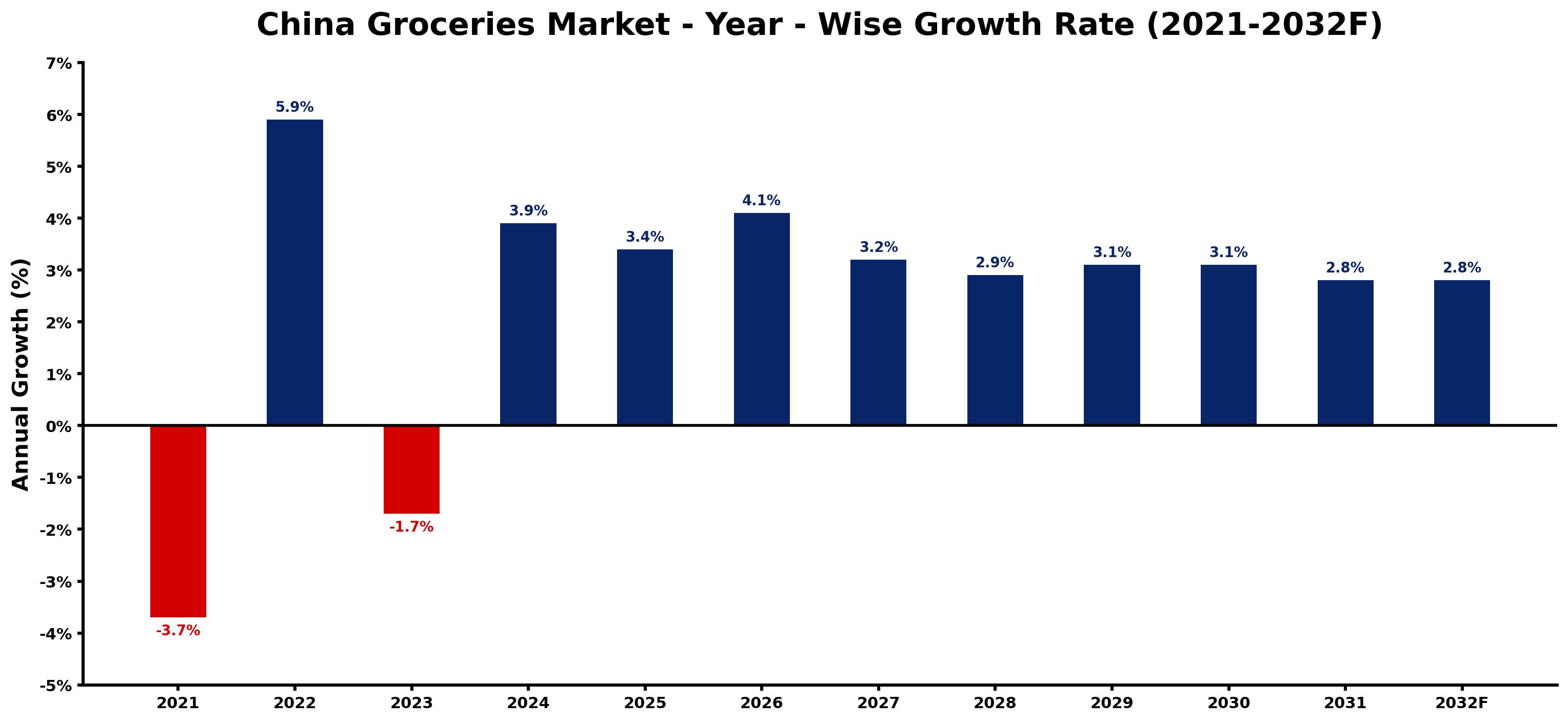
The table below presents the year wise growth rates along with the key drivers influencing the market
| Year | Growth Rate | Major Drivers |
| 2021 | -3.7% | Uncertainty surrounding pandemicrelated lockdowns curtailed consumer spending on nonessential grocery items. |
| 2022 | 5.9% | Urbanization trends created demand for convenience products among younger consumers. |
| 2023 | -1.7% | Heightened food safety concerns prompted consumers to prioritize quality over quantity, leading to decreased grocery spending. |
| 2024 | 3.9% | Sustainability concerns influenced consumer preferences towards organic and locally sourced items. |
| 2025 | 3.4% | Competitive pricing strategies became essential for brands to capture market share. |
| 2026 | 4.1% | E-commerce platforms expanded, increasing accessibility to diverse grocery options nationwide. |
| 2027 | 3.2% | Health-conscious lifestyles prompted a surge in demand for functional food products. |
| 2028 | 2.9% | Investment in cold chain logistics enhanced product quality and shelf life significantly. |
| 2029 | 3.1% | Cultural shifts encouraged greater integration of international cuisines into local markets. |
| 2030 | 3.1% | Digital payment systems gained traction, streamlining the grocery purchasing experience. |
| 2031 | 2.8% | Community-supported agriculture initiatives attracted consumers seeking direct farm-to-table options. |
| 2032 | 2.8% | AI-driven analytics enabled personalized shopping experiences, enhancing customer engagement. |
Note - Market size estimations and growth projections presented in this report are based on 6Wresearch's advanced forecasting approach, validated with industry datasets as of June 2026.
China Groceries Market Synopsis
The China Groceries Market is projected to reach 4.1% and witness significant growth during the forecast period (2026-2032). This growth is driven by urbanization, an increase in disposable incomes, and evolving consumer preferences. Traditional shopping methods are being reshaped by the surge in e-commerce and online grocery delivery services, which have gained considerable traction in recent years. Consumer expectations are shifting towards convenience, quality, and competitive pricing, influencing how retailers operate in this fast-paced market.
China Groceries Market Growth Drivers
Several key factors are driving the growth of the China groceries market. Firstly, the rapid urbanization of China's population has led to a burgeoning middle class with increasing purchasing power. Secondly, the shift towards online shopping, catalyzed by the COVID-19 pandemic, has prompted more consumers to seek out e-commerce platforms for grocery purchases. Thirdly, the demand for organic and healthy food options is on the rise, as health-conscious consumers prioritize nutritious products. Additionally, domestic brands are gaining momentum, as consumers increasingly prefer locally sourced goods. Finally, logistical enhancements and supply chain optimization are enabling retailers to meet the growing need for faster and more reliable delivery services.
China Groceries Market Trends and Opportunities
The China groceries market is characterized by distinct trends that create various opportunities for industry players. There is a notable transition towards mobile shopping and digital payment platforms, which enhance consumer convenience. The increasing focus on sustainability is also shaping consumer purchasing decisions, with shoppers favoring eco-friendly packaging and ethically sourced products. Retailers are responding by expanding their range of organic and premium items, thus catering to the health-conscious demographic. Furthermore, technological advancements are enabling innovations in supply chain management, allowing for improved inventory control and enhanced customer experiences. Lastly, there is a growing interest in unique and specialty food products that reflect local culture, providing avenues for niche brands to thrive.
China Groceries Market Challenges and Restraints
Despite the promising outlook for the China groceries market, several challenges and restraints must be addressed. There is fierce competition among both domestic and international retailers, which peaks in major urban areas. This competition is further intensified by the pace at which consumer preferences change, often leaving retailers scrambling to adapt. Additionally, logistical challenges persist, particularly concerning distribution and transportation infrastructure, impacting the efficiency of supply chains. Regulatory complexities and compliance demands can also impose burdens on companies seeking to enter or expand in the market. Finally, external factors such as fluctuating commodity prices and rising labor costs necessitate innovative marketing strategies to effectively attract and retain consumers.
China Groceries Market Investment Opportunities
The China groceries market provides a landscape ripe for investment due to several compelling factors. The large and diverse consumer base, coupled with rising disposable incomes, presents ample opportunities for growth. E-commerce platforms focused on grocery delivery services are becoming increasingly attractive to investors, as they capitalize on the trend towards online shopping. There is also a notable shift towards higher-quality and organic food products, creating opportunities for companies that specialize in premium offerings. Partnerships with local grocery chains can further enhance market penetration for foreign investors, leveraging established distribution networks and local market knowledge. Additionally, with government support for retail developments, the prospects for long-term growth in the groceries sector appear robust.
China Groceries Market Government Investment and Initiatives
The Chinese government has implemented various policies and initiatives aimed at sustaining growth in the groceries market. These include stringent regulations focused on food safety, quality standards, and product traceability systems, which protect consumer interests and bolster confidence in food products. Initiatives to promote sustainable agriculture, such as subsidies for local farmers and support for organic farming, are pivotal in encouraging improved practices within the sector. Furthermore, the government has rolled out measures aimed at stimulating the retail sector post-COVID-19, including the promotion of digital grocery shopping and the implementation of health and safety protocols for physical stores. These comprehensive policies are designed to foster stability and growth within the groceries market, contributing to a sustainable food supply chain across the nation.
China Groceries Market Latest Developments (May 2025 - June 2026)
In the period from May 2025 to June 2026, the China groceries market has witnessed several noteworthy developments. E-commerce platforms continue to expand their reach, integrating advanced technologies to enhance the shopping experience and streamlining logistics processes. Consumer interest in health and wellness products has surged, prompting retailers to increase their offerings of organic and functional food items. Additionally, there is a growing focus on sustainable practices, with many retailers adopting environmentally friendly packaging solutions. The competitive landscape has also seen new entrants, challenging existing players to innovate and differentiate their products. Lastly, partnerships between technology providers and grocery retailers have become more common, showcasing a collaborative approach to meet evolving consumer demands.
China Groceries Market - Key Attractiveness of the Report
- 10 Years of Market Numbers
- Historical Data Starting from 2022 to 2025
- Base Year: 2025
- Forecast Data until 2032
- Key Performance Indicators Impacting the Market
- Major Upcoming Developments and Projects
Key Highlights of the Report:
- China Groceries Market Outlook
- Market Size of China Groceries Market, 2025
- Forecast of China Groceries Market, 2032F
- Historical Data and Forecast of China Groceries Revenues & Volume for the Period 2022-2032F
- China Groceries Market Trend Evolution
- China Groceries Market Drivers and Challenges
- China Groceries Price Trends
- China Groceries Porter's Five Forces
- China Groceries Industry Life Cycle
- Historical Data and Forecast of China Groceries Market Revenues & Volume By Product Types for the Period 2022-2032F
- Historical Data and Forecast of China Groceries Market Revenues & Volume By Packaged Food for the Period 2022-2032F
- Historical Data and Forecast of China Groceries Market Revenues & Volume By Unpackaged Food for the Period 2022-2032F
- Historical Data and Forecast of China Groceries Market Revenues & Volume By Drinks for the Period 2022-2032F
- Historical Data and Forecast of China Groceries Market Revenues & Volume By Tobacco for the Period 2022-2032F
- Historical Data and Forecast of China Groceries Market Revenues & Volume By Household Products for the Period 2022-2032F
- Historical Data and Forecast of China Groceries Market Revenues & Volume By Others for the Period 2022-2032F
- Historical Data and Forecast of China Groceries Market Revenues & Volume By Distribution Channel for the Period 2022-2032F
- Historical Data and Forecast of China Groceries Market Revenues & Volume By Supermarkets & Hypermarkets for the Period 2022-2032F
- Historical Data and Forecast of China Groceries Market Revenues & Volume By Convenience Store for the Period 2022-2032F
- Historical Data and Forecast of China Groceries Market Revenues & Volume By Online for the Period 2022-2032F
- China Groceries Import Export Trade Statistics
- Market Opportunity Assessment By Product Types
- Market Opportunity Assessment By Distribution Channel
- China Groceries Top Companies Market Share
- China Groceries Competitive Benchmarking By Technical and Operational Parameters
- China Groceries Company Profiles
- China Groceries Key Strategic Recommendations






































