China Hafnium Market Size, Share & Growth Rate
The China Hafnium Market was estimated at USD 171 Million in 2025 and is projected to reach USD 197 Million by 2032, growing at a CAGR of 2.0% from 2026 to 2032. This growth trajectory is primarily fueled by increased investments in semiconductor manufacturing and aerospace applications, where hafnium's unique properties offer critical advantages. As industries become more reliant on advanced materials, hafnium's demand in China is set to expand significantly in the coming years.
China Hafnium Market Year-wise Growth Rate and Key Drivers
This graph highlights how the China Hafnium Market has steadily grown over the years, supported by major growth factors.
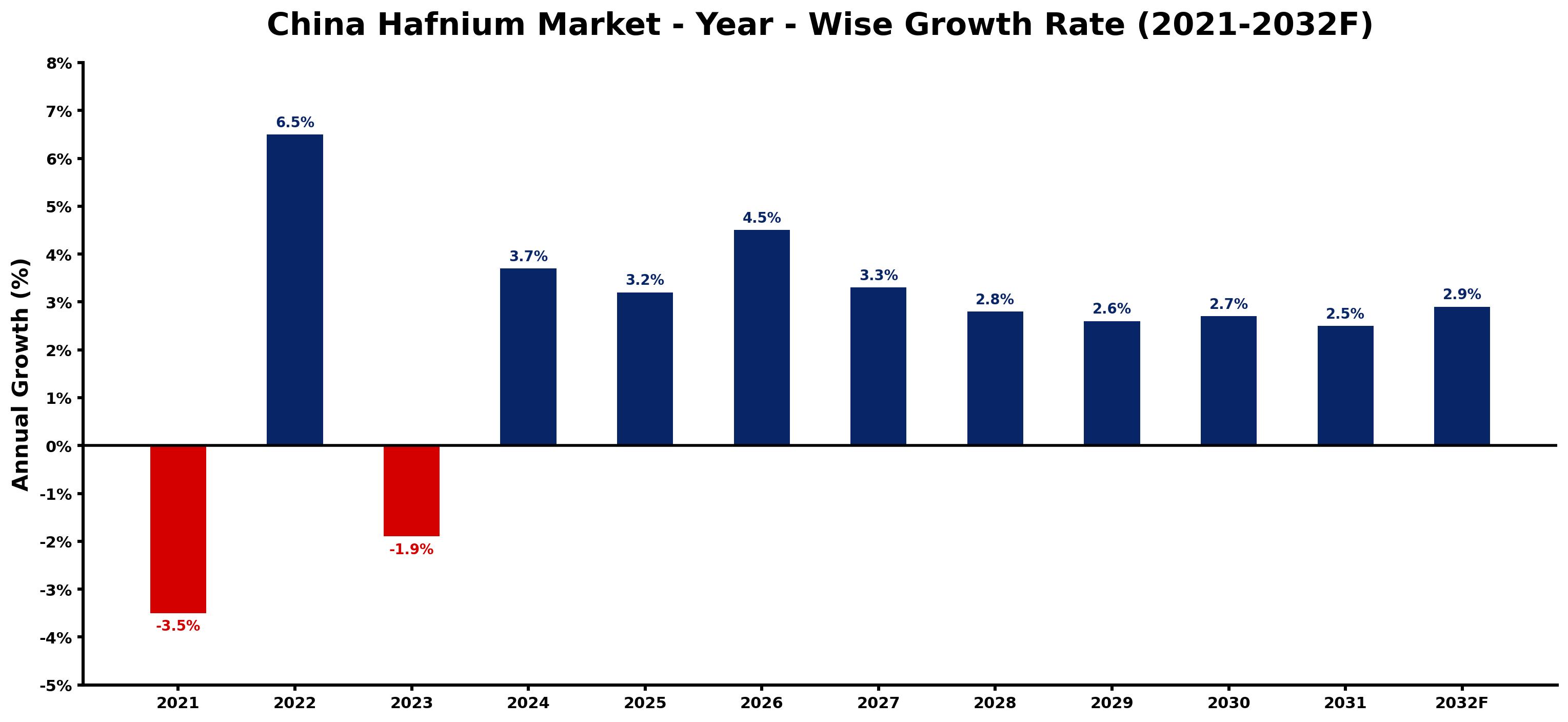
The table below presents the year‑wise growth rates along with the key drivers influencing the market
| Year | Growth Rate | Major Drivers |
| 2021 | -3.5% | Decreased industrial production rates |
| 2022 | 6.5% | Rising demand in electronics sector |
| 2023 | -1.9% | Lower investments in mining projects |
| 2024 | 3.7% | Expansion in renewable energy applications |
| 2025 | 3.2% | Growth in aerospace manufacturing demand |
| 2026 | 4.5% | Increased use in nuclear technology |
| 2027 | 3.3% | Surge in defense industry requirements |
| 2028 | 2.8% | Higher demand from automotive sector |
| 2029 | 2.6% | Expansion of semiconductor technologies |
| 2030 | 2.7% | Rising investments in research initiatives |
| 2031 | 2.5% | rising infrastructure development spending |
| 2032 | 2.9% | Increased applications in medical devices |
Note: Market size estimations and growth projections presented in this report are based on 6Wresearch's proprietary forecasting methodology, utilizing the latest available industry data, government publications, and primary research inputs.
China Hafnium Market Synopsis
Hafnium is gaining traction in China, especially within the semiconductor sector, where it plays a vital role in enhancing the performance of chips. With the nations push towards technological independence, hafnium's applications are expanding rapidly.
Furthermore, the aerospace industrys growth in China continues to drive demand for hafnium-based alloys, crucial for manufacturing components that must withstand extreme conditions. These developments are instrumental in positioning hafnium as a metal of choice across multiple sectors.
China Hafnium Market Key Takeaways
- The hafnium market in China is driven by growing applications in aerospace, electronics, and nuclear energy.
- Investments in research and development are crucial for enhancing hafniums properties and applications.
- Chinas government policies are aimed at balancing production sustainability with market competitiveness.
- The market is experiencing an upward trend due to increasing production capacities and technological advancements.
- Opportunities in hafnium recycling and eco-friendly production processes are emerging as growth areas.
Evaluation of Restraints in China Hafnium Market
The China Hafnium market encounters notable restraints, primarily stemming from the limited applications of hafnium, which can lead to unpredictable demand fluctuations. Its production, characterized by high costs and complex processes, presents a barrier to maintaining competitive pricing. Furthermore, China's heavy reliance on global trade dynamics adds layers of uncertainty, as shifts in international policy or competition from countries with hafnium reserves can significantly impact local market conditions.
China Hafnium Market Trends
Current trends reveal a pronounced shift towards sustainable practices in hafnium production, aligning with global environmental regulations. Innovations in hafnium applications, particularly within high-performance electronics and aerospace superalloys, are influencing market demand. Additionally, the growing focus on renewable energy sources, such as nuclear power, underscores the essential role hafnium will play in future energy solutions.
China Hafnium Market Opportunities
Investment opportunities in the China Hafnium market are increasingly promising, particularly as industries seek high-performance materials for advanced technology applications. The rising focus on nuclear energy suggests that hafnium's role in nuclear reactors will become even more pronounced. Furthermore, advancements in hafnium recycling processes and the development of new hafnium-based technologies open additional avenues for innovation and profitability within this sector.
Government Initiatives in the China Hafnium Market
The Chinese government has instituted several policies aimed at regulating the hafnium market, emphasizing sustainable extraction practices and resource management. Export quotas have been implemented to ensure the domestic industry remains robust, while price controls are designed to mitigate market volatility. These measures are intended to protect the environment while maintaining China's leadership position in global hafnium production.
Future Insights of the China Hafnium Market
Looking ahead to 2026-2032, the China Hafnium Market is expected to continue its upward trajectory, driven by escalating demand across critical sectors. The increased use of hafnium in next-generation semiconductors and advanced aerospace materials positions it as a strategic metal for the future. However, navigating potential supply chain disruptions and regulatory hurdles will be essential for industry players to sustain growth in this evolving landscape.
China Hafnium Market Latest Developments (2025 - 2026)
Recent developments within the China Hafnium market highlight a growing emphasis on enhancing production efficiencies and expanding capacity to meet rising demand. Innovations in recycling techniques and eco-friendly production methods have gained traction, signaling a shift towards sustainable practices in hafnium usage. Additionally, collaborations between industry stakeholders are fostering advancements in hafnium applications, particularly within semiconductor manufacturing and aerospace technologies.
China Hafnium Market - Key Attractiveness of the Report
- 10 Years of Market Numbers
- Historical Data Starting from 2022 to 2025
- Base Year: 2025
- Forecast Data until 2032
- Key Performance Indicators Impacting the Market
- Major Upcoming Developments and Projects
Key Highlights of the Report:
- China Hafnium Market Outlook
- Market Size of China Hafnium Market, 2025
- Forecast of China Hafnium Market, 2032
- Historical Data and Forecast of China Hafnium Revenues & Volume for the Period 2022-2032F
- China Hafnium Market Trend Evolution
- China Hafnium Market Drivers and Challenges
- China Hafnium Price Trends
- China Hafnium Porter's Five Forces
- China Hafnium Industry Life Cycle
- Historical Data and Forecast of China Hafnium Market Revenues & Volume By Type for the Period 2022-2032F
- Historical Data and Forecast of China Hafnium Market Revenues & Volume By Hafnium Oxide for the Period 2022-2032F
- Historical Data and Forecast of China Hafnium Market Revenues & Volume By Hafnium Carbide for the Period 2022-2032F
- Historical Data and Forecast of China Hafnium Market Revenues & Volume By Other for the Period 2022-2032F
- Historical Data and Forecast of China Hafnium Market Revenues & Volume By Application for the Period 2022-2032F
- Historical Data and Forecast of China Hafnium Market Revenues & Volume By Super Alloy for the Period 2022-2032F
- Historical Data and Forecast of China Hafnium Market Revenues & Volume By Optical Coating for the Period 2022-2032F
- Historical Data and Forecast of China Hafnium Market Revenues & Volume By Nuclear for the Period 2022-2032F
- Historical Data and Forecast of China Hafnium Market Revenues & Volume By Plasma Cutting for the Period 2022-2032F
- Historical Data and Forecast of China Hafnium Market Revenues & Volume By Other for the Period 2022-2032F
- China Hafnium Import Export Trade Statistics
- Market Opportunity Assessment By Type
- Market Opportunity Assessment By Application
- China Hafnium Top Companies Market Share
- China Hafnium Competitive Benchmarking By Technical and Operational Parameters
- China Hafnium Company Profiles
- China Hafnium Key Strategic Recommendations






































