China Hyaluronic Acid Market Top 5 Importing Countries and Market Competition (HHI) Analysis
In 2024, China hyaluronic acid import market saw a shift in concentration from high to moderate, with top exporting countries such as Sweden, USA, and Germany maintaining their strong presence. Despite a negative Compound Annual Growth Rate (CAGR) of -3.05% from 2020 to 2024, the market experienced a significant decline in growth rate from 2023 to 2024 at -16.81%. This indicates a challenging environment for hyaluronic acid imports in China, potentially influenced by various factors impacting the industry dynamics and market demand.
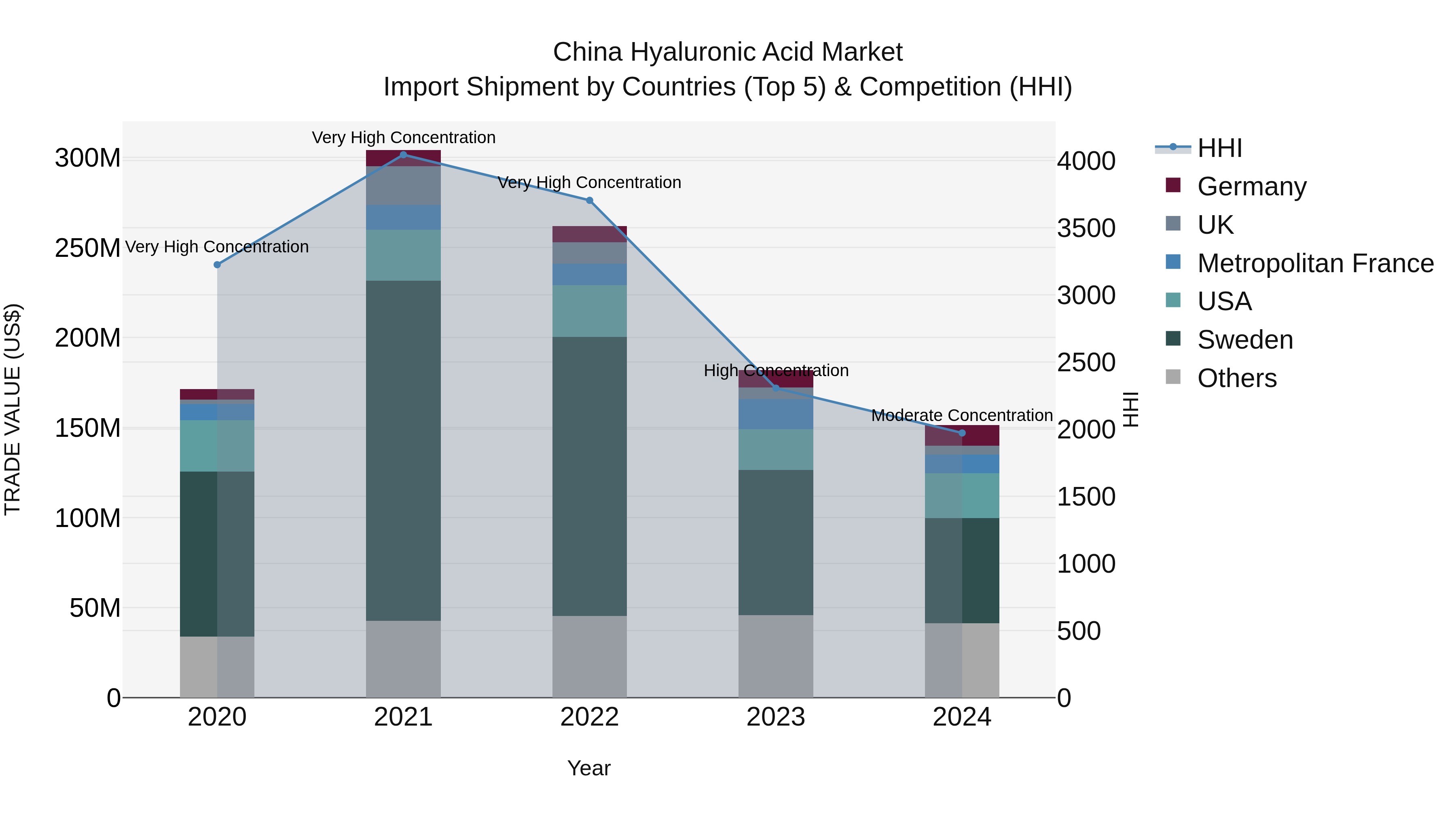
China Hyaluronic Acid Market Overview
The China hyaluronic acid market is experiencing steady growth due to increasing demand from the cosmetics and healthcare industries. The market is driven by factors such as the growing aging population, rising awareness about skincare, and the expanding use of hyaluronic acid in medical applications such as osteoarthritis treatment. The market is characterized by intense competition among key players, both domestic and international, leading to innovations in product formulations and manufacturing processes. Additionally, government initiatives to promote the use of hyaluronic acid in various industries further contribute to market growth. With a strong emphasis on research and development, the China hyaluronic acid market is expected to continue to expand, offering lucrative opportunities for market players in the coming years.
China Hyaluronic Acid Market Trends
The China hyaluronic acid market is witnessing a significant growth trend driven by increasing demand for skincare and cosmetic products. Hyaluronic acid, known for its moisturizing and anti-aging properties, is being increasingly used in a wide range of beauty products such as serums, creams, and masks. The market is also benefiting from the rising awareness about the benefits of hyaluronic acid in maintaining skin hydration and elasticity, particularly among the younger population. Additionally, the growing aging population in China is fueling the demand for hyaluronic acid-based dermal fillers and other anti-aging treatments. As a result, key players in the market are focusing on product innovation, expanding their product portfolios, and strengthening distribution channels to capitalize on the growing opportunities in the China hyaluronic acid market.
China Hyaluronic Acid Market Challenges
In the China hyaluronic acid market, some challenges include regulatory uncertainties surrounding the approval process for hyaluronic acid products, the presence of counterfeit or low-quality products in the market, and increasing competition from domestic and international manufacturers. Additionally, fluctuations in raw material prices and the complexity of the production process can impact the overall cost structure for companies operating in this market. Furthermore, the lack of standardized quality control measures and varying consumer perceptions of hyaluronic acid products can also pose challenges for market players in terms of building trust and brand loyalty. Overall, navigating these challenges requires companies to adapt quickly to changes in regulations, invest in quality control measures, and differentiate their products effectively to remain competitive in the China hyaluronic acid market.
China Hyaluronic Acid Market Investment Opportunities
The China hyaluronic acid market presents several investment opportunities due to the increasing demand for cosmetic and skincare products, as well as the growing aging population seeking anti-aging solutions. Investors could consider opportunities in hyaluronic acid production and manufacturing companies, as well as companies specializing in hyaluronic acid-based products such as dermal fillers, skincare products, and medical devices. Additionally, with the rising trend of natural and organic beauty products, there is potential for investments in companies focusing on sustainable and eco-friendly hyaluronic acid production methods. Given the market`s projected growth and the diverse applications of hyaluronic acid in various industries, investing in this sector could yield profitable returns for investors looking to capitalize on the increasing demand for hyaluronic acid products in China.
China Hyaluronic Acid Market Government Policy
The Chinese government has implemented various policies to regulate the hyaluronic acid market. These include quality control measures to ensure the safety and efficacy of hyaluronic acid products, pricing regulations to prevent price manipulation and ensure affordability, as well as licensing requirements for manufacturers and distributors to ensure compliance with standards. Additionally, the government has introduced incentives to promote research and development in the hyaluronic acid industry, such as tax breaks and grants for innovation. Overall, these policies aim to foster a competitive and sustainable hyaluronic acid market in China while safeguarding consumer interests and promoting industry growth.
China Hyaluronic Acid Market Future Outlook
The future outlook for the China hyaluronic acid market appears to be promising due to growing awareness about the benefits of hyaluronic acid in skincare, pharmaceuticals, and medical applications. The market is anticipated to experience significant growth driven by increasing demand for anti-aging products, dermal fillers, and osteoarthritis treatments. Furthermore, the rising disposable income levels, expanding middle-class population, and emphasis on personal care and aesthetics are expected to fuel the market growth. With advancements in technology and research leading to the development of innovative hyaluronic acid-based products, the market is likely to witness continuous expansion in the coming years. However, regulatory challenges and competition from alternative ingredients may pose some hurdles for market players to navigate.
Key Highlights of the Report:
- China Hyaluronic Acid Market Outlook
- Market Size of China Hyaluronic Acid Market,2024
- Forecast of China Hyaluronic Acid Market, 2031
- Historical Data and Forecast of China Hyaluronic Acid Revenues & Volume for the Period 2021-2031
- China Hyaluronic Acid Market Trend Evolution
- China Hyaluronic Acid Market Drivers and Challenges
- China Hyaluronic Acid Price Trends
- China Hyaluronic Acid Porter's Five Forces
- China Hyaluronic Acid Industry Life Cycle
- Historical Data and Forecast of China Hyaluronic Acid Market Revenues & Volume By Type for the Period 2021-2031
- Historical Data and Forecast of China Hyaluronic Acid Market Revenues & Volume By High Molecular Weight for the Period 2021-2031
- Historical Data and Forecast of China Hyaluronic Acid Market Revenues & Volume By Medium Molecular Weight for the Period 2021-2031
- Historical Data and Forecast of China Hyaluronic Acid Market Revenues & Volume By Low Molecular Weight for the Period 2021-2031
- Historical Data and Forecast of China Hyaluronic Acid Market Revenues & Volume By Cross-Linked for the Period 2021-2031
- Historical Data and Forecast of China Hyaluronic Acid Market Revenues & Volume By Non-Cross-Linked for the Period 2021 - 2029
- Historical Data and Forecast of China Hyaluronic Acid Market Revenues & Volume By Application for the Period 2021-2031
- Historical Data and Forecast of China Hyaluronic Acid Market Revenues & Volume By Dermatology for the Period 2021-2031
- Historical Data and Forecast of China Hyaluronic Acid Market Revenues & Volume By Ophthalmology for the Period 2021-2031
- Historical Data and Forecast of China Hyaluronic Acid Market Revenues & Volume By Orthopedics for the Period 2021-2031
- Historical Data and Forecast of China Hyaluronic Acid Market Revenues & Volume By Wound Healing for the Period 2021-2031
- Historical Data and Forecast of China Hyaluronic Acid Market Revenues & Volume By Cosmetics for the Period 2021 - 2029
- Historical Data and Forecast of China Hyaluronic Acid Market Revenues & Volume By End Use for the Period 2021-2031
- Historical Data and Forecast of China Hyaluronic Acid Market Revenues & Volume By Personal Care for the Period 2021-2031
- Historical Data and Forecast of China Hyaluronic Acid Market Revenues & Volume By Pharmaceuticals for the Period 2021-2031
- Historical Data and Forecast of China Hyaluronic Acid Market Revenues & Volume By Dietary Supplements for the Period 2021-2031
- Historical Data and Forecast of China Hyaluronic Acid Market Revenues & Volume By Food & Beverages for the Period 2021-2031
- Historical Data and Forecast of China Hyaluronic Acid Market Revenues & Volume By Biotech Research for the Period 2021 - 2029
- Historical Data and Forecast of China Hyaluronic Acid Market Revenues & Volume By Form for the Period 2021-2031
- Historical Data and Forecast of China Hyaluronic Acid Market Revenues & Volume By Powder for the Period 2021-2031
- Historical Data and Forecast of China Hyaluronic Acid Market Revenues & Volume By Liquid for the Period 2021-2031
- Historical Data and Forecast of China Hyaluronic Acid Market Revenues & Volume By Gel for the Period 2021-2031
- Historical Data and Forecast of China Hyaluronic Acid Market Revenues & Volume By Solution for the Period 2021-2031
- Historical Data and Forecast of China Hyaluronic Acid Market Revenues & Volume By Injectable for the Period 2021 - 2029
- Historical Data and Forecast of China Hyaluronic Acid Market Revenues & Volume By Source for the Period 2021-2031
- Historical Data and Forecast of China Hyaluronic Acid Market Revenues & Volume By Synthetic for the Period 2021-2031
- Historical Data and Forecast of China Hyaluronic Acid Market Revenues & Volume By Natural (Fermentation) for the Period 2021-2031
- Historical Data and Forecast of China Hyaluronic Acid Market Revenues & Volume By Animal-Based for the Period 2021-2031
- Historical Data and Forecast of China Hyaluronic Acid Market Revenues & Volume By Plant-Based for the Period 2021 - 2029
- Historical Data and Forecast of China Hyaluronic Acid Market Revenues & Volume By Microbial Fermentation for the Period 2021 - 2029
- China Hyaluronic Acid Import Export Trade Statistics
- Market Opportunity Assessment By Type
- Market Opportunity Assessment By Application
- Market Opportunity Assessment By End Use
- Market Opportunity Assessment By Form
- Market Opportunity Assessment By Source
- China Hyaluronic Acid Top Companies Market Share
- China Hyaluronic Acid Competitive Benchmarking By Technical and Operational Parameters
- China Hyaluronic Acid Company Profiles
- China Hyaluronic Acid Key Strategic Recommendations






































