China Hyperscale Data Center Market Size & Growth Rate (2026-2032)
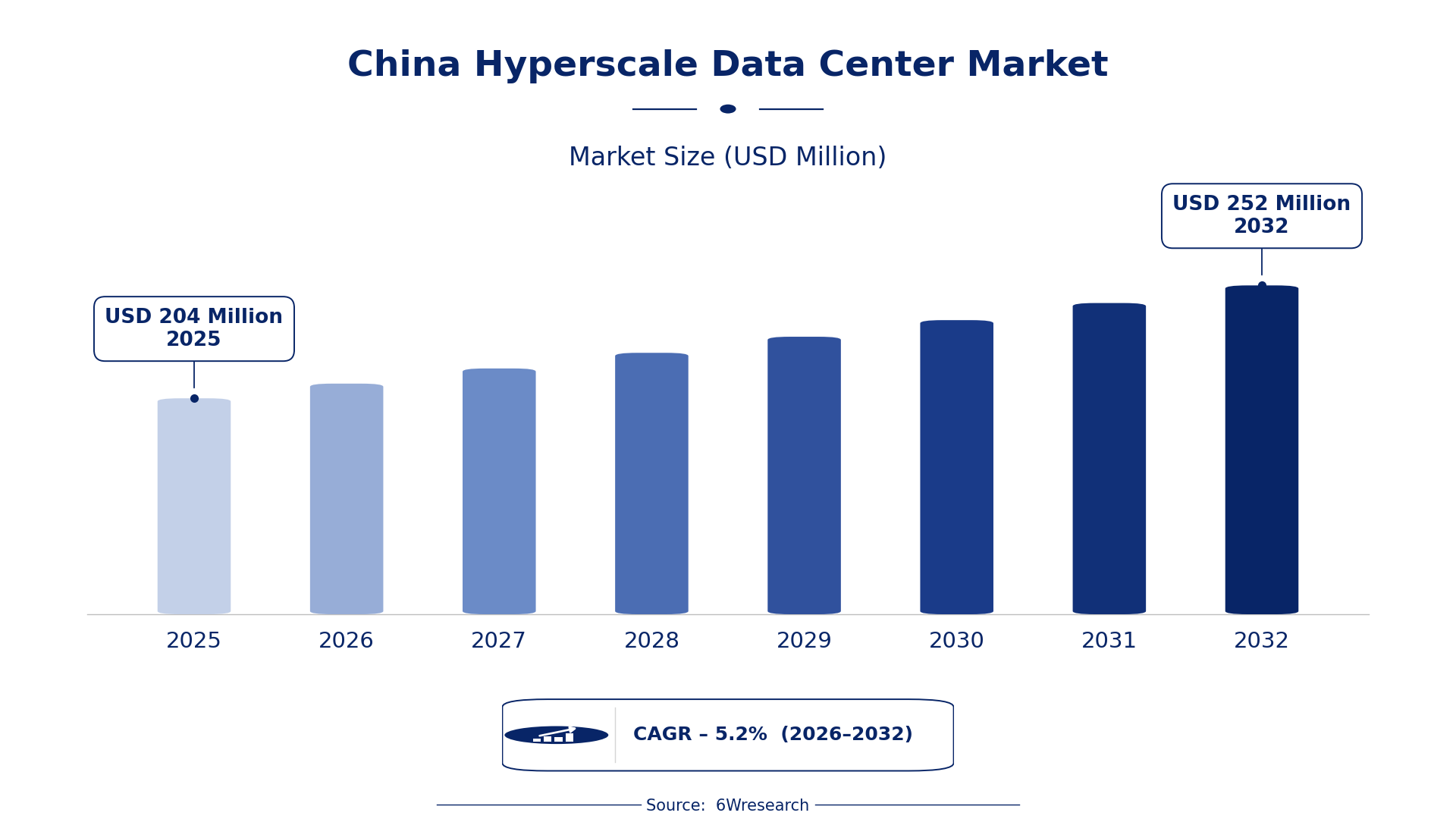
The China Hyperscale Data Center Market was estimated at USD 204 Million in 2025 and is projected to reach USD 252 Million by 2032, growing at a CAGR of 5.2% from 2026 to 2032.
China Hyperscale Data Center Market Synopsis
As digital transformation accelerates across industries in China, hyperscale data centers are becoming vital to meet the surging demand for cloud services and big data analytics. This demand is not only driven by tech giants but also by the increasing need for efficient computing resources from various sectors, including finance, healthcare, and retail.
Major cities like Beijing, Shanghai, and Shenzhen are witnessing rapid expansion in data center facilities, equipped with cutting-edge technologies. The integration of advanced cooling systems and modular designs has become standard practice, enhancing energy efficiency while addressing the growing operational demands of these facilities.
China Hyperscale Data Center Market Year-wise Growth Rate and Key Drivers
This graph illustrates the annual growth rates of the China Hyperscale Data Center Market from 2021 to 2032, highlighting a steady upward trajectory and projected expansion over the forecast period.
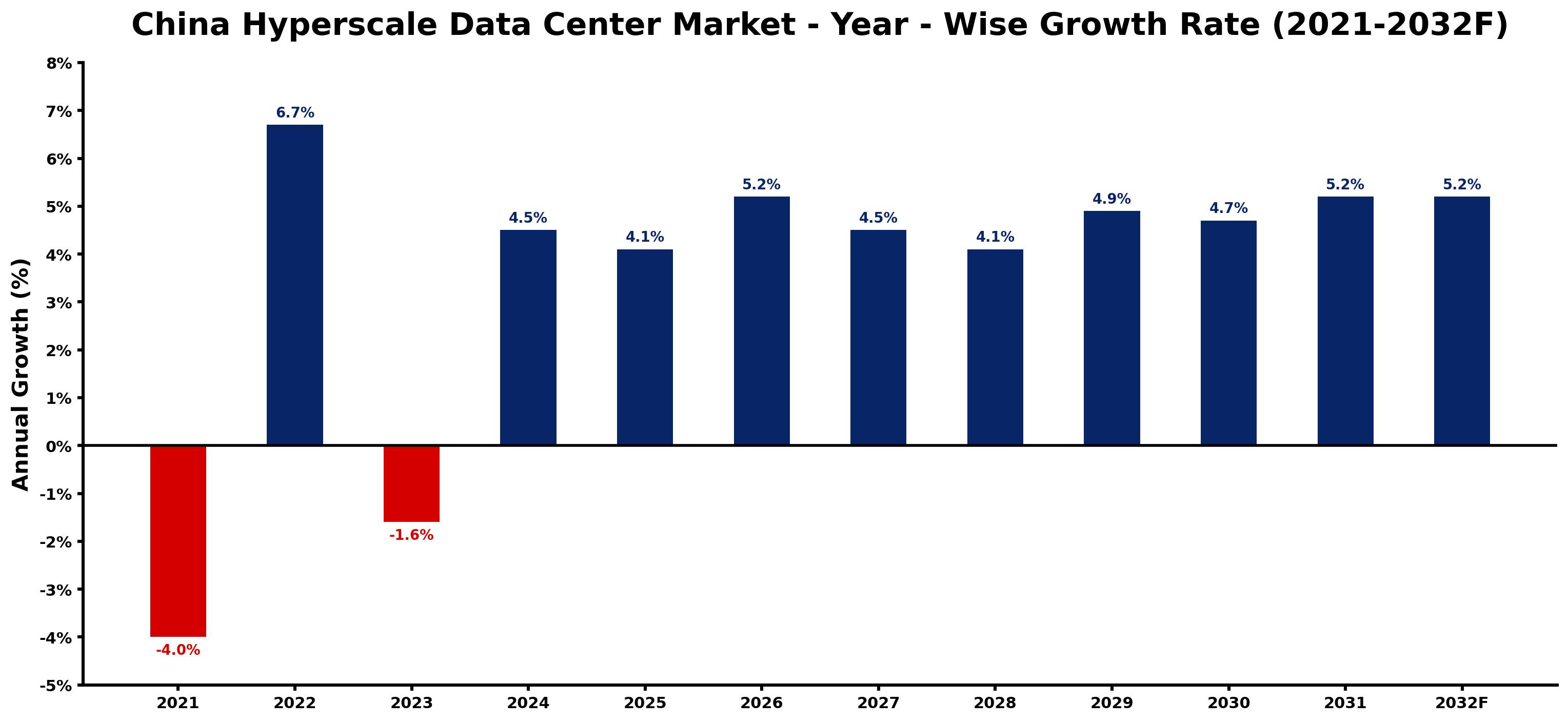
The table below presents the year‑wise growth rates along with the key drivers influencing the market
| Year | Growth Rate | Major Drivers |
| 2021 | -4.0% | Tighter energy regulations impacting data center operations. |
| 2022 | 6.7% | Government support for 5G infrastructure rollouts boosts capacity |
| 2023 | -1.6% | Slower adoption of AI technologies in competing firms. |
| 2024 | 4.5% | Increased AI adoption driving demand for data processing |
| 2025 | 4.1% | National cybersecurity regulations enhance data center security needs |
| 2026 | 5.2% | Sustainability initiatives fostering growth of green data centers |
| 2027 | 4.5% | Rising IoT device usage increasing data storage requirements |
| 2028 | 4.1% | Digital economy growth fueling hyperscale facility investments |
| 2029 | 4.9% | Local cloud service providers expanding infrastructure offerings |
| 2030 | 4.7% | Rapid urbanization leading to higher data center demand |
| 2031 | 5.2% | Bipartisan support for tech industry enhancing investment climates |
| 2032 | 5.2% | Accelerating digital transformation initiatives among large enterprises |
Note: Market size estimations and growth projections presented in this report are based on 6Wresearch's proprietary forecasting methodology, utilizing the latest available industry data, government publications, and primary research inputs.
China Hyperscale Data Center Market Key Takeaways
Below are some of the specific key takeaways from the market, including:
- Increasing cloud service adoption is a primary driver for market growth.
- Technological innovations are key to improving operational efficiencies in data centers.
- Strategic partnerships between local and international players are on the rise.
- Government policies are shaping the regulatory environment for data center operations.
- Investment opportunities are abundant, particularly in infrastructure and technology solutions.
Evaluation of Restraints in China Hyperscale Data Center Market
Despite the growth potential, the China hyperscale data center market faces real constraints. Competition among providers is fierce, leading to a race to expand infrastructure, which can strain resources. Land acquisition challenges, coupled with stringent regulatory requirements, complicate new developments. Additionally, geopolitical issues and data security regulations present ongoing hurdles that companies must strategically navigate to maintain their market positions.
China Hyperscale Data Center Market Trends
Current trends in the China hyperscale data center market include a shift towards greener technologies, such as liquid cooling systems that reduce energy consumption. Modular data center designs are becoming increasingly popular, allowing for scalability and quicker deployments. There is also a noticeable uptick in the integration of AI and machine learning tools, aimed at optimizing operations and enhancing data management capabilities.
China Hyperscale Data Center Market Opportunities
The market offers substantial growth opportunities, particularly for investors focusing on cloud infrastructure and colocation services. With China's digital economy expanding rapidly, there is a pressing need for data centers that support advanced analytics and IoT applications. Companies that invest in innovative technologies or offer specialized services are likely to reap significant rewards as businesses increasingly rely on hyperscale solutions for their operational needs.
Government Initiatives in the China Hyperscale Data Center Market
Government policies are crucial in shaping the future of the hyperscale data center market in China. The regulatory environment is designed to promote technological innovation while addressing concerns around data security and sustainability. As the government aims to enhance the digital economy, support for local infrastructure development is a key priority.
- A national digital infrastructure upgrade programme launched in 2023 aims to enhance the capabilities of data centers across key regions.
- Current initiatives focus on providing financial incentives for energy-efficient data center operations to minimize environmental impact.
- A planned public-private partnership expected to commence in 2026 aims to boost data localization efforts and compliance with local regulations.
- Regulatory frameworks introduced in 2024 emphasize transparency in data handling, ensuring compliance with national security standards.
- Ongoing efforts to streamline permit processes for new data center construction aim to facilitate quicker project rollouts.
Future Insights of the China Hyperscale Data Center Market
Looking ahead, the China hyperscale data center market is set for robust expansion through 2032. As digital services proliferate and the demand for cloud capabilities intensifies, data centers will play a critical role in supporting this growth. The shift towards AI and machine learning will not only enhance operational efficiencies but also influence the design and functionality of future facilities. Overall, the market is expected to evolve rapidly, with both local and international players investing significantly in infrastructure and technology.
China Hyperscale Data Center Market Latest Developments
Recent activities in the China hyperscale data center market indicate a dynamic environment, characterized by substantial investments and technological advancements. Providers are increasingly focusing on enhancing operational efficiency while maintaining compliance with evolving regulations.
- A major technology vendor announced the rollout of a new AI-powered resource management system in Q3 2025, aimed at optimizing data center operations.
- Construction of a state-of-the-art modular data center facility began in early 2025, projected to be operational by late 2025.
- A leading regional operator is currently developing a liquid cooling system for its facilities, with trials expected to commence in mid-2026.
- An initiative that began in early 2025 focuses on increasing partnerships between local firms and global providers to leverage combined expertise.
- Plans for a public-private collaboration set to kick off in 2027 aim to enhance broadband access and data center connectivity across rural areas.
China Hyperscale Data Center Market - Key Attractiveness of the Report
- 10 Years of Market Numbers
- Historical Data Starting from 2022 to 2025
- Base Year: 2025
- Forecast Data until 2032
- Key Performance Indicators Impacting the Market
- Major Upcoming Developments and Projects
Key Highlights of the Report:
- China Hyperscale Data Center Market Outlook
- Market Size of China Hyperscale Data Center Market, 2025
- Forecast of China Hyperscale Data Center Market, 2032
- Historical Data and Forecast of China Hyperscale Data Center Revenues & Volume for the Period 2022-2032F
- China Hyperscale Data Center Market Trend Evolution
- China Hyperscale Data Center Market Drivers and Challenges
- China Hyperscale Data Center Price Trends
- China Hyperscale Data Center Porter's Five Forces
- China Hyperscale Data Center Industry Life Cycle
- Historical Data and Forecast of China Hyperscale Data Center Market Revenues & Volume By Solution for the Period 2022-2032F
- Historical Data and Forecast of China Hyperscale Data Center Market Revenues & Volume By Server for the Period 2022-2032F
- Historical Data and Forecast of China Hyperscale Data Center Market Revenues & Volume By Storage for the Period 2022-2032F
- Historical Data and Forecast of China Hyperscale Data Center Market Revenues & Volume By Networking for the Period 2022-2032F
- Historical Data and Forecast of China Hyperscale Data Center Market Revenues & Volume By Software for the Period 2022-2032F
- Historical Data and Forecast of China Hyperscale Data Center Market Revenues & Volume By Service for the Period 2022-2032F
- Historical Data and Forecast of China Hyperscale Data Center Market Revenues & Volume By Consulting for the Period 2022-2032F
- Historical Data and Forecast of China Hyperscale Data Center Market Revenues & Volume By Installation and deployment for the Period 2022-2032F
- Historical Data and Forecast of China Hyperscale Data Center Market Revenues & Volume By Maintenance and support for the Period 2022-2032F
- Historical Data and Forecast of China Hyperscale Data Center Market Revenues & Volume By End-User for the Period 2022-2032F
- Historical Data and Forecast of China Hyperscale Data Center Market Revenues & Volume By Cloud providers for the Period 2022-2032F
- Historical Data and Forecast of China Hyperscale Data Center Market Revenues & Volume By Colocation providers for the Period 2022-2032F
- Historical Data and Forecast of China Hyperscale Data Center Market Revenues & Volume By Enterprises for the Period 2022-2032F
- Historical Data and Forecast of China Hyperscale Data Center Market Revenues & Volume By Data Center Size for the Period 2022-2032F
- Historical Data and Forecast of China Hyperscale Data Center Market Revenues & Volume By Small and medium-sized data centers for the Period 2022-2032F
- Historical Data and Forecast of China Hyperscale Data Center Market Revenues & Volume By Large data centers for the Period 2022-2032F
- Historical Data and Forecast of China Hyperscale Data Center Market Revenues & Volume By Industry for the Period 2022-2032F
- Historical Data and Forecast of China Hyperscale Data Center Market Revenues & Volume By Banking, Financial Services, and Insurance (BFSI) for the Period 2022-2032F
- Historical Data and Forecast of China Hyperscale Data Center Market Revenues & Volume By IT and telecom for the Period 2022-2032F
- Historical Data and Forecast of China Hyperscale Data Center Market Revenues & Volume By Research and academics for the Period 2022-2032F
- Historical Data and Forecast of China Hyperscale Data Center Market Revenues & Volume By Government and defense for the Period 2022-2032F
- Historical Data and Forecast of China Hyperscale Data Center Market Revenues & Volume By Retail for the Period 2022-2032F
- Historical Data and Forecast of China Hyperscale Data Center Market Revenues & Volume By Manufacturing for the Period 2022-2032F
- Historical Data and Forecast of China Hyperscale Data Center Market Revenues & Volume By Healthcare for the Period 2022-2032F
- Historical Data and Forecast of China Hyperscale Data Center Market Revenues & Volume By Media and entertainment for the Period 2022-2032F
- China Hyperscale Data Center Import Export Trade Statistics
- Market Opportunity Assessment By Solution
- Market Opportunity Assessment By Service
- Market Opportunity Assessment By End-User
- Market Opportunity Assessment By Data Center Size
- Market Opportunity Assessment By Industry
- China Hyperscale Data Center Top Companies Market Share
- China Hyperscale Data Center Competitive Benchmarking By Technical and Operational Parameters
- China Hyperscale Data Center Company Profiles
- China Hyperscale Data Center Key Strategic Recommendations






































