China Image Recognition Market Size & Growth Rate (2026-2032)
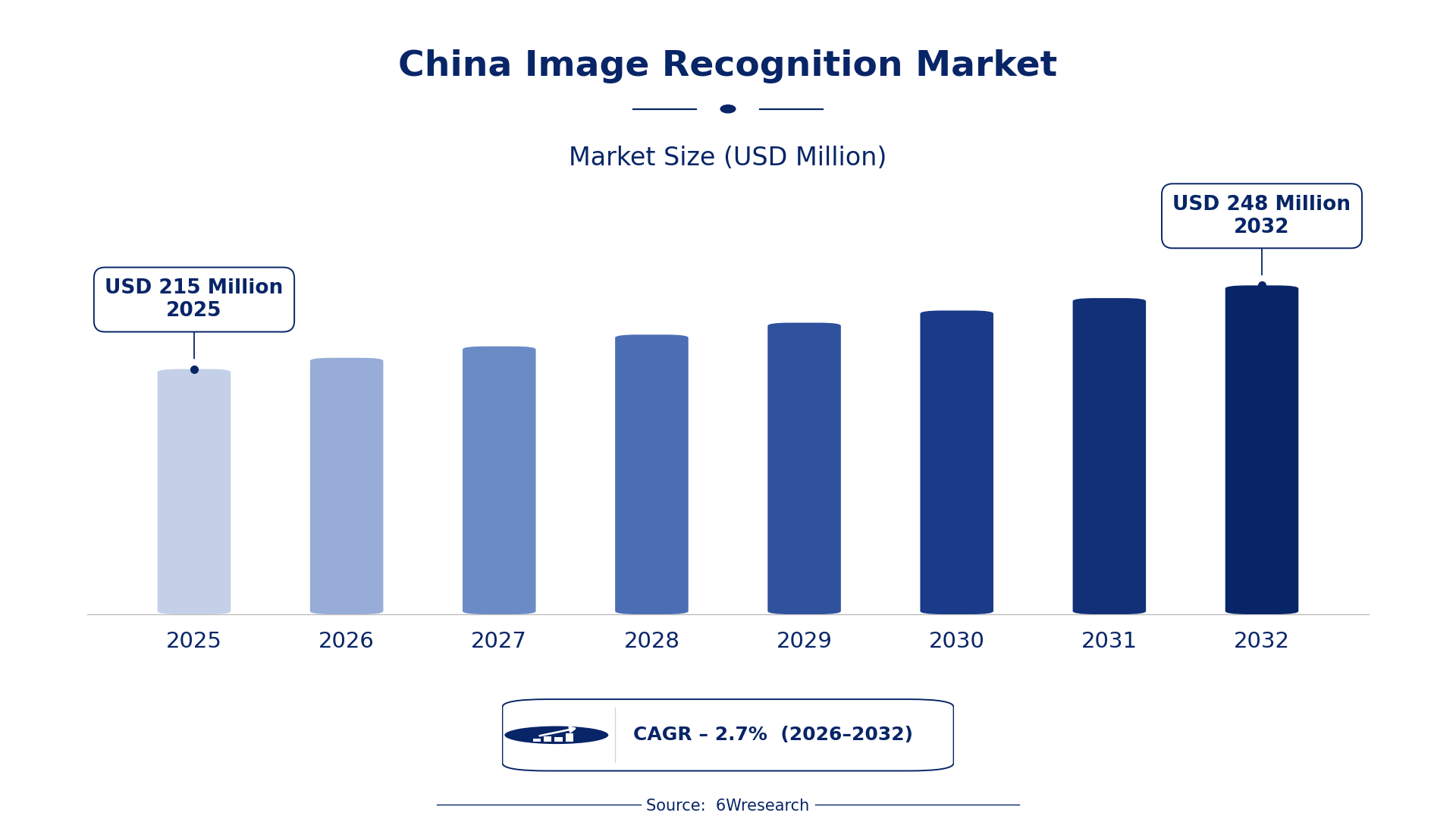
The China Image Recognition Market was estimated at USD 215 Million in 2025 and is projected to reach USD 248 Million by 2032, growing at a CAGR of 2.7% from 2026 to 2032.
China Image Recognition Market Synopsis
The demand for image recognition technology in China is rapidly accelerating, driven by diverse applications across sectors like retail, healthcare, and security. This increasing integration of advanced technologies is transforming traditional business models and consumer interactions.
As artificial intelligence and deep learning continue to evolve, companies are investing heavily to enhance the accuracy and speed of image recognition systems. This investment is crucial as industries seek to improve operational efficiency and customer engagement through innovative solutions.
China Image Recognition Market Year-wise Growth Rate and Key Drivers
This graph illustrates the annual growth rates of the China Image Recognition Market from 2021 to 2032, highlighting a steady upward trajectory and projected expansion over the forecast period.
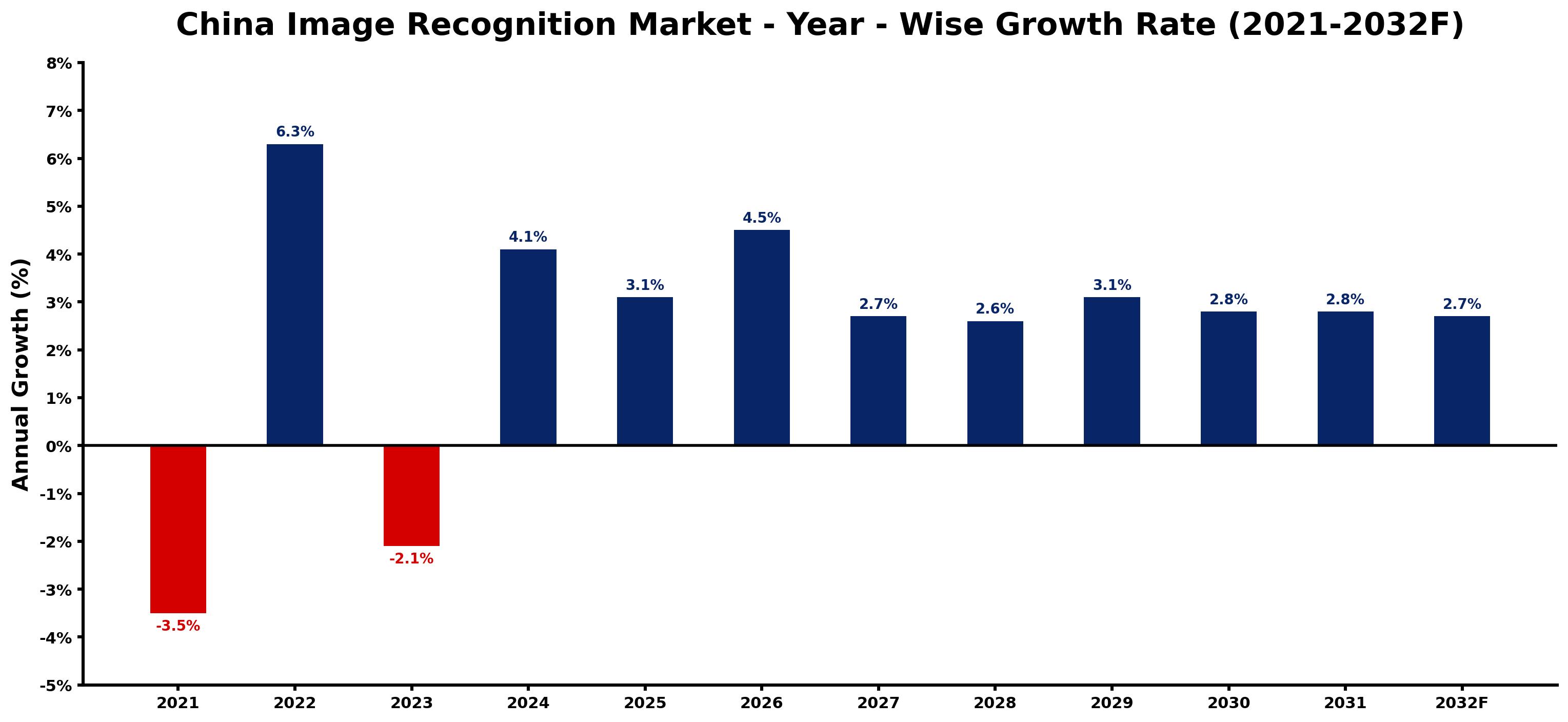
The table below presents the year‑wise growth rates along with the key drivers influencing the market
| Year | Growth Rate | Major Drivers |
| 2021 | -3.5% | U.S. export restrictions on advanced AI technologies |
| 2022 | 6.3% | Increased investments in smart city technology deployments. |
| 2023 | -2.1% | Government investment shifted to quantum computing initiatives |
| 2024 | 4.1% | Government support for AI development in public safety. |
| 2025 | 3.1% | Boost from nationwide biometric identification policy adoption. |
| 2026 | 4.5% | Surge in online retail requiring advanced visual search. |
| 2027 | 2.7% | Growth spurred by augmented reality marketing strategies. |
| 2028 | 2.6% | Rise in demand for personalized advertising solutions. |
| 2029 | 3.1% | Enhancements in autonomous vehicle navigation systems. |
| 2030 | 2.8% | Adoption of image recognition in healthcare diagnostics. |
| 2031 | 2.8% | Emergence of smart home devices using visual detection. |
| 2032 | 2.7% | Increased use in sports analytics and performance evaluation. |
Note: Market size estimations and growth projections presented in this report are based on 6Wresearch's proprietary forecasting methodology, utilizing the latest available industry data, government publications, and primary research inputs.
China Image Recognition Market Key Takeaways
Below are some of the specific key takeaways from the market, including:
- The growing adoption of image recognition technology is reshaping consumer experiences across various industries.
- Advancements in AI and deep learning are critical to enhancing image analysis capabilities.
- Cloud-based solutions are gaining traction, facilitating scalability for businesses of all sizes.
- Continuous R&D efforts are necessary to address accuracy challenges in complex environments.
- Government policies are fostering an environment conducive to technological innovation in the sector.
Evaluation of Restraints in China Image Recognition Market
Despite the promising outlook, the China Image Recognition Market faces several challenges that hinder its growth. Data privacy concerns loom large, especially given the sensitive nature of personal data utilized in image recognition technologies. Regulatory hurdles are intensifying as the government imposes strict guidelines aimed at protecting user information.
on top of that, the market is characterized by fierce competition, with established entities dominating the landscape. This necessitates continuous innovation to maintain a competitive edge. Companies must prioritize investment in advanced algorithms to enhance the reliability and accuracy of their solutions, particularly in diverse datasets.
China Image Recognition Market Trends
Emerging trends in the China Image Recognition Market highlight a shift towards automated solutions that streamline operations across sectors. Retailers are increasingly employing facial recognition technology to personalize customer experiences, while healthcare providers utilize image analysis for more accurate diagnostics.
Additionally, there is a notable pivot towards cloud-based platforms that enable businesses to adopt image recognition solutions without significant upfront investments. The focus on enhancing algorithmic efficiency remains a priority, with stakeholders committed to research and development to push technological boundaries.
China Image Recognition Market Opportunities
Investment opportunities abound in the China Image Recognition Market, particularly within sectors experiencing rapid digital transformation. E-commerce and security are at the forefront, driving demand for sophisticated image recognition applications.
Companies specializing in facial recognition and object detection technologies are well-positioned for growth as businesses seek to enhance operational efficiencies. on top of that, the integration of AI and machine learning across various industries presents additional avenues for innovation and investment.
Government Initiatives in the China Image Recognition Market
The Chinese government is actively shaping the Image Recognition Market through various supportive policies and initiatives. These measures aim to promote the growth of AI technologies and encourage innovation across sectors. A focus on data security and ethical practices is also crucial in the implementation of these technologies.
- A recently completed initiative includes the launch of the "New Generation Artificial Intelligence Development Plan," targeting AI leadership by 2030.
- Currently underway is the "Internet Plus" strategy, which integrates internet technologies with traditional industries to foster growth in the image recognition sector.
- Planned for the near future is a regulatory framework aimed at enhancing data security and privacy standards in AI applications.
- The government is also funding research programs that explore innovative applications of image recognition technology in public services.
- Upcoming initiatives focus on establishing public-private partnerships to enhance infrastructure for AI development.
Future Insights of the China Image Recognition Market
Looking ahead, the China Image Recognition Market is set to witness substantial growth driven by the increasing need for automation and enhanced customer experiences. The expansion of AI applications in sectors like e-commerce, healthcare, and security will continue to create new market opportunities.
Technological advancements, coupled with supportive government policies, will further accelerate the adoption of image recognition solutions. As businesses prioritize digital transformation, the demand for innovative image recognition technologies will undoubtedly rise, shaping the future of this dynamic market.
China Image Recognition Market Latest Developments
Recent activity in the China Image Recognition Market reflects a strong commitment to technological advancement and innovation. Over the past year, various initiatives have been launched to enhance the capabilities of image recognition technologies across different sectors.
- A major technology vendor rolled out a new cloud-based image recognition platform in early 2025, aimed at improving accessibility for small and medium-sized enterprises.
- In mid-2025, a leading regional operator initiated a partnership with a healthcare provider to develop AI-driven medical imaging solutions.
- Upcoming in late 2026 is a planned deployment of an advanced facial recognition system across major retail chains to enhance customer engagement.
- A successful pilot program for augmented reality applications using image recognition was completed in early 2025, demonstrating its viability in educational settings.
- Currently, an initiative is underway to enhance the accuracy of image recognition algorithms through collaborative research efforts with academic institutions.
China Image Recognition Market - Key Attractiveness of the Report
- 10 Years of Market Numbers
- Historical Data Starting from 2022 to 2025
- Base Year: 2025
- Forecast Data until 2032
- Key Performance Indicators Impacting the Market
- Major Upcoming Developments and Projects
Key Highlights of the Report:
- China Image Recognition Market Outlook
- Market Size of China Image Recognition Market, 2025
- Forecast of China Image Recognition Market, 2032
- Historical Data and Forecast of China Image Recognition Revenues & Volume for the Period 2022-2032F
- China Image Recognition Market Trend Evolution
- China Image Recognition Market Drivers and Challenges
- China Image Recognition Price Trends
- China Image Recognition Porter's Five Forces
- China Image Recognition Industry Life Cycle
- Historical Data and Forecast of China Image Recognition Market Revenues & Volume By Technology for the Period 2022-2032F
- Historical Data and Forecast of China Image Recognition Market Revenues & Volume By Digital Image Processing for the Period 2022-2032F
- Historical Data and Forecast of China Image Recognition Market Revenues & Volume By Facial Recognition for the Period 2022-2032F
- Historical Data and Forecast of China Image Recognition Market Revenues & Volume By Pattern Recognition for the Period 2022-2032F
- Historical Data and Forecast of China Image Recognition Market Revenues & Volume By Deployment Mode for the Period 2022-2032F
- Historical Data and Forecast of China Image Recognition Market Revenues & Volume By On-premises for the Period 2022-2032F
- Historical Data and Forecast of China Image Recognition Market Revenues & Volume By Cloud for the Period 2022-2032F
- Historical Data and Forecast of China Image Recognition Market Revenues & Volume By Component for the Period 2022-2032F
- Historical Data and Forecast of China Image Recognition Market Revenues & Volume By Hardware for the Period 2022-2032F
- Historical Data and Forecast of China Image Recognition Market Revenues & Volume By Software for the Period 2022-2032F
- Historical Data and Forecast of China Image Recognition Market Revenues & Volume By Services for the Period 2022-2032F
- Historical Data and Forecast of China Image Recognition Market Revenues & Volume By Application for the Period 2022-2032F
- Historical Data and Forecast of China Image Recognition Market Revenues & Volume By Scanning and Imaging for the Period 2022-2032F
- Historical Data and Forecast of China Image Recognition Market Revenues & Volume By Security and Surveillance for the Period 2022-2032F
- Historical Data and Forecast of China Image Recognition Market Revenues & Volume By Image Search for the Period 2022-2032F
- Historical Data and Forecast of China Image Recognition Market Revenues & Volume By Augmented Reality for the Period 2022-2032F
- Historical Data and Forecast of China Image Recognition Market Revenues & Volume By Marketing and Advertising for the Period 2022-2032F
- China Image Recognition Import Export Trade Statistics
- Market Opportunity Assessment By Technology
- Market Opportunity Assessment By Deployment Mode
- Market Opportunity Assessment By Component
- Market Opportunity Assessment By Application
- China Image Recognition Top Companies Market Share
- China Image Recognition Competitive Benchmarking By Technical and Operational Parameters
- China Image Recognition Company Profiles
- China Image Recognition Key Strategic Recommendations






































