China Incident Response Market Size & Growth Rate (2026-2032)
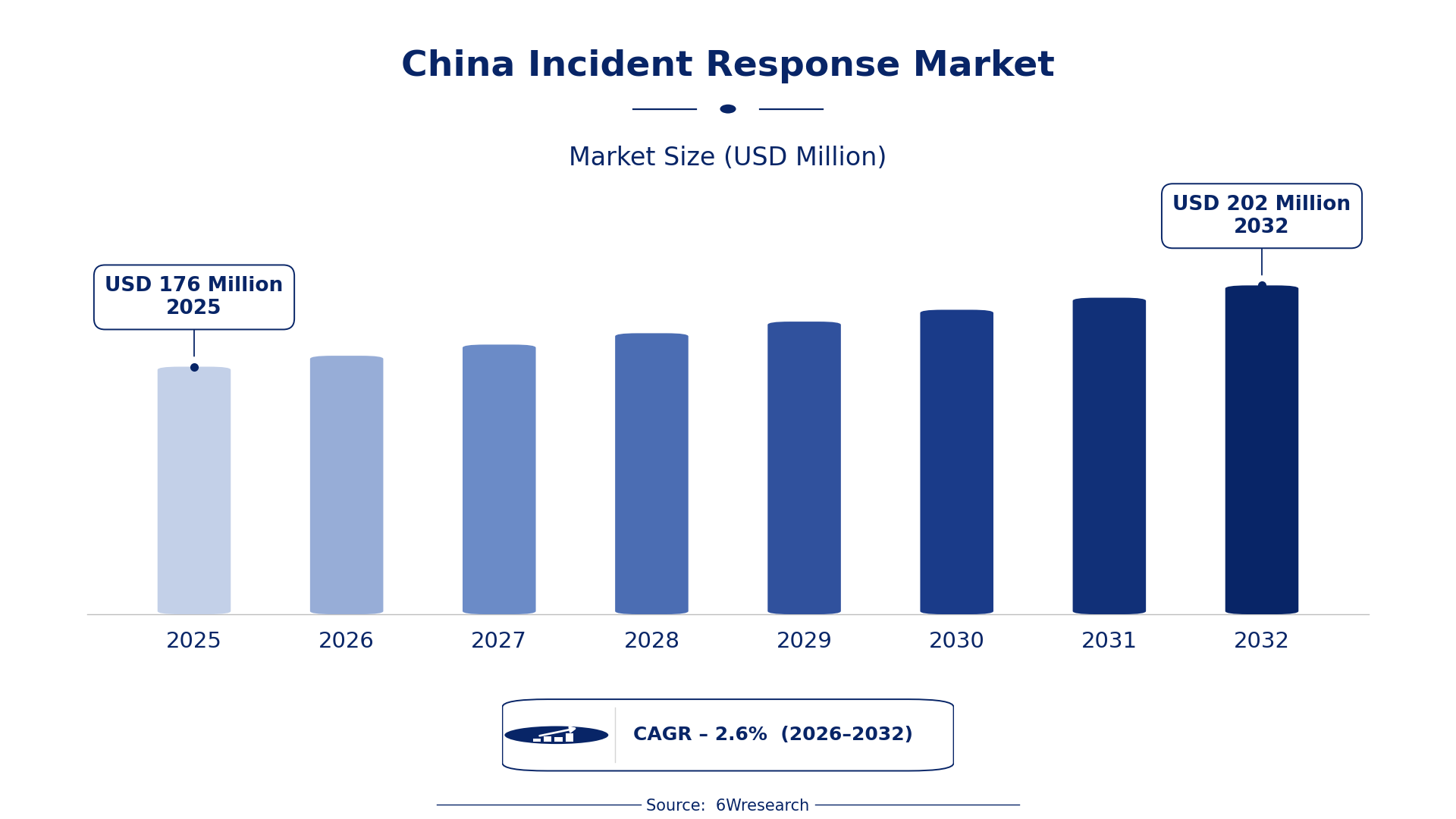
The China Incident Response Market was estimated at USD 176 Million in 2025 and is projected to reach USD 202 Million by 2032, growing at a CAGR of 2.6% from 2026 to 2032.
China Incident Response Market Synopsis
The urgency for robust incident response solutions is escalating in China, given the relentless rise in cyber threats that target critical infrastructure and sensitive data. Organizations across sectors are making strategic investments to ensure they can effectively detect, respond, and recover from security breaches, thus securing their operational integrity.
This market is becoming increasingly competitive, characterized by a surge of both domestic and international vendors. They are offering a diverse array of solutions, such as threat intelligence and forensic analysis, aimed at enhancing security protocols and compliance with emerging regulatory standards.
China Incident Response Market Year-wise Growth Rate and Key Drivers
This graph illustrates the annual growth rates of the China Incident Response Market from 2021 to 2032, highlighting a steady upward trajectory and projected expansion over the forecast period.
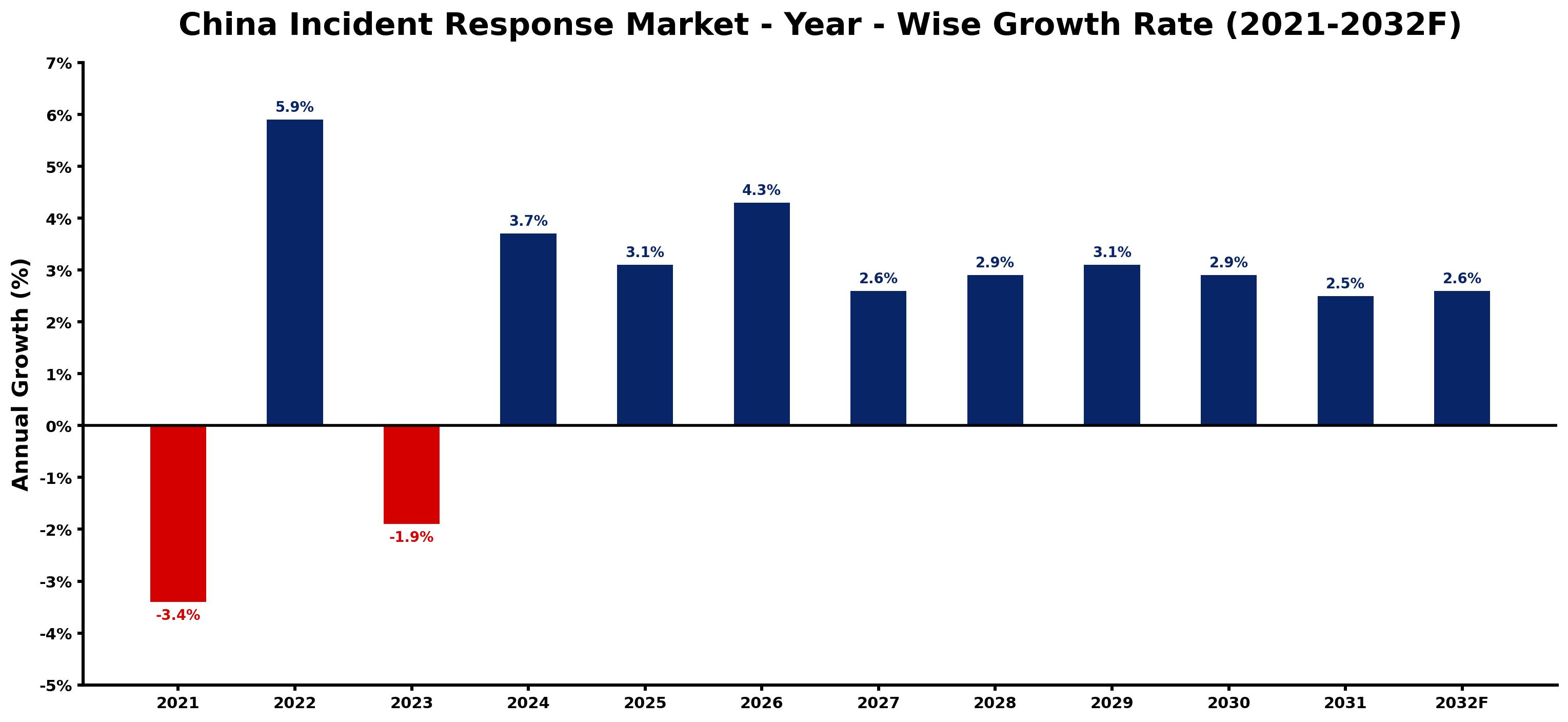
The table below presents the year‑wise growth rates along with the key drivers influencing the market
| Year | Growth Rate | Major Drivers |
| 2021 | -3.4% | Cybersecurity budget cuts by State Council directives |
| 2022 | 5.9% | Government cybersecurity policy mandates enhanced incident management strategies |
| 2023 | -1.9% | Increased reliance on local competitors like Neusoft |
| 2024 | 3.7% | Increasing cyber threats targeting China’s financial institutions boost demand |
| 2025 | 3.1% | Growing e-commerce sector drives need for swift incident responses |
| 2026 | 4.3% | Major data breaches prompt businesses to prioritize incident preparedness |
| 2027 | 2.6% | Cybersecurity talent shortages push firms to outsource incident response |
| 2028 | 2.9% | Investment in digital transformation accelerates incident response capabilities |
| 2029 | 3.1% | Rising adoption of cloud services requires effective incident management |
| 2030 | 2.9% | Regulations on data protection necessitate enhanced incident response frameworks |
| 2031 | 2.5% | Shift towards remote work increases demand for cybersecurity solutions |
| 2032 | 2.6% | Corporate governance standards emphasize incident response protocol improvements |
Note: Market size estimations and growth projections presented in this report are based on 6Wresearch's proprietary forecasting methodology, utilizing the latest available industry data, government publications, and primary research inputs.
China Incident Response Market Key Takeaways
Below are some of the specific key takeaways from the market, including:
- The demand for AI-driven incident response solutions is on the rise, providing organizations with advanced threat detection capabilities.
- Government regulations are increasingly dictating compliance standards that necessitate enhanced incident response frameworks.
- Managed incident response services are becoming essential for organizations grappling with skill shortages in cybersecurity.
- Cloud-based solutions are gaining traction as businesses look for scalable and efficient incident response options.
- The competitive landscape is evolving, with a focus on partnerships and collaborations to strengthen service offerings.
Evaluation of Restraints in China Incident Response Market
Despite its growth potential, the China Incident Response Market is hindered by several critical factors. The acute shortage of skilled cybersecurity professionals presents a significant barrier for organizations aiming to establish effective incident response capabilities. Additionally, the complex regulatory environment poses challenges for both local and international players trying to navigate compliance and operational mandates. Cultural and language differences further complicate collaborations between foreign firms and domestic entities, making it vital for international companies to tailor their strategies to meet local needs.
China Incident Response Market Trends
The market is witnessing a shift towards proactive threat detection strategies, with organizations adopting advanced technologies like AI and machine learning to improve their incident response times. There's also a growing demand for managed services that can alleviate the pressure on internal resources. In addition, the influx of government regulations focusing on cybersecurity compliance is prompting organizations to bolster their incident response mechanisms to align with new mandates.
China Incident Response Market Opportunities
Investors and vendors in the cybersecurity sector should focus on opportunities surrounding incident response consulting, threat intelligence, and digital forensics. With the increasing frequency of cyber threats, there is a clear market demand for solutions that offer rapid incident analysis and recovery. Embracing technologies such as AI and automation can enhance capabilities and present lucrative avenues for growth. Collaborating with local firms and government bodies will also be crucial in addressing the evolving cybersecurity challenges.
Government Initiatives in the China Incident Response Market
The Chinese government is actively shaping the incident response market through a series of comprehensive policies aimed at enhancing cybersecurity. These initiatives underscore the government's commitment to building a robust incident response ecosystem that can effectively tackle the increasing cyber threats faced by various sectors.
- A recently completed initiative includes the Cybersecurity Law, which imposes strict incident reporting requirements for network operators.
- A current program involves the National Cybersecurity Strategy, focusing on developing a comprehensive framework to bolster national cybersecurity defenses.
- Another ongoing effort is the establishment of the National Computer Network Emergency Response Technical Team Coordination Center (CNCERT), promoting nationwide incident response coordination.
- Planned for the near future is a national campaign to enhance public-private partnerships aimed at elevating cybersecurity awareness and incident preparedness.
- Upcoming regulations expected to be introduced in 2026 will mandate transparency in incident reporting and response practices.
Future Insights of the China Incident Response Market
Looking ahead to 2026-2032, the China Incident Response Market is set for continued growth. The escalating threat of cyber incidents will drive businesses to adopt more sophisticated security measures. Organizations will increasingly seek comprehensive incident response solutions that not only address compliance demands but also enhance their operational resilience against cyber threats. As technologies evolve, the incorporation of AI and machine learning will further refine incident response strategies, establishing a more agile and effective cybersecurity posture across industries.
China Incident Response Market Latest Developments
Recent activity in the China Incident Response Market highlights a dynamic shift toward enhanced security measures among businesses. Over the past year, numerous advancements have been made to address the increasing risks posed by cyber threats, showcasing the sector's rapid evolution.
- A leading regional operator launched a new incident response platform in early 2025, focusing on AI-based threat detection and analysis.
- In mid-2025, a major technology vendor began an ongoing project to integrate machine learning capabilities into existing incident response frameworks.
- A collaborative initiative between public and private sectors, expected to kick off in late 2025, aims to develop a nationwide cybersecurity training program.
- By the end of 2025, several firms are anticipated to unveil upgraded services designed to enhance forensic analysis and post-incident recovery processes.
China Incident Response Market - Key Attractiveness of the Report
- 10 Years of Market Numbers
- Historical Data Starting from 2022 to 2025
- Base Year: 2025
- Forecast Data until 2032
- Key Performance Indicators Impacting the Market
- Major Upcoming Developments and Projects
Key Highlights of the Report:
- China Incident Response Market Outlook
- Market Size of China Incident Response Market, 2025
- Forecast of China Incident Response Market, 2032
- Historical Data and Forecast of China Incident Response Revenues & Volume for the Period 2022-2032F
- China Incident Response Market Trend Evolution
- China Incident Response Market Drivers and Challenges
- China Incident Response Price Trends
- China Incident Response Porter's Five Forces
- China Incident Response Industry Life Cycle
- Historical Data and Forecast of China Incident Response Market Revenues & Volume By Component for the Period 2022-2032F
- Historical Data and Forecast of China Incident Response Market Revenues & Volume By Solution for the Period 2022-2032F
- Historical Data and Forecast of China Incident Response Market Revenues & Volume By Services for the Period 2022-2032F
- Historical Data and Forecast of China Incident Response Market Revenues & Volume By Service for the Period 2022-2032F
- Historical Data and Forecast of China Incident Response Market Revenues & Volume By Retainer for the Period 2022-2032F
- Historical Data and Forecast of China Incident Response Market Revenues & Volume By Assessment for the Period 2022-2032F
- Historical Data and Forecast of China Incident Response Market Revenues & Volume By Response for the Period 2022-2032F
- Historical Data and Forecast of China Incident Response Market Revenues & Volume By Planning for the Period 2022-2032F
- Historical Data and Forecast of China Incident Response Market Revenues & Volume By Development for the Period 2022-2032F
- Historical Data and Forecast of China Incident Response Market Revenues & Volume By Security Type for the Period 2022-2032F
- Historical Data and Forecast of China Incident Response Market Revenues & Volume By Web Security for the Period 2022-2032F
- Historical Data and Forecast of China Incident Response Market Revenues & Volume By Application Security for the Period 2022-2032F
- Historical Data and Forecast of China Incident Response Market Revenues & Volume By Endpoint Security for the Period 2022-2032F
- Historical Data and Forecast of China Incident Response Market Revenues & Volume By Network Security for the Period 2022-2032F
- Historical Data and Forecast of China Incident Response Market Revenues & Volume By Cloud Security for the Period 2022-2032F
- Historical Data and Forecast of China Incident Response Market Revenues & Volume By Deployment Mode for the Period 2022-2032F
- Historical Data and Forecast of China Incident Response Market Revenues & Volume By On-Premises for the Period 2022-2032F
- Historical Data and Forecast of China Incident Response Market Revenues & Volume By Cloud for the Period 2022-2032F
- Historical Data and Forecast of China Incident Response Market Revenues & Volume By Organization Size for the Period 2022-2032F
- Historical Data and Forecast of China Incident Response Market Revenues & Volume By SMEs for the Period 2022-2032F
- Historical Data and Forecast of China Incident Response Market Revenues & Volume By Large Enterprises for the Period 2022-2032F
- Historical Data and Forecast of China Incident Response Market Revenues & Volume By Vertical for the Period 2022-2032F
- Historical Data and Forecast of China Incident Response Market Revenues & Volume By BFSI for the Period 2022-2032F
- Historical Data and Forecast of China Incident Response Market Revenues & Volume By Government for the Period 2022-2032F
- Historical Data and Forecast of China Incident Response Market Revenues & Volume By Healthcare and Life Sciences for the Period 2022-2032F
- Historical Data and Forecast of China Incident Response Market Revenues & Volume By Retail and E-Commerce for the Period 2022-2032F
- Historical Data and Forecast of China Incident Response Market Revenues & Volume By Travel and Hospitality for the Period 2022-2032F
- Historical Data and Forecast of China Incident Response Market Revenues & Volume By Manufacturing for the Period 2022-2032F
- Historical Data and Forecast of China Incident Response Market Revenues & Volume By IT and Telecommunication for the Period 2022-2032F
- Historical Data and Forecast of China Incident Response Market Revenues & Volume By Others for the Period 2022-2032F
- China Incident Response Import Export Trade Statistics
- Market Opportunity Assessment By Component
- Market Opportunity Assessment By Service
- Market Opportunity Assessment By Security Type
- Market Opportunity Assessment By Deployment Mode
- Market Opportunity Assessment By Organization Size
- Market Opportunity Assessment By Vertical
- China Incident Response Top Companies Market Share
- China Incident Response Competitive Benchmarking By Technical and Operational Parameters
- China Incident Response Company Profiles
- China Incident Response Key Strategic Recommendations






































