China Industrial Paper Sacks Market Summary
The china industrial paper sacks market was estimated at USD 216 Million in 2025 and is projected to reach USD 249 Million by 2032, growing at a CAGR of 4.3% from 2026 to 2032.
China Industrial Paper Sacks Market Year-wise Growth Rate and Key Drivers
This graph highlights how the China Industrial Paper Sacks Market has steadily grown over the past five years, supported by major growth factors.
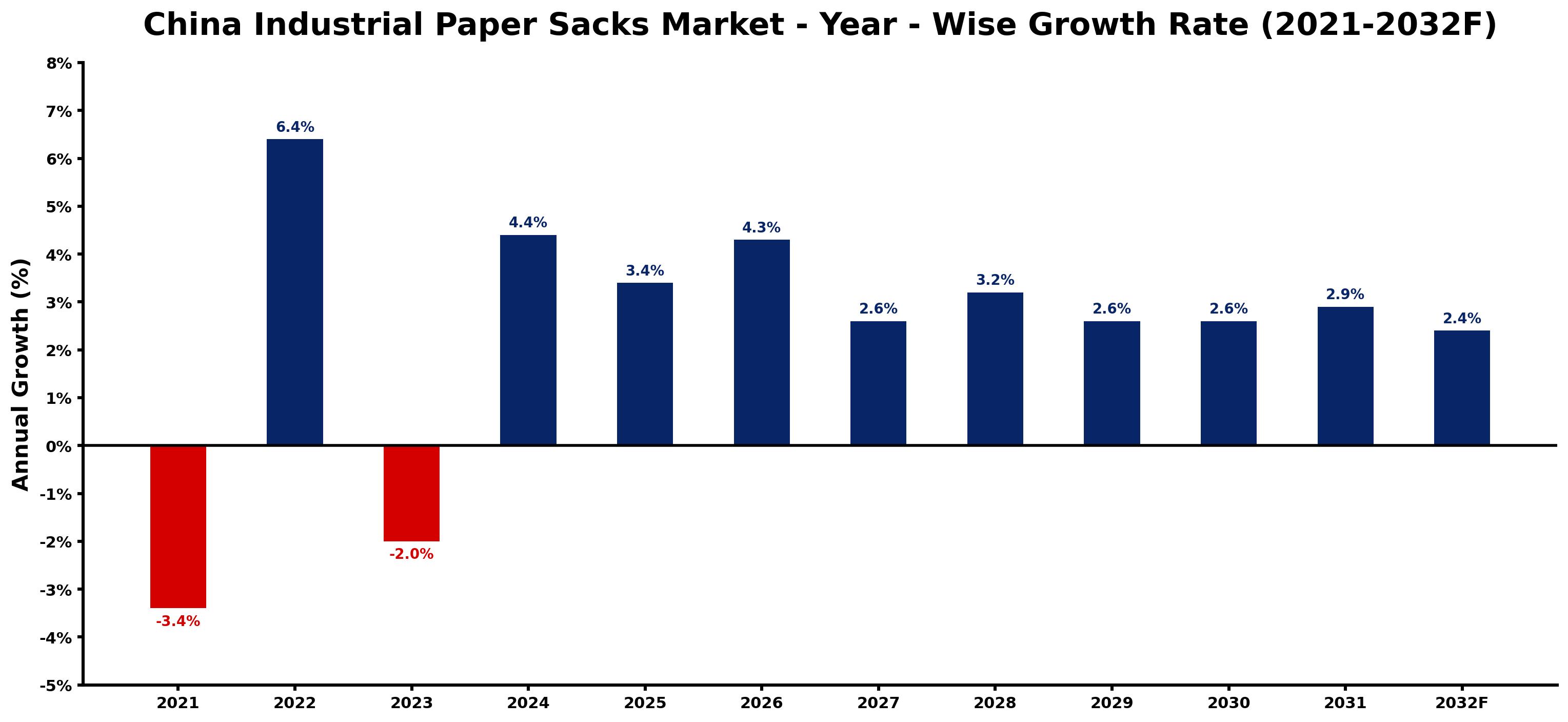
The table below presents the year wise growth rates along with the key drivers influencing the market
| Year | Growth Rate | Major Drivers |
| 2021 | -3.4% | Supply chain disruptions caused by the pandemic hindered production capabilities and delayed delivery timelines for manufacturers. |
| 2022 | 6.4% | Rural supply chain enhancements prompted an uptick in industrial paper sack usage. |
| 2023 | -2.0% | Increased competition from alternative packaging solutions diminished demand for traditional industrial paper sacks. |
| 2024 | 4.4% | E-commerce expansion necessitated robust packaging solutions for diverse product categories. |
| 2025 | 3.4% | Structural reforms in logistics fostered a demand for durable and lightweight packaging materials. |
| 2026 | 4.3% | Innovations in paper technologies enabled higher strength-to-weight ratios for industrial sacks. |
| 2027 | 2.6% | Growing awareness of environmental impact spurred consumer preference for recyclable materials. |
| 2028 | 3.2% | Local manufacturing capabilities improved, reducing dependency on imported packaging solutions. |
| 2029 | 2.6% | Collaboration between retailers and manufacturers enhanced supply chain efficiencies for paper sacks. |
| 2030 | 2.6% | Investment in digital technologies streamlined manufacturing processes within the paper sack sector. |
| 2031 | 2.9% | Increased urbanization influenced packaging needs, driving demand for paper sacks in cities. |
| 2032 | 2.4% | Industry consolidation and mergers optimized production capacities, enhancing market competitiveness. |
Note - Market size estimations and growth projections presented in this report are based on 6Wresearch's advanced forecasting approach, validated with industry datasets as of June 2026.
China Industrial Paper Sacks Market Synopsis
The China Industrial Paper Sacks Market is projected to reach 4.3% and witness significant growth during the forecast period (2026-2032). As demand for sustainable packaging solutions escalates, industrial paper sacks are increasingly preferred for their eco-friendly properties and versatility across various bulk material applications. The market is primarily fueled by advancements in manufacturing technologies and a growing emphasis on environmentally responsible packaging solutions.
China Industrial Paper Sacks Market Growth Drivers
The growth of the China Industrial Paper Sacks Market is driven by several key factors:
- Increasing consumption of industrial paper sacks in sectors such as food processing, chemicals, and construction significantly boosts demand, as these sectors require reliable packaging for bulk materials.
- Technological advancements have enhanced the durability and performance of paper sacks, providing better barrier properties which are crucial for preserving product integrity during transportation and storage.
- As environmental consciousness rises, many industries are shifting towards sustainable packaging solutions, leading to heightened demand for recyclable and biodegradable paper sacks.
- The expansion of industrial activities in China, particularly in manufacturing and infrastructure development, correlates with the increasing usage of paper sacks for packaging bulk materials efficiently.
- Customisation and design innovations in paper sacks enhance their appeal, offering businesses tailored solutions that cater to specific product requirements and branding needs.
China Industrial Paper Sacks Market Challenges and Restraints
Despite significant growth prospects, the China Industrial Paper Sacks Market faces several challenges:
- The sustainability of raw materials is a pressing challenge; ensuring that paper sacks are produced from responsibly sourced materials often requires careful supply chain management.
- Cost management remains critical, as manufacturers strive to maintain high-quality production while navigating fluctuating raw material prices and operational costs.
- Maintaining performance standards in paper sacks can be difficult, especially as they must meet the diverse packaging needs of various industries.
- The market's transition towards environmentally friendly products necessitates ongoing innovation, which can tax resources and financial stability of companies.
- Compliance with stringent environmental regulations and standards may require additional investments in recycling technologies and sustainable practices.
China Industrial Paper Sacks Market Government Investment and Initiatives
The Chinese government actively promotes the use of sustainable packaging solutions, creating a conducive environment for the growth of the industrial paper sacks market. Government policies encouraging the adoption of recyclable and biodegradable materials aim to mitigate environmental impacts associated with waste. Initiatives include investments in research and development for innovative packaging technologies that enhance sustainability. Additionally, various incentives are offered to manufacturers who adopt eco-friendly practices, thereby fostering a transition towards greener operations in the industrial sector.
China Industrial Paper Sacks Market Latest Developments (May 2025 - June 2026)
Over the period from May 2025 to June 2026, the China Industrial Paper Sacks Market has witnessed notable advancements in product innovation and technology integration. Companies are focusing on enhancing the performance attributes of paper sacks, such as moisture resistance and load-bearing capacity, thereby improving their usability across various sectors. The push for sustainability has led to increased collaboration between manufacturers and environmental organizations, aiming to develop new standards for sustainable packaging. Additionally, market players are exploring digital transformation strategies to optimize supply chain efficiencies, further driving growth and adaptation in the marketplace.
China Industrial Paper Sacks Market - Key Attractiveness of the Report
- 10 Years of Market Numbers
- Historical Data Starting from 2022 to 2025
- Base Year: 2025
- Forecast Data until 2032
- Key Performance Indicators Impacting the Market
- Major Upcoming Developments and Projects
Key Highlights of the Report:
- China Industrial Paper Sacks Market Outlook
- Market Size of China Industrial Paper Sacks Market, 2025
- Forecast of China Industrial Paper Sacks Market, 2032
- Historical Data and Forecast of China Industrial Paper Sacks Revenues & Volume for the Period 2022-2032F
- China Industrial Paper Sacks Market Trend Evolution
- China Industrial Paper Sacks Market Drivers and Challenges
- China Industrial Paper Sacks Price Trends
- China Industrial Paper Sacks Porter's Five Forces
- China Industrial Paper Sacks Industry Life Cycle
- Historical Data and Forecast of China Industrial Paper Sacks Market Revenues & Volume By Product Type for the Period 2022-2032F
- Historical Data and Forecast of China Industrial Paper Sacks Market Revenues & Volume By Sewn-Open Mouth for the Period 2022-2032F
- Historical Data and Forecast of China Industrial Paper Sacks Market Revenues & Volume By Pinched-Bottom Open Mouth for the Period 2022-2032F
- Historical Data and Forecast of China Industrial Paper Sacks Market Revenues & Volume By Valve Sacks for the Period 2022-2032F
- Historical Data and Forecast of China Industrial Paper Sacks Market Revenues & Volume By Open-Mouth Sacks for the Period 2022-2032F
- Historical Data and Forecast of China Industrial Paper Sacks Market Revenues & Volume By Grade for the Period 2022-2032F
- Historical Data and Forecast of China Industrial Paper Sacks Market Revenues & Volume By Unbleached for the Period 2022-2032F
- Historical Data and Forecast of China Industrial Paper Sacks Market Revenues & Volume By Bleached for the Period 2022-2032F
- Historical Data and Forecast of China Industrial Paper Sacks Market Revenues & Volume By Thickness for the Period 2022-2032F
- Historical Data and Forecast of China Industrial Paper Sacks Market Revenues & Volume By 1 ply for the Period 2022-2032F
- Historical Data and Forecast of China Industrial Paper Sacks Market Revenues & Volume By 2 ply for the Period 2022-2032F
- Historical Data and Forecast of China Industrial Paper Sacks Market Revenues & Volume By 3 ply for the Period 2022-2032F
- Historical Data and Forecast of China Industrial Paper Sacks Market Revenues & Volume By >3 ply for the Period 2022-2032F
- Historical Data and Forecast of China Industrial Paper Sacks Market Revenues & Volume By End-Use for the Period 2022-2032F
- Historical Data and Forecast of China Industrial Paper Sacks Market Revenues & Volume By Building & Construction for the Period 2022-2032F
- Historical Data and Forecast of China Industrial Paper Sacks Market Revenues & Volume By Chemicals for the Period 2022-2032F
- Historical Data and Forecast of China Industrial Paper Sacks Market Revenues & Volume By Agriculture & Allied Industries for the Period 2022-2032F
- Historical Data and Forecast of China Industrial Paper Sacks Market Revenues & Volume By Food for the Period 2022-2032F
- Historical Data and Forecast of China Industrial Paper Sacks Market Revenues & Volume By Others for the Period 2022-2032F
- China Industrial Paper Sacks Import Export Trade Statistics
- Market Opportunity Assessment By Product Type
- Market Opportunity Assessment By Grade
- Market Opportunity Assessment By Thickness
- Market Opportunity Assessment By End-Use
- China Industrial Paper Sacks Top Companies Market Share
- China Industrial Paper Sacks Competitive Benchmarking By Technical and Operational Parameters
- China Industrial Paper Sacks Company Profiles
- China Industrial Paper Sacks Key Strategic Recommendations






































