China Industrial Vacuum Cleaner Market Size, Share & Growth Rate
The China Industrial Vacuum Cleaner Market was estimated at USD 214 Million in 2025 and is projected to reach USD 247 Million by 2032, growing at a CAGR of 2.1% from 2026 to 2032. This growth trajectory reflects the escalating demand for robust cleaning solutions across diverse industrial settings. The market is buoyed by increasing manufacturing activities, infrastructure development, and a heightened emphasis on workplace hygiene and safety standards.
China Industrial Vacuum Cleaner Market Year-wise Growth Rate and Key Drivers
This graph highlights how the China Industrial Vacuum Cleaner Market has steadily grown over the years, supported by major growth factors.
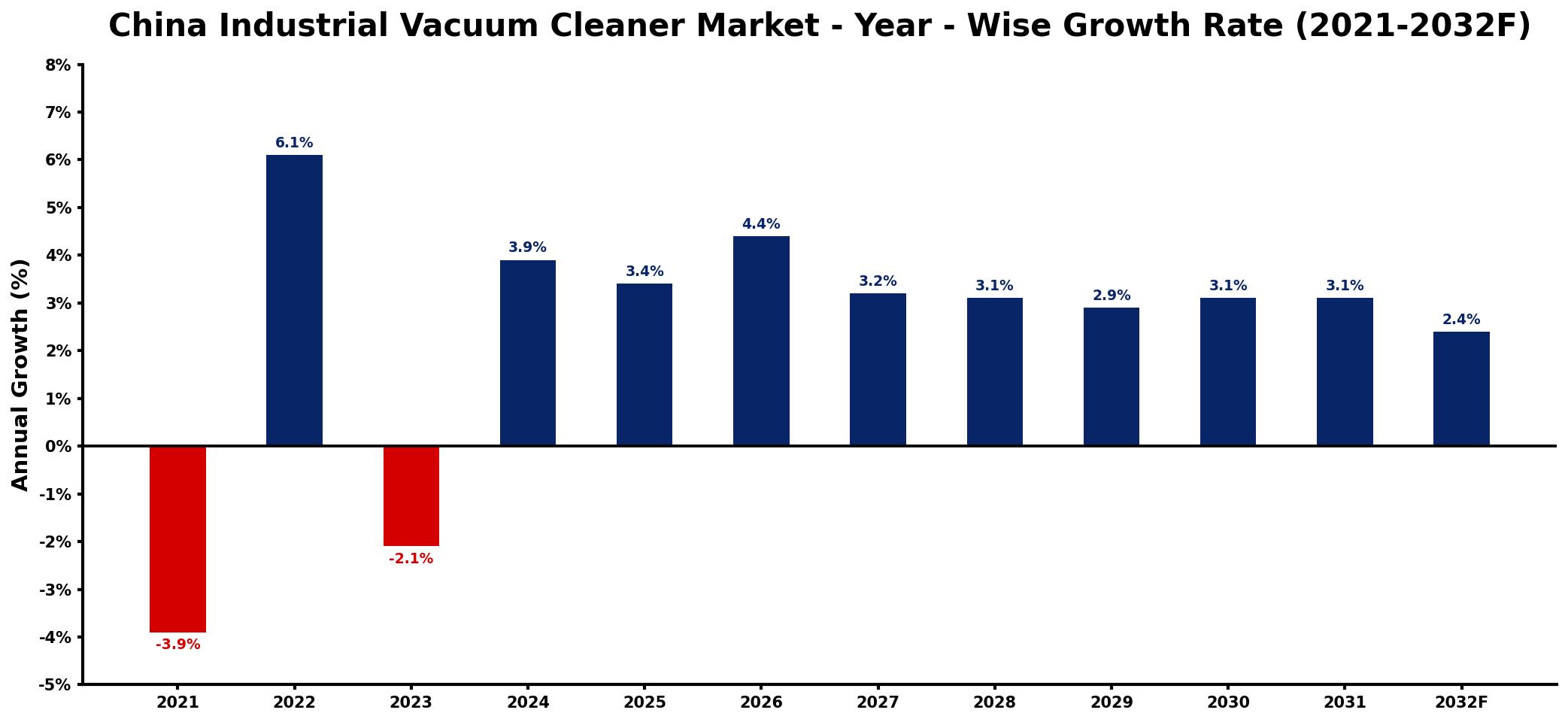
The table below presents the year‑wise growth rates along with the key drivers influencing the market
| Year | Growth Rate | Major Drivers |
| 2021 | -3.9% | decrease in manufacturing output |
| 2022 | 6.1% | expansion in construction sector |
| 2023 | -2.1% | reduction in export activities |
| 2024 | 3.9% | growth in logistics demand |
| 2025 | 3.4% | improved raw material availability |
| 2026 | 4.4% | increased focus on hygiene |
| 2027 | 3.2% | development in food processing |
| 2028 | 3.1% | surge in retail activities |
| 2029 | 2.9% | rising end-use demand growth |
| 2030 | 3.1% | strengthening underlying market demand |
| 2031 | 3.1% | stronger distribution network expansion |
| 2032 | 2.4% | rise in energy efficiency projects |
Note: Market size estimations and growth projections presented in this report are based on 6Wresearch's proprietary forecasting methodology, utilizing the latest available industry data, government publications, and primary research inputs.
China Industrial Vacuum Cleaner Market Synopsis
With rapid industrialization, there is an increasing demand for effective cleaning solutions in large-scale environments, particularly in manufacturing, logistics, and healthcare sectors. Industrial vacuum cleaners play a pivotal role in ensuring operational efficiency and maintaining the necessary hygiene standards required for safe working conditions.
The market is witnessing innovations in technology, including enhanced suction capabilities and advanced filtration systems, which cater specifically to the unique requirements of various industries. As companies seek sustainable practices, the shift towards energy-efficient vacuum systems is becoming more pronounced.
China Industrial Vacuum Cleaner Market Key Takeaways
- The market is experiencing growth driven by the need for efficient and powerful cleaning solutions.
- Technological advancements are enhancing the performance and functionality of industrial vacuum cleaners.
- Workplace safety and hygiene regulations are fostering an increased adoption of advanced cleaning technologies.
- The government encourages the use of energy-efficient cleaning systems aligned with environmental protection goals.
- Innovations in design and automation are crucial factors for competitive differentiation in the market.
Evaluation of Restraints in China Industrial Vacuum Cleaner Market
While the China Industrial Vacuum Cleaner Market is poised for growth, it faces specific challenges that could inhibit its potential. For instance, the integration of advanced technologies into vacuum cleaners raises concerns regarding production costs and complexity. Balancing the need for high efficiency with affordability is an ongoing hurdle, especially in a competitive landscape where diverse customer demands necessitate continuous innovation. Furthermore, establishing reliable performance standards for new technologies remains a critical concern for manufacturers.
China Industrial Vacuum Cleaner Market Trends
Current trends indicate a shift towards automation and smart technology within the industrial vacuum cleaner sector. As industries prioritize efficiency, the integration of IoT capabilities allows for real-time monitoring and predictive maintenance, enhancing overall operational effectiveness. Moreover, manufacturers are increasingly focusing on sustainable practices, leading to the development of vacuum cleaners that are both energy-efficient and environmentally friendly.
China Industrial Vacuum Cleaner Market Opportunities
The market presents significant opportunities for growth in sectors such as healthcare, where stringent cleanliness standards necessitate advanced cleaning solutions. Additionally, as logistics and warehousing expand, so does the demand for specialized vacuum cleaners capable of managing specific debris types. Investing in R&D to create vacuum cleaners that meet unique industry needs can pave the way for enhanced market presence and profitability.
Government Initiatives in the China Industrial Vacuum Cleaner Market
Government policies are increasingly supportive of initiatives aimed at improving workplace safety and environmental hygiene. Regulatory frameworks promote the adoption of high-efficiency vacuum cleaners that significantly reduce airborne pollutants and dust. Additionally, the government provides incentives for innovations that align with energy conservation and ecological sustainability, thereby encouraging manufacturers to explore advanced technological solutions.
Future Insights of the China Industrial Vacuum Cleaner Market
Looking ahead to 2026-2032, the China Industrial Vacuum Cleaner Market is expected to evolve with a greater emphasis on integrating intelligent technologies. As industries seek to optimize operational efficiency, vacuum cleaners will become more automated and connected. Enhanced features like remote monitoring, smart reporting, and automated cleaning schedules will likely define future product offerings, while compliance with stricter environmental regulations will shape innovations in energy efficiency.
China Industrial Vacuum Cleaner Market Latest Developments (2025 - 2026)
Recent developments in the China Industrial Vacuum Cleaner Market indicate a trend towards increased customization in product design to cater to specific industrial needs. Manufacturers are investing in advanced filtration technologies to tackle unique cleaning challenges across different sectors. Additionally, there is a marked focus on enhancing user experience through improved ergonomics and usability features, making the machines more accessible for operators.
China Industrial Vacuum Cleaner Market - Key Attractiveness of the Report
- 10 Years of Market Numbers
- Historical Data Starting from 2022 to 2025
- Base Year: 2025
- Forecast Data until 2032
- Key Performance Indicators Impacting the Market
- Major Upcoming Developments and Projects
Key Highlights of the Report:
- China Industrial Vacuum Cleaner Market Outlook
- Market Size of China Industrial Vacuum Cleaner Market, 2025
- Forecast of China Industrial Vacuum Cleaner Market, 2032
- Historical Data and Forecast of China Industrial Vacuum Cleaner Revenues & Volume for the Period 2022-2032F
- China Industrial Vacuum Cleaner Market Trend Evolution
- China Industrial Vacuum Cleaner Market Drivers and Challenges
- China Industrial Vacuum Cleaner Price Trends
- China Industrial Vacuum Cleaner Porter's Five Forces
- China Industrial Vacuum Cleaner Industry Life Cycle
- Historical Data and Forecast of China Industrial Vacuum Cleaner Market Revenues & Volume By Type for the Period 2022-2032F
- Historical Data and Forecast of China Industrial Vacuum Cleaner Market Revenues & Volume By Dry for the Period 2022-2032F
- Historical Data and Forecast of China Industrial Vacuum Cleaner Market Revenues & Volume By Wet & Dry for the Period 2022-2032F
- Historical Data and Forecast of China Industrial Vacuum Cleaner Market Revenues & Volume By Power Source for the Period 2022-2032F
- Historical Data and Forecast of China Industrial Vacuum Cleaner Market Revenues & Volume By Electric for the Period 2022-2032F
- Historical Data and Forecast of China Industrial Vacuum Cleaner Market Revenues & Volume By Pneumatic for the Period 2022-2032F
- Historical Data and Forecast of China Industrial Vacuum Cleaner Market Revenues & Volume By Industry for the Period 2022-2032F
- Historical Data and Forecast of China Industrial Vacuum Cleaner Market Revenues & Volume By Food & Beverages for the Period 2022-2032F
- Historical Data and Forecast of China Industrial Vacuum Cleaner Market Revenues & Volume By Metalworking for the Period 2022-2032F
- Historical Data and Forecast of China Industrial Vacuum Cleaner Market Revenues & Volume By Pharmaceuticals for the Period 2022-2032F
- Historical Data and Forecast of China Industrial Vacuum Cleaner Market Revenues & Volume By Manufacturing for the Period 2022-2032F
- Historical Data and Forecast of China Industrial Vacuum Cleaner Market Revenues & Volume By Building & Construction for the Period 2022-2032F
- Historical Data and Forecast of China Industrial Vacuum Cleaner Market Revenues & Volume By Others for the Period 2022-2032F
- China Industrial Vacuum Cleaner Import Export Trade Statistics
- Market Opportunity Assessment By Type
- Market Opportunity Assessment By Power Source
- Market Opportunity Assessment By Industry
- China Industrial Vacuum Cleaner Top Companies Market Share
- China Industrial Vacuum Cleaner Competitive Benchmarking By Technical and Operational Parameters
- China Industrial Vacuum Cleaner Company Profiles
- China Industrial Vacuum Cleaner Key Strategic Recommendations






































