China IoT Connectivity Market Size & Growth Rate (2026-2032)
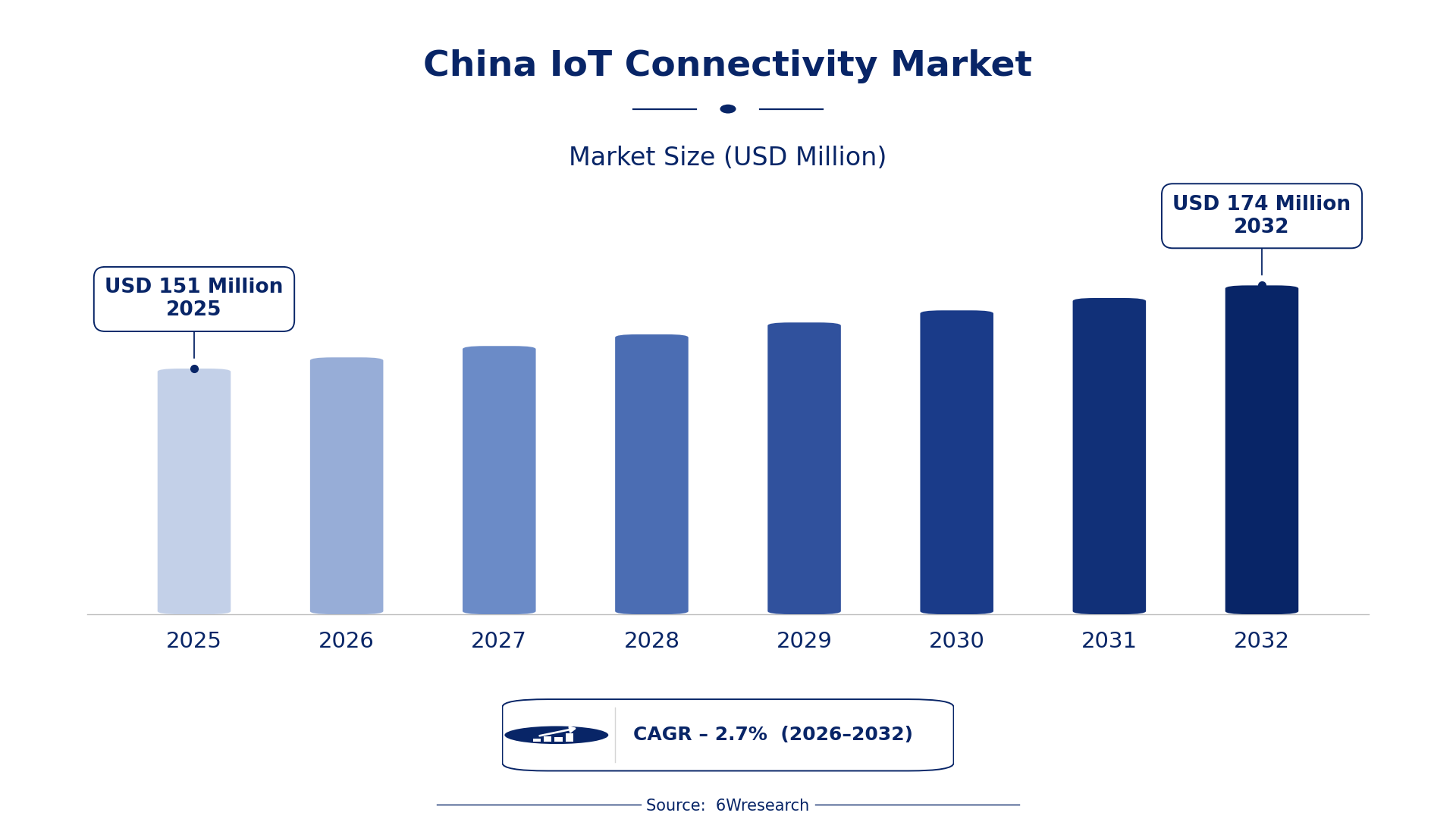
The China IoT Connectivity Market was estimated at USD 151 Million in 2025 and is projected to reach USD 174 Million by 2032, growing at a CAGR of 2.7% from 2026 to 2032.
China IoT Connectivity Market Synopsis
The demand for IoT connectivity solutions in China has surged, driven by the proliferation of connected devices across various sectors. As smart cities expand and industrial automation accelerates, the need for reliable, high-speed connectivity continues to grow, shaping a dynamic market landscape.
Connectivity technologies like 5G and LPWAN are at the forefront of this evolution, providing the necessary infrastructure for seamless communication between devices. With the government’s backing and increasing investment in digital infrastructure, the market is set for steady growth as it addresses diverse applications ranging from healthcare to smart manufacturing.
China IoT Connectivity Market Year-wise Growth Rate and Key Drivers
This graph illustrates the annual growth rates of the China IoT Connectivity Market from 2021 to 2032, highlighting a steady upward trajectory and projected expansion over the forecast period.
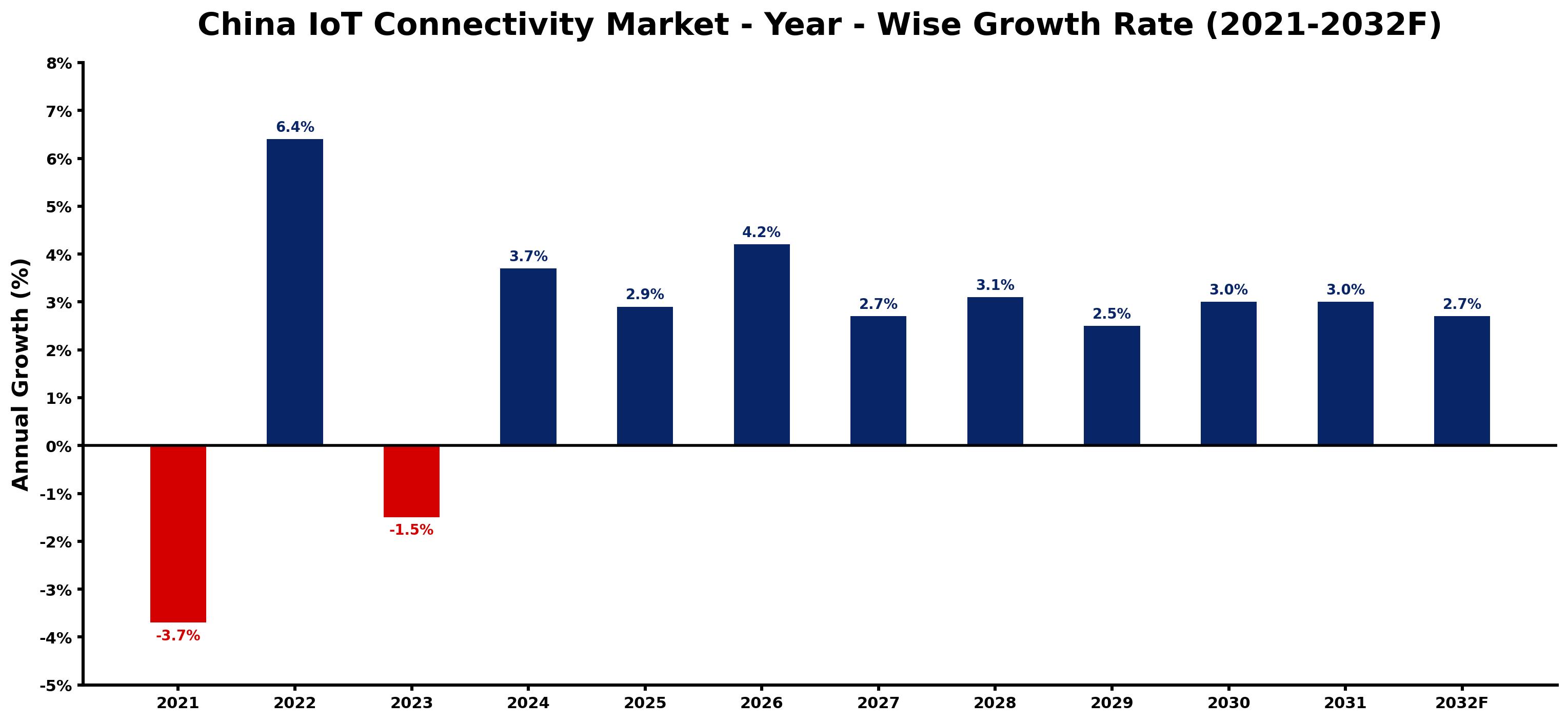
The table below presents the year‑wise growth rates along with the key drivers influencing the market
| Year | Growth Rate | Major Drivers |
| 2021 | -3.7% | Chip shortages impacted IoT device production nationwide. |
| 2022 | 6.4% | China's Five-Year Plan emphasizes smart manufacturing growth |
| 2023 | -1.5% | Government restrictions limited foreign IoT connectivity vendors. |
| 2024 | 3.7% | Increased connectivity standards from China's Ministry of Industry |
| 2025 | 2.9% | Rapid development of 5G networks enhancing IoT applications |
| 2026 | 4.2% | Government initiatives promoting IoT in healthcare sector |
| 2027 | 2.7% | Growing interest in sustainable agriculture IoT solutions |
| 2028 | 3.1% | Investment in industrial automation boosting IoT connectivity needs |
| 2029 | 2.5% | Focus on connected vehicle technology by local manufacturers |
| 2030 | 3.0% | Government support for smart grid IoT integration projects |
| 2031 | 3.0% | Surge in wearable tech driving IoT adoption rates |
| 2032 | 2.7% | Rising interest in AI technologies enhancing IoT capabilities |
Note: Market size estimations and growth projections presented in this report are based on 6Wresearch's proprietary forecasting methodology, utilizing the latest available industry data, government publications, and primary research inputs.
China IoT Connectivity Market Key Takeaways
Below are some of the specific key takeaways from the market, including:
- The market is witnessing a steady rise in demand for IoT connectivity solutions across various applications.
- Government policies are fostering the growth of advanced connectivity technologies, enhancing market viability.
- Smart cities and industrial automation are pivotal areas driving the adoption of IoT connectivity.
- Challenges related to network infrastructure and integration persist, requiring innovative solutions.
- Investment opportunities abound, particularly in enhancing network coverage and reducing latency.
Evaluation of Restraints in China IoT Connectivity Market
Despite the promising growth trajectory, the China IoT connectivity market faces substantial hurdles. A primary concern is the existing network infrastructure, which often struggles to support the vast number of connected devices. This gap can lead to reliability issues and hampered performance. Additionally, the costs associated with deploying and maintaining advanced connectivity solutions can be daunting, particularly for smaller players in the field. The regulatory environment adds another layer of complexity, as companies must navigate evolving standards and compliance requirements while striving to meet customer demands for innovation.
China IoT Connectivity Market Trends
Several trends are currently shaping the China IoT connectivity market. One significant development is the increasing integration of AI and machine learning into connectivity solutions, which enhances data processing capabilities and optimizes network performance. The shift towards edge computing is also noteworthy, allowing for faster data processing closer to the source, thereby reducing latency.
on top of that, there is a noticeable push towards sustainable and energy-efficient connectivity solutions, reflecting broader environmental concerns. As more organizations commit to sustainability goals, the demand for eco-friendly technologies is likely to rise, further influencing market dynamics.
China IoT Connectivity Market Opportunities
Opportunities for growth in the China IoT connectivity market are abundant, particularly as businesses seek to enhance operational efficiency through connected devices. Industries such as healthcare and agriculture are ripe for innovation, where improved connectivity can drive significant advancements in service delivery and productivity. Additionally, the expansion of smart city initiatives presents a unique avenue for investment, enabling the development of integrated systems that improve urban living.
The transition to 5G technology is another area poised for growth, as it facilitates faster data transmission and more reliable connections. Companies that focus on developing applications tailored to this new standard will likely see substantial returns in the coming years.
Government Initiatives in the China IoT Connectivity Market
The Chinese government is actively shaping the IoT connectivity market through targeted policies aimed at bolstering digital infrastructure. With a focus on enhancing connectivity, these initiatives are designed to support a range of applications, from smart cities to industrial automation. The strategic regulatory framework and investment incentives are crucial for driving the adoption of advanced technologies that underpin IoT connectivity.
- A national digital infrastructure upgrade programme now in its rollout phase aims to expand broadband access across urban and rural areas.
- A regulatory framework introduced in 2025 mandates improved standards for IoT device security and data privacy.
- A public-private initiative expected to expand telecom infrastructure access by 2028 is currently underway.
- Incentives for deploying 5G technology have been established to accelerate its adoption in various sectors, particularly in urban settings.
- A recently completed pilot programme tested LPWAN applications in smart agriculture, showcasing potential benefits and scalability.
Future Insights of the China IoT Connectivity Market
Looking ahead to 2026-2032, the China IoT connectivity market is expected to evolve substantially. The increasing integration of IoT applications across sectors will drive demand for more sophisticated connectivity solutions. As technology advances, particularly in 5G and beyond, the market will likely see enhancements in network capacity and reliability.
The continued focus on smart cities and industrial automation will further stimulate innovation, encouraging investments in scalable and efficient connectivity options. Stakeholders who can navigate the regulatory landscape and address infrastructure challenges will position themselves advantageously in this growing market.
China IoT Connectivity Market Latest Developments
Recent developments in the China IoT connectivity market indicate a surge of activity, with companies exploring new technologies and applications. The past year has seen significant investments aimed at enhancing connectivity capabilities across various sectors. As organizations adapt to the demands of an increasingly connected world, the pace of innovation is accelerating.
- A major technology vendor announced the launch of a new IoT connectivity platform in early 2025, designed to streamline device management and data analytics.
- An initiative that began in mid-2025 and remains underway focuses on enhancing 5G infrastructure in urban centers to support growing IoT applications.
- A partnership between leading telecom providers was formed in Q3 2025 to develop a national LPWAN network, enhancing coverage for rural IoT deployments.
- A rollout expected to begin in the second half of 2026 will focus on integrating AI-driven analytics into existing IoT platforms.
- A pilot program completed in late 2025 demonstrated the effectiveness of smart sensors in reducing energy consumption in industrial settings.
China IoT Connectivity Market - Key Attractiveness of the Report
- 10 Years of Market Numbers
- Historical Data Starting from 2022 to 2025
- Base Year: 2025
- Forecast Data until 2032
- Key Performance Indicators Impacting the Market
- Major Upcoming Developments and Projects
Key Highlights of the Report:
- China IoT Connectivity Market Outlook
- Market Size of China IoT Connectivity Market, 2025
- Forecast of China IoT Connectivity Market, 2032
- Historical Data and Forecast of China IoT Connectivity Revenues & Volume for the Period 2022-2032F
- China IoT Connectivity Market Trend Evolution
- China IoT Connectivity Market Drivers and Challenges
- China IoT Connectivity Price Trends
- China IoT Connectivity Porter's Five Forces
- China IoT Connectivity Industry Life Cycle
- Historical Data and Forecast of China IoT Connectivity Market Revenues & Volume By Component for the Period 2022-2032F
- Historical Data and Forecast of China IoT Connectivity Market Revenues & Volume By Platform for the Period 2022-2032F
- Historical Data and Forecast of China IoT Connectivity Market Revenues & Volume By Services for the Period 2022-2032F
- Historical Data and Forecast of China IoT Connectivity Market Revenues & Volume By Application Areas for the Period 2022-2032F
- Historical Data and Forecast of China IoT Connectivity Market Revenues & Volume By Building & Home Automation for the Period 2022-2032F
- Historical Data and Forecast of China IoT Connectivity Market Revenues & Volume By Smart Energy & Utility for the Period 2022-2032F
- Historical Data and Forecast of China IoT Connectivity Market Revenues & Volume By Smart Manufacturing for the Period 2022-2032F
- Historical Data and Forecast of China IoT Connectivity Market Revenues & Volume By Connected Health for the Period 2022-2032F
- Historical Data and Forecast of China IoT Connectivity Market Revenues & Volume By Smart Retail for the Period 2022-2032F
- Historical Data and Forecast of China IoT Connectivity Market Revenues & Volume By Smart Transportation for the Period 2022-2032F
- Historical Data and Forecast of China IoT Connectivity Market Revenues & Volume By Others (Education and Agriculture) for the Period 2022-2032F
- Historical Data and Forecast of China IoT Connectivity Market Revenues & Volume By Organization Size for the Period 2022-2032F
- Historical Data and Forecast of China IoT Connectivity Market Revenues & Volume By Large Enterprises for the Period 2022-2032F
- Historical Data and Forecast of China IoT Connectivity Market Revenues & Volume By SMEs for the Period 2022-2032F
- China IoT Connectivity Import Export Trade Statistics
- Market Opportunity Assessment By Component
- Market Opportunity Assessment By Application Areas
- Market Opportunity Assessment By Organization Size
- China IoT Connectivity Top Companies Market Share
- China IoT Connectivity Competitive Benchmarking By Technical and Operational Parameters
- China IoT Connectivity Company Profiles
- China IoT Connectivity Key Strategic Recommendations






































