China Iron Powder Market Size, Share & Growth Rate
The China Iron Powder Market was estimated at USD 184 Million in 2025 and is projected to reach USD 212 Million by 2032, growing at a CAGR of 2.0% from 2026 to 2032. This steady growth trajectory is propelled by increasing industrial applications, particularly in metallurgy and electronics, where iron powder is critical in the production of high-performance materials. As technological advancements improve production techniques, the efficiency and application range of iron powders continue to expand, thereby strengthening market dynamics.
China Iron Powder Market Year-wise Growth Rate and Key Drivers
This graph highlights how the China Iron Powder Market has steadily grown over the years, supported by major growth factors.
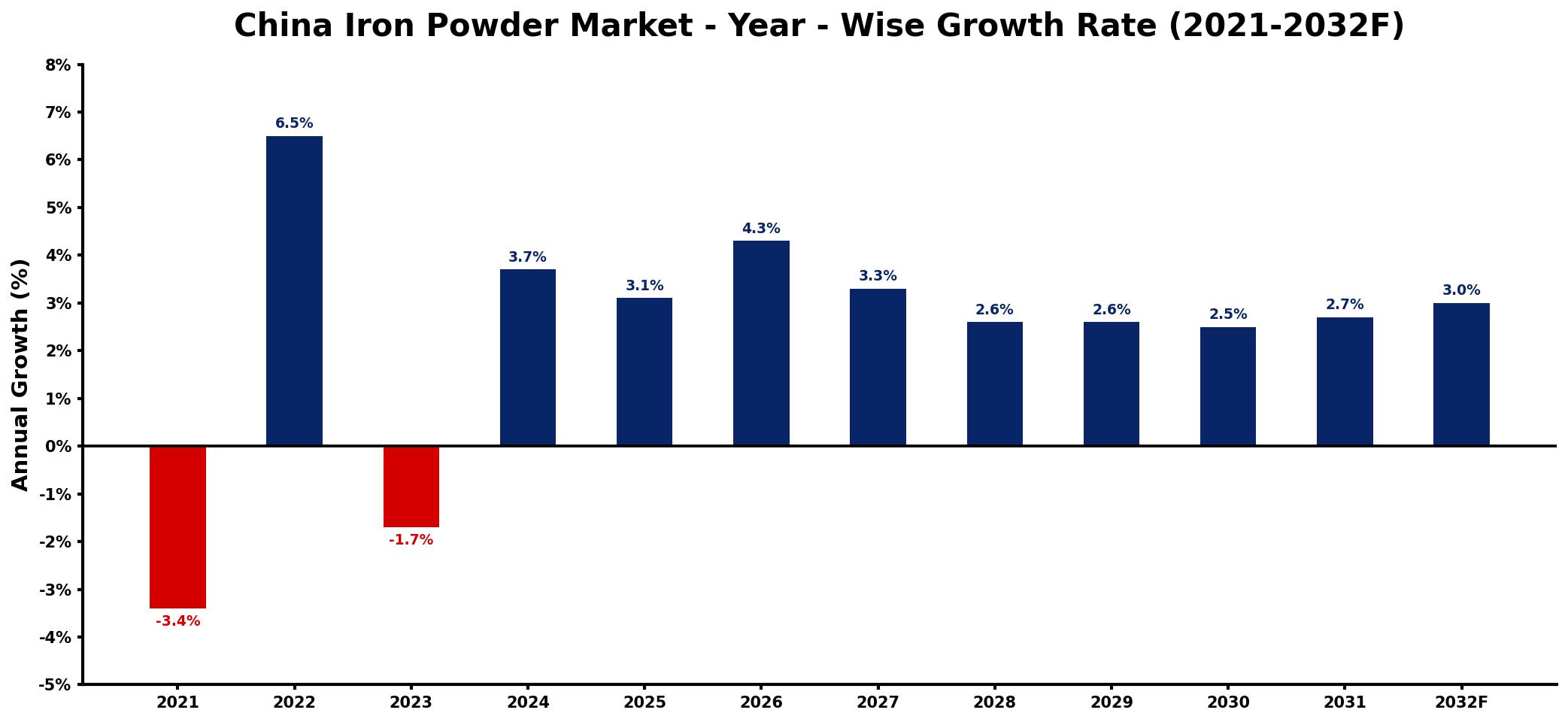
The table below presents the year‑wise growth rates along with the key drivers influencing the market
| Year | Growth Rate | Major Drivers |
| 2021 | -3.4% | Decrease in industrial investments |
| 2022 | 6.5% | Surge in automotive manufacturing demand |
| 2023 | -1.7% | Fall in construction sector activities |
| 2024 | 3.7% | Growth in renewable energy projects |
| 2025 | 3.1% | Increase in aerospace sector requirements |
| 2026 | 4.3% | Expansion of electronics production lines |
| 2027 | 3.3% | Rise in domestic manufacturing capacity |
| 2028 | 2.6% | Development in infrastructure projects |
| 2029 | 2.6% | Boost in consumer goods production |
| 2030 | 2.5% | growing downstream application demand |
| 2031 | 2.7% | increased overall sector activity |
| 2032 | 3.0% | improved processing technologies adoption |
Note: Market size estimations and growth projections presented in this report are based on 6Wresearch's proprietary forecasting methodology, utilizing the latest available industry data, government publications, and primary research inputs.
China Iron Powder Market Synopsis
Recently, the China Iron Powder Market has gained momentum, driven largely by innovations in manufacturing and rising demand across sectors like automotive and energy storage. However, as we look ahead, challenges such as production efficiency and competition from alternative materials could temper some of this growth potential.
Moreover, while there is robust interest in emerging applications for iron powder, maintaining quality standards and navigating environmental regulations will be key to sustaining growth. Overall, the market's trajectory remains positive, yet it will require strategic navigation through its complex landscape.
China Iron Powder Market Key Takeaways
- Expanding applications in metallurgy and electronics are driving significant demand for iron powders.
- Technological advancements in production methods are enhancing efficiency and product quality.
- Government policies are supportive of the manufacturing sector, boosting the iron powder market.
- Emerging sectors like additive manufacturing present new opportunities for growth.
- Environmental compliance and competition with alternative materials pose challenges to market expansion.
Evaluation of Restraints in China Iron Powder Market
Despite the growth trajectory, the China Iron Powder Market faces notable restraints. The need for efficient production processes is paramount; manufacturers must balance cost reduction with the maintenance of high-quality standards. Additionally, fluctuations in market demand and the rise of alternative materials intensify competition, complicating the landscape further. As firms innovate and comply with environmental regulations, these operational challenges could impede rapid growth unless adequately addressed.
China Iron Powder Market Trends
Current trends indicate a marked shift toward the incorporation of high-performance materials in various industries, elevating the demand for specialized iron powders. Additionally, the growth of additive manufacturing is reshaping how iron powders are utilized, allowing for greater customization in component production. Notably, sustainability efforts are also influencing the market, driving investments in environmentally friendly production techniques and materials.
China Iron Powder Market Opportunities
The iron powder market is poised for significant growth, particularly in sectors where high-performance materials are essential. Investment in R&D for advanced production technologies presents a substantial opportunity for manufacturers looking to innovate. Furthermore, as industries embrace additive manufacturing, the potential for customized solutions and specialized applications in energy storage will create new avenues for market expansion.
Government Initiatives in the China Iron Powder Market
Government policies play a crucial role in shaping the China Iron Powder Market by promoting industrial growth and innovation. Initiatives aimed at bolstering the manufacturing sector encourage the use of iron powder in various applications, including powder metallurgy and magnetic materials. Moreover, public funding for research and development is pivotal, as it enhances the quality and efficiency of iron powder production processes.
Future Insights of the China Iron Powder Market
Looking towards 2026-2032, the China Iron Powder Market is expected to navigate its challenges while capitalizing on growth opportunities. The increasing integration of iron powders in emerging technologies such as electric vehicles and renewable energy storage will drive market demand. Companies that invest in sustainable practices and innovation in production techniques are likely to emerge as leaders in this evolving landscape, fostering a more resilient and diversified market.
China Iron Powder Market Latest Developments (2025 - 2026)
Recent industry developments indicate a growing focus on the production of specialized iron powders tailored for high-performance applications. Innovative production techniques are being adopted, enhancing efficiency and reducing environmental impact. Additionally, partnerships between academic institutions and industry leaders are promoting advancements in R&D, thereby paving the way for future innovations in the market.
China Iron Powder Market - Key Attractiveness of the Report
- 10 Years of Market Numbers
- Historical Data Starting from 2022 to 2025
- Base Year: 2025
- Forecast Data until 2032
- Key Performance Indicators Impacting the Market
- Major Upcoming Developments and Projects
Key Highlights of the Report:
- China Iron Powder Market Outlook
- Market Size of China Iron Powder Market, 2025
- Forecast of China Iron Powder Market, 2032
- Historical Data and Forecast of China Iron Powder Revenues & Volume for the Period 2022-2032F
- China Iron Powder Market Trend Evolution
- China Iron Powder Market Drivers and Challenges
- China Iron Powder Price Trends
- China Iron Powder Porter's Five Forces
- China Iron Powder Industry Life Cycle
- Historical Data and Forecast of China Iron Powder Market Revenues & Volume By End Use for the Period 2022-2032F
- Historical Data and Forecast of China Iron Powder Market Revenues & Volume By Aerospace & defense for the Period 2022-2032F
- Historical Data and Forecast of China Iron Powder Market Revenues & Volume By Automotive for the Period 2022-2032F
- Historical Data and Forecast of China Iron Powder Market Revenues & Volume By Oil & Gas for the Period 2022-2032F
- Historical Data and Forecast of China Iron Powder Market Revenues & Volume By Medical for the Period 2022-2032F
- Historical Data and Forecast of China Iron Powder Market Revenues & Volume By Others for the Period 2022-2032F
- Historical Data and Forecast of China Iron Powder Market Revenues & Volume By Product Type for the Period 2022-2032F
- Historical Data and Forecast of China Iron Powder Market Revenues & Volume By Unalloyed for the Period 2022-2032F
- Historical Data and Forecast of China Iron Powder Market Revenues & Volume By Alloyed for the Period 2022-2032F
- Historical Data and Forecast of China Iron Powder Market Revenues & Volume By Insulated Iron powder for the Period 2022-2032F
- Historical Data and Forecast of China Iron Powder Market Revenues & Volume By Manufacturing Process for the Period 2022-2032F
- Historical Data and Forecast of China Iron Powder Market Revenues & Volume By Physical for the Period 2022-2032F
- Historical Data and Forecast of China Iron Powder Market Revenues & Volume By Atomization for the Period 2022-2032F
- Historical Data and Forecast of China Iron Powder Market Revenues & Volume By Electro deposition for the Period 2022-2032F
- Historical Data and Forecast of China Iron Powder Market Revenues & Volume By Chemical for the Period 2022-2032F
- Historical Data and Forecast of China Iron Powder Market Revenues & Volume By Reduction for the Period 2022-2032F
- Historical Data and Forecast of China Iron Powder Market Revenues & Volume By Decomposition for the Period 2022-2032F
- Historical Data and Forecast of China Iron Powder Market Revenues & Volume By Mechanical for the Period 2022-2032F
- Historical Data and Forecast of China Iron Powder Market Revenues & Volume By Pulverization for the Period 2022-2032F
- China Iron Powder Import Export Trade Statistics
- Market Opportunity Assessment By End Use
- Market Opportunity Assessment By Product Type
- Market Opportunity Assessment By Manufacturing Process
- China Iron Powder Top Companies Market Share
- China Iron Powder Competitive Benchmarking By Technical and Operational Parameters
- China Iron Powder Company Profiles
- China Iron Powder Key Strategic Recommendations






































