China IT Operations Analytics Market Size & Growth Rate (2026-2032)
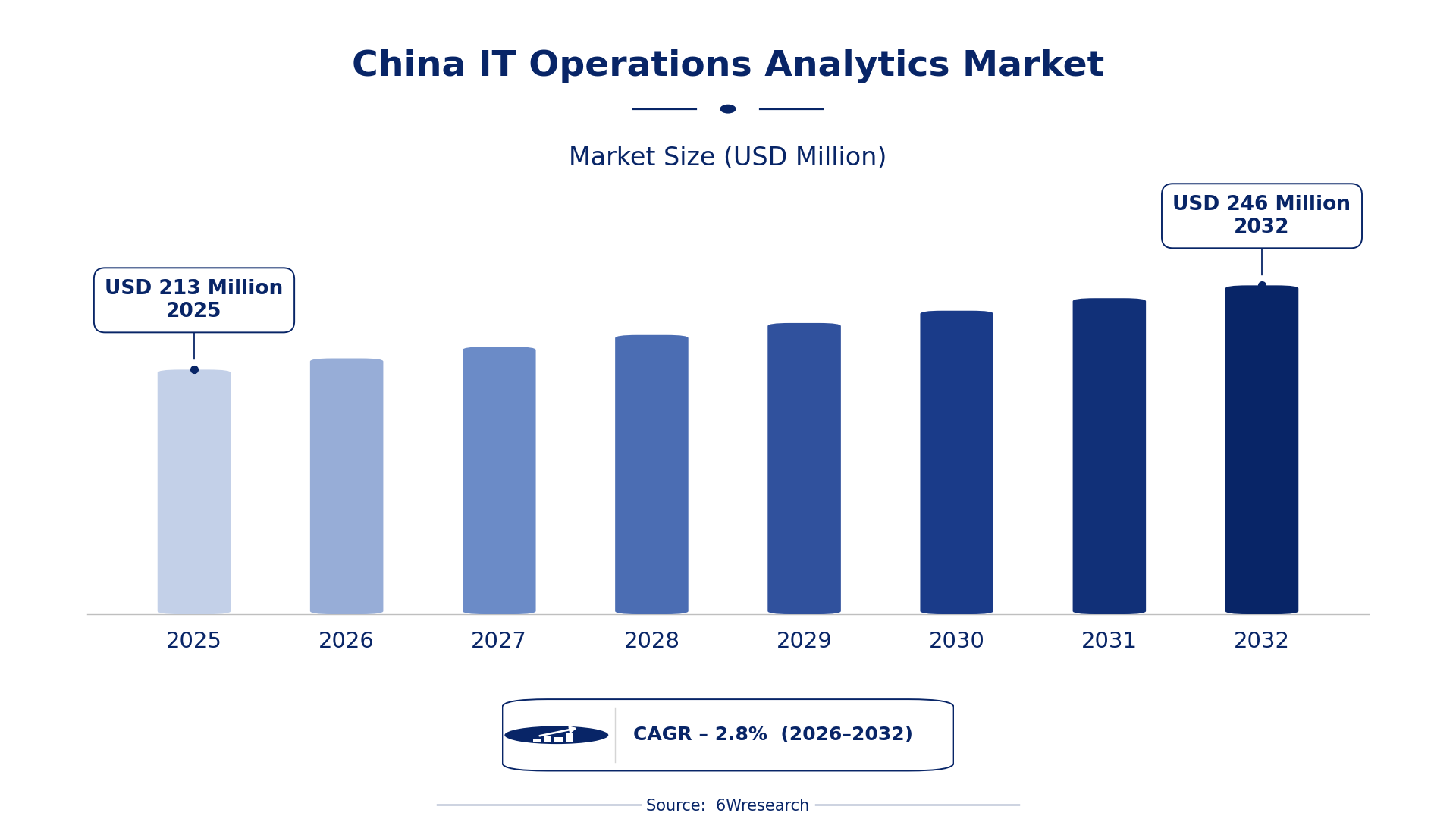
The China IT Operations Analytics Market was estimated at USD 213 Million in 2025 and is projected to reach USD 246 Million by 2032, growing at a CAGR of 2.8% from 2026 to 2032.
China IT Operations Analytics Market Synopsis
The growth trajectory of the China IT Operations Analytics Market reflects a broader trend of digital transformation across industries. Organizations are increasingly relying on sophisticated analytics solutions to optimize IT performance, enhance operational efficiency, and improve decision-making capabilities.
As businesses in China adopt advanced technologies like artificial intelligence and machine learning, the demand for real-time monitoring and predictive insights is surging. This shift is reshaping the competitive landscape, with various vendors offering tailored solutions to meet sector-specific needs.
China IT Operations Analytics Market Year-wise Growth Rate and Key Drivers
This graph illustrates the annual growth rates of the China IT Operations Analytics Market from 2021 to 2032, highlighting a steady upward trajectory and projected expansion over the forecast period.
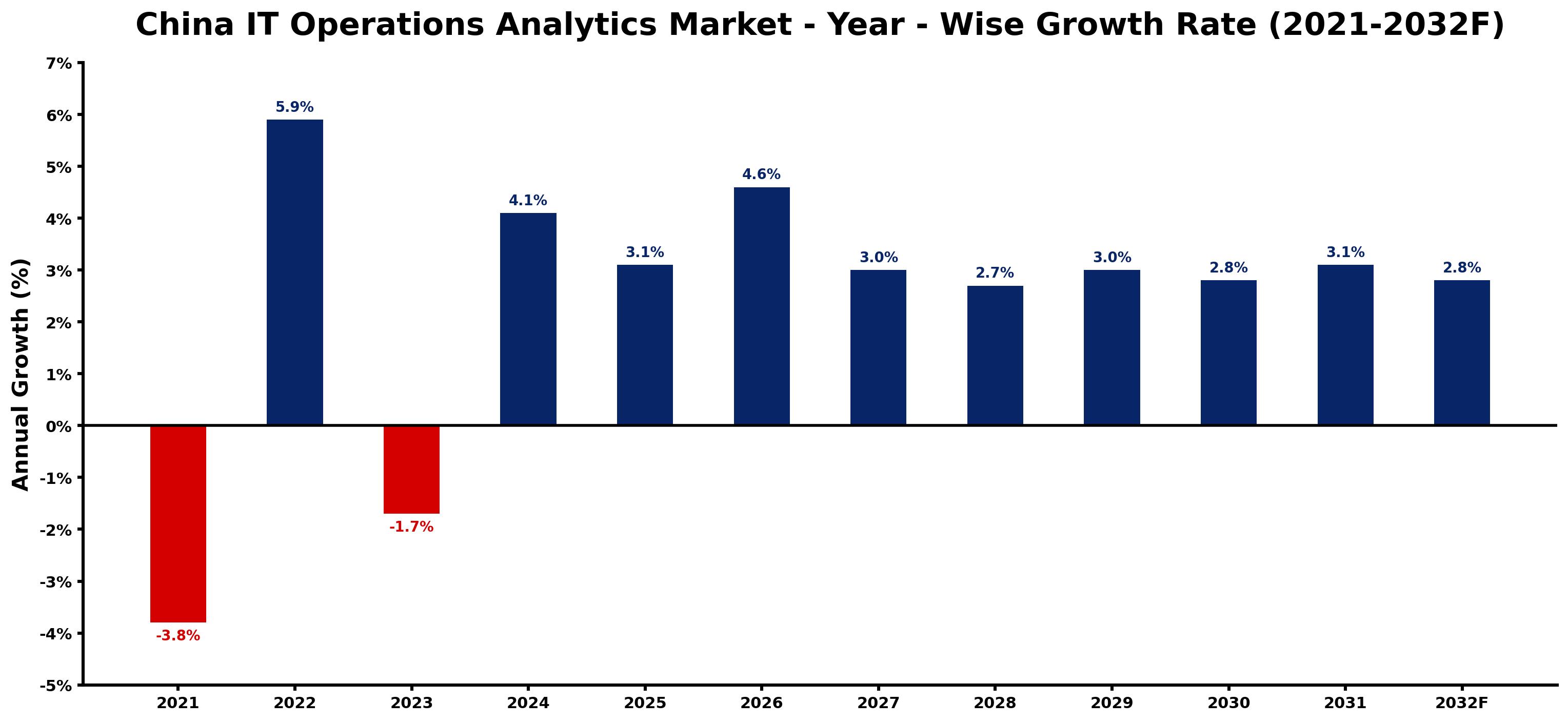
The table below presents the year‑wise growth rates along with the key drivers influencing the market
| Year | Growth Rate | Major Drivers |
| 2021 | -3.8% | Strict cybersecurity regulations hindered IT investment growth. |
| 2022 | 5.9% | Increased demand for data-driven decision making in enterprises. |
| 2023 | -1.7% | Slow adoption of AI technologies in enterprise environments. |
| 2024 | 4.1% | Implementation of AI-driven analytics in IT operations. |
| 2025 | 3.1% | Growing investments in digital transformation by Chinese SMEs. |
| 2026 | 4.6% | Regulatory support for cloud adoption in IT operations. |
| 2027 | 3.0% | Surge in remote work driving IT performance insights demand. |
| 2028 | 2.7% | Rising cybersecurity threats enhancing analytics usage in firms. |
| 2029 | 3.0% | Partnerships between tech giants to improve analytics tools. |
| 2030 | 2.8% | Government incentives for technology upgrades in IT sectors. |
| 2031 | 3.1% | Focus on energy efficiency driving IT operations optimization. |
| 2032 | 2.8% | Increased competition prompting robust analytics adoption. |
Note: Market size estimations and growth projections presented in this report are based on 6Wresearch's proprietary forecasting methodology, utilizing the latest available industry data, government publications, and primary research inputs.
China IT Operations Analytics Market Key Takeaways
Below are some of the specific key takeaways from the market, including:
- The integration of AI and machine learning is enhancing predictive analytics capabilities.
- Cloud-based solutions are becoming increasingly popular due to their scalability.
- Real-time analytics are essential for efficient IT infrastructure management.
- The market is characterized by intense competition among local and international players.
- Investment opportunities are growing, driven by digital transformation initiatives.
Evaluation of Restraints in China IT Operations Analytics Market
While the market is expanding, several restraints hinder its full potential. Data privacy concerns are paramount, influenced by stringent regulations that require local data storage. Many analytics tools are not available in the Chinese language, creating barriers for non-English speaking users.
on top of that, the need for skilled professionals to implement and manage these analytics solutions remains a challenge. The competitive environment also leads to pricing pressures, making it difficult for smaller companies to thrive. Integration with legacy systems presents additional hurdles, as organizations struggle to modernize without disrupting existing operations.
China IT Operations Analytics Market Trends
Several key trends are currently shaping the China IT Operations Analytics Market. The demand for real-time analytics solutions is rising, as organizations seek to monitor and manage their IT infrastructure more effectively. Cloud-based tools are gaining traction, primarily due to their cost-effectiveness and flexibility.
on top of that, the incorporation of AI and machine learning technologies is empowering companies to implement predictive analytics, allowing them to anticipate and address potential issues before they escalate. The shift towards hybrid IT environments necessitates analytics solutions that can bridge on-premises, cloud, and edge technologies, driving innovation in this space.
China IT Operations Analytics Market Opportunities
The China IT Operations Analytics Market is ripe with investment opportunities. As organizations embark on digital transformation journeys, the need for advanced analytics solutions is becoming more pronounced. Companies focusing on AI-driven platforms and cloud-based monitoring tools are positioned well to capture this demand.
Investing in businesses that harness big data and machine learning can yield significant returns, especially as China emphasizes technological advancement. The increasing complexity of IT infrastructures further underlines the necessity for comprehensive analytics tools that drive operational efficiency.
Government Initiatives in the China IT Operations Analytics Market
Government policy is playing a critical role in shaping the China IT Operations Analytics Market. Through various regulations and initiatives, authorities are striving to enhance data security, foster innovation, and support the growth of domestic technology firms. These policies are crucial in establishing a conducive environment for market expansion.
- A recently completed Cybersecurity Law mandates that companies store data locally and undergo security assessments.
- A national initiative aimed at enhancing technology infrastructure is currently underway, focusing on improving data centers and cloud services.
- The National Information Security Standardization Technical Committee is actively setting standards for IT operations and security practices.
- The "Made in China 2025" strategy promotes domestic technology companies, particularly in artificial intelligence and big data analytics.
- Plans for a public-private partnership to expand broadband access are expected to be launched by 2026, improving overall connectivity.
Future Insights of the China IT Operations Analytics Market
Looking ahead to 2026-2032, the China IT Operations Analytics Market is positioned for substantial growth. With increased reliance on cloud computing and big data analytics, organizations will seek more sophisticated solutions to enhance their operations.
The emphasis on data-driven decision-making will drive demand for analytics tools that offer real-time insights. As digital transformation initiatives proliferate across industries, businesses will prioritize investments in IT operations analytics to remain competitive and innovative.
China IT Operations Analytics Market Latest Developments
Recent industry activity in the China IT Operations Analytics Market reveals a dynamic environment marked by innovation and growth. Companies are actively rolling out new solutions to meet the increasing demand for analytics capabilities.
- A leading technology vendor launched a new AI-powered analytics platform in Q1 2025, designed to enhance IT performance monitoring.
- An ongoing collaboration between major technology firms aims to develop integrated analytics solutions for hybrid IT environments, with a project start date in mid-2025.
- A new cloud-based monitoring tool is expected to be rolled out in late 2025, aimed at improving scalability for small to medium enterprises.
- An initiative to upgrade existing IT infrastructure for real-time analytics began in early 2025 and is currently underway, targeting key sectors like finance and healthcare.
- Plans for a major technology conference focusing on IT operations analytics are set for late 2026, bringing together industry leaders to discuss future trends and innovations.
China IT Operations Analytics Market - Key Attractiveness of the Report
- 10 Years of Market Numbers
- Historical Data Starting from 2022 to 2025
- Base Year: 2025
- Forecast Data until 2032
- Key Performance Indicators Impacting the Market
- Major Upcoming Developments and Projects
Key Highlights of the Report:
- China IT Operations Analytics Market Outlook
- Market Size of China IT Operations Analytics Market, 2025
- Forecast of China IT Operations Analytics Market, 2032
- Historical Data and Forecast of China IT Operations Analytics Revenues & Volume for the Period 2022-2032F
- China IT Operations Analytics Market Trend Evolution
- China IT Operations Analytics Market Drivers and Challenges
- China IT Operations Analytics Price Trends
- China IT Operations Analytics Porter's Five Forces
- China IT Operations Analytics Industry Life Cycle
- Historical Data and Forecast of China IT Operations Analytics Market Revenues & Volume By Component for the Period 2022-2032F
- Historical Data and Forecast of China IT Operations Analytics Market Revenues & Volume By Solutions for the Period 2022-2032F
- Historical Data and Forecast of China IT Operations Analytics Market Revenues & Volume By Services for the Period 2022-2032F
- Historical Data and Forecast of China IT Operations Analytics Market Revenues & Volume By Service for the Period 2022-2032F
- Historical Data and Forecast of China IT Operations Analytics Market Revenues & Volume By Professional Services for the Period 2022-2032F
- Historical Data and Forecast of China IT Operations Analytics Market Revenues & Volume By Managed Services for the Period 2022-2032F
- Historical Data and Forecast of China IT Operations Analytics Market Revenues & Volume By Solution for the Period 2022-2032F
- Historical Data and Forecast of China IT Operations Analytics Market Revenues & Volume By Log Management for the Period 2022-2032F
- Historical Data and Forecast of China IT Operations Analytics Market Revenues & Volume By Application Performance Management (APM) for the Period 2022-2032F
- Historical Data and Forecast of China IT Operations Analytics Market Revenues & Volume By Network and Security Management for the Period 2022-2032F
- Historical Data and Forecast of China IT Operations Analytics Market Revenues & Volume By Root Cause Analysis for the Period 2022-2032F
- Historical Data and Forecast of China IT Operations Analytics Market Revenues & Volume By Anomaly Detection for the Period 2022-2032F
- Historical Data and Forecast of China IT Operations Analytics Market Revenues & Volume By Others for the Period 2022-2032F
- Historical Data and Forecast of China IT Operations Analytics Market Revenues & Volume By Deployment Mode for the Period 2022-2032F
- Historical Data and Forecast of China IT Operations Analytics Market Revenues & Volume By Cloud for the Period 2022-2032F
- Historical Data and Forecast of China IT Operations Analytics Market Revenues & Volume By On-premises for the Period 2022-2032F
- Historical Data and Forecast of China IT Operations Analytics Market Revenues & Volume By End User for the Period 2022-2032F
- Historical Data and Forecast of China IT Operations Analytics Market Revenues & Volume By BFSI for the Period 2022-2032F
- Historical Data and Forecast of China IT Operations Analytics Market Revenues & Volume By Retail and Consumer Goods for the Period 2022-2032F
- Historical Data and Forecast of China IT Operations Analytics Market Revenues & Volume By Telecom for the Period 2022-2032F
- Historical Data and Forecast of China IT Operations Analytics Market Revenues & Volume By Manufacturing for the Period 2022-2032F
- Historical Data and Forecast of China IT Operations Analytics Market Revenues & Volume By Energy and Utilities for the Period 2022-2032F
- Historical Data and Forecast of China IT Operations Analytics Market Revenues & Volume By Healthcare and Life Sciences for the Period 2022-2032F
- Historical Data and Forecast of China IT Operations Analytics Market Revenues & Volume By Government and Defense for the Period 2022-2032F
- Historical Data and Forecast of China IT Operations Analytics Market Revenues & Volume By Transportation and Logistics for the Period 2022-2032F
- Historical Data and Forecast of China IT Operations Analytics Market Revenues & Volume By Organization Size for the Period 2022-2032F
- Historical Data and Forecast of China IT Operations Analytics Market Revenues & Volume By SMEs for the Period 2022-2032F
- Historical Data and Forecast of China IT Operations Analytics Market Revenues & Volume By Large Enterprises for the Period 2022-2032F
- China IT Operations Analytics Import Export Trade Statistics
- Market Opportunity Assessment By Component
- Market Opportunity Assessment By Service
- Market Opportunity Assessment By Solution
- Market Opportunity Assessment By Deployment Mode
- Market Opportunity Assessment By End User
- Market Opportunity Assessment By Organization Size
- China IT Operations Analytics Top Companies Market Share
- China IT Operations Analytics Competitive Benchmarking By Technical and Operational Parameters
- China IT Operations Analytics Company Profiles
- China IT Operations Analytics Key Strategic Recommendations






































