China Kosher Food Market Size, Share & Growth Rate
The China Kosher Food Market was estimated at USD 86 Million in 2025 and is projected to reach USD 99 Million by 2032, growing at a CAGR of 2.0% from 2026 to 2032. This growth trajectory is fueled by a burgeoning interest in diverse food options among consumers, particularly within health-conscious segments. Increased availability of kosher-certified products in retail and online platforms has made it easier for consumers to access these specialized food items, further driving demand.
China Kosher Food Market Year-wise Growth Rate and Key Drivers
This graph highlights how the China Kosher Food Market has steadily grown over the years, supported by major growth factors.
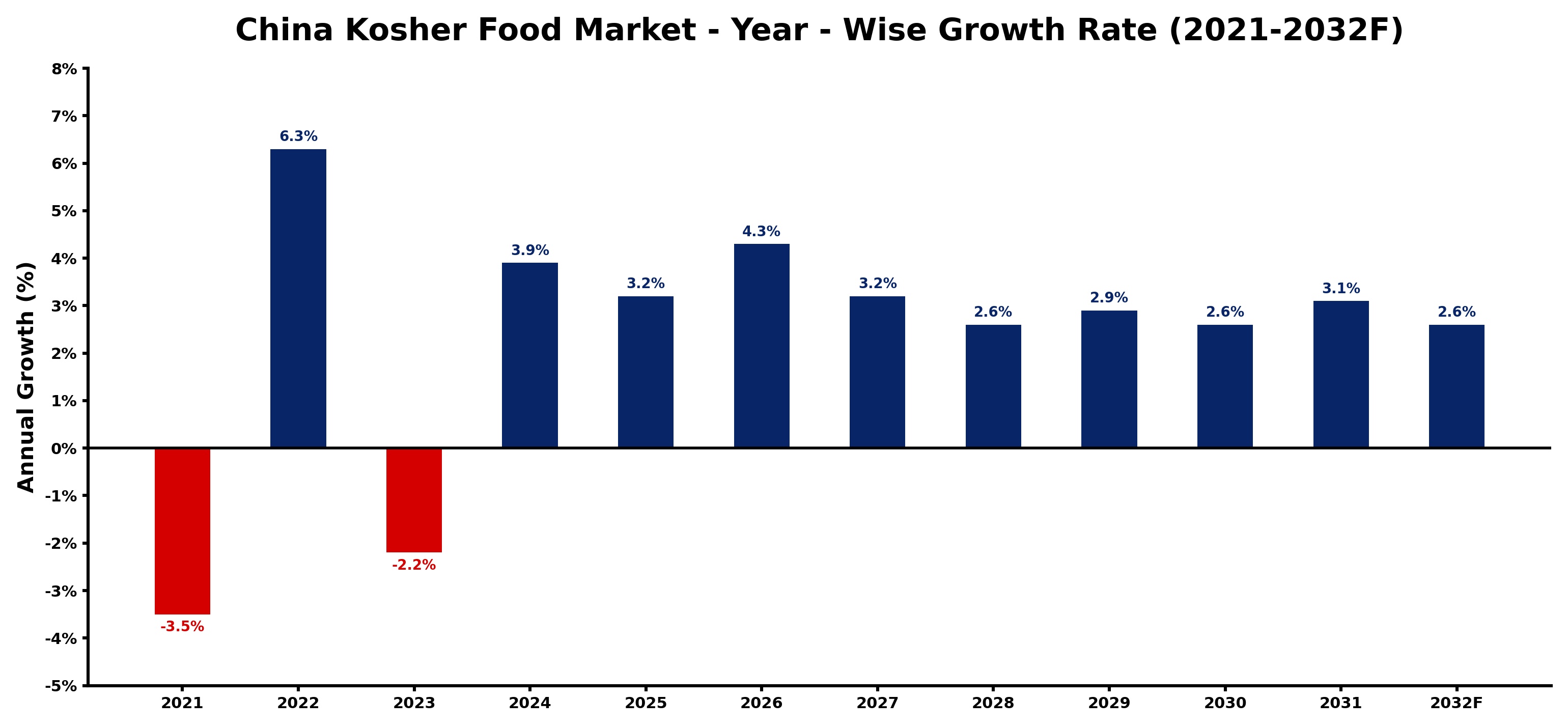
The table below presents the year‑wise growth rates along with the key drivers influencing the market
| Year | Growth Rate | Major Drivers |
| 2021 | -3.5% | Supply chain disruptions decreased kosher food production efficiency |
| 2022 | 6.3% | Local processing facilities modernize to meet stricter kosher certification standards |
| 2023 | -2.2% | Manufacturing investments declined due to persistent supply chain disruptions |
| 2024 | 3.9% | New production facilities boost kosher certification processing capacities |
| 2025 | 3.2% | Local demand for Kosher certification fuels food production investments |
| 2026 | 4.3% | Commercial demand recovery fueled expansion in kosher food processing facilities |
| 2027 | 3.2% | Kosher certification investments boost production capabilities in meat processing |
| 2028 | 2.6% | Retail demand surge boosts kosher food processing facility upgrades |
| 2029 | 2.9% | Kosher certification technology adoption boosts food processing efficiency |
| 2030 | 2.6% | New kosher certification processes boost supply chain efficiency across producers |
| 2031 | 3.1% | Kosher certification improvements boost production efficiencies in food manufacturing |
| 2032 | 2.6% | Export driven production expansions enhanced kosher food processing capacities |
Note - Market size estimations and growth projections presented in this report are based on 6Wresearch’s advanced forecasting approach, validated with industry datasets as of June 2026.
China Kosher Food Market Synopsis
In recent years, the awareness of kosher dietary laws in China has seen a noticeable increase, leading to greater consumer interest in kosher foods. This trend is indicative of a broader shift towards health and quality-focused eating habits, as kosher foods are often perceived as being of higher quality due to stringent preparation standards.
The growing Jewish population in China, along with a diverse array of health-conscious consumers, is contributing to the market's expansion. As more brands introduce kosher-certified products, consumers are becoming increasingly educated about the benefits and authenticity of kosher foods, propelling further growth.
China Kosher Food Market Key Takeaways
- The increasing demand for kosher-certified products is reshaping the market landscape in China.
- Health-conscious consumers are driving the trend towards specialized food offerings, including kosher options.
- Advancements in certification processes and product authenticity are essential for market growth.
- Challenges related to consumer education and production costs continue to affect market dynamics.
- The expanding distribution channels are making kosher products more accessible to a broader audience.
Evaluation of Restraints in China Kosher Food Market
Despite the promising growth trajectory, the China Kosher Food Market faces notable restraints. One significant hurdle is the complexity of securing kosher certification, which involves stringent compliance with dietary laws and can escalate production costs. Furthermore, there is a pressing need for consumer education regarding the benefits of kosher foods, which remains an obstacle in a market saturated with non-kosher alternatives. Adapting to evolving regulatory requirements and market demands adds another layer of complexity for manufacturers and distributors alike.
China Kosher Food Market Trends
Emerging trends in the China Kosher Food Market indicate a shift towards innovation and product diversification. New product lines, such as vegan and gluten-free kosher offerings, are gaining traction, catering to a more health-conscious demographic. Additionally, e-commerce platforms are becoming increasingly important, facilitating easier access to kosher products for urban consumers who value convenience. Social media and influencer marketing also play pivotal roles in raising awareness and educating potential consumers about kosher dietary practices.
China Kosher Food Market Opportunities
Investment opportunities in the China Kosher Food Market are ripe for those looking to capitalize on a growing niche. Developing partnerships with local distributors and retailers can enhance product visibility and accessibility. Additionally, creating targeted marketing campaigns to educate consumers about the health benefits and authenticity of kosher foods can further drive interest. The introduction of new, innovative kosher products that cater to modern dietary preferences, such as organic and sustainably sourced items, also presents significant growth potential.
Government Initiatives in the China Kosher Food Market
The Chinese government has implemented specific guidelines that affect the kosher food market, focusing on certification and labeling to ensure compliance with cultural and religious standards. These regulations aim to protect consumer interests while facilitating international trade of specialty food products. Additionally, the government emphasizes food safety and quality, aligning with its broader goals of enhancing consumer protection and boosting market confidence in imported goods.
Future Insights of the China Kosher Food Market
Looking ahead to 2026-2032, the China Kosher Food Market is poised for continuous growth. The increasing integration of kosher products into mainstream retail and the continuing expansion of health-conscious consumers will likely drive demand. As the government continues to refine regulations and support the kosher certification process, we anticipate an influx of new products and brands entering the market, reinforcing the trend towards diverse and specialized food offerings.
China Kosher Food Market Latest Developments (May 2025 - June 2026)
Recently, the China Kosher Food Market has seen increased collaboration between manufacturers and local distributors to enhance product accessibility. Innovative marketing strategies utilizing digital platforms have begun to raise awareness among younger consumers regarding kosher dietary laws. As new products enter the market, educational campaigns are also being launched to inform consumers about the advantages of choosing kosher options, thus facilitating a wider acceptance and appreciation of kosher foods in mainstream Chinese society.
China Kosher Food Market - Key Attractiveness of the Report
- 10 Years of Market Numbers
- Historical Data Starting from 2022 to 2025
- Base Year: 2025
- Forecast Data until 2032
- Key Performance Indicators Impacting the Market
- Major Upcoming Developments and Projects
Key Highlights of the Report:
- China Kosher Food Market Outlook
- Market Size of China Kosher Food Market, 2025
- Forecast of China Kosher Food Market, 2032
- Historical Data and Forecast of China Kosher Food Revenues & Volume for the Period 2022-2032F
- China Kosher Food Market Trend Evolution
- China Kosher Food Market Drivers and Challenges
- China Kosher Food Price Trends
- China Kosher Food Porter's Five Forces
- China Kosher Food Industry Life Cycle
- Historical Data and Forecast of China Kosher Food Market Revenues & Volume By Type for the Period 2022-2032F
- Historical Data and Forecast of China Kosher Food Market Revenues & Volume By Meat for the Period 2022-2032F
- Historical Data and Forecast of China Kosher Food Market Revenues & Volume By Dairy for the Period 2022-2032F
- Historical Data and Forecast of China Kosher Food Market Revenues & Volume By Pareve for the Period 2022-2032F
- Historical Data and Forecast of China Kosher Food Market Revenues & Volume By Application for the Period 2022-2032F
- Historical Data and Forecast of China Kosher Food Market Revenues & Volume By Seafood for the Period 2022-2032F
- Historical Data and Forecast of China Kosher Food Market Revenues & Volume By Processed Meat and Poultry for the Period 2022-2032F
- Historical Data and Forecast of China Kosher Food Market Revenues & Volume By Beverages for the Period 2022-2032F
- Historical Data and Forecast of China Kosher Food Market Revenues & Volume By Staples for the Period 2022-2032F
- Historical Data and Forecast of China Kosher Food Market Revenues & Volume By Snacks & Savoury for the Period 2022-2032F
- Historical Data and Forecast of China Kosher Food Market Revenues & Volume By Bakery and Confectionery for the Period 2022-2032F
- Historical Data and Forecast of China Kosher Food Market Revenues & Volume By Others for the Period 2022-2032F
- Historical Data and Forecast of China Kosher Food Market Revenues & Volume By Distribution Channel for the Period 2022-2032F
- Historical Data and Forecast of China Kosher Food Market Revenues & Volume By Supermarkets and Hypermarkets for the Period 2022-2032F
- Historical Data and Forecast of China Kosher Food Market Revenues & Volume By Grocery Stores for the Period 2022-2032F
- Historical Data and Forecast of China Kosher Food Market Revenues & Volume By Online Stores for the Period 2022-2032F
- China Kosher Food Import Export Trade Statistics
- Market Opportunity Assessment By Type
- Market Opportunity Assessment By Application
- Market Opportunity Assessment By Distribution Channel
- China Kosher Food Top Companies Market Share
- China Kosher Food Competitive Benchmarking By Technical and Operational Parameters
- China Kosher Food Company Profiles
- China Kosher Food Key Strategic Recommendations






































