China Log Management Market Size & Growth Rate (2026-2032)
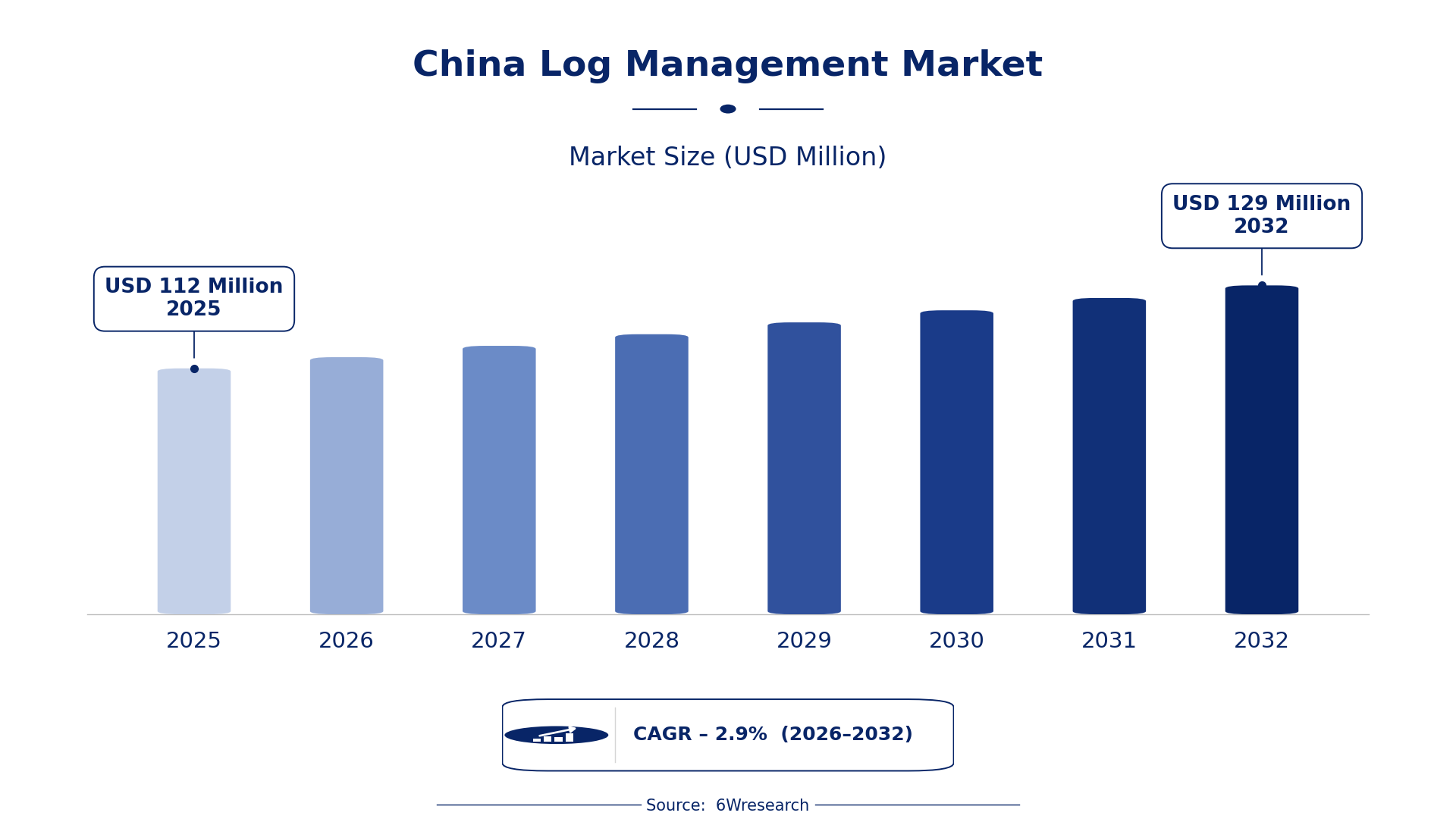
The China Log Management Market was estimated at USD 112 Million in 2025 and is projected to reach USD 129 Million by 2032, growing at a CAGR of 2.9% from 2026 to 2032.
China Log Management Market Synopsis
In China, the demand for log management solutions is surging as organizations grapple with the influx of data generated from IT systems. Companies are seeking effective ways to manage this data for improved security, compliance, and operational efficiency.
As regulatory requirements intensify, businesses are focusing on innovative log management technologies. These advancements not only help in enhancing security measures but also streamline the analysis and integration of log data across various platforms.
China Log Management Market Year-wise Growth Rate and Key Drivers
This graph illustrates the annual growth rates of the China Log Management Market from 2021 to 2032, highlighting a steady upward trajectory and projected expansion over the forecast period.
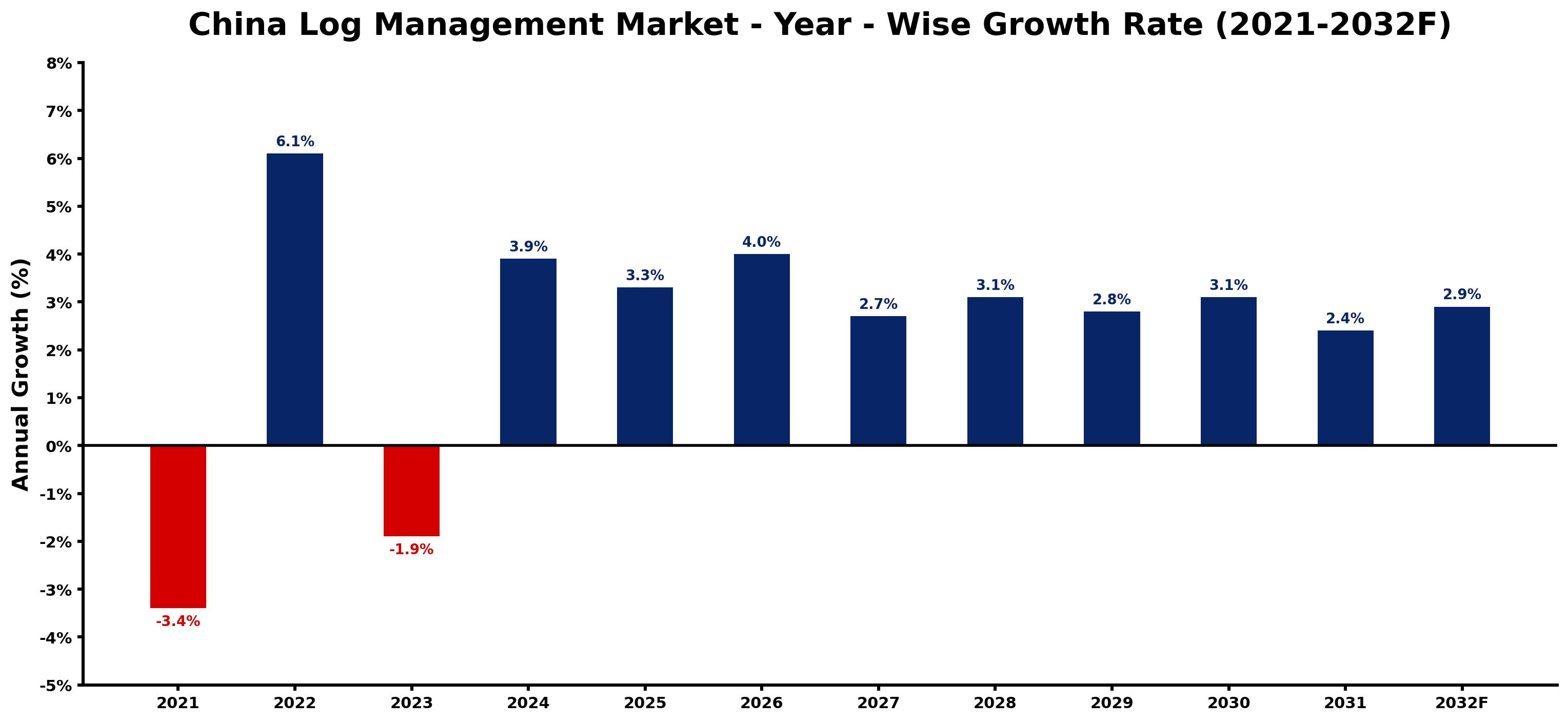
The table below presents the year‑wise growth rates along with the key drivers influencing the market
| Year | Growth Rate | Major Drivers |
| 2021 | -3.4% | Tightened cybersecurity regulations by the Cyberspace Administration of China. |
| 2022 | 6.1% | Strengthening cybersecurity laws drive log management adoption. |
| 2023 | -1.9% | Increased adoption of local open-source log management tools. |
| 2024 | 3.9% | Rise in IoT devices increases data logging requirements. |
| 2025 | 3.3% | E-commerce growth demands enhanced transaction monitoring systems. |
| 2026 | 4.0% | Digital economy initiatives accelerate cloud log management usage. |
| 2027 | 2.7% | Government push for smart cities enhances data tracking solutions. |
| 2028 | 3.1% | Increased online gaming spurs demand for activity logs. |
| 2029 | 2.8% | Financial sector modernizations require advanced log retention policies. |
| 2030 | 3.1% | Surge in remote work elevates log monitoring needs. |
| 2031 | 2.4% | AI developments boost demand for anomaly detection logs. |
| 2032 | 2.9% | Emergence of fintech firms drives log data analysis growth. |
Note: Market size estimations and growth projections presented in this report are based on 6Wresearch's proprietary forecasting methodology, utilizing the latest available industry data, government publications, and primary research inputs.
China Log Management Market Key Takeaways
Below are some of the specific key takeaways from the market, including:
- The increasing complexity of IT systems is driving the demand for sophisticated log management solutions.
- Cybersecurity threats are prompting organizations to enhance their log analysis capabilities for timely threat detection.
- Integration with Security Information and Event Management (SIEM) systems is becoming a standard requirement.
- Government regulations are shaping the strategies companies adopt for compliance and data protection.
- Innovations in automation and AI are elevating the efficiency of log data processing.
Evaluation of Restraints in China Log Management Market
While the market is experiencing growth, several constraints hinder its full potential. Data security remains a pressing concern, as businesses must navigate complex regulations to ensure compliance. The challenge of integrating new technologies with existing systems can lead to operational disruptions, and organizations often face budget constraints that limit their ability to invest in advanced log management solutions. on top of that, the competitive landscape is fierce, with numerous providers vying for market share, making it difficult for new entrants to establish themselves.
China Log Management Market Trends
One of the most prominent trends is the shift towards automation in log management. As organizations continue to generate vast volumes of log data, automated solutions are critical for effective analysis and response. on top of that, there’s an increasing emphasis on integrating log management with broader IT management systems, enabling organizations to have a centralized approach to data management.
Another emerging trend is the incorporation of artificial intelligence and machine learning algorithms into log management practices. These technologies enhance the capability to identify anomalies and potential threats in real-time, offering organizations a proactive stance against cyber threats.
China Log Management Market Opportunities
Growth opportunities abound in sectors that have traditionally lagged in log management adoption. Industries such as healthcare, finance, and e-commerce present lucrative prospects, especially as regulatory scrutiny intensifies. Additionally, the push towards cloud-based solutions is creating openings for vendors to offer scalable log management services that can cater to diverse organizational needs. This trend will likely accelerate as more businesses undergo digital transformation.
Government Initiatives in the China Log Management Market
Government policy plays a crucial role in shaping the China Log Management Market. Regulatory frameworks focused on data security and compliance are influencing how organizations approach log management. The government is actively promoting technological innovations in this sector, aligning its policies to support the growth of efficient data management practices.
- A national cybersecurity enhancement initiative launched in early 2025 aims to strengthen the data protection measures across various sectors.
- Current discussions are underway for a regulatory framework that will mandate all businesses to adopt standardized log management practices by 2027.
- Planned funding programs are set to be introduced in 2026 to encourage research and development of advanced log management technologies.
- An ongoing public-private partnership initiative focuses on improving access to log management solutions for small and medium enterprises, helping them enhance their compliance and security measures.
Future Insights of the China Log Management Market
Looking ahead, the China Log Management Market is expected to continue its upward trajectory. As regulatory pressures grow, organizations will increasingly prioritize comprehensive log management strategies. The integration of AI and machine learning will enhance operational efficiency, and demand for scalable, cloud-based solutions will accelerate. This environment presents both challenges and opportunities, prompting vendors to innovate and adapt to evolving market needs.
China Log Management Market Latest Developments
Recent industry activity indicates a robust focus on technological advancements within the China Log Management Market. Companies are rolling out innovative solutions that promise to improve the efficiency of log data management. These developments reflect a growing recognition of the importance of log management in maintaining security and compliance.
- A major technology vendor launched a new cloud-based log management solution in late 2025, aimed at enhancing scalability for businesses of all sizes.
- In mid-2025, a collaboration between tech firms resulted in an integrated platform that combines log management with enhanced security features, which is currently ongoing.
- A planned rollout of a multi-tiered log management service is expected to begin in early 2026, designed to cater specifically to the needs of healthcare providers.
- A recent upgrade to an existing log management system was completed in Q4 2025, integrating AI capabilities to improve threat detection accuracy.
China Log Management Market - Key Attractiveness of the Report
- 10 Years of Market Numbers
- Historical Data Starting from 2022 to 2025
- Base Year: 2025
- Forecast Data until 2032
- Key Performance Indicators Impacting the Market
- Major Upcoming Developments and Projects
Key Highlights of the Report:
- China Log Management Market Outlook
- Market Size of China Log Management Market, 2025
- Forecast of China Log Management Market, 2032
- Historical Data and Forecast of China Log Management Revenues & Volume for the Period 2022-2032F
- China Log Management Market Trend Evolution
- China Log Management Market Drivers and Challenges
- China Log Management Price Trends
- China Log Management Porter's Five Forces
- China Log Management Industry Life Cycle
- Historical Data and Forecast of China Log Management Market Revenues & Volume By Component for the Period 2022-2032F
- Historical Data and Forecast of China Log Management Market Revenues & Volume By Solution for the Period 2022-2032F
- Historical Data and Forecast of China Log Management Market Revenues & Volume By Services for the Period 2022-2032F
- Historical Data and Forecast of China Log Management Market Revenues & Volume By Organization Size for the Period 2022-2032F
- Historical Data and Forecast of China Log Management Market Revenues & Volume By Large Enterprises for the Period 2022-2032F
- Historical Data and Forecast of China Log Management Market Revenues & Volume By SMEs for the Period 2022-2032F
- Historical Data and Forecast of China Log Management Market Revenues & Volume By Deployment Mode for the Period 2022-2032F
- Historical Data and Forecast of China Log Management Market Revenues & Volume By Cloud for the Period 2022-2032F
- Historical Data and Forecast of China Log Management Market Revenues & Volume By On-premises for the Period 2022-2032F
- Historical Data and Forecast of China Log Management Market Revenues & Volume By Vertical for the Period 2022-2032F
- Historical Data and Forecast of China Log Management Market Revenues & Volume By IT and ITeS for the Period 2022-2032F
- Historical Data and Forecast of China Log Management Market Revenues & Volume By BFSI for the Period 2022-2032F
- Historical Data and Forecast of China Log Management Market Revenues & Volume By Healthcare for the Period 2022-2032F
- Historical Data and Forecast of China Log Management Market Revenues & Volume By Telecom, and Education for the Period 2022-2032F
- China Log Management Import Export Trade Statistics
- Market Opportunity Assessment By Component
- Market Opportunity Assessment By Organization Size
- Market Opportunity Assessment By Deployment Mode
- Market Opportunity Assessment By Vertical
- China Log Management Top Companies Market Share
- China Log Management Competitive Benchmarking By Technical and Operational Parameters
- China Log Management Company Profiles
- China Log Management Key Strategic Recommendations






































