China Logistics Automation Market Size & Growth Rate (2026-2032)
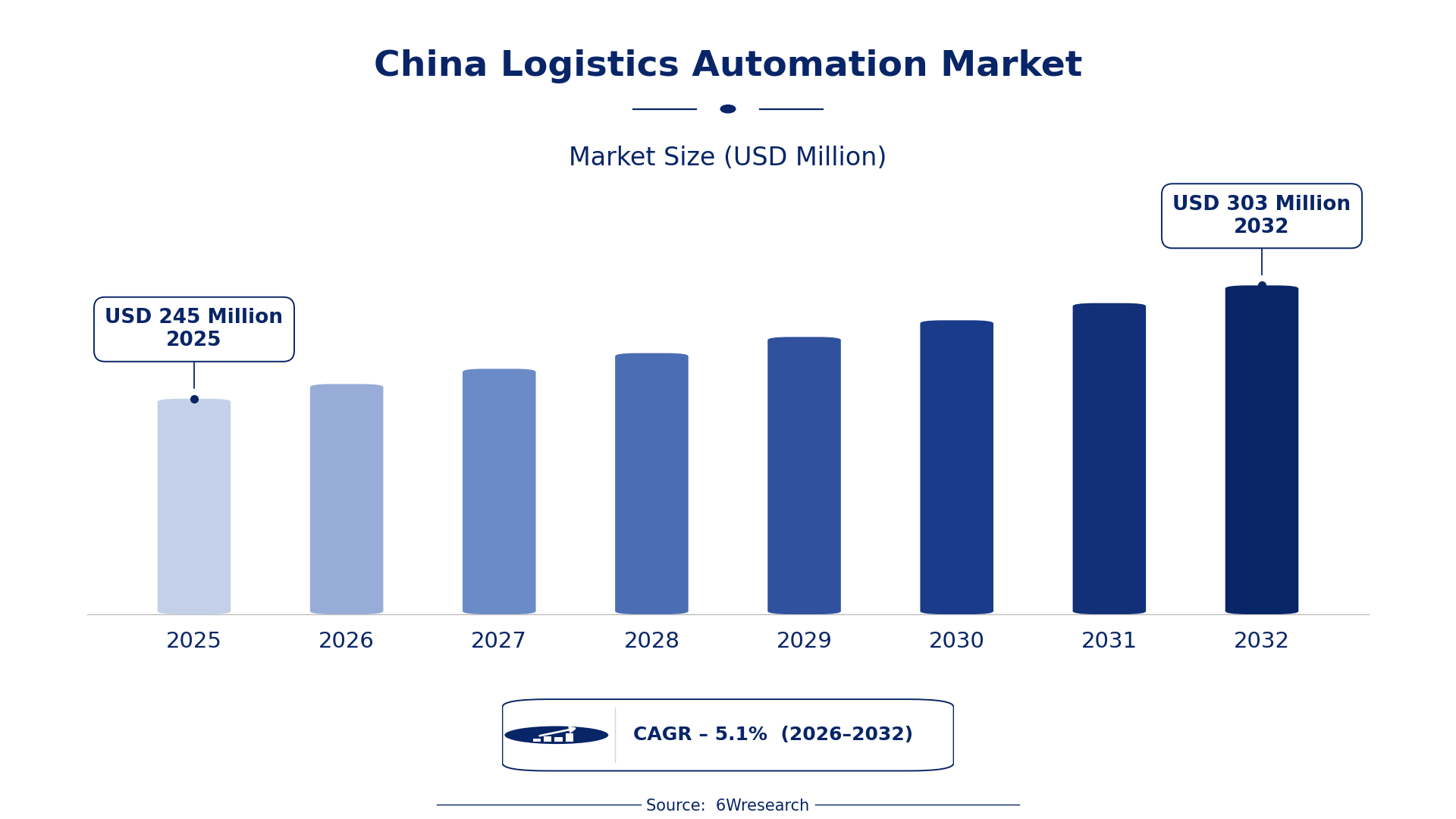
The China Logistics Automation Market was estimated at USD 245 Million in 2025 and is projected to reach USD 303 Million by 2032, growing at a CAGR of 5.1% from 2026 to 2032.
China Logistics Automation Market Synopsis
The logistics automation sector in China is witnessing robust expansion, driven by the urgent need for efficiency in supply chain operations. As e-commerce continues to flourish, businesses are increasingly turning to automated solutions to meet consumer demands for speed and accuracy in deliveries.
Technological advancements such as robotics and artificial intelligence are central to this growth. Companies are investing heavily in integrated systems that enhance operational workflows, reduce costs, and improve overall service delivery in logistics.
China Logistics Automation Market Year-wise Growth Rate and Key Drivers
This graph illustrates the annual growth rates of the China Logistics Automation Market from 2021 to 2032, highlighting a steady upward trajectory and projected expansion over the forecast period.
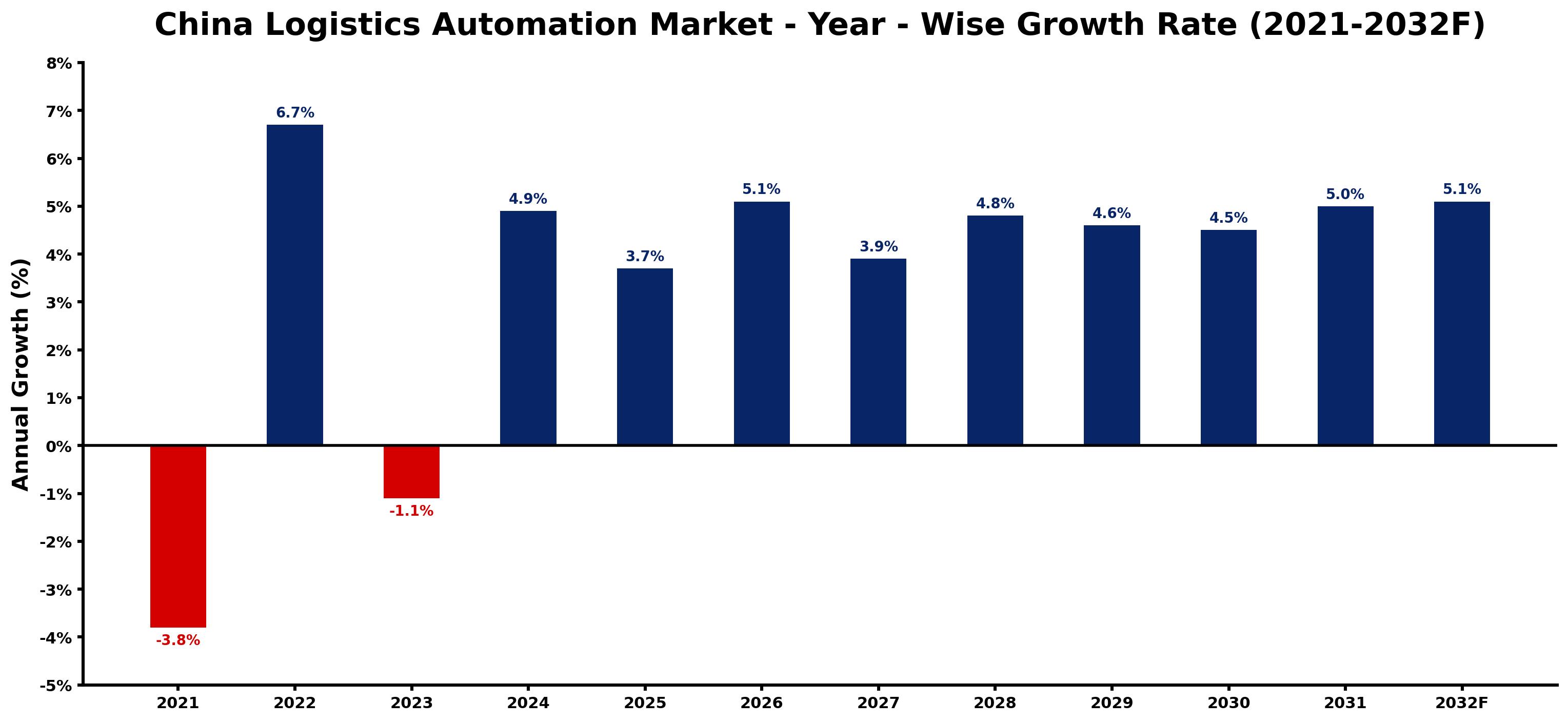
The table below presents the year‑wise growth rates along with the key drivers influencing the market
| Year | Growth Rate | Major Drivers |
| 2021 | -3.8% | Beijing's stringent regulations on warehouse automation technology. |
| 2022 | 6.7% | Adoption of national smart logistics development plan. |
| 2023 | -1.1% | Shanghai port congestion impacting logistics efficiency significantly. |
| 2024 | 4.9% | Increased investment in AI-driven warehouse management systems. |
| 2025 | 3.7% | Government subsidies promoting automation in last-mile delivery. |
| 2026 | 5.1% | Rise in e-commerce demand stimulated by population growth. |
| 2027 | 3.9% | National policies favoring robotics in freight handling. |
| 2028 | 4.8% | Enhanced digital infrastructure supporting logistics tech innovations. |
| 2029 | 4.6% | Growth of cross-border trade necessitating automation solutions. |
| 2030 | 4.5% | Emergence of 5G technology improving logistics efficiency. |
| 2031 | 5.0% | Increased urbanization driving demand for automated warehouses. |
| 2032 | 5.1% | Implementation of carbon reduction targets influencing automation. |
Note: Market size estimations and growth projections presented in this report are based on 6Wresearch's proprietary forecasting methodology, utilizing the latest available industry data, government publications, and primary research inputs.
China Logistics Automation Market Key Takeaways
Below are some of the specific key takeaways from the market, including:
- The logistics automation market is primarily driven by the surge in e-commerce and demand for faster logistics solutions.
- Innovative technologies like IoT and robotics are key enablers of efficiency in warehousing and distribution.
- Cost reduction and enhanced operational efficiency remain top priorities for businesses adopting automation.
- Government initiatives are increasingly supporting technological advancements and sustainability in logistics.
- Companies are focusing on creating integrated solutions that enhance supply chain management.
Evaluation of Restraints in China Logistics Automation Market
Despite its growth, the China Logistics Automation Market faces hurdles related to technology integration. Many firms struggle to implement effective automation solutions due to high initial costs and the complexity of syncing new technologies with existing systems. on top of that, there is fierce competition among automation providers, leading to challenges in market adoption. Compliance with evolving regulatory standards also complicates the landscape for stakeholders aiming to enhance their logistics capabilities.
China Logistics Automation Market Trends
Current trends indicate a strong shift towards the adoption of AI-driven analytics in logistics automation. Companies are utilizing big data to optimize route planning and inventory management. Additionally, the focus on sustainability is prompting businesses to seek energy-efficient automation solutions that align with environmental goals. As the demand for customization grows, flexible automation systems that can adapt to varying operational needs are gaining traction.
China Logistics Automation Market Opportunities
There are substantial growth opportunities for companies investing in logistics automation. As the logistics sector continues to expand, especially in urban areas, the need for automated warehouses and smart transportation solutions will increase. Emerging technologies such as drones and autonomous vehicles present exciting possibilities for improving last-mile delivery efficiencies. Businesses that can offer tailored automation solutions will be well-positioned to capture a larger market share.
Government Initiatives in the China Logistics Automation Market
Government policy plays a crucial role in shaping the China Logistics Automation Market. The Chinese government actively promotes technological innovation and supports initiatives aimed at enhancing supply chain efficiency. Current regulations encourage the adoption of automation technologies, which helps streamline operations and reduce costs.
- A national digital infrastructure upgrade programme launched recently aims to enhance connectivity and facilitate logistics automation.
- Current funding initiatives support research and development of advanced automation technologies in the logistics sector.
- A regulatory framework introduced in 2025 mandates safety standards for automated logistics systems.
- Ongoing public-private partnerships focus on developing smart logistics hubs across major cities.
- Upcoming policies are expected to incentivize green technologies in logistics automation by 2028.
Future Insights of the China Logistics Automation Market
Looking ahead to 2026-2032, the China Logistics Automation Market is set for steady growth driven by technological advancements and increasing demand for efficiency. As companies adapt to the evolving needs of consumers, the integration of AI and machine learning will likely reshape logistics operations. The market will also see a greater emphasis on sustainable practices, as both consumers and regulators push for greener logistics solutions.
China Logistics Automation Market Latest Developments
In the past year, the China Logistics Automation Market has seen a flurry of activity, with companies ramping up efforts to adopt innovative solutions. Investment in automation technologies remains strong, driven by the need for efficiency in a competitive landscape. Partnerships between technology firms and logistics operators are becoming more common as businesses seek to enhance operational capabilities.
- A leading technology vendor initiated a large-scale rollout of robotic systems in warehouses, expected to be completed by early 2026.
- A partnership formed in mid-2025 between a logistics company and a software provider focuses on developing AI-driven supply chain solutions, currently underway.
- An upcoming project planned for late 2026 aims to establish a network of automated distribution centers in key urban areas.
- A major logistics firm launched a pilot program for autonomous delivery vehicles in Q3 2025, with promising initial results.
- Ongoing efforts to integrate IoT solutions in logistics are gaining traction, with several pilot projects expected to conclude by mid-2026.
China Logistics Automation Market - Key Attractiveness of the Report
- 10 Years of Market Numbers
- Historical Data Starting from 2022 to 2025
- Base Year: 2025
- Forecast Data until 2032
- Key Performance Indicators Impacting the Market
- Major Upcoming Developments and Projects
Key Highlights of the Report:
- China Logistics Automation Market Outlook
- Market Size of China Logistics Automation Market, 2025
- Forecast of China Logistics Automation Market, 2032
- Historical Data and Forecast of China Logistics Automation Revenues & Volume for the Period 2022-2032F
- China Logistics Automation Market Trend Evolution
- China Logistics Automation Market Drivers and Challenges
- China Logistics Automation Price Trends
- China Logistics Automation Porter's Five Forces
- China Logistics Automation Industry Life Cycle
- Historical Data and Forecast of China Logistics Automation Market Revenues & Volume By Function for the Period 2022-2032F
- Historical Data and Forecast of China Logistics Automation Market Revenues & Volume By Inventory and Storage Management for the Period 2022-2032F
- Historical Data and Forecast of China Logistics Automation Market Revenues & Volume By Transportation logistics for the Period 2022-2032F
- Historical Data and Forecast of China Logistics Automation Market Revenues & Volume By Vertical for the Period 2022-2032F
- Historical Data and Forecast of China Logistics Automation Market Revenues & Volume By Retail & eCommerce for the Period 2022-2032F
- Historical Data and Forecast of China Logistics Automation Market Revenues & Volume By Manufacturing for the Period 2022-2032F
- Historical Data and Forecast of China Logistics Automation Market Revenues & Volume By Healthcare & Pharmaceuticals for the Period 2022-2032F
- Historical Data and Forecast of China Logistics Automation Market Revenues & Volume By Food & Beverages for the Period 2022-2032F
- Historical Data and Forecast of China Logistics Automation Market Revenues & Volume By Automotive for the Period 2022-2032F
- Historical Data and Forecast of China Logistics Automation Market Revenues & Volume By Aerospace and Defense for the Period 2022-2032F
- Historical Data and Forecast of China Logistics Automation Market Revenues & Volume By Chemicals for the Period 2022-2032F
- Historical Data and Forecast of China Logistics Automation Market Revenues & Volume By Other Verticals (paper and printing, and textiles and clothing) for the Period 2022-2032F
- Historical Data and Forecast of China Logistics Automation Market Revenues & Volume By Organization Size for the Period 2022-2032F
- Historical Data and Forecast of China Logistics Automation Market Revenues & Volume By SMES for the Period 2022-2032F
- Historical Data and Forecast of China Logistics Automation Market Revenues & Volume By Large Enterprises for the Period 2022-2032F
- Historical Data and Forecast of China Logistics Automation Market Revenues & Volume By Logistics Type for the Period 2022-2032F
- Historical Data and Forecast of China Logistics Automation Market Revenues & Volume By Sales Logistics for the Period 2022-2032F
- Historical Data and Forecast of China Logistics Automation Market Revenues & Volume By Production Logistics for the Period 2022-2032F
- Historical Data and Forecast of China Logistics Automation Market Revenues & Volume By Recovery Logistics for the Period 2022-2032F
- Historical Data and Forecast of China Logistics Automation Market Revenues & Volume By Procurement Logistics for the Period 2022-2032F
- Historical Data and Forecast of China Logistics Automation Market Revenues & Volume By Software Application for the Period 2022-2032F
- Historical Data and Forecast of China Logistics Automation Market Revenues & Volume By Inventory Management for the Period 2022-2032F
- Historical Data and Forecast of China Logistics Automation Market Revenues & Volume By Order Management for the Period 2022-2032F
- Historical Data and Forecast of China Logistics Automation Market Revenues & Volume By Yard Management for the Period 2022-2032F
- Historical Data and Forecast of China Logistics Automation Market Revenues & Volume By Shipping Management for the Period 2022-2032F
- Historical Data and Forecast of China Logistics Automation Market Revenues & Volume By Labor Management for the Period 2022-2032F
- Historical Data and Forecast of China Logistics Automation Market Revenues & Volume By Vendor Management for the Period 2022-2032F
- Historical Data and Forecast of China Logistics Automation Market Revenues & Volume By Customer Support for the Period 2022-2032F
- China Logistics Automation Import Export Trade Statistics
- Market Opportunity Assessment By Function
- Market Opportunity Assessment By Vertical
- Market Opportunity Assessment By Organization Size
- Market Opportunity Assessment By Logistics Type
- Market Opportunity Assessment By Software Application
- China Logistics Automation Top Companies Market Share
- China Logistics Automation Competitive Benchmarking By Technical and Operational Parameters
- China Logistics Automation Company Profiles
- China Logistics Automation Key Strategic Recommendations






































