China Luxury Bath and Body Products Market Top 5 Importing Countries and Market Competition (HHI) Analysis
China import market for luxury bath and body products saw a notable shift in concentration levels in 2024, moving from high to moderate concentration. Despite facing a challenging CAGR of -24.62% from 2020 to 2024, the market experienced a steep decline in growth rate by -49.42% from 2023 to 2024. Top exporting countries such as Italy, UK, Japan, USA, and Metropolitan France continued to play a significant role in supplying these products to meet the demands of Chinese consumers, showcasing their enduring appeal and quality in the market.
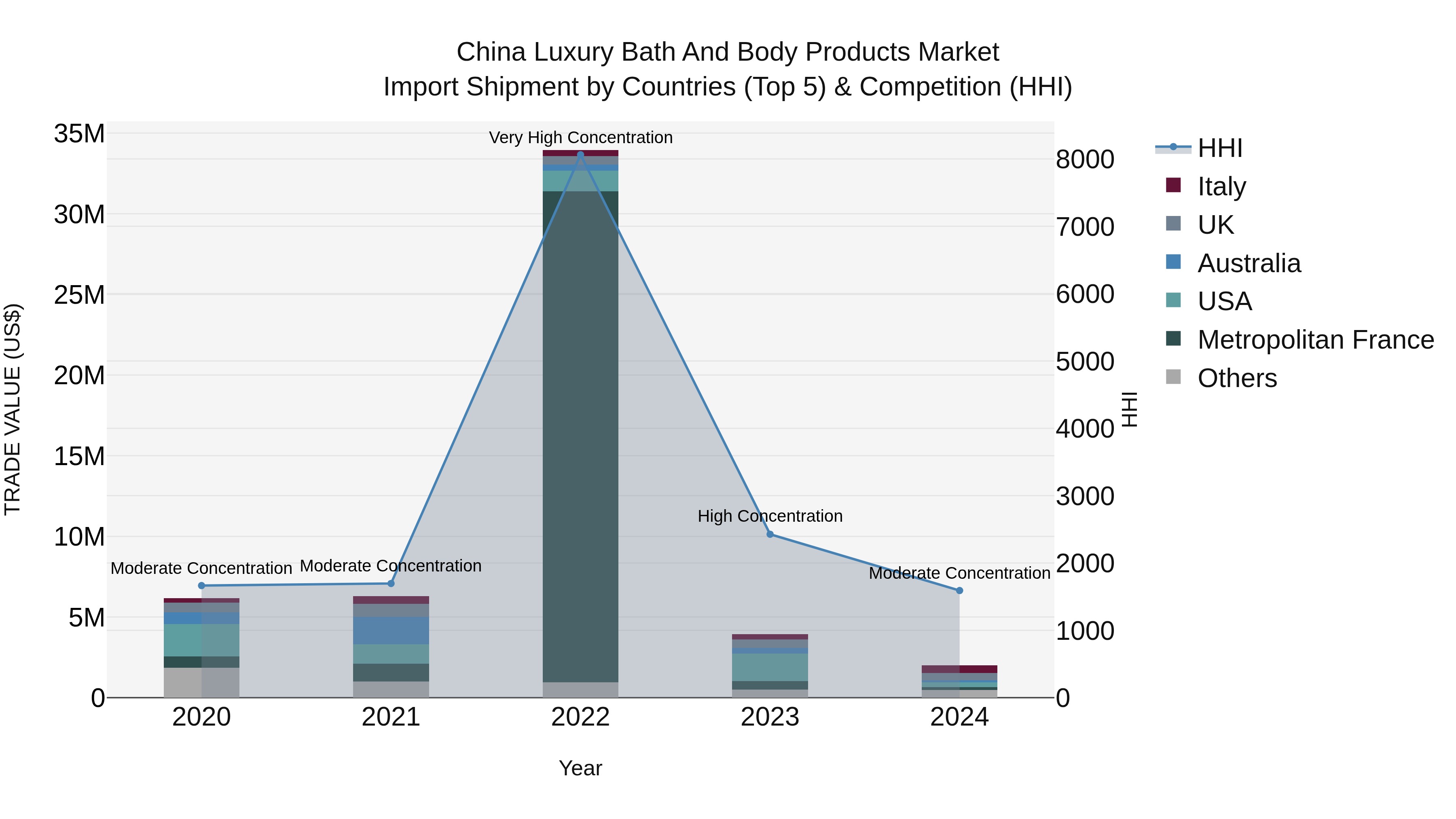
China Luxury Bath And Body Products Market Synopsis
The China Luxury Bath and Body Products market is witnessing significant growth due to increasing disposable incomes, changing lifestyles, and a growing awareness of personal grooming. Consumers are increasingly seeking high-quality, premium bath and body products that offer both functional benefits and a luxurious experience. Key trends in the market include a rising demand for natural and organic products, innovative packaging designs, and a preference for products with unique scents and ingredients. Major players in the market are focusing on expanding their product portfolios, launching new collections, and leveraging digital marketing strategies to reach a wider consumer base. With the increasing popularity of self-care and wellness trends, the China Luxury Bath and Body Products market is expected to continue its growth trajectory in the coming years.
China Luxury Bath And Body Products Market Trends
The China luxury bath and body products market is experiencing significant growth driven by increasing disposable income, shifting consumer preferences towards premium personal care items, and a growing awareness of health and wellness. Key trends in the market include the rising demand for natural and organic products, personalized skincare solutions, and innovative packaging designs. Opportunities lie in targeting younger consumers through digital marketing strategies, expanding product offerings to include gender-neutral options, and capitalizing on the trend of self-care and relaxation rituals. With the Chinese market becoming increasingly sophisticated and competitive, brands that prioritize sustainability, transparency, and cultural relevance are likely to succeed in capturing a larger share of this lucrative market.
China Luxury Bath And Body Products Market Challenges
The China luxury bath and body products market faces several challenges, including increasing competition from both domestic and international brands, navigating stringent regulations and compliance requirements in the beauty industry, and addressing consumer concerns regarding product safety and authenticity. Additionally, the market is influenced by evolving consumer preferences and trends, making it crucial for companies to stay innovative and adapt quickly to changing demands. Brand positioning and differentiation are also key challenges in a crowded market where luxury brands vie for consumer attention and loyalty. Overall, succeeding in the China luxury bath and body products market requires a deep understanding of local consumer behavior, effective marketing strategies, and a strong commitment to quality and innovation.
China Luxury Bath And Body Products Market Investment Opportunities
The China Luxury Bath and Body Products Market is primarily driven by the increasing disposable income of Chinese consumers, growing urbanization leading to a higher demand for premium personal care products, and a shifting consumer preference towards luxury and high-quality products. The rise of social media and e-commerce platforms has also played a significant role in driving market growth by increasing accessibility and awareness of luxury bath and body products among Chinese consumers. Additionally, a rising awareness of health and wellness, coupled with a desire for self-pampering and indulgence, has further fueled the demand for luxury bath and body products in the Chinese market. These factors combined contribute to a positive outlook for the China Luxury Bath and Body Products Market.
China Luxury Bath And Body Products Market Government Polices
The Chinese government has implemented various policies that impact the luxury bath and body products market. One significant regulation is the requirement for foreign cosmetic companies to undergo animal testing before their products can be sold in China, which has implications for luxury brands that adhere to cruelty-free practices. Additionally, the government has imposed import tariffs on luxury goods, affecting the pricing and competitiveness of foreign brands in the Chinese market. On the other hand, the government`s efforts to crack down on counterfeit products and strengthen intellectual property rights protection have provided some level of support for luxury bath and body product companies seeking to safeguard their brand reputation and market share in China. Overall, navigating the regulatory landscape and market dynamics in China requires luxury brands to stay informed and adaptable to government policies impacting the industry.
China Luxury Bath And Body Products Market Future Outlook
The future outlook for the China Luxury Bath and Body Products Market appears promising as the country`s growing middle and affluent class, increasing disposable income, and changing consumer preferences towards premium and high-quality personal care products are driving the demand for luxury bath and body products. The market is expected to witness steady growth in the coming years, fueled by factors such as urbanization, rising beauty and wellness trends, and the influence of social media on consumer buying behavior. Key players in the industry are likely to focus on product innovation, expanding distribution channels, and leveraging digital marketing strategies to capitalize on the growing demand for luxury bath and body products in China. Overall, the market presents opportunities for both domestic and international brands to establish a strong presence and cater to the evolving preferences of Chinese consumers.
Key Highlights of the Report:
- China Luxury Bath And Body Products Market Outlook
- Market Size of China Luxury Bath And Body Products Market, 2024
- Forecast of China Luxury Bath And Body Products Market, 2031
- Historical Data and Forecast of China Luxury Bath And Body Products Revenues & Volume for the Period 2021- 2031
- China Luxury Bath And Body Products Market Trend Evolution
- China Luxury Bath And Body Products Market Drivers and Challenges
- China Luxury Bath And Body Products Price Trends
- China Luxury Bath And Body Products Porter's Five Forces
- China Luxury Bath And Body Products Industry Life Cycle
- Historical Data and Forecast of China Luxury Bath And Body Products Market Revenues & Volume By Product for the Period 2021- 2031
- Historical Data and Forecast of China Luxury Bath And Body Products Market Revenues & Volume By Body Oil for the Period 2021- 2031
- Historical Data and Forecast of China Luxury Bath And Body Products Market Revenues & Volume By Body Lotions & Creams for the Period 2021- 2031
- Historical Data and Forecast of China Luxury Bath And Body Products Market Revenues & Volume By Body Washes for the Period 2021- 2031
- Historical Data and Forecast of China Luxury Bath And Body Products Market Revenues & Volume By Distribution Channel for the Period 2021- 2031
- Historical Data and Forecast of China Luxury Bath And Body Products Market Revenues & Volume By Online for the Period 2021- 2031
- Historical Data and Forecast of China Luxury Bath And Body Products Market Revenues & Volume By Offline for the Period 2021- 2031
- China Luxury Bath And Body Products Import Export Trade Statistics
- Market Opportunity Assessment By Product
- Market Opportunity Assessment By Distribution Channel
- China Luxury Bath And Body Products Top Companies Market Share
- China Luxury Bath And Body Products Competitive Benchmarking By Technical and Operational Parameters
- China Luxury Bath And Body Products Company Profiles
- China Luxury Bath And Body Products Key Strategic Recommendations






































