China Magnetic Field Sensors Market Top 5 Importing Countries and Market Competition (HHI) Analysis
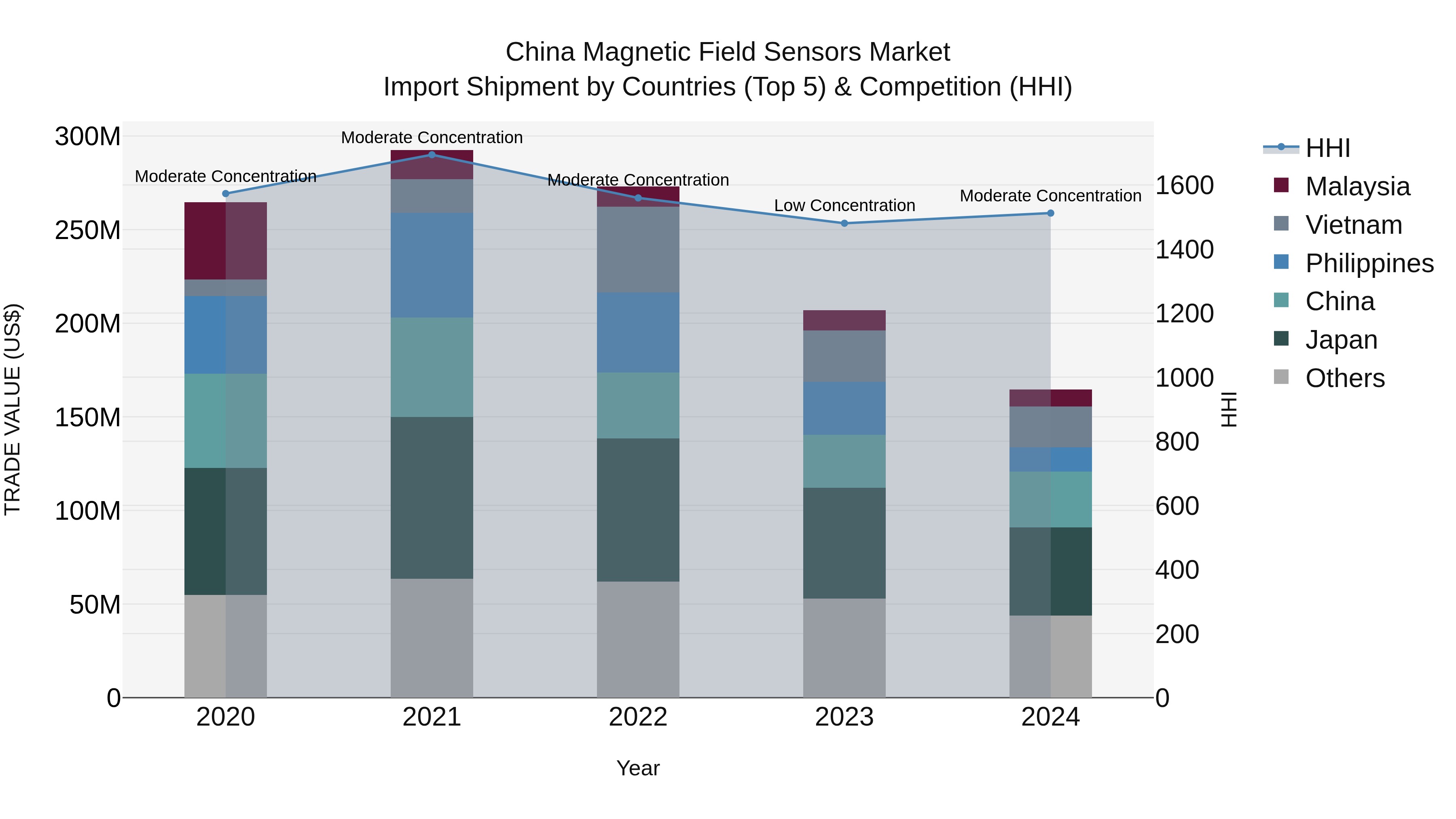
China import of magnetic field sensors in 2024 saw a shift in concentration from low to moderate, indicating a changing landscape in the market. The top exporting countries to China included Japan, China, Vietnam, Germany, and the Philippines, showcasing a diverse range of sources. Despite a negative CAGR of -11.18% from 2020 to 2024, the growth rate in 2024 improved slightly with a decline of -20.38% compared to the previous year. This data suggests a dynamic market environment for magnetic field sensors in China, with potential opportunities for both domestic and international suppliers.
China Magnetic Field Sensors Market Overview
The China magnetic field sensors market is experiencing significant growth driven by increasing demand across various industries such as automotive, consumer electronics, industrial, and healthcare. The market is witnessing a surge in adoption due to the rising need for accurate positioning and navigation systems, as well as the growing trend of automation and digitization in manufacturing processes. Key players in the market are focusing on developing advanced sensor technologies to meet the evolving requirements of end-users. Additionally, government initiatives to promote the adoption of electric vehicles and smart devices are further propelling market growth. With the increasing investment in research and development activities, the China magnetic field sensors market is expected to continue its upward trajectory in the coming years.
China Magnetic Field Sensors Market Trends
The China magnetic field sensors market is witnessing several key trends. One significant trend is the increasing adoption of magnetoresistive sensors due to their high sensitivity and accuracy in various applications such as automotive, consumer electronics, and industrial sectors. Another trend is the growing demand for Hall effect sensors driven by the automotive industry for applications like position sensing, speed detection, and current sensing. Additionally, there is a rising focus on developing innovative magnetic field sensor technologies, such as tunnel magnetoresistance (TMR) sensors, to enhance performance and efficiency. The market is also experiencing a shift towards non-contact magnetic field sensors for applications requiring contactless and precise measurements. Overall, the China magnetic field sensors market is evolving towards advanced, high-performance sensor technologies to meet the increasing demand across diverse industries.
China Magnetic Field Sensors Market Challenges
In the China magnetic field sensors market, one of the key challenges faced is intense competition from both domestic and international players. The market is crowded with numerous companies offering a wide range of magnetic field sensor products, leading to price wars and margin pressures. Additionally, technological advancements and rapid innovations in the field of magnetic sensors pose a challenge for companies to stay ahead in terms of product development and performance. Moreover, the regulatory environment in China, including intellectual property protection and government policies, can present barriers to entry for new players and hinder market growth. Companies operating in this market need to focus on differentiation, innovation, and strategic partnerships to overcome these challenges and sustain competitiveness in the rapidly evolving landscape.
China Magnetic Field Sensors Market Investment Opportunities
The China magnetic field sensors market presents promising investment opportunities due to the growing demand for these sensors in various industries such as automotive, consumer electronics, healthcare, and industrial automation. With the increasing adoption of automation and IoT technologies, the need for accurate and reliable magnetic field sensors is on the rise. Additionally, the emphasis on developing smart cities and infrastructure projects in China further drives the demand for these sensors for applications like traffic management, energy efficiency, and security systems. Investing in companies that manufacture or develop magnetic field sensors, as well as those involved in research and development of new sensor technologies, could yield significant returns in the rapidly expanding Chinese market.
China Magnetic Field Sensors Market Government Policy
The Chinese government has been actively promoting the development and adoption of magnetic field sensors in various industries through a combination of policies and initiatives. These include subsidies and incentives for companies investing in research and development of magnetic field sensor technologies, as well as measures to support the local production and supply chain of these sensors. Additionally, regulatory requirements and standards have been put in place to ensure the quality and reliability of magnetic field sensors used in critical applications such as automotive, consumer electronics, and industrial automation. The government`s focus on fostering innovation and competitiveness in the magnetic field sensors market is in line with China`s broader goals of advancing its technology sector and becoming a global leader in high-tech industries.
China Magnetic Field Sensors Market Future Outlook
The future outlook for the China magnetic field sensors market appears promising, driven by the increasing adoption of these sensors across various industries such as automotive, consumer electronics, healthcare, and industrial applications. The demand for magnetic field sensors is expected to rise due to their crucial role in applications like navigation systems, position sensing, speed detection, and proximity sensing. Additionally, the growing trend of automation and IoT integration in China is further fueling the market growth for magnetic field sensors. Advancements in technology leading to smaller, more accurate, and energy-efficient sensors are anticipated to drive market expansion. Overall, the China magnetic field sensors market is expected to experience steady growth in the coming years, offering opportunities for manufacturers and suppliers to capitalize on the evolving market landscape.
Key Highlights of the Report:
- China Magnetic Field Sensors Market Outlook
- Market Size of China Magnetic Field Sensors Market,2024
- Forecast of China Magnetic Field Sensors Market, 2031
- Historical Data and Forecast of China Magnetic Field Sensors Revenues & Volume for the Period 2021-2031
- China Magnetic Field Sensors Market Trend Evolution
- China Magnetic Field Sensors Market Drivers and Challenges
- China Magnetic Field Sensors Price Trends
- China Magnetic Field Sensors Porter's Five Forces
- China Magnetic Field Sensors Industry Life Cycle
- Historical Data and Forecast of China Magnetic Field Sensors Market Revenues & Volume By Type for the Period 2021-2031
- Historical Data and Forecast of China Magnetic Field Sensors Market Revenues & Volume By Hall Effect for the Period 2021-2031
- Historical Data and Forecast of China Magnetic Field Sensors Market Revenues & Volume By AMR for the Period 2021-2031
- Historical Data and Forecast of China Magnetic Field Sensors Market Revenues & Volume By GMR for the Period 2021-2031
- Historical Data and Forecast of China Magnetic Field Sensors Market Revenues & Volume By Technology for the Period 2021-2031
- Historical Data and Forecast of China Magnetic Field Sensors Market Revenues & Volume By Semiconductor for the Period 2021-2031
- Historical Data and Forecast of China Magnetic Field Sensors Market Revenues & Volume By Industrial for the Period 2021-2031
- Historical Data and Forecast of China Magnetic Field Sensors Market Revenues & Volume By Precision Electronics for the Period 2021-2031
- Historical Data and Forecast of China Magnetic Field Sensors Market Revenues & Volume By Application for the Period 2021-2031
- Historical Data and Forecast of China Magnetic Field Sensors Market Revenues & Volume By Automotive Sensors for the Period 2021-2031
- Historical Data and Forecast of China Magnetic Field Sensors Market Revenues & Volume By Robotics for the Period 2021-2031
- Historical Data and Forecast of China Magnetic Field Sensors Market Revenues & Volume By Consumer Electronics for the Period 2021-2031
- Historical Data and Forecast of China Magnetic Field Sensors Market Revenues & Volume By End User for the Period 2021-2031
- Historical Data and Forecast of China Magnetic Field Sensors Market Revenues & Volume By Automotive for the Period 2021-2031
- Historical Data and Forecast of China Magnetic Field Sensors Market Revenues & Volume By Manufacturing for the Period 2021-2031
- Historical Data and Forecast of China Magnetic Field Sensors Market Revenues & Volume By Electronics for the Period 2021-2031
- Historical Data and Forecast of China Magnetic Field Sensors Market Revenues & Volume By Sales Channel for the Period 2021-2031
- Historical Data and Forecast of China Magnetic Field Sensors Market Revenues & Volume By Direct Sales for the Period 2021-2031
- Historical Data and Forecast of China Magnetic Field Sensors Market Revenues & Volume By Distributors for the Period 2021-2031
- Historical Data and Forecast of China Magnetic Field Sensors Market Revenues & Volume By Online Sales for the Period 2021-2031
- China Magnetic Field Sensors Import Export Trade Statistics
- Market Opportunity Assessment By Type
- Market Opportunity Assessment By Technology
- Market Opportunity Assessment By Application
- Market Opportunity Assessment By End User
- Market Opportunity Assessment By Sales Channel
- China Magnetic Field Sensors Top Companies Market Share
- China Magnetic Field Sensors Competitive Benchmarking By Technical and Operational Parameters
- China Magnetic Field Sensors Company Profiles
- China Magnetic Field Sensors Key Strategic Recommendations






































