China Medical Tubing Market Size, Share & Growth Rate
The China Medical Tubing Market was estimated at USD 184 Million in 2025 and is projected to reach USD 212 Million by 2032, growing at a CAGR of 2.0% from 2026 to 2032. This growth trajectory is underpinned by several critical factors, including escalating healthcare expenditures and a rising demand for advanced medical devices. Additionally, the aging population in China further fuels the necessity for specialized medical tubing to support various healthcare applications.
China Medical Tubing Market Year-wise Growth Rate and Key Drivers
This graph highlights how the China Medical Tubing Market has steadily grown over the years, supported by major growth factors.
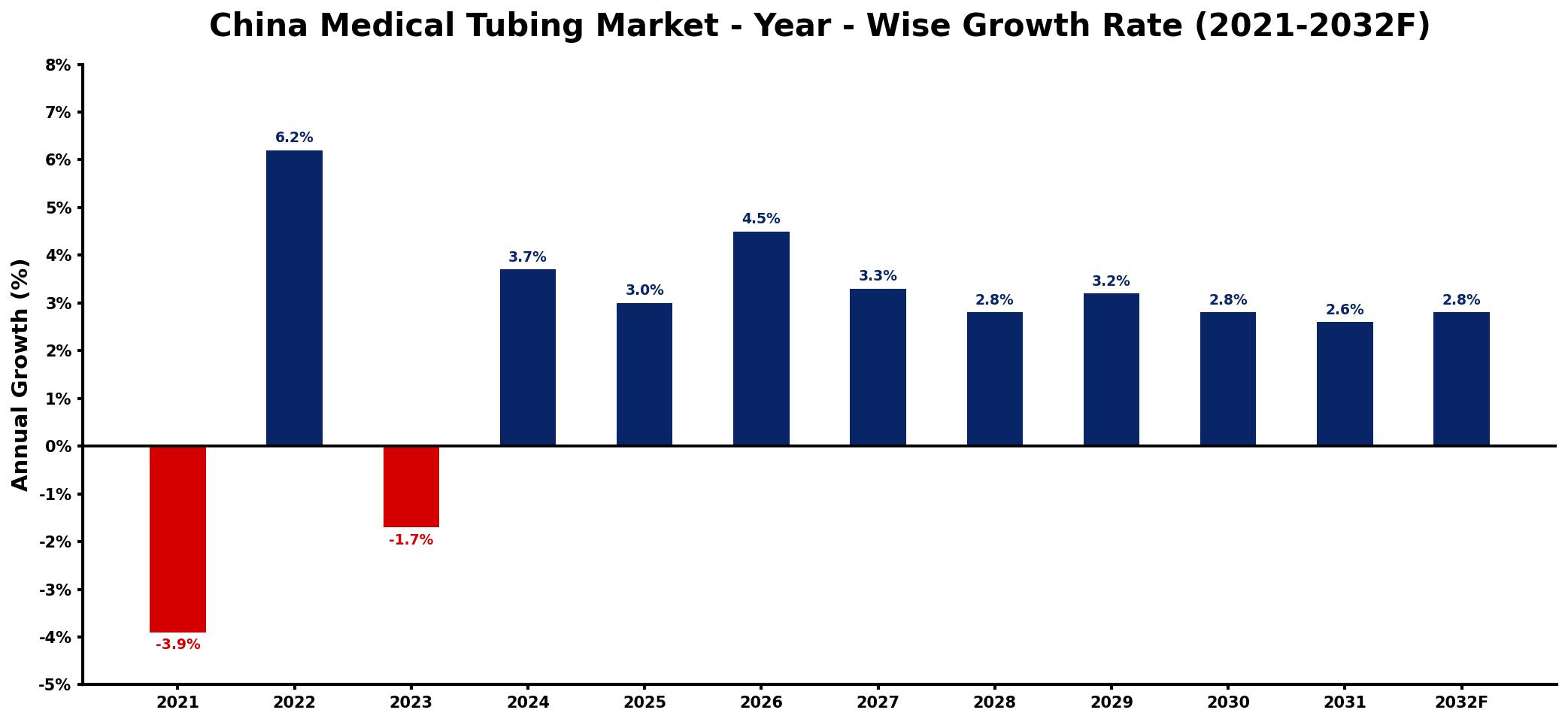
The table below presents the year‑wise growth rates along with the key drivers influencing the market
| Year | Growth Rate | Major Drivers |
| 2021 | -3.9% | decrease in healthcare investments |
| 2022 | 6.2% | rising healthcare sector demands |
| 2023 | -1.7% | falling production capacity utilization |
| 2024 | 3.7% | expansion of healthcare facilities |
| 2025 | 3.0% | growing demand for innovations |
| 2026 | 4.5% | increased focus on sustainability |
| 2027 | 3.3% | advancements in manufacturing technologies |
| 2028 | 2.8% | higher prevalence of chronic diseases |
| 2029 | 3.2% | surge in export opportunities |
| 2030 | 2.8% | development of new applications |
| 2031 | 2.6% | strengthening regulatory standards compliance |
| 2032 | 2.8% | enhancement of distribution networks |
Note: Market size estimations and growth projections presented in this report are based on 6Wresearch's proprietary forecasting methodology, utilizing the latest available industry data, government publications, and primary research inputs.
China Medical Tubing Market Synopsis
The increasing prevalence of chronic diseases is driving substantial demand for medical tubing in China. As healthcare facilities expand and modernize, the need for high-quality tubing—used in products such as catheters and respiratory devices—has surged. This is coupled with the adoption of minimally invasive procedures, where advanced tubing solutions play a pivotal role in improving patient outcomes.
Technological advancements have been instrumental in the evolution of medical tubing materials, leading to the emergence of innovative solutions like thermoplastic elastomers and antimicrobial coatings. These developments aim to enhance biocompatibility, performance, and safety, addressing the dynamic needs of healthcare providers and patients alike.
China Medical Tubing Market Key Takeaways
- Significant growth forecast driven by technological advancements and healthcare demand.
- Strong emphasis on product innovation, particularly in biocompatible materials.
- Increased usage of single-use disposable tubing to mitigate infection risks.
- Healthcare sector expansion is a critical factor propelling market growth.
- Customization and miniaturization trends are gaining prominence in product offerings.
Evaluation of Restraints in China Medical Tubing Market
The China Medical Tubing Market is navigating through a landscape marked by fierce competition and the imperative for continuous innovation. Regulatory compliance presents another significant challenge, as manufacturers must adapt to rapidly evolving safety standards. Furthermore, fluctuations in raw material prices can disrupt supply chains, potentially impacting profitability. Companies are increasingly required to focus on quality assurance while maintaining cost efficiency to thrive in this dynamic environment.
China Medical Tubing Market Trends
Current trends indicate a strong pivot towards more sophisticated materials that offer enhanced performance characteristics. The integration of antimicrobial coatings into medical tubing is becoming more prevalent, driven by an acute focus on reducing healthcare-associated infections. Simultaneously, the movement towards miniaturization in medical devices is pushing manufacturers to develop smaller, more specialized tubing solutions tailored for specific applications such as cardiac catheterization and endoscopic procedures.
China Medical Tubing Market Opportunities
The landscape of the China Medical Tubing Market is ripe with investment opportunities. The growing aging population necessitates the development of high-quality tubing for essential healthcare applications, including intravenous therapy and respiratory management. There is a palpable demand for specialized tubing solutions that exhibit biocompatibility, flexibility, and durability. Furthermore, advancements in smart tubing technology and antimicrobial innovations are paving the way for new avenues of growth.
Government Initiatives in the China Medical Tubing Market
Government policies significantly influence the China Medical Tubing Market, emphasizing strict adherence to safety and quality standards. The Medical Device Regulation mandates that manufacturers secure necessary certifications before introducing products to the market. In addition, the Chinese government actively supports innovation through incentives and subsidies for research and development initiatives, thereby fostering advancements in the medical tubing sector.
Future Insights of the China Medical Tubing Market
The future outlook for the China Medical Tubing Market appears positive, with continued growth anticipated through 2032. Factors such as increasing healthcare investments and advancements in medical technologies will likely enhance market dynamics. As healthcare infrastructure expands and disposable medical devices become more prevalent, demand for high-quality medical tubing will persist. Continuous research and development will further refine product offerings, ensuring they align with evolving healthcare demands and standards.
China Medical Tubing Market Latest Developments (2025 - 2026)
Recent developments in the China Medical Tubing Market include a heightened focus on manufacturing practices aimed at reducing environmental impact and enhancing product safety. Industry players are increasingly adopting green technologies in their production processes. Additionally, collaborations between research institutions and manufacturers are on the rise, fostering innovation in materials and product design to meet the burgeoning needs of healthcare providers.
China Medical Tubing Market - Key Attractiveness of the Report
- 10 Years of Market Numbers
- Historical Data Starting from 2022 to 2025
- Base Year: 2025
- Forecast Data until 2032
- Key Performance Indicators Impacting the Market
- Major Upcoming Developments and Projects
Key Highlights of the Report:
- China Medical Tubing Market Outlook
- Market Size of China Medical Tubing Market, 2025
- Forecast of China Medical Tubing Market, 2032
- Historical Data and Forecast of China Medical Tubing Revenues & Volume for the Period 2022-2032F
- China Medical Tubing Market Trend Evolution
- China Medical Tubing Market Drivers and Challenges
- China Medical Tubing Price Trends
- China Medical Tubing Porter's Five Forces
- China Medical Tubing Industry Life Cycle
- Historical Data and Forecast of China Medical Tubing Market Revenues & Volume By Material for the Period 2022-2032F
- Historical Data and Forecast of China Medical Tubing Market Revenues & Volume By Plastics for the Period 2022-2032F
- Historical Data and Forecast of China Medical Tubing Market Revenues & Volume By Rubbers for the Period 2022-2032F
- Historical Data and Forecast of China Medical Tubing Market Revenues & Volume By Specialty Polymers for the Period 2022-2032F
- Historical Data and Forecast of China Medical Tubing Market Revenues & Volume By Structure for the Period 2022-2032F
- Historical Data and Forecast of China Medical Tubing Market Revenues & Volume By Single-lumen for the Period 2022-2032F
- Historical Data and Forecast of China Medical Tubing Market Revenues & Volume By Co-extruded for the Period 2022-2032F
- Historical Data and Forecast of China Medical Tubing Market Revenues & Volume By Multi-lumen for the Period 2022-2032F
- Historical Data and Forecast of China Medical Tubing Market Revenues & Volume By Tapered Or Bump Tubing for the Period 2022-2032F
- Historical Data and Forecast of China Medical Tubing Market Revenues & Volume By Braided Tubing for the Period 2022-2032F
- Historical Data and Forecast of China Medical Tubing Market Revenues & Volume By Application for the Period 2022-2032F
- Historical Data and Forecast of China Medical Tubing Market Revenues & Volume By Bulk Disposable Tubing for the Period 2022-2032F
- Historical Data and Forecast of China Medical Tubing Market Revenues & Volume By Catheters & Cannulas for the Period 2022-2032F
- Historical Data and Forecast of China Medical Tubing Market Revenues & Volume By Drug Delivery System for the Period 2022-2032F
- Historical Data and Forecast of China Medical Tubing Market Revenues & Volume By Special Applications for the Period 2022-2032F
- China Medical Tubing Import Export Trade Statistics
- Market Opportunity Assessment By Material
- Market Opportunity Assessment By Structure
- Market Opportunity Assessment By Application
- China Medical Tubing Top Companies Market Share
- China Medical Tubing Competitive Benchmarking By Technical and Operational Parameters
- China Medical Tubing Company Profiles
- China Medical Tubing Key Strategic Recommendations






































