China Metal Cans Market Size, Share & Growth Rate
The China Metal Cans Market was estimated at USD 128 Million in 2025 and is projected to reach USD 146 Million by 2032, growing at a CAGR of 1.9% from 2026 to 2032. This growth trajectory is primarily driven by the increasing demand for canned beverages, which reflects changing consumer lifestyles and preferences for convenient, on-the-go packaging. Additionally, the food industrys expansion, alongside rising disposable incomes among the Chinese population, further fuels market growth as consumers are more willing to invest in quality, sustainable packaging solutions.
China Metal Cans Market Year-wise Growth Rate and Key Drivers
This graph highlights how the China Metal Cans Market has steadily grown over the years, supported by major growth factors.
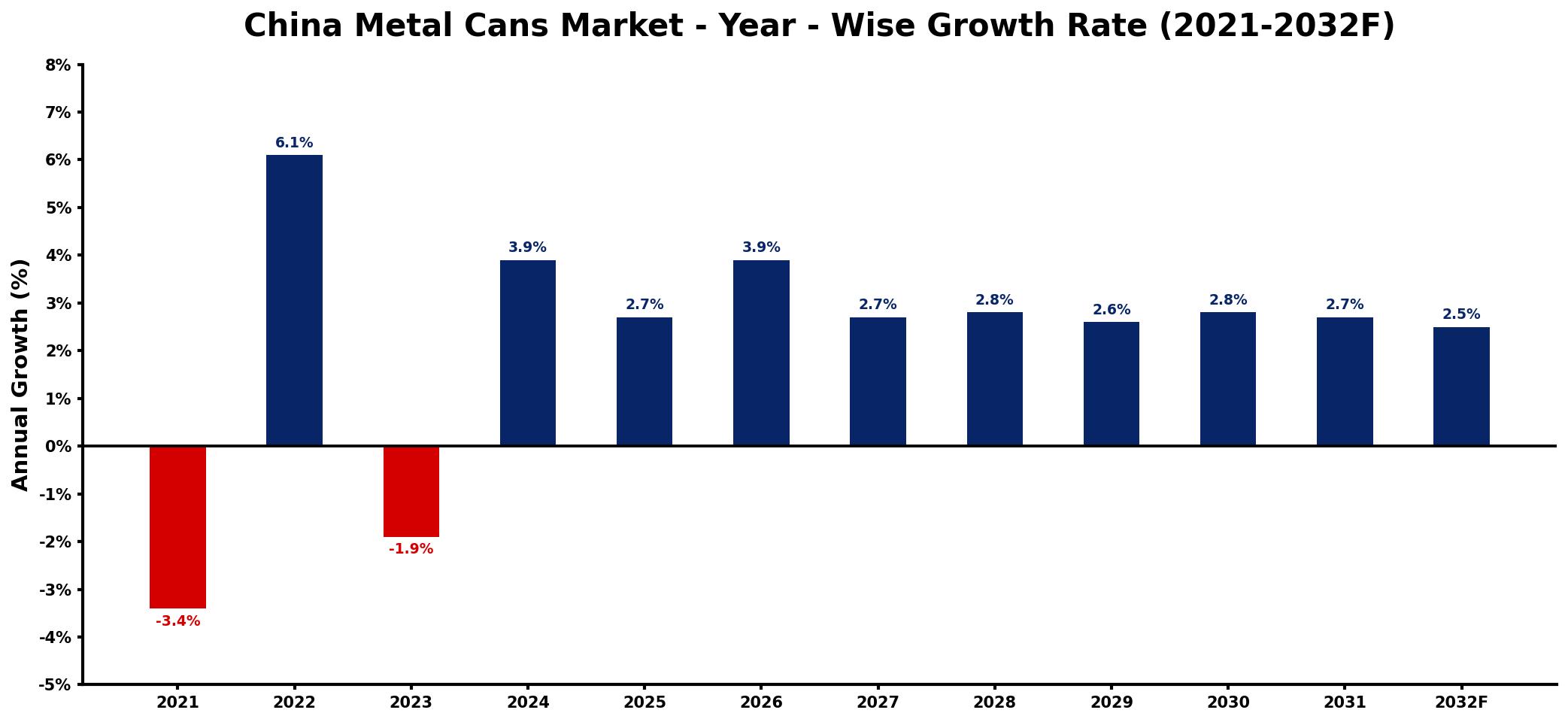
The table below presents the year‑wise growth rates along with the key drivers influencing the market
| Year | Growth Rate | Major Drivers |
| 2021 | -3.4% | decrease in consumer spending |
| 2022 | 6.1% | rise in beverage consumption trends |
| 2023 | -1.9% | fall in industrial production rates |
| 2024 | 3.9% | growth in sustainable packaging initiatives |
| 2025 | 2.7% | increase in export opportunities |
| 2026 | 3.9% | expansion of food service sector |
| 2027 | 2.7% | development of new distribution channels |
| 2028 | 2.8% | surge in e-commerce sales |
| 2029 | 2.6% | rising demand from electronics |
| 2030 | 2.8% | increased pharmaceutical industry usage |
| 2031 | 2.7% | increased capital investment inflows |
| 2032 | 2.5% | strengthening international trade flows |
Note: Market size estimations and growth projections presented in this report are based on 6Wresearch's proprietary forecasting methodology, utilizing the latest available industry data, government publications, and primary research inputs.
China Metal Cans Market Synopsis
The most influential force shaping the China Metal Cans Market currently is the growing consumer preference for eco-friendly packaging. With heightened awareness regarding sustainability, consumers are increasingly seeking out recyclable options, making metal cans a favored choice due to their recyclability and durability. This shift is pushing manufacturers to innovate and produce cans that not only meet these demands but also appeal aesthetically with high-quality prints and designs.
Additionally, the market is benefiting from the rising popularity of ready-to-drink beverages such as energy drinks and teas. This trend is not only propelling the beverage sector but also enhancing the overall demand for metal cans. As urbanization progresses and lifestyles change, the convenience offered by canned products is becoming an integral part of daily consumption.
China Metal Cans Market Key Takeaways
- The market is projected to grow from USD 128 Million in 2025 to USD 146 Million by 2032.
- Consumer preference for sustainable packaging is a driving force behind market dynamics.
- Innovations in can design, including resealable and easy-open features, are gaining traction.
- The expanding food and beverage industries are pivotal to the increasing demand for metal cans.
- Government initiatives promoting recycling further influence market growth.
Evaluation of Restraints in China Metal Cans Market
Despite robust growth, the China Metal Cans Market faces notable restraints that could hinder its potential. Intense competition among both local and international players leads to pricing pressures, complicating profitability. Fluctuations in raw material prices can also strain production costs, creating instability. Furthermore, as regulatory pressures around environmental sustainability heighten, companies must adapt swiftly to new standards or risk falling behind. These challenges necessitate a proactive approach to innovation and market strategy in order to maintain competitiveness.
China Metal Cans Market Trends
A significant trend influencing the China Metal Cans Market is the increasing adoption of environmentally friendly packaging solutions. Metal cans are viewed favorably in this context due to their recyclability and protective qualities. This trend is paralleled by a surge in the demand for canned beverages, especially in sectors like energy drinks and ready-to-drink teas, which are becoming staples for busy consumers.
Additionally, advancements in can technology are enhancing usability, with innovations such as easy-open lids and resealable options gaining popularity. The growing trend of online shopping also supports market expansion, as consumers increasingly seek the convenience of packaged food and beverages that fit their dynamic lifestyles.
China Metal Cans Market Opportunities
The China Metal Cans Market presents multiple avenues for investment and growth. With the urbanization and evolving lifestyles of the population, demand for canned food and beverages is on the rise. Investing in manufacturers focused on developing innovative, sustainable metal cans could yield significant returns as they adapt to consumer demands. Furthermore, there exists a robust opportunity for companies to explore advancements in eco-friendly packaging technology, aligning with the growing consumer focus on sustainability.
Government Initiatives in the China Metal Cans Market
The Chinese government has implemented various policies affecting the metal cans market, notably those aimed at environmental protection. Regulations are being introduced to promote sustainable manufacturing practices and reduce pollution. Additionally, protective tariffs on imported metal cans support domestic production and encourage local industry growth. Government programs promoting recycling and waste management initiatives further underline a commitment to balancing economic expansion with environmental sustainability.
Future Insights of the China Metal Cans Market
Looking ahead to 2026-2032, the China Metal Cans Market is expected to continue its upward trajectory, driven by an increasing focus on convenience and sustainability. Changing consumer preferences towards ready-to-eat and on-the-go products will significantly bolster the demand for metal cans. The ongoing technological advancements in manufacturing processes will likely improve product quality while reducing costs, contributing to market expansion. Overall, the alignment between consumer behavior and innovative packaging solutions positions this market for promising growth.
China Metal Cans Market Latest Developments (2025 - 2026)
In the recent months, there has been a notable shift towards innovation in the metal cans sector, with manufacturers focusing on enhancing product designs and functionality. The integration of sustainable materials and processes is becoming standard practice as companies strive to meet both regulatory requirements and consumer expectations. Additionally, the rise of online retail channels has compelled many companies to adapt their distribution strategies to better serve this evolving market. Overall, the industry is witnessing a strong commitment to sustainability and convenience, shaping its future direction.
China Metal Cans Market - Key Attractiveness of the Report
- 10 Years of Market Numbers
- Historical Data Starting from 2022 to 2025
- Base Year: 2025
- Forecast Data until 2032
- Key Performance Indicators Impacting the Market
- Major Upcoming Developments and Projects
Key Highlights of the Report:
- China Metal Cans Market Outlook
- Market Size of China Metal Cans Market, 2025
- Forecast of China Metal Cans Market, 2032
- Historical Data and Forecast of China Metal Cans Revenues & Volume for the Period 2022-2032F
- China Metal Cans Market Trend Evolution
- China Metal Cans Market Drivers and Challenges
- China Metal Cans Price Trends
- China Metal Cans Porter's Five Forces
- China Metal Cans Industry Life Cycle
- Historical Data and Forecast of China Metal Cans Market Revenues & Volume By Material Type for the Period 2022-2032F
- Historical Data and Forecast of China Metal Cans Market Revenues & Volume By Aluminium for the Period 2022-2032F
- Historical Data and Forecast of China Metal Cans Market Revenues & Volume By Steel for the Period 2022-2032F
- Historical Data and Forecast of China Metal Cans Market Revenues & Volume By Tin for the Period 2022-2032F
- Historical Data and Forecast of China Metal Cans Market Revenues & Volume By Fabrication Type for the Period 2022-2032F
- Historical Data and Forecast of China Metal Cans Market Revenues & Volume By Two Piece Can for the Period 2022-2032F
- Historical Data and Forecast of China Metal Cans Market Revenues & Volume By Three Piece Can for the Period 2022-2032F
- Historical Data and Forecast of China Metal Cans Market Revenues & Volume By Application for the Period 2022-2032F
- Historical Data and Forecast of China Metal Cans Market Revenues & Volume By Alcoholic Beverages for the Period 2022-2032F
- Historical Data and Forecast of China Metal Cans Market Revenues & Volume By Non??Alcoholic Beverages for the Period 2022-2032F
- Historical Data and Forecast of China Metal Cans Market Revenues & Volume By Processed Dairy Food Products for the Period 2022-2032F
- Historical Data and Forecast of China Metal Cans Market Revenues & Volume By Other Processed Food Products for the Period 2022-2032F
- Historical Data and Forecast of China Metal Cans Market Revenues & Volume By Edible Oil for the Period 2022-2032F
- Historical Data and Forecast of China Metal Cans Market Revenues & Volume By Medicinal Tablets and Syrups for the Period 2022-2032F
- Historical Data and Forecast of China Metal Cans Market Revenues & Volume By Personal Care and Cosmetic Products for the Period 2022-2032F
- Historical Data and Forecast of China Metal Cans Market Revenues & Volume By Industrial Chemicals for the Period 2022-2032F
- Historical Data and Forecast of China Metal Cans Market Revenues & Volume By End User for the Period 2022-2032F
- Historical Data and Forecast of China Metal Cans Market Revenues & Volume By Food & Beverages for the Period 2022-2032F
- Historical Data and Forecast of China Metal Cans Market Revenues & Volume By Pharmaceutical Industry for the Period 2022-2032F
- Historical Data and Forecast of China Metal Cans Market Revenues & Volume By Consumers Goods for the Period 2022-2032F
- Historical Data and Forecast of China Metal Cans Market Revenues & Volume By Chemical for the Period 2022-2032F
- China Metal Cans Import Export Trade Statistics
- Market Opportunity Assessment By Material Type
- Market Opportunity Assessment By Fabrication Type
- Market Opportunity Assessment By Application
- Market Opportunity Assessment By End User
- China Metal Cans Top Companies Market Share
- China Metal Cans Competitive Benchmarking By Technical and Operational Parameters
- China Metal Cans Company Profiles
- China Metal Cans Key Strategic Recommendations






































