China Metal Forming Tools Market Summary
The china metal forming tools market was estimated at USD 246 Million in 2025 and is projected to reach USD 284 Million by 2032, growing at a CAGR of 4.4% from 2026 to 2032.
China Metal Forming Tools Market Year-wise Growth Rate and Key Drivers
This graph highlights how the China Metal Forming Tools Market has steadily grown over the past five years, supported by major growth factors.
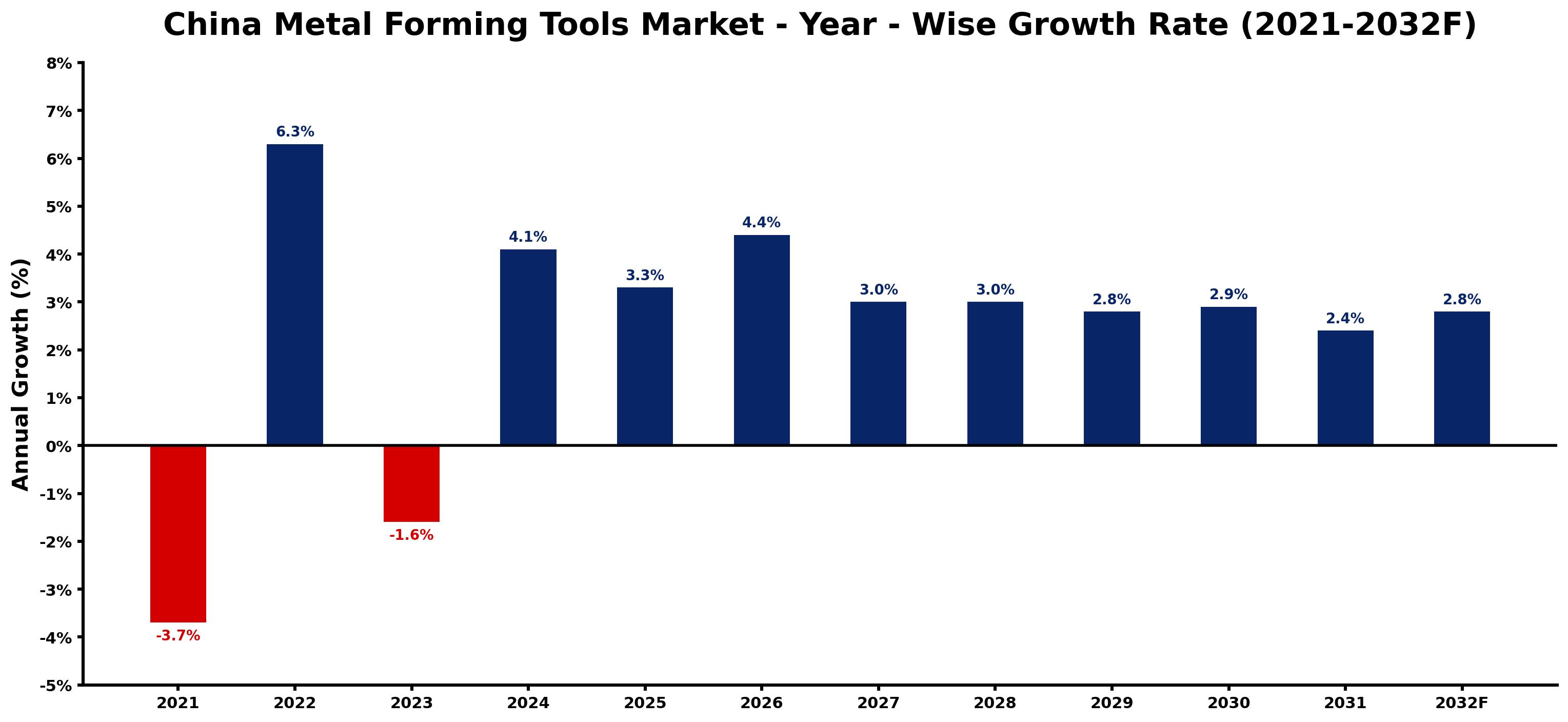
The table below presents the year wise growth rates along with the key drivers influencing the market
| Year | Growth Rate | Major Drivers |
| 2021 | -3.7% | Escalating trade tensions resulted in increased tariffs, adversely impacting manufacturing and investment in metal forming tools. |
| 2022 | 6.3% | Domestic demand for automotive components spurred the need for advanced metal forming tools. |
| 2023 | -1.6% | Increased trade tensions led to supply chain disruptions, negatively impacting production and shipment capabilities. |
| 2024 | 4.1% | Construction sector expansions required precision tools for high-quality building projects. |
| 2025 | 3.3% | Sustainability initiatives encouraged companies to adopt energy-efficient manufacturing practices. |
| 2026 | 4.4% | Growing focus on lightweight materials drove advancements in metal forming technologies. |
| 2027 | 3.0% | Rising labor costs prompted manufacturers to invest in automated metal forming solutions. |
| 2028 | 3.0% | Shifts in consumer preferences towards customized products encouraged flexibility in production tools. |
| 2029 | 2.8% | Increased global competition forced local companies to enhance operational efficiencies. |
| 2030 | 2.9% | E-commerce growth led to rising demand for quick-turnaround manufacturing capabilities. |
| 2031 | 2.4% | Integration of IoT into manufacturing provided real-time data, optimizing metal forming processes. |
| 2032 | 2.8% | Emerging market players introduced innovative products, challenging established leaders' market share. |
Note - Market size estimations and growth projections presented in this report are based on 6Wresearch's advanced forecasting approach, validated with industry datasets as of June 2026.
China Metal Forming Tools Market Synopsis
The China Metal Forming Tools Market is projected to reach 4.4% and witness significant growth during the forecast period (2026-2032). This growth is driven by the increasing demand for precision-engineered metal components across various industries, including automotive, aerospace, and electronics. As manufacturing processes become more intricate, the necessity for advanced metal forming tools continues to escalate, underpinning the market's expansion.
China Metal Forming Tools Market Growth Drivers
The growth of the China Metal Forming Tools Market can be attributed to several pivotal factors:
- Increasing industrial activity in China is spurring demand for high-quality metal forming tools, essential in manufacturing precise components.
- Advancements in tool design and material innovations are enhancing the effectiveness and durability of metal forming solutions.
- The rise in automation and smart manufacturing practices necessitates sophisticated tools capable of meeting high-speed production demands.
- Growing investments in the automotive and aerospace sectors are driving the requirement for specialized metal forming tools.
- Trends towards lightweight materials in design processes are increasing the complexity of metal components, further necessitating advanced forming tools.
China Metal Forming Tools Market Challenges and Restraints
Despite the optimistic growth prospects, the China Metal Forming Tools Market faces several challenges that could impact its trajectory:
- The need for customization in tool production complicates manufacturing processes and may lead to increased lead times.
- Maintaining cost efficiency while adopting advanced technologies poses a significant challenge for manufacturers in the market.
- Competition from low-cost imports can hinder domestic producers, forcing them to innovate continuously.
- Ensuring compliance with stringent government regulations regarding safety and quality can increase operational complexities.
- Environmental concerns related to manufacturing processes require companies to adopt sustainable practices, which can involve significant investment.
China Metal Forming Tools Market Government Investment and Initiatives
The Chinese government plays a crucial role in shaping the Metal Forming Tools Market through various policies and initiatives. These include:
- Investment in research and development initiatives aimed at fostering innovation in metal forming technologies, ensuring alignment with global standards.
- Regulatory frameworks that dictate safety and quality standards, thereby reinforcing the development of reliable metal forming tools.
- Public spending on infrastructure projects that utilize advanced metal forming techniques, thereby stimulating demand.
- Incentives for companies that integrate sustainable practices in metal forming operations, encouraging environmentally-friendly production methods.
- Support for domestic manufacturers through funding programs aimed at enhancing technology adoption and improving competitive positioning globally.
China Metal Forming Tools Market Latest Developments (May 2025 - June 2026)
In the period spanning May 2025 to June 2026, the China Metal Forming Tools Market has witnessed several significant developments:
- The introduction of new, high-performance metal forming tools designed to meet the increasing demands of the automotive sector has been noted.
- Companies are investing in automation technologies, leading to enhanced production efficiency and reduced cycle times in tool manufacturing.
- There has been a noticeable shift towards the adoption of sustainable materials and processes, driven by governmental policies aimed at environmental protection.
- Collaborations among industry stakeholders, including research institutions and manufacturers, have increased to foster innovation in tool design and application.
- Market players are focusing on expanding their service offerings, providing clients with customized solutions that address specific manufacturing challenges.
China Metal Forming Tools Market - Key Attractiveness of the Report
- 10 Years of Market Numbers
- Historical Data Starting from 2022 to 2025
- Base Year: 2025
- Forecast Data until 2032
- Key Performance Indicators Impacting the Market
- Major Upcoming Developments and Projects
Key Highlights of the Report:
- China Metal Forming Tools Market Outlook
- Market Size of China Metal Forming Tools Market, 2025
- Forecast of China Metal Forming Tools Market, 2032
- Historical Data and Forecast of China Metal Forming Tools Revenues & Volume for the Period 2022-2032F
- China Metal Forming Tools Market Trend Evolution
- China Metal Forming Tools Market Drivers and Challenges
- China Metal Forming Tools Price Trends
- China Metal Forming Tools Porter's Five Forces
- China Metal Forming Tools Industry Life Cycle
- Historical Data and Forecast of China Metal Forming Tools Market Revenues & Volume By Technology for the Period 2022-2032F
- Historical Data and Forecast of China Metal Forming Tools Market Revenues & Volume By Computerized Numerical Control (CNC) for the Period 2022-2032F
- Historical Data and Forecast of China Metal Forming Tools Market Revenues & Volume By Conventional for the Period 2022-2032F
- Historical Data and Forecast of China Metal Forming Tools Market Revenues & Volume By Product Type for the Period 2022-2032F
- Historical Data and Forecast of China Metal Forming Tools Market Revenues & Volume By Rolling Mill Machine for the Period 2022-2032F
- Historical Data and Forecast of China Metal Forming Tools Market Revenues & Volume By Bending Machines for the Period 2022-2032F
- Historical Data and Forecast of China Metal Forming Tools Market Revenues & Volume By Hydraulic Presses for the Period 2022-2032F
- Historical Data and Forecast of China Metal Forming Tools Market Revenues & Volume By Mechanical Presses for the Period 2022-2032F
- Historical Data and Forecast of China Metal Forming Tools Market Revenues & Volume By Shearing Machines for the Period 2022-2032F
- Historical Data and Forecast of China Metal Forming Tools Market Revenues & Volume By Forging Machines for the Period 2022-2032F
- Historical Data and Forecast of China Metal Forming Tools Market Revenues & Volume By Wire Forming Machines for the Period 2022-2032F
- Historical Data and Forecast of China Metal Forming Tools Market Revenues & Volume By Others for the Period 2022-2032F
- Historical Data and Forecast of China Metal Forming Tools Market Revenues & Volume By End-user for the Period 2022-2032F
- Historical Data and Forecast of China Metal Forming Tools Market Revenues & Volume By Automotive for the Period 2022-2032F
- Historical Data and Forecast of China Metal Forming Tools Market Revenues & Volume By Industrial machinery for the Period 2022-2032F
- Historical Data and Forecast of China Metal Forming Tools Market Revenues & Volume By Transportation for the Period 2022-2032F
- Historical Data and Forecast of China Metal Forming Tools Market Revenues & Volume By Precision engineering for the Period 2022-2032F
- Historical Data and Forecast of China Metal Forming Tools Market Revenues & Volume By Others for the Period 2022-2032F
- China Metal Forming Tools Import Export Trade Statistics
- Market Opportunity Assessment By Technology
- Market Opportunity Assessment By Product Type
- Market Opportunity Assessment By End-user
- China Metal Forming Tools Top Companies Market Share
- China Metal Forming Tools Competitive Benchmarking By Technical and Operational Parameters
- China Metal Forming Tools Company Profiles
- China Metal Forming Tools Key Strategic Recommendations






































