China Metal Slabs Market Growth Rate Analysis (2025 - 2031)
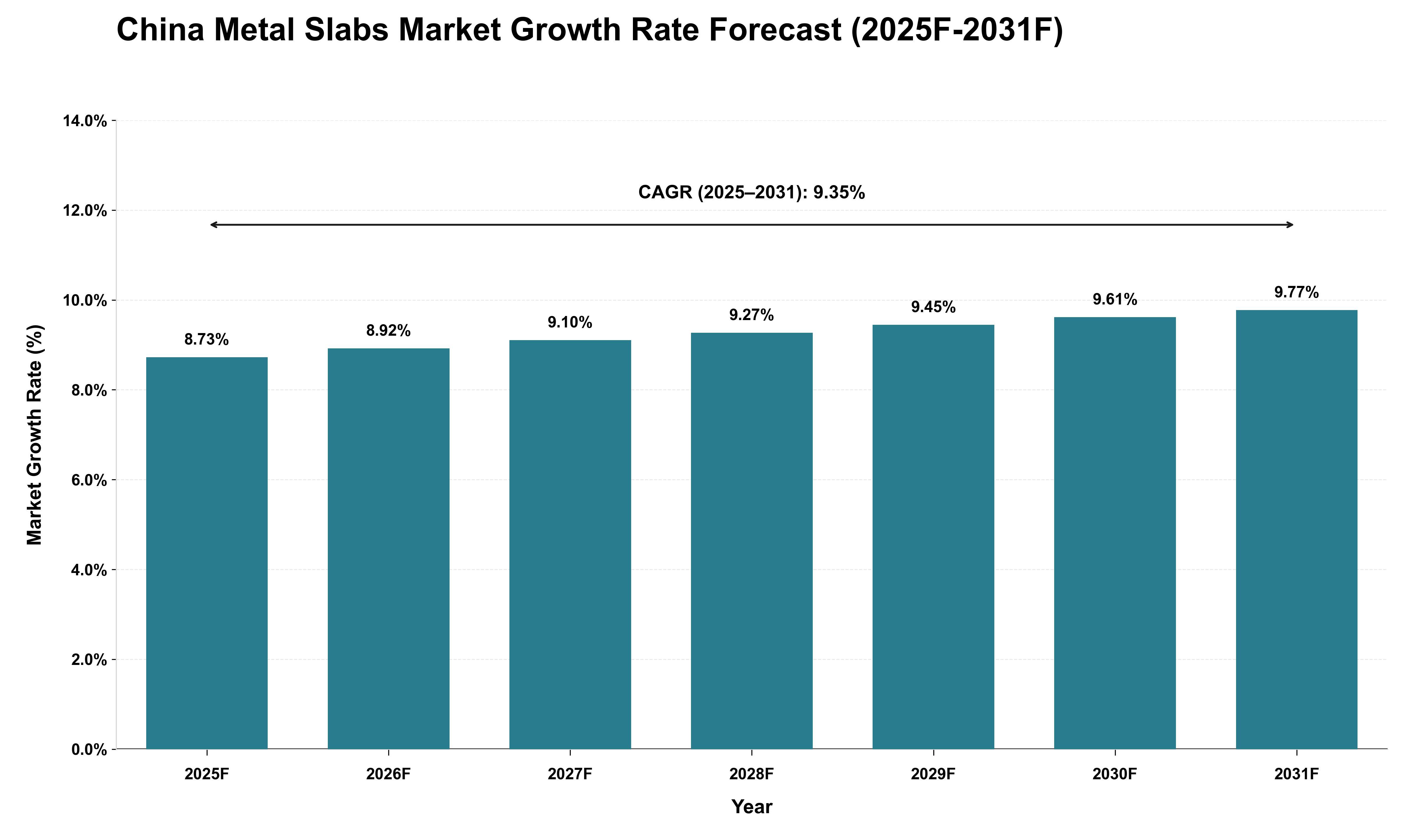
The China metal slabs market will experience significant growth driven by evolving regulatory frameworks and trade policies that favor domestic production while addressing environmental concerns. As the government implements stricter emissions standards, manufacturers will likely invest in cleaner technologies, enhancing efficiency and output. This shift will support a compound annual growth rate (CAGR) of 9.35% from 2025 to 2031, with annual growth rates progressively increasing from 8.73% in 2025 to 9.77% by 2031. Additionally, the anticipated rise in infrastructure projects and urbanization will bolster demand for metal slabs, further reinforcing import dependencies on raw materials that may fluctuate due to geopolitical tensions or trade agreements. Consequently, cyclical trends in global steel prices and supply chain dynamics will play a crucial role in shaping market conditions throughout this period, influencing both pricing strategies and competitive positioning within the sector.
Key Highlights of the Report:
- China Metal Slabs Market Outlook
- Market Size of China Metal Slabs Market, 2024
- Forecast of China Metal Slabs Market, 2026
- Historical Data and Forecast of China Metal Slabs Revenues & Volume for the Period 2021 - 2031
- China Metal Slabs Market Trend Evolution
- China Metal Slabs Market Drivers and Challenges
- China Metal Slabs Price Trends
- China Metal Slabs Porter's Five Forces
- China Metal Slabs Industry Life Cycle
- Historical Data and Forecast of China Metal Slabs Market Revenues & Volume By Size Types for the Period 2021 - 2031
- Historical Data and Forecast of China Metal Slabs Market Revenues & Volume By Small for the Period 2021 - 2031
- Historical Data and Forecast of China Metal Slabs Market Revenues & Volume By Medium for the Period 2021 - 2031
- Historical Data and Forecast of China Metal Slabs Market Revenues & Volume By Large for the Period 2021 - 2031
- Historical Data and Forecast of China Metal Slabs Market Revenues & Volume By End-users for the Period 2021 - 2031
- Historical Data and Forecast of China Metal Slabs Market Revenues & Volume By Commercial for the Period 2021 - 2031
- Historical Data and Forecast of China Metal Slabs Market Revenues & Volume By Residential for the Period 2021 - 2031
- Historical Data and Forecast of China Metal Slabs Market Revenues & Volume By Industrial for the Period 2021 - 2031
- Historical Data and Forecast of China Metal Slabs Market Revenues & Volume By Product Types for the Period 2021 - 2031
- Historical Data and Forecast of China Metal Slabs Market Revenues & Volume By Worktops for the Period 2021 - 2031
- Historical Data and Forecast of China Metal Slabs Market Revenues & Volume By Window Sills for the Period 2021 - 2031
- Historical Data and Forecast of China Metal Slabs Market Revenues & Volume By Floor Step for the Period 2021 - 2031
- Historical Data and Forecast of China Metal Slabs Market Revenues & Volume By Others for the Period 2021 - 2031
- China Metal Slabs Import Export Trade Statistics
- Market Opportunity Assessment By Size Types
- Market Opportunity Assessment By End-users
- Market Opportunity Assessment By Product Types
- China Metal Slabs Top Companies Market Share
- China Metal Slabs Competitive Benchmarking By Technical and Operational Parameters
- China Metal Slabs Company Profiles
- China Metal Slabs Key Strategic Recommendations






































