China Methyl Cellulose Market Top 5 Importing Countries and Market Competition (HHI) Analysis
China methyl cellulose import market in 2024 continued to show high concentration levels, with top exporting countries being Japan, Netherlands, Germany, Finland, and Metropolitan France. The compound annual growth rate (CAGR) from 2020 to 2024 was recorded at a healthy 8.46%, indicating a steady upward trend in demand. Additionally, the growth rate from 2023 to 2024 stood at 3.11%, suggesting sustained momentum in the market. These figures underscore the importance of these key exporting countries in meeting China methyl cellulose import needs and highlight the overall positive trajectory of the market.
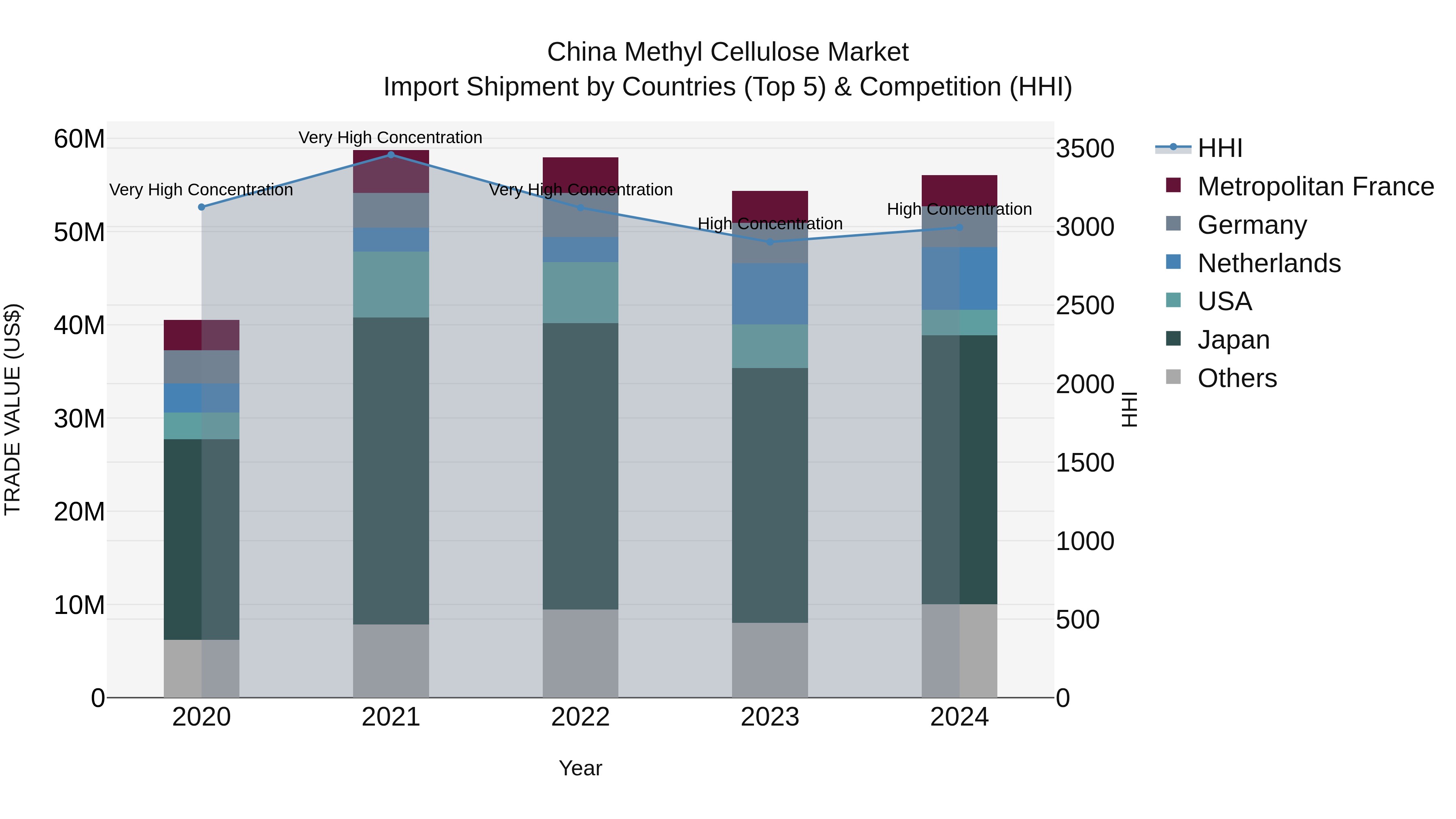
China Methyl Cellulose Market Overview
The China methyl cellulose market is experiencing steady growth, driven by factors such as increasing demand from end-use industries like construction, food and beverage, pharmaceuticals, and personal care. Methyl cellulose is widely used as a thickener, stabilizer, emulsifier, and film-former in various applications. The construction sector is a major consumer of methyl cellulose due to its properties such as water retention and workability enhancement in cement-based products. In the food industry, methyl cellulose is utilized as a food additive for its ability to improve texture and stability. With the growing urbanization and infrastructure development in China, the demand for methyl cellulose is expected to continue rising, presenting opportunities for market players to expand their product offerings and strengthen their market presence.
China Methyl Cellulose Market Trends
The China methyl cellulose market is witnessing several key trends. One prominent trend is the increasing demand for methyl cellulose in the construction industry, particularly in applications such as cement-based tile adhesives and mortars due to its water retention properties and ability to improve workability and adhesion. Additionally, the food and beverage industry in China is also driving growth in the methyl cellulose market, with the ingredient being used as a thickening agent and stabilizer in various products. Another notable trend is the focus on product innovation and development to cater to evolving customer needs and regulatory requirements. Sustainability and eco-friendly production processes are also becoming important considerations for manufacturers in the China methyl cellulose market as they seek to align with global environmental standards.
China Methyl Cellulose Market Challenges
One of the key challenges faced in the China methyl cellulose market is the increasing competition from alternative products and substitutes. As the market for methyl cellulose grows, there is a rising demand for environmentally friendly and cost-effective alternatives, which can pose a threat to the market share of methyl cellulose. Additionally, fluctuations in raw material prices and regulatory constraints can impact the production and pricing of methyl cellulose in China. Furthermore, the need for continuous innovation and product development to meet changing customer preferences and industry standards adds complexity to the market landscape. Overall, navigating these challenges requires companies in the China methyl cellulose market to stay agile, invest in research and development, and maintain strong relationships with suppliers and customers.
China Methyl Cellulose Market Investment Opportunities
The China methyl cellulose market presents various investment opportunities due to the increasing demand for the product across industries such as construction, food and beverage, pharmaceuticals, and personal care. With the growing construction sector in China driving the demand for methyl cellulose in applications like cement and tile adhesives, there is a significant opportunity for investors to capitalize on this trend. Additionally, the expanding food industry in China and the increasing adoption of methyl cellulose as a food additive for its thickening and stabilizing properties further contribute to the market`s growth potential. Investing in companies involved in the production, distribution, or research and development of methyl cellulose in China could offer promising returns for investors looking to tap into this thriving market.
China Methyl Cellulose Market Government Policy
In China, the government has implemented various policies related to the methyl cellulose market to promote sustainable development and regulate the industry. These policies primarily focus on environmental protection, quality control, and market supervision. For instance, the government has set stringent environmental regulations to control pollution from methyl cellulose production processes. Quality control measures ensure that products meet national standards and are safe for consumer use. Additionally, market supervision policies aim to prevent monopolies and promote fair competition among manufacturers. Overall, these government policies play a crucial role in shaping the methyl cellulose market in China by balancing economic growth with environmental protection and consumer safety.
China Methyl Cellulose Market Future Outlook
The future outlook for the China methyl cellulose market appears positive, driven by increasing demand across various end-use industries such as construction, food and beverages, pharmaceuticals, and personal care. The growing construction activities in the region, coupled with the rising disposable income and changing lifestyles, are expected to boost the demand for methyl cellulose in applications like cement and mortar, food thickening agents, drug formulations, and cosmetics. Additionally, the increasing focus on sustainable and eco-friendly products is likely to drive the adoption of methyl cellulose as a green alternative in different sectors. However, factors such as fluctuating raw material prices and regulatory constraints may pose challenges to market growth. Overall, the China methyl cellulose market is poised for expansion in the coming years, supported by evolving industry trends and consumer preferences.
Key Highlights of the Report:
- China Methyl Cellulose Market Outlook
- Market Size of China Methyl Cellulose Market,2024
- Forecast of China Methyl Cellulose Market, 2031
- Historical Data and Forecast of China Methyl Cellulose Revenues & Volume for the Period 2021-2031
- China Methyl Cellulose Market Trend Evolution
- China Methyl Cellulose Market Drivers and Challenges
- China Methyl Cellulose Price Trends
- China Methyl Cellulose Porter's Five Forces
- China Methyl Cellulose Industry Life Cycle
- Historical Data and Forecast of China Methyl Cellulose Market Revenues & Volume By Type for the Period 2021-2031
- Historical Data and Forecast of China Methyl Cellulose Market Revenues & Volume By Powder for the Period 2021-2031
- Historical Data and Forecast of China Methyl Cellulose Market Revenues & Volume By Granules for the Period 2021-2031
- Historical Data and Forecast of China Methyl Cellulose Market Revenues & Volume By Liquid for the Period 2021-2031
- Historical Data and Forecast of China Methyl Cellulose Market Revenues & Volume By Application for the Period 2021-2031
- Historical Data and Forecast of China Methyl Cellulose Market Revenues & Volume By Pharmaceuticals for the Period 2021-2031
- Historical Data and Forecast of China Methyl Cellulose Market Revenues & Volume By Food Additives for the Period 2021-2031
- Historical Data and Forecast of China Methyl Cellulose Market Revenues & Volume By Coatings for the Period 2021-2031
- Historical Data and Forecast of China Methyl Cellulose Market Revenues & Volume By End Use for the Period 2021-2031
- Historical Data and Forecast of China Methyl Cellulose Market Revenues & Volume By Construction for the Period 2021-2031
- Historical Data and Forecast of China Methyl Cellulose Market Revenues & Volume By Personal Care for the Period 2021-2031
- Historical Data and Forecast of China Methyl Cellulose Market Revenues & Volume By Paper & Textiles for the Period 2021-2031
- Historical Data and Forecast of China Methyl Cellulose Market Revenues & Volume By Purity Level for the Period 2021-2031
- Historical Data and Forecast of China Methyl Cellulose Market Revenues & Volume By High Purity for the Period 2021-2031
- Historical Data and Forecast of China Methyl Cellulose Market Revenues & Volume By Industrial Grade for the Period 2021-2031
- Historical Data and Forecast of China Methyl Cellulose Market Revenues & Volume By Low Purity for the Period 2021-2031
- Historical Data and Forecast of China Methyl Cellulose Market Revenues & Volume By Manufacturing Process for the Period 2021-2031
- Historical Data and Forecast of China Methyl Cellulose Market Revenues & Volume By Etherification for the Period 2021-2031
- Historical Data and Forecast of China Methyl Cellulose Market Revenues & Volume By Hydroxypropylation for the Period 2021-2031
- Historical Data and Forecast of China Methyl Cellulose Market Revenues & Volume By Others for the Period 2021-2031
- China Methyl Cellulose Import Export Trade Statistics
- Market Opportunity Assessment By Type
- Market Opportunity Assessment By Application
- Market Opportunity Assessment By End Use
- Market Opportunity Assessment By Purity Level
- Market Opportunity Assessment By Manufacturing Process
- China Methyl Cellulose Top Companies Market Share
- China Methyl Cellulose Competitive Benchmarking By Technical and Operational Parameters
- China Methyl Cellulose Company Profiles
- China Methyl Cellulose Key Strategic Recommendations






































