China MLOps Market Size & Growth Rate (2026-2032)
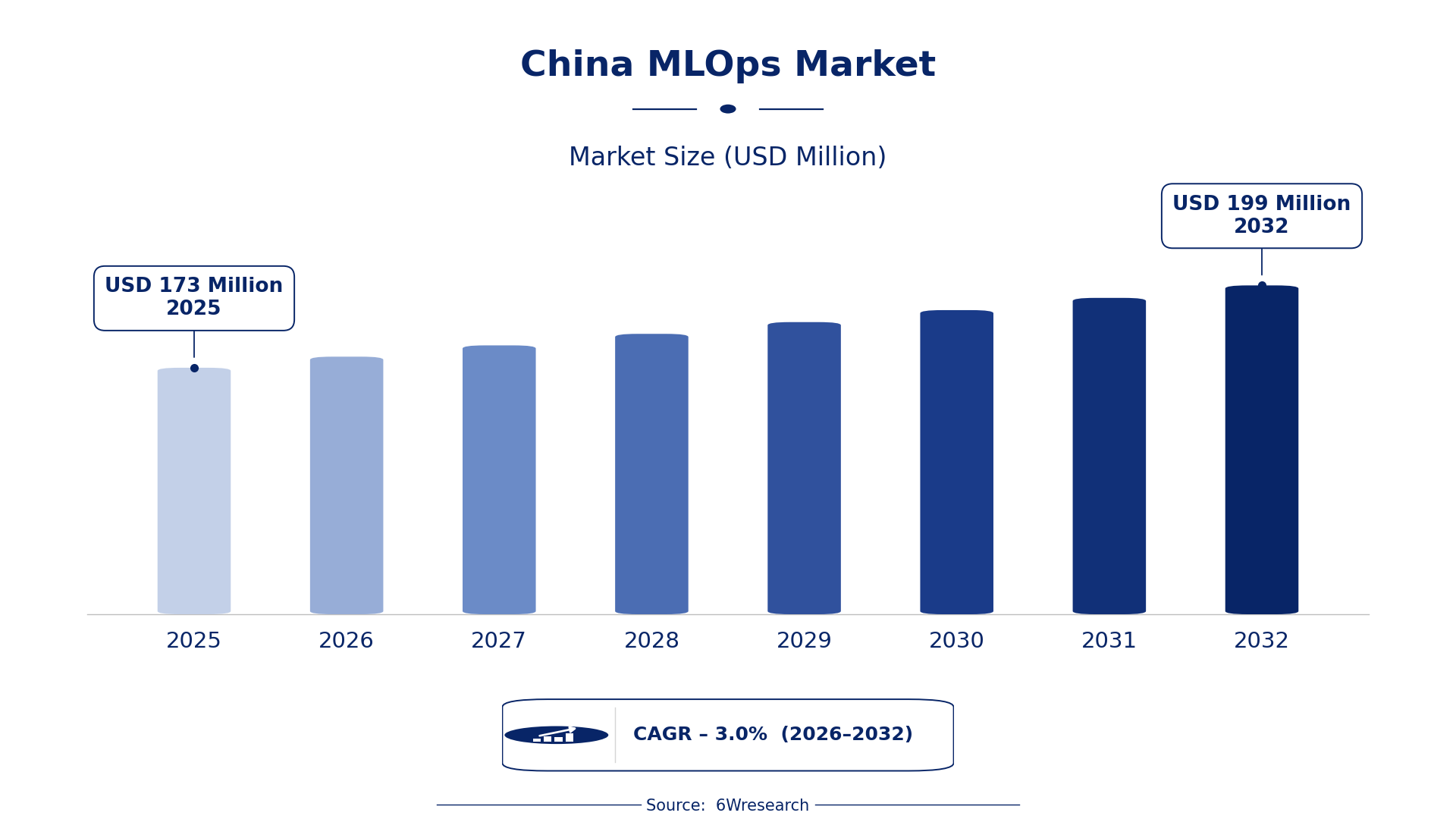
The China MLOps Market was estimated at USD 173 Million in 2025 and is projected to reach USD 199 Million by 2032, growing at a CAGR of 3.0% from 2026 to 2032.
China MLOps Market Synopsis
The adoption of machine learning and artificial intelligence technologies is rapidly transforming various sectors in China, particularly as businesses seek to optimize their operations. MLOps, which focuses on the operationalization of machine learning models, is emerging as a vital component in this technological shift, enabling companies to enhance efficiency and scalability.
As enterprises invest heavily in AI capabilities, the demand for MLOps solutions is surging. Organizations are increasingly aware of the need for streamlined development and deployment processes, fostering collaboration between data science and IT teams, and pushing for automation throughout the machine learning lifecycle.
China MLOps Market Year-wise Growth Rate and Key Drivers
This graph illustrates the annual growth rates of the China MLOps Market from 2021 to 2032, highlighting a steady upward trajectory and projected expansion over the forecast period.
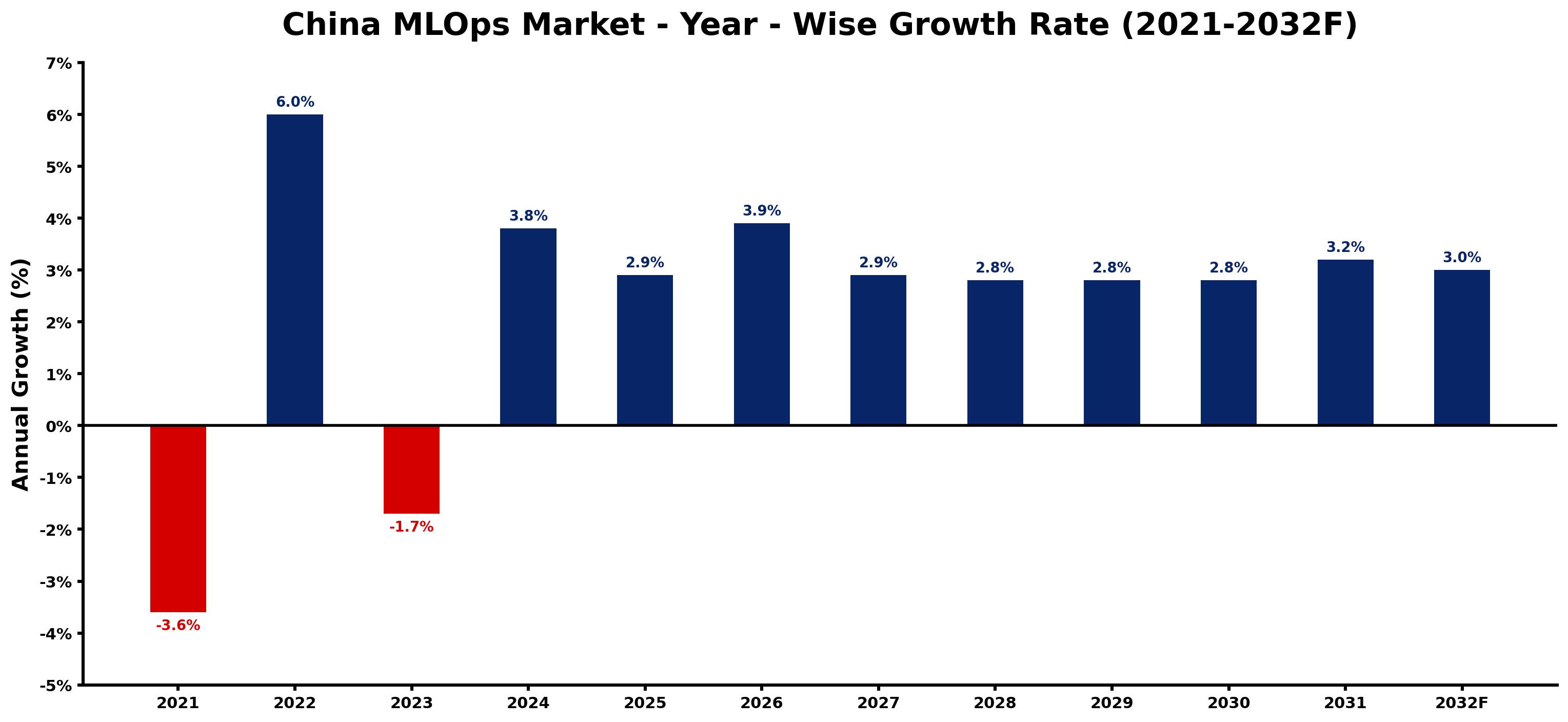
The table below presents the year‑wise growth rates along with the key drivers influencing the market
| Year | Growth Rate | Major Drivers |
| 2021 | -3.6% | Regulatory pressures from China's Ministry of Industry and Information Technology |
| 2022 | 6.0% | AI governance frameworks initiated by the Chinese government. |
| 2023 | -1.7% | Stiff competition from domestic AI service providers. |
| 2024 | 3.8% | Increased investment from major tech firms in AI research. |
| 2025 | 2.9% | Rising adoption of machine learning in local enterprises. |
| 2026 | 3.9% | Supportive policies from MIIT for AI talent development. |
| 2027 | 2.9% | Demand for predictive analytics in manufacturing sectors. |
| 2028 | 2.8% | Chinese businesses leveraging data for competitive advantage. |
| 2029 | 2.8% | Focus on AI ethics influencing development standards. |
| 2030 | 2.8% | Enhanced collaboration between universities and tech startups. |
| 2031 | 3.2% | Export potential of Chinese AI solutions boosting growth. |
| 2032 | 3.0% | Emergence of local AI clusters stimulating innovation. |
Note: Market size estimations and growth projections presented in this report are based on 6Wresearch's proprietary forecasting methodology, utilizing the latest available industry data, government publications, and primary research inputs.
China MLOps Market Key Takeaways
Below are some of the specific key takeaways from the market, including:
- Rapid adoption of AI technologies is driving MLOps demand across multiple industries.
- Collaboration between data scientists and IT operations is becoming essential for project success.
- Automation and scalability are critical factors influencing MLOps solutions development.
- Investment opportunities exist for providers of MLOps platforms, tools, and services.
- Government initiatives are shaping the regulatory environment and supporting industry growth.
Evaluation of Restraints in China MLOps Market
Despite the market's promising outlook, several real constraints hinder its progress. A limited understanding of MLOps practices among organizations poses a significant challenge. Many companies struggle with the lack of skilled professionals, making it difficult to adopt best practices effectively. Data privacy and security concerns also weigh heavily, particularly given China's stringent regulations. on top of that, the rapid pace of technological advancements can overwhelm organizations, complicating their ability to keep up with evolving tools and methodologies.
Cultural factors, such as traditional organizational hierarchies and resistance to change, can further impede MLOps adoption. Addressing these barriers requires a concerted effort, including investments in talent development and the establishment of robust data governance frameworks.
China MLOps Market Trends
Several key trends are shaping the China MLOps market. The surge in AI adoption across sectors like finance, healthcare, and manufacturing is driving demand for solutions that streamline the machine learning lifecycle. As companies work to optimize their models for production deployment, the focus on automation and collaborative practices between data scientists and IT operations teams is intensifying.
Additionally, organizations are increasingly prioritizing model performance and reliability, looking for MLOps solutions that provide comprehensive monitoring and management capabilities. This shift is indicative of a broader trend towards efficiency, as businesses aim to enhance their competitive edge through effective AI integration.
China MLOps Market Opportunities
The China MLOps market presents numerous investment opportunities across various sectors. Companies that specialize in AI and machine learning solutions, cloud computing, and data management are particularly well-positioned to capitalize on the market's growth. As demand for MLOps solutions increases, especially in finance, healthcare, and manufacturing, stakeholders can explore avenues for partnerships and collaborations with local enterprises.
Startups focusing on enhancing AI model deployment, monitoring, and management are also attractive targets for investment. The emphasis on operational efficiency and scalability will drive innovation and growth, creating a fertile environment for new solutions and services.
Government Initiatives in the China MLOps Market
The Chinese government is actively influencing the MLOps market through a series of supportive policies and regulations. With a focus on promoting artificial intelligence technologies, these initiatives aim to ensure ethical practices while fostering innovation. Government backing is crucial as it establishes a framework that encourages businesses to adopt MLOps solutions effectively.
- A recently completed initiative, the "New Generation Artificial Intelligence Development Plan," aims to enhance AI capabilities across sectors.
- Current efforts include the ongoing "Three-Year Action Plan for Promoting the Development of New Generation Artificial Intelligence Industry," which encourages collaboration between public and private sectors.
- Future plans include the introduction of regulatory guidelines that will mandate data privacy and security standards for AI applications.
- A national digital infrastructure upgrade programme is currently in its rollout phase, aimed at enhancing connectivity and data management capabilities.
- Upcoming initiatives are expected to focus on developing educational resources to cultivate talent in the AI and MLOps fields.
Future Insights of the China MLOps Market
Looking ahead to 2026-2032, the China MLOps market is set for considerable expansion. Organizations are increasingly prioritizing the operationalization of machine learning models, driven by the necessity for efficiency and effectiveness. As AI technologies continue to permeate various industries, the demand for advanced analytics solutions will only grow.
With a large and tech-savvy workforce, China is well-equipped to establish itself as a dominant player in the global MLOps market. Companies are realizing the critical role that MLOps plays in the success of their AI initiatives, leading to heightened investment and innovation in this sector.
China MLOps Market Latest Developments
In the past year, the China MLOps market has seen notable activity, reflecting the growing interest and investment in this sector. Companies are increasingly focused on enhancing their MLOps capabilities, with several initiatives and partnerships emerging to meet the demand for efficient AI solutions.
- A major technology vendor announced a partnership with a regional AI startup to co-develop MLOps tools, launched in early 2025 and completed by mid-2025.
- Another leading regional operator is currently rolling out a new MLOps platform aimed at improving model deployment and monitoring processes.
- A comprehensive training program for data scientists and IT professionals is underway, aimed at addressing the skills gap in MLOps practices.
- A planned public-private initiative is expected to be launched in late 2026, focusing on the ethical use of AI technologies in China.
- Recent advancements in cloud computing solutions are enhancing the scalability of MLOps applications, with several providers integrating these technologies into their offerings.
China MLOps Market - Key Attractiveness of the Report
- 10 Years of Market Numbers
- Historical Data Starting from 2022 to 2025
- Base Year: 2025
- Forecast Data until 2032
- Key Performance Indicators Impacting the Market
- Major Upcoming Developments and Projects
Key Highlights of the Report:
- China MLOps Market Outlook
- Market Size of China MLOps Market, 2025
- Forecast of China MLOps Market, 2032
- Historical Data and Forecast of China MLOps Revenues & Volume for the Period 2022-2032F
- China MLOps Market Trend Evolution
- China MLOps Market Drivers and Challenges
- China MLOps Price Trends
- China MLOps Porter's Five Forces
- China MLOps Industry Life Cycle
- Historical Data and Forecast of China MLOps Market Revenues & Volume By Component for the Period 2022-2032F
- Historical Data and Forecast of China MLOps Market Revenues & Volume By Platform for the Period 2022-2032F
- Historical Data and Forecast of China MLOps Market Revenues & Volume By Services for the Period 2022-2032F
- Historical Data and Forecast of China MLOps Market Revenues & Volume By Deployment Mode for the Period 2022-2032F
- Historical Data and Forecast of China MLOps Market Revenues & Volume By Cloud for the Period 2022-2032F
- Historical Data and Forecast of China MLOps Market Revenues & Volume By On-premises for the Period 2022-2032F
- Historical Data and Forecast of China MLOps Market Revenues & Volume By Organization Size for the Period 2022-2032F
- Historical Data and Forecast of China MLOps Market Revenues & Volume By Large Enterprises for the Period 2022-2032F
- Historical Data and Forecast of China MLOps Market Revenues & Volume By SMEs for the Period 2022-2032F
- Historical Data and Forecast of China MLOps Market Revenues & Volume By Vertical for the Period 2022-2032F
- Historical Data and Forecast of China MLOps Market Revenues & Volume By BFSI for the Period 2022-2032F
- Historical Data and Forecast of China MLOps Market Revenues & Volume By Healthcare and Life Sciences for the Period 2022-2032F
- Historical Data and Forecast of China MLOps Market Revenues & Volume By Retail and eCommerce for the Period 2022-2032F
- Historical Data and Forecast of China MLOps Market Revenues & Volume By Telecom for the Period 2022-2032F
- China MLOps Import Export Trade Statistics
- Market Opportunity Assessment By Component
- Market Opportunity Assessment By Deployment Mode
- Market Opportunity Assessment By Organization Size
- Market Opportunity Assessment By Vertical
- China MLOps Top Companies Market Share
- China MLOps Competitive Benchmarking By Technical and Operational Parameters
- China MLOps Company Profiles
- China MLOps Key Strategic Recommendations






































