China Mobile Accelerator Market Size & Growth Rate (2026-2032)
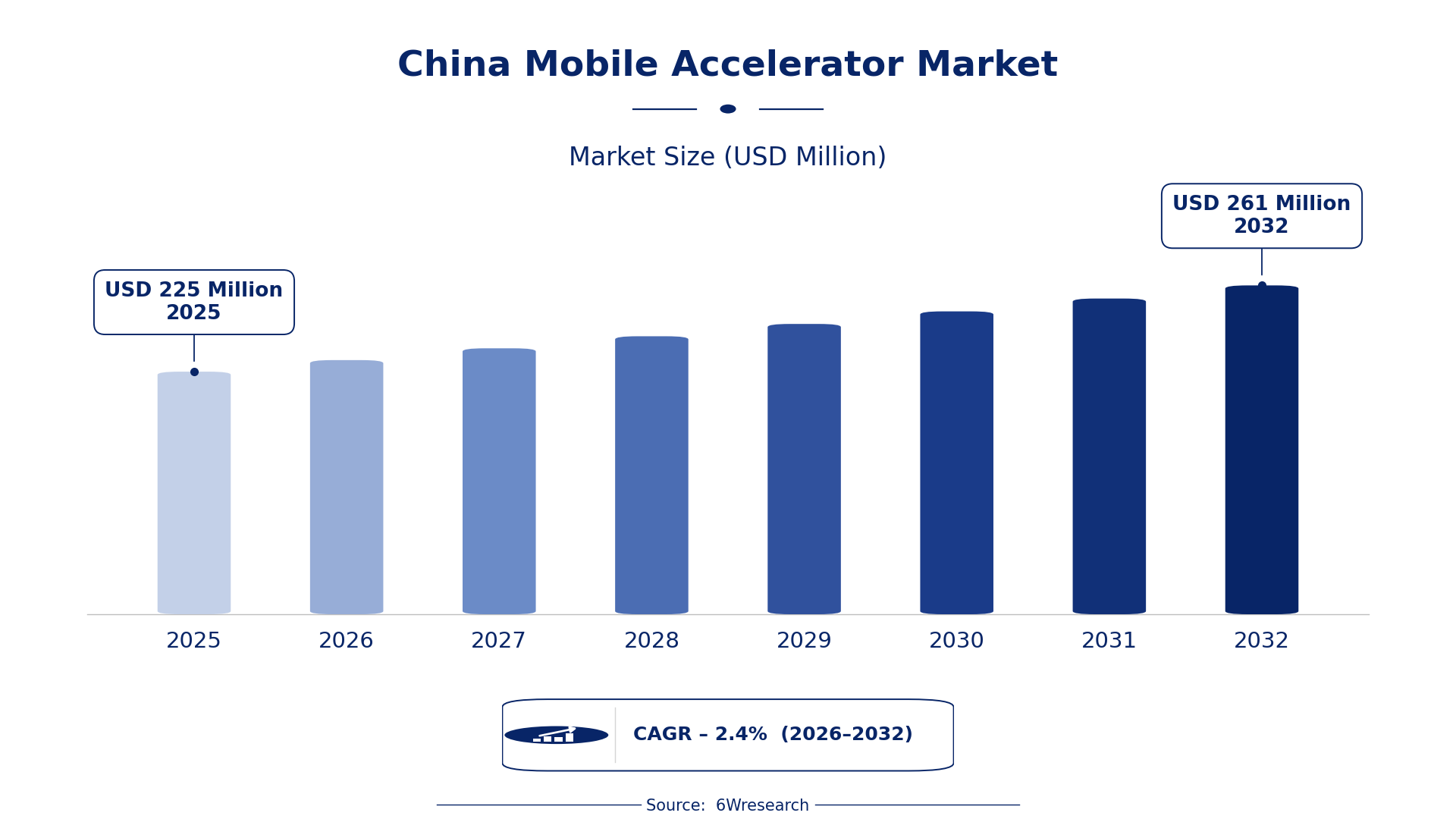
The China Mobile Accelerator Market was estimated at USD 225 Million in 2025 and is projected to reach USD 261 Million by 2032, growing at a CAGR of 2.4% from 2026 to 2032.
China Mobile Accelerator Market Synopsis
The China Mobile Accelerator Market is witnessing a surge in activity, propelled by an expanding startup ecosystem and a strong emphasis on technology innovation. Various mobile accelerators across the region are stepping up to provide essential resources, mentorship, and networking opportunities tailored to meet the needs of burgeoning businesses.
With the rise of industry-specific accelerators, startups are benefitting from targeted programs that cater to sectors like fintech, e-commerce, and healthcare. The support from the government for entrepreneurship and digital transformation is further enhancing the environment for growth, making this market a focal point for investment and innovation.
China Mobile Accelerator Market Year-wise Growth Rate and Key Drivers
This graph illustrates the annual growth rates of the China Mobile Accelerator Market from 2021 to 2032, highlighting a steady upward trajectory and projected expansion over the forecast period.
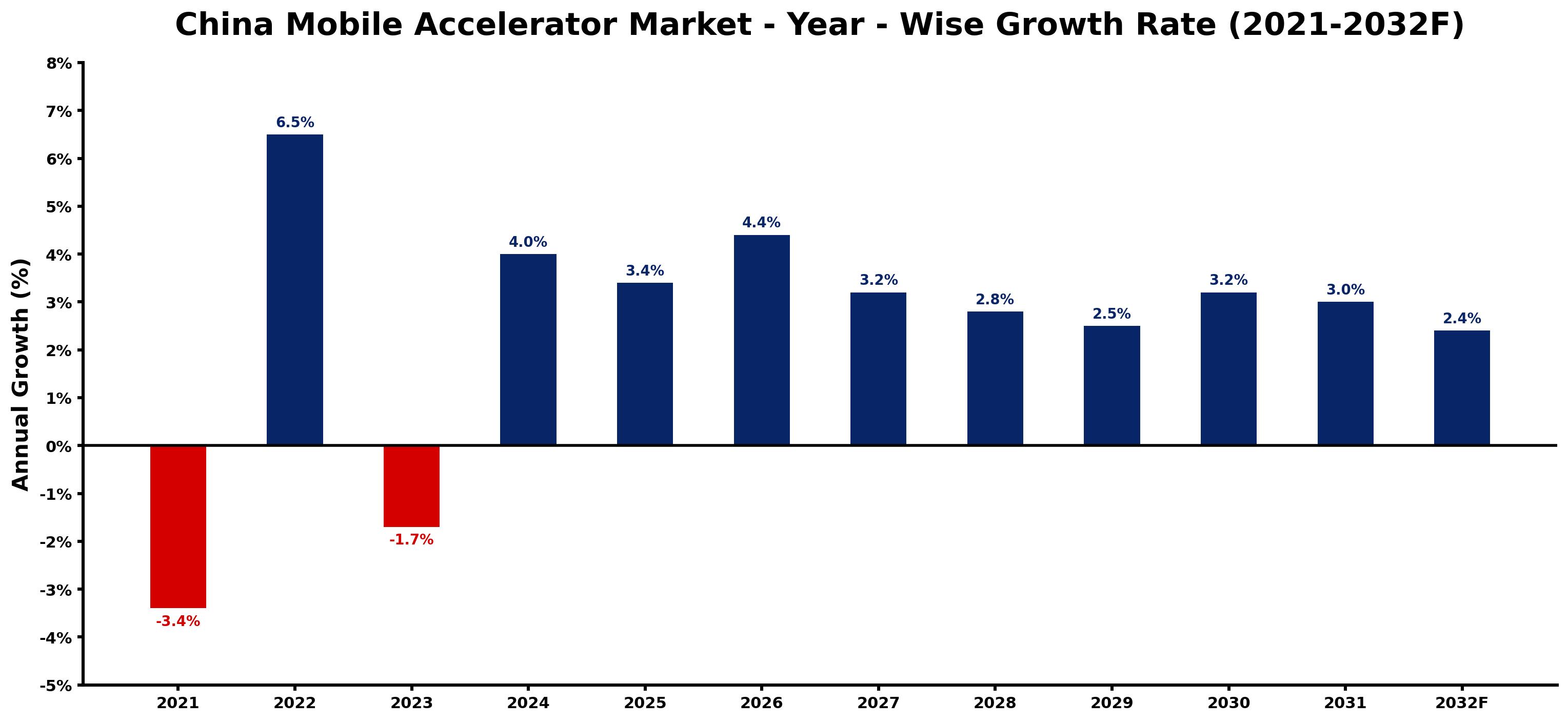
The table below presents the year‑wise growth rates along with the key drivers influencing the market
| Year | Growth Rate | Major Drivers |
| 2021 | -3.4% | Increased restrictions by the Ministry of Industry and Information Technology |
| 2022 | 6.5% | Increased adoption of 5G technology nationwide. |
| 2023 | -1.7% | Decreased demand due to smartphone gaming market maturation |
| 2024 | 4.0% | Mobile payment solutions gaining wider consumer acceptance. |
| 2025 | 3.4% | Rise in mobile gaming driving app development growth. |
| 2026 | 4.4% | Government initiatives fostering tech start-ups in urban areas. |
| 2027 | 3.2% | Surge in mobile health applications post-pandemic. |
| 2028 | 2.8% | Higher smartphone penetration in rural demographics. |
| 2029 | 2.5% | Growing interest in mobile education platforms among youths. |
| 2030 | 3.2% | Supportive regulatory environment for mobile app innovations. |
| 2031 | 3.0% | Emergence of augmented reality applications for retail. |
| 2032 | 2.4% | Increase in cross-border mobile commerce transactions. |
Note: Market size estimations and growth projections presented in this report are based on 6Wresearch's proprietary forecasting methodology, utilizing the latest available industry data, government publications, and primary research inputs.
China Mobile Accelerator Market Key Takeaways
Below are some of the specific key takeaways from the market, including:
- The market is primarily driven by the increasing demand for mobile technologies across various sectors.
- Investments in mobile app development and innovative solutions are on the rise, particularly in AI and blockchain.
- There is a growing trend of startups seeking specialized accelerators to enhance their market readiness.
- Government policies are actively promoting digital transformation and entrepreneurship within the mobile sector.
- Challenges such as intense competition and a lack of standardized success metrics persist in the ecosystem.
Evaluation of Restraints in China Mobile Accelerator Market
The China Mobile Accelerator Market faces notable restraints that hinder its potential. The intense competition among numerous accelerators complicates the landscape, as startups often find it challenging to choose the right program. Additionally, the absence of standardized metrics for measuring the effectiveness of accelerator programs creates uncertainty for both startups and investors. This lack of clarity can diminish the perceived value of participation, making it vital for accelerators to continuously innovate and adapt their offerings to remain competitive.
China Mobile Accelerator Market Trends
Several current trends are shaping the China Mobile Accelerator Market. There's an observable shift towards mobile-first strategies, as businesses aim to enhance customer engagement through innovative mobile solutions. The integration of advanced technologies, such as AI and IoT, is becoming increasingly prevalent, driving demand for specialized accelerator programs. on top of that, the focus on mobile security and data privacy is intensifying, reflecting the growing awareness among consumers and businesses alike.
China Mobile Accelerator Market Opportunities
Opportunities abound for investment in the China Mobile Accelerator Market, particularly in sectors experiencing rapid growth. As the nation continues to lead in mobile innovation, accelerators are well-positioned to attract diverse startups eager to access crucial resources and mentorship. Investors can capitalize on this market by supporting accelerators that foster next-generation mobile technologies, thereby tapping into a dynamic ecosystem ripe for disruption.
Government Initiatives in the China Mobile Accelerator Market
Government policy is a key driver in shaping the China Mobile Accelerator Market, with various initiatives aimed at fostering innovation and supporting startups. Recent regulatory frameworks and financial incentives are designed to create a conducive environment for mobile technology development. These measures are essential for ensuring the sustainable growth of the sector, particularly in the face of evolving technological demands.
- A regulatory framework introduced in 2025 mandates enhanced data security measures for mobile applications.
- A national digital infrastructure upgrade program is currently underway, aimed at improving connectivity across urban and rural areas.
- Recently completed initiatives include tax incentives for startups within the mobile technology sector to stimulate growth.
- A planned public-private partnership is expected to launch in 2026, focusing on expanding access to mobile acceleration resources.
- Current efforts to establish innovation hubs are fostering collaboration between academia and industry, promoting cutting-edge research in mobile technologies.
Future Insights of the China Mobile Accelerator Market
Looking ahead to 2026-2032, the China Mobile Accelerator Market is set to experience substantial growth fueled by ongoing advancements in mobile technologies. The acceleration of digital transformation initiatives will drive demand for innovative solutions across various industries. Additionally, the rise of 5G technology will create new avenues for mobile applications and services, enhancing the competitive landscape for accelerators. As the government continues to emphasize entrepreneurship, the market's potential appears promising for both startups and investors.
China Mobile Accelerator Market Latest Developments
In the last 12-14 months, the China Mobile Accelerator Market has seen a flurry of activity, indicating a robust commitment to fostering innovation and supporting startups. Various accelerators are adapting to the changing landscape by introducing new programs and partnerships that align with emerging technologies.
- A major technology vendor launched a new accelerator program in late 2025, focusing on AI-driven mobile solutions.
- An initiative that began in Q2 2025 is currently underway, aimed at enhancing mentorship programs for startups within the mobile sector.
- A leading regional operator is preparing for a rollout of expanded networking events in early 2026, designed to connect startups with potential investors.
- A public-private collaboration expected to begin in mid-2026 will focus on developing specialized training programs for mobile developers.
- A recent partnership formed in late 2025 is enhancing resources for startups by integrating cloud services into accelerator offerings.
China Mobile Accelerator Market - Key Attractiveness of the Report
- 10 Years of Market Numbers
- Historical Data Starting from 2022 to 2025
- Base Year: 2025
- Forecast Data until 2032
- Key Performance Indicators Impacting the Market
- Major Upcoming Developments and Projects
Key Highlights of the Report:
- China Mobile Accelerator Market Outlook
- Market Size of China Mobile Accelerator Market, 2025
- Forecast of China Mobile Accelerator Market, 2032
- Historical Data and Forecast of China Mobile Accelerator Revenues & Volume for the Period 2022-2032F
- China Mobile Accelerator Market Trend Evolution
- China Mobile Accelerator Market Drivers and Challenges
- China Mobile Accelerator Price Trends
- China Mobile Accelerator Porter's Five Forces
- China Mobile Accelerator Industry Life Cycle
- Historical Data and Forecast of China Mobile Accelerator Market Revenues & Volume By Device for the Period 2022-2032F
- Historical Data and Forecast of China Mobile Accelerator Market Revenues & Volume By Smartphones for the Period 2022-2032F
- Historical Data and Forecast of China Mobile Accelerator Market Revenues & Volume By Tablets for the Period 2022-2032F
- Historical Data and Forecast of China Mobile Accelerator Market Revenues & Volume By Other Devices for the Period 2022-2032F
- Historical Data and Forecast of China Mobile Accelerator Market Revenues & Volume By Type for the Period 2022-2032F
- Historical Data and Forecast of China Mobile Accelerator Market Revenues & Volume By Content/Web Applications for the Period 2022-2032F
- Historical Data and Forecast of China Mobile Accelerator Market Revenues & Volume By Content Delivery Network Acceleration for the Period 2022-2032F
- Historical Data and Forecast of China Mobile Accelerator Market Revenues & Volume By WAN Optimization for the Period 2022-2032F
- Historical Data and Forecast of China Mobile Accelerator Market Revenues & Volume By Mobile Application Accelerator for the Period 2022-2032F
- Historical Data and Forecast of China Mobile Accelerator Market Revenues & Volume By Device/User End Acceleration for the Period 2022-2032F
- Historical Data and Forecast of China Mobile Accelerator Market Revenues & Volume By Other Types for the Period 2022-2032F
- Historical Data and Forecast of China Mobile Accelerator Market Revenues & Volume By Application for the Period 2022-2032F
- Historical Data and Forecast of China Mobile Accelerator Market Revenues & Volume By Gaming Applications for the Period 2022-2032F
- Historical Data and Forecast of China Mobile Accelerator Market Revenues & Volume By M-Commerce Applications for the Period 2022-2032F
- Historical Data and Forecast of China Mobile Accelerator Market Revenues & Volume By Location-based Service Applications for the Period 2022-2032F
- Historical Data and Forecast of China Mobile Accelerator Market Revenues & Volume By Social Networking Applications for the Period 2022-2032F
- Historical Data and Forecast of China Mobile Accelerator Market Revenues & Volume By Music and Messaging Applications for the Period 2022-2032F
- Historical Data and Forecast of China Mobile Accelerator Market Revenues & Volume By Other Applications for the Period 2022-2032F
- China Mobile Accelerator Import Export Trade Statistics
- Market Opportunity Assessment By Device
- Market Opportunity Assessment By Type
- Market Opportunity Assessment By Application
- China Mobile Accelerator Top Companies Market Share
- China Mobile Accelerator Competitive Benchmarking By Technical and Operational Parameters
- China Mobile Accelerator Company Profiles
- China Mobile Accelerator Key Strategic Recommendations






































