China Mobile Security Market Size & Growth Rate (2026-2032)
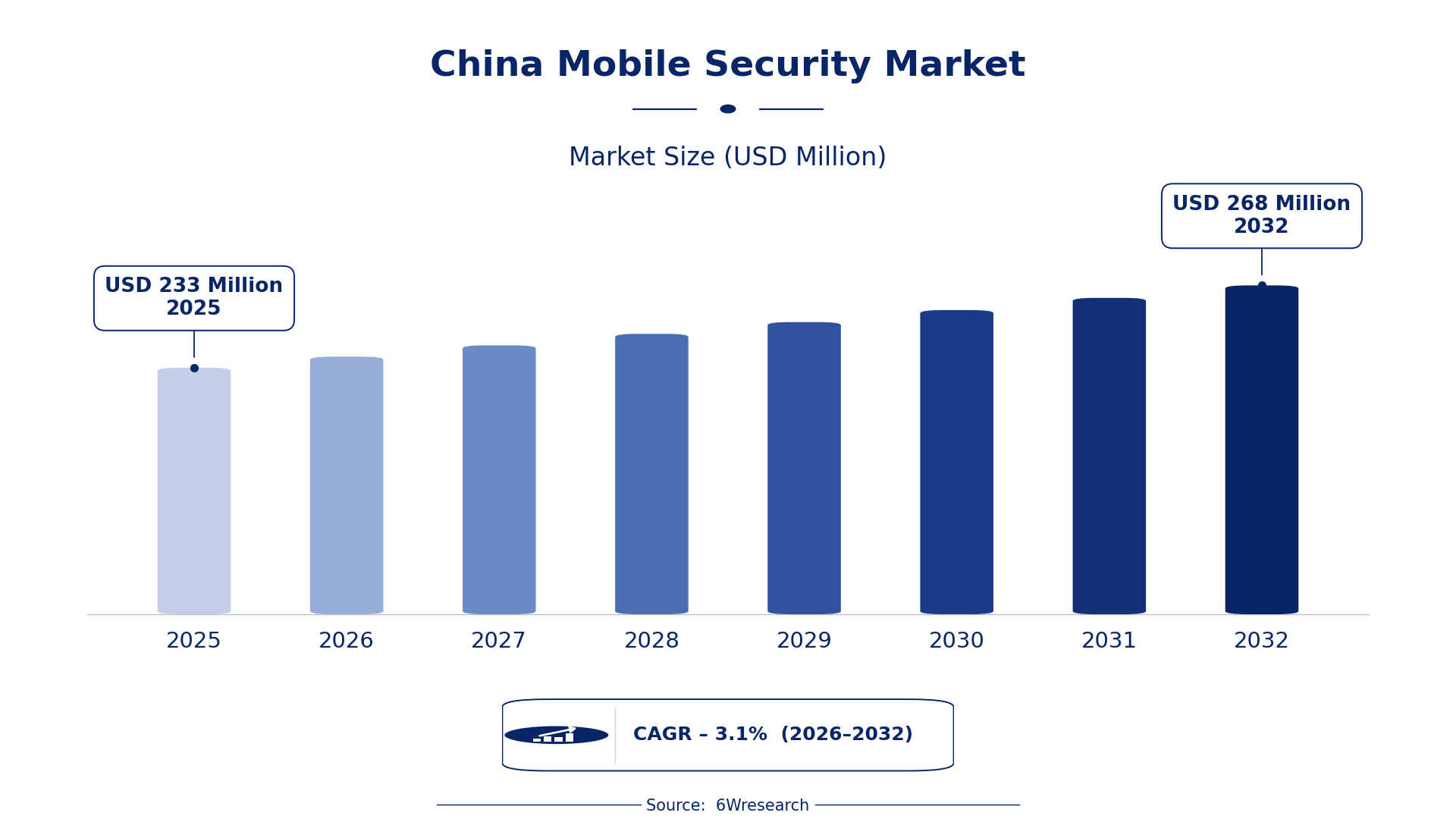
The China Mobile Security Market was estimated at USD 233 Million in 2025 and is projected to reach USD 268 Million by 2032, growing at a CAGR of 3.1% from 2026 to 2032.
China Mobile Security Market Synopsis
In recent years, the China Mobile Security Market has gained significant traction, largely driven by escalating cyber threats and data breach incidents. As mobile device usage continues to surge, the urgency for advanced security measures has become undeniable, pushing both consumers and businesses toward robust mobile security solutions.
Looking ahead, the market faces a challenging environment characterized by fast-changing cyber threats and the complex regulatory landscape. Companies are compelled to innovate continually while ensuring compliance with stringent data protection laws, making it essential to stay ahead of potential vulnerabilities.
China Mobile Security Market Year-wise Growth Rate and Key Drivers
This graph illustrates the annual growth rates of the China Mobile Security Market from 2021 to 2032, highlighting a steady upward trajectory and projected expansion over the forecast period.
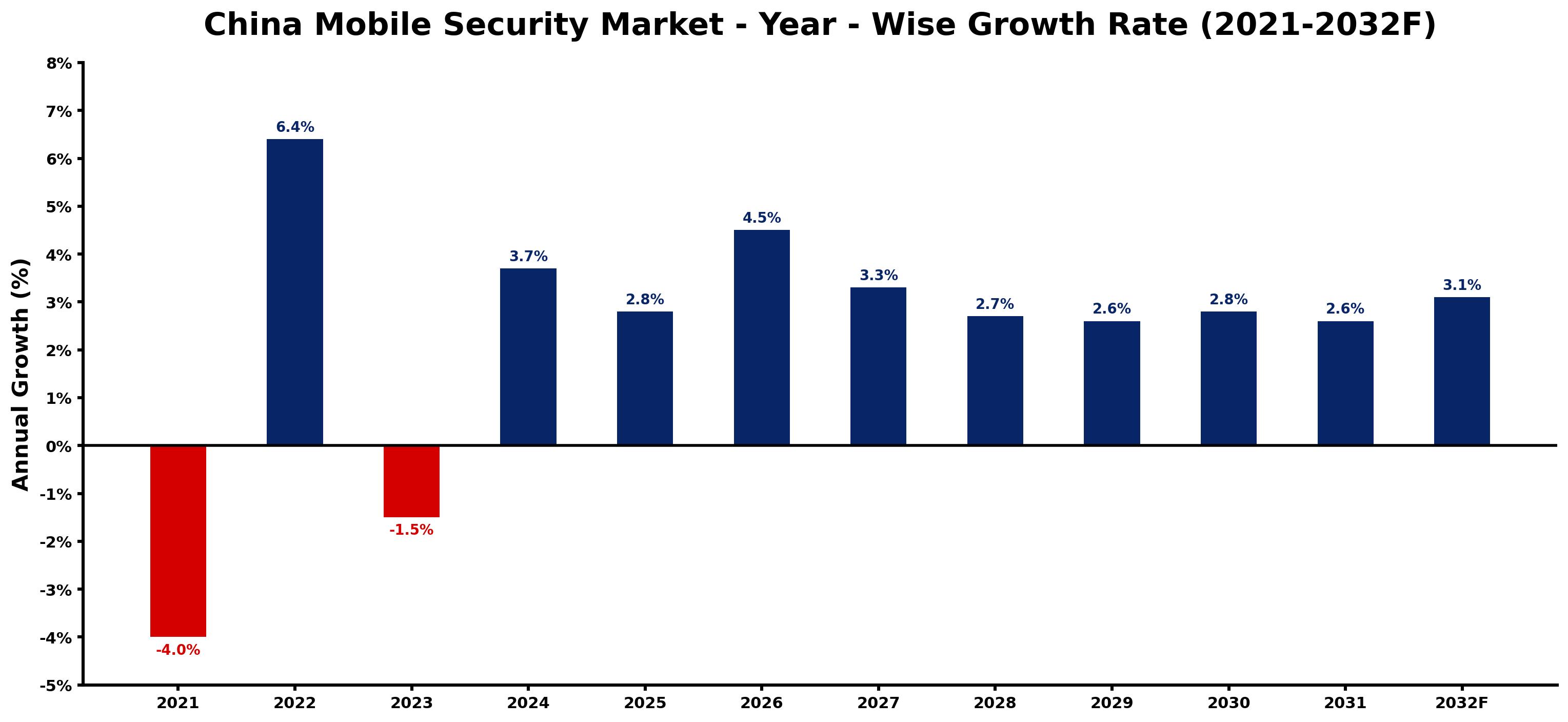
The table below presents the year‑wise growth rates along with the key drivers influencing the market
| Year | Growth Rate | Major Drivers |
| 2021 | -4.0% | Censorship laws limited data protection software growth. |
| 2022 | 6.4% | Implementation of Cybersecurity Law enhancing mobile data protection |
| 2023 | -1.5% | Huawei's 5G expansion hindered local security startups. |
| 2024 | 3.7% | Growing smartphone penetration increases mobile security requirements |
| 2025 | 2.8% | Increased cybersecurity awareness among consumers and businesses |
| 2026 | 4.5% | Government support for digital transformation initiatives boosts security |
| 2027 | 3.3% | Emergence of AI-driven security software tailored for Chinese users |
| 2028 | 2.7% | Rise in online financial services driving security solution adoption |
| 2029 | 2.6% | Increased data privacy regulations prompting security upgrades |
| 2030 | 2.8% | Local cyber threat landscape necessitating enhanced security measures |
| 2031 | 2.6% | Regulatory pressures on mobile apps for user data protection |
| 2032 | 3.1% | Launch of nationwide security awareness campaigns enhancing user engagement |
Note: Market size estimations and growth projections presented in this report are based on 6Wresearch's proprietary forecasting methodology, utilizing the latest available industry data, government publications, and primary research inputs.
China Mobile Security Market Key Takeaways
Below are some of the specific key takeaways from the market, including:
- The market is experiencing steady growth driven by increasing mobile device usage and heightened cybersecurity concerns.
- Technologies like encryption and threat detection are crucial components of mobile security solutions.
- Regulatory compliance is becoming increasingly complex, demanding sophisticated security measures.
- Investment in mobile security technologies is crucial for safeguarding sensitive information and maintaining user trust.
- Innovation in response to rapidly changing cyber threats will define the competitive landscape.
Evaluation of Restraints in China Mobile Security Market
The growth of the China Mobile Security Market is not without its challenges. The rapid advancement of cyber threats means that security solutions must evolve continuously to stay relevant. This creates a daunting task for companies that must innovate while keeping pace with emerging attack vectors.
Additionally, the demand for sophisticated security measures can strain resources, especially for smaller firms. Navigating the complex web of regulatory compliance further complicates matters, as businesses need to align their security practices with national laws while maintaining user confidence in their data protection efforts.
China Mobile Security Market Trends
A noticeable trend is the growing adoption of multi-layered security protocols. Companies are increasingly looking to integrate solutions that combine several defensive measures, like encryption, threat detection, and real-time monitoring. This approach enhances the resilience of mobile devices against cyber threats.
There’s also a shift toward user-centric security models that emphasize end-user education. Companies recognize that even the best technology can fail without informed users, making security awareness training a vital aspect of any mobile security strategy.
China Mobile Security Market Opportunities
Amid the challenges, opportunities abound in the China Mobile Security Market. The rapid digitization of various sectors presents a fertile ground for security providers. Businesses are actively seeking partnerships with security technology firms to enhance their defenses and streamline their compliance processes.
There is significant potential in developing tailored security solutions for specific industries, such as finance and healthcare, where data sensitivity is paramount. on top of that, the rising trend of remote work is prompting organizations to invest in mobile security solutions that ensure secure access to corporate resources.
Government Initiatives in the China Mobile Security Market
Government policies play a crucial role in shaping the dynamics of the China Mobile Security Market. With a keen focus on enhancing cybersecurity standards, the Chinese government has established a framework that promotes the development and adoption of advanced mobile security technologies. Such initiatives not only bolster national security but also align with global data protection standards, making compliance a key priority for businesses.
- A recently launched national cybersecurity awareness campaign aimed at educating businesses about data protection best practices.
- A regulatory framework introduced in 2025 mandating higher security standards for mobile applications, which is currently in enforcement.
- Planned investments in national digital infrastructure upgrades to enhance the security of mobile networks, expected to begin in 2026.
- Ongoing partnerships between government agencies and private tech firms to foster innovation in mobile security solutions.
Future Insights of the China Mobile Security Market
As we approach the end of this decade, the China Mobile Security Market is expected to witness steady growth fueled by technological advancements and regulatory pressures. The integration of artificial intelligence into security solutions will likely emerge as a key trend, enhancing threat detection capabilities and automating responses to incidents.
By 2032, firms that prioritize cybersecurity as a central component of their operational strategy will not only mitigate risks but also gain a competitive advantage in attracting tech-savvy consumers concerned about data privacy.
China Mobile Security Market Latest Developments
In the past year, the China Mobile Security Market has seen a flurry of activity as companies rush to enhance their cybersecurity measures amid increasing threats. Stakeholders are actively collaborating to devise solutions that can keep up with the evolving landscape of mobile security.
- A major technology vendor announced an upgrade to its mobile security suite in early 2025, introducing AI-powered threat detection tools.
- An initiative focused on improving encryption protocols for mobile apps that began in late 2025 and remains ongoing.
- Recent partnerships between telecom operators and cybersecurity firms aimed at integrating security features into mobile networks are currently underway.
- A rollout of a government-backed program expected to begin in Q3 2026, focusing on mobile security training for SMEs.
China Mobile Security Market - Key Attractiveness of the Report
- 10 Years of Market Numbers
- Historical Data Starting from 2022 to 2025
- Base Year: 2025
- Forecast Data until 2032
- Key Performance Indicators Impacting the Market
- Major Upcoming Developments and Projects
Key Highlights of the Report:
- China Mobile Security Market Outlook
- Market Size of China Mobile Security Market, 2025
- Forecast of China Mobile Security Market, 2032
- Historical Data and Forecast of China Mobile Security Revenues & Volume for the Period 2022-2032F
- China Mobile Security Market Trend Evolution
- China Mobile Security Market Drivers and Challenges
- China Mobile Security Price Trends
- China Mobile Security Porter's Five Forces
- China Mobile Security Industry Life Cycle
- Historical Data and Forecast of China Mobile Security Market Revenues & Volume By End User for the Period 2022-2032F
- Historical Data and Forecast of China Mobile Security Market Revenues & Volume By Individual for the Period 2022-2032F
- Historical Data and Forecast of China Mobile Security Market Revenues & Volume By Enterprise (Solution (Authentication, Application Security, & Device Security), Service) for the Period 2022-2032F
- Historical Data and Forecast of China Mobile Security Market Revenues & Volume By Deployment Mode for the Period 2022-2032F
- Historical Data and Forecast of China Mobile Security Market Revenues & Volume By On-premises for the Period 2022-2032F
- Historical Data and Forecast of China Mobile Security Market Revenues & Volume By Cloud for the Period 2022-2032F
- Historical Data and Forecast of China Mobile Security Market Revenues & Volume By Organization Size for the Period 2022-2032F
- Historical Data and Forecast of China Mobile Security Market Revenues & Volume By Small and Medium-Sized Enterprises (SMEs) for the Period 2022-2032F
- Historical Data and Forecast of China Mobile Security Market Revenues & Volume By Large Enterprises for the Period 2022-2032F
- Historical Data and Forecast of China Mobile Security Market Revenues & Volume By Vertical for the Period 2022-2032F
- Historical Data and Forecast of China Mobile Security Market Revenues & Volume By BFSI for the Period 2022-2032F
- Historical Data and Forecast of China Mobile Security Market Revenues & Volume By Telecom & IT for the Period 2022-2032F
- Historical Data and Forecast of China Mobile Security Market Revenues & Volume By Retail for the Period 2022-2032F
- Historical Data and Forecast of China Mobile Security Market Revenues & Volume By Healthcare for the Period 2022-2032F
- Historical Data and Forecast of China Mobile Security Market Revenues & Volume By Government & Defense for the Period 2022-2032F
- Historical Data and Forecast of China Mobile Security Market Revenues & Volume By Manufacturing for the Period 2022-2032F
- Historical Data and Forecast of China Mobile Security Market Revenues & Volume By Others for the Period 2022-2032F
- Historical Data and Forecast of China Mobile Security Market Revenues & Volume By Operating System for the Period 2022-2032F
- Historical Data and Forecast of China Mobile Security Market Revenues & Volume By iOS for the Period 2022-2032F
- Historical Data and Forecast of China Mobile Security Market Revenues & Volume By Android for the Period 2022-2032F
- China Mobile Security Import Export Trade Statistics
- Market Opportunity Assessment By End User
- Market Opportunity Assessment By Deployment Mode
- Market Opportunity Assessment By Organization Size
- Market Opportunity Assessment By Vertical
- Market Opportunity Assessment By Operating System
- China Mobile Security Top Companies Market Share
- China Mobile Security Competitive Benchmarking By Technical and Operational Parameters
- China Mobile Security Company Profiles
- China Mobile Security Key Strategic Recommendations






































