China Multifunctional Composite Materials Market Summary
The china multifunctional composite materials market was estimated at USD 160 Million in 2025 and is projected to reach USD 185 Million by 2032, growing at a CAGR of 4.2% from 2026 to 2032.
China Multifunctional Composite Materials Market Year-wise Growth Rate and Key Drivers
This graph highlights how the China Multifunctional Composite Materials Market has steadily grown over the past five years, supported by major growth factors.
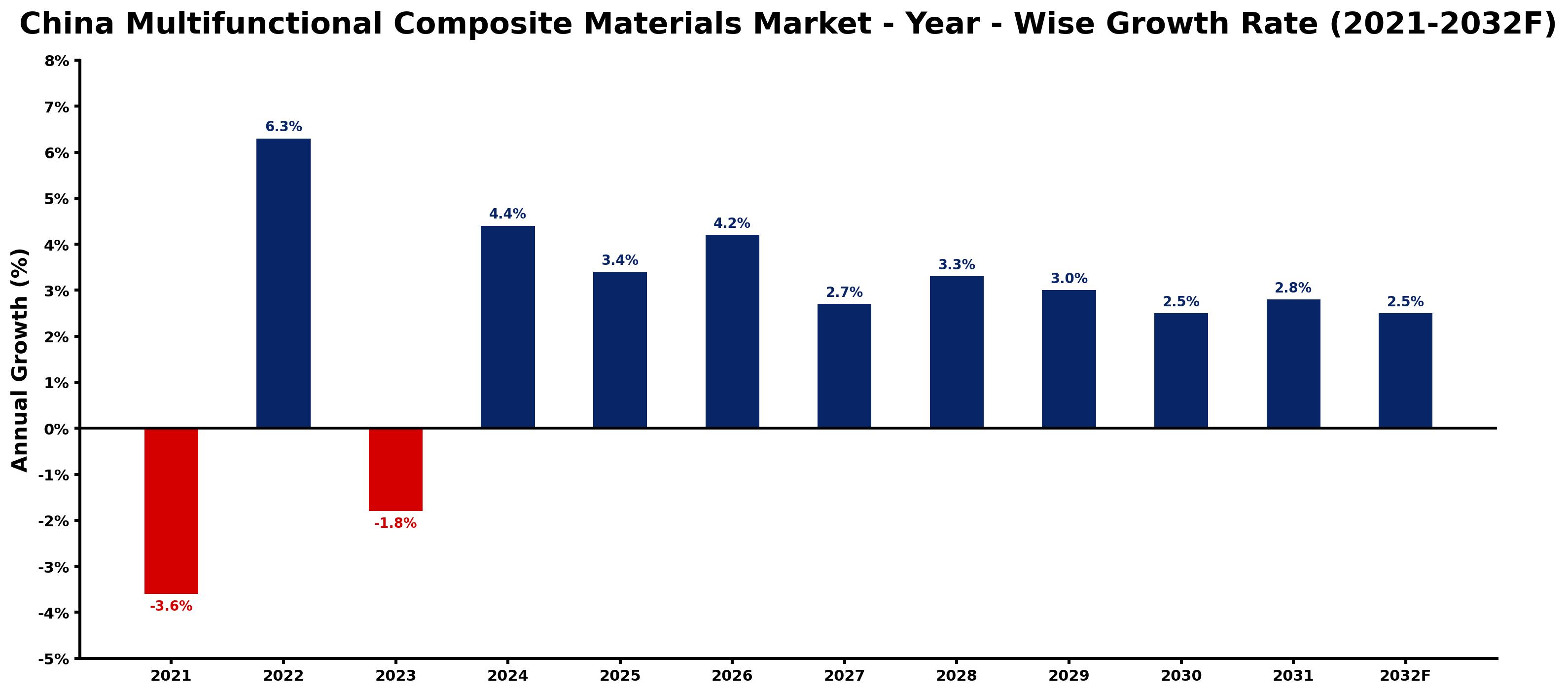
The table below presents the year wise growth rates along with the key drivers influencing the market
| Year | Growth Rate | Major Drivers |
| 2021 | -3.6% | Supply chain disruptions due to pandemicrelated restrictions hindered production capacity and delayed project timelines in the construction sector. |
| 2022 | 6.3% | Sustainability goals are prompting industries to opt for eco-friendly composite solutions. |
| 2023 | -1.8% | Geopolitical tensions led to supply chain disruptions, diminishing market stability for composite materials. |
| 2024 | 4.4% | The demand for energy-efficient building materials aligns with green construction practices. |
| 2025 | 3.4% | Smart manufacturing techniques are revolutionizing the production of composite materials. |
| 2026 | 4.2% | Emerging sectors are integrating multifunctional composites into consumer electronics design. |
| 2027 | 2.7% | Infrastructure expansion plans are favoring advanced materials for enhanced durability. |
| 2028 | 3.3% | Local innovations in composites are addressing specific regional climate challenges effectively. |
| 2029 | 3.0% | Cross-industry collaborations are stimulating growth in composite material applications. |
| 2030 | 2.5% | End-user customization in products is driving the need for versatile composite solutions. |
| 2031 | 2.8% | Global supply chain enhancements are improving access to advanced composite materials. |
| 2032 | 2.5% | Market consolidation among key players is leading to innovative product developments. |
Note - Market size estimations and growth projections presented in this report are based on 6Wresearch's advanced forecasting approach, validated with industry datasets as of June 2026.
China Multifunctional Composite Materials Market Synopsis
The China Multifunctional Composite Materials Market is projected to reach 4.2% and witness significant growth during the forecast period (2026-2032). This expansion is primarily attributed to the increasing demand for advanced materials that possess multiple functionalities across various industries. Multifunctional composites are particularly recognized for their strength-to-weight ratio and additional features such as thermal and electrical conductivity, making them invaluable in critical sectors including aerospace, automotive, and construction.
China Multifunctional Composite Materials Market Growth Drivers
Several key drivers are propelling the growth of the China Multifunctional Composite Materials Market. Firstly, the consistent advancements in materials science are facilitating the development of innovative composite solutions tailored to meet industry-specific needs. Secondly, the rising demand for lightweight yet durable materials in the automotive and aerospace sectors is further increasing the appeal of multifunctional composites. Thirdly, the rapid industrialization in China is driving the necessity for materials that can improve efficiency and reduce operational costs. Moreover, increasing environmental concerns are prompting industries to adopt sustainable materials, which multifunctional composites can often provide. Lastly, investments in research and development aimed at enhancing product performance and versatility are significantly shaping the market landscape.
China Multifunctional Composite Materials Market Challenges and Restraints
Despite the growth potential, the China Multifunctional Composite Materials Market encounters several challenges. One of the primary hurdles is the high cost associated with the development and production of these advanced materials. The research and manufacturing expenses can deter small and medium-sized enterprises from entering the market. Additionally, ensuring the reliability and performance of composite materials in diverse applications poses significant challenges, particularly as emerging technologies evolve. The competition from alternative materials, such as metals and plastics, which may offer cost-effective advantages for specific applications, also poses a significant constraint. Lastly, the market must navigate the complexities of regulatory compliance and industry standards, which can influence product development timelines and costs.
China Multifunctional Composite Materials Market Government Investment and Initiatives
Government policy plays a crucial role in shaping the China Multifunctional Composite Materials Market. The Chinese government is actively investing in initiatives aimed at advancing materials innovation, which includes providing funding for research and development of multifunctional composites. Policies have been established to enhance industry standards regarding safety and performance, ensuring that composite materials meet stringent requirements. Furthermore, the government has implemented incentives to encourage collaboration between academia and industry, fostering an environment conducive to innovation. Efforts are also underway to address sustainability concerns, with the government promoting best practices in composite manufacturing that align with global environmental standards. Through these initiatives, the government is supporting the development of a robust multifunctional composite materials sector in China.
China Multifunctional Composite Materials Market Latest Developments (May 2025 - June 2026)
Recent developments within the China Multifunctional Composite Materials Market reflect a heightened focus on technological advancements and application diversification. During this period, there has been a notable increase in research initiatives aimed at improving the mechanical properties and thermal management capabilities of composites. The sector has also witnessed expanded collaborations between research institutions and industrial players to accelerate innovation. Additionally, the integration of automation in production processes has emerged as a critical trend, enhancing efficiency and reducing manufacturing costs. This phase has also seen an emphasis on sustainability, with companies exploring bio-based composites and recycling methods to minimize environmental impacts. Overall, these developments indicate a dynamic market environment with a clear trajectory towards enhanced performance and sustainability.
China Multifunctional Composite Materials Market - Key Attractiveness of the Report
- 10 Years of Market Numbers
- Historical Data Starting from 2022 to 2025
- Base Year: 2025
- Forecast Data until 2032
- Key Performance Indicators Impacting the Market
- Major Upcoming Developments and Projects
Key Highlights of the Report:
- China Multifunctional Composite Materials Market Outlook
- Market Size of China Multifunctional Composite Materials Market, 2025
- Forecast of China Multifunctional Composite Materials Market, 2032
- Historical Data and Forecast of China Multifunctional Composite Materials Revenues & Volume for the Period 2022-2032F
- China Multifunctional Composite Materials Market Trend Evolution
- China Multifunctional Composite Materials Market Drivers and Challenges
- China Multifunctional Composite Materials Price Trends
- China Multifunctional Composite Materials Porter's Five Forces
- China Multifunctional Composite Materials Industry Life Cycle
- Historical Data and Forecast of China Multifunctional Composite Materials Market Revenues & Volume By Product Type for the Period 2022-2032F
- Historical Data and Forecast of China Multifunctional Composite Materials Market Revenues & Volume By Carbon Fiber for the Period 2022-2032F
- Historical Data and Forecast of China Multifunctional Composite Materials Market Revenues & Volume By Fabrics/Reinforcements for the Period 2022-2032F
- Historical Data and Forecast of China Multifunctional Composite Materials Market Revenues & Volume By Prepregs/Resins for the Period 2022-2032F
- Historical Data and Forecast of China Multifunctional Composite Materials Market Revenues & Volume By Adhesives for the Period 2022-2032F
- Historical Data and Forecast of China Multifunctional Composite Materials Market Revenues & Volume By Honeycomb for the Period 2022-2032F
- Historical Data and Forecast of China Multifunctional Composite Materials Market Revenues & Volume By Other for the Period 2022-2032F
- Historical Data and Forecast of China Multifunctional Composite Materials Market Revenues & Volume By Applications for the Period 2022-2032F
- Historical Data and Forecast of China Multifunctional Composite Materials Market Revenues & Volume By Aerospace Industry for the Period 2022-2032F
- Historical Data and Forecast of China Multifunctional Composite Materials Market Revenues & Volume By Medical Industry for the Period 2022-2032F
- Historical Data and Forecast of China Multifunctional Composite Materials Market Revenues & Volume By Machinery Industry for the Period 2022-2032F
- Historical Data and Forecast of China Multifunctional Composite Materials Market Revenues & Volume By Achitechture Industry for the Period 2022-2032F
- Historical Data and Forecast of China Multifunctional Composite Materials Market Revenues & Volume By Other for the Period 2022-2032F
- China Multifunctional Composite Materials Import Export Trade Statistics
- Market Opportunity Assessment By Product Type
- Market Opportunity Assessment By Applications
- China Multifunctional Composite Materials Top Companies Market Share
- China Multifunctional Composite Materials Competitive Benchmarking By Technical and Operational Parameters
- China Multifunctional Composite Materials Company Profiles
- China Multifunctional Composite Materials Key Strategic Recommendations






































