China Network Slicing Market Size, Share & Growth Rate
The China Network Slicing Market was estimated at USD 235 Million in 2025 and is projected to reach USD 271 Million by 2032, growing at a CAGR of 2.1% from 2026 to 2032. This growth trajectory is driven primarily by the rapid advancement of 5G technology, which empowers telecom operators to develop more innovative and customized network solutions. Additionally, the increasing demand for tailored network services and efficient resource allocation further amplifies the market's potential in China.
China Network Slicing Market Year-wise Growth Rate and Key Drivers
This graph highlights how the China Network Slicing Market has steadily grown over the years, supported by major growth factors.
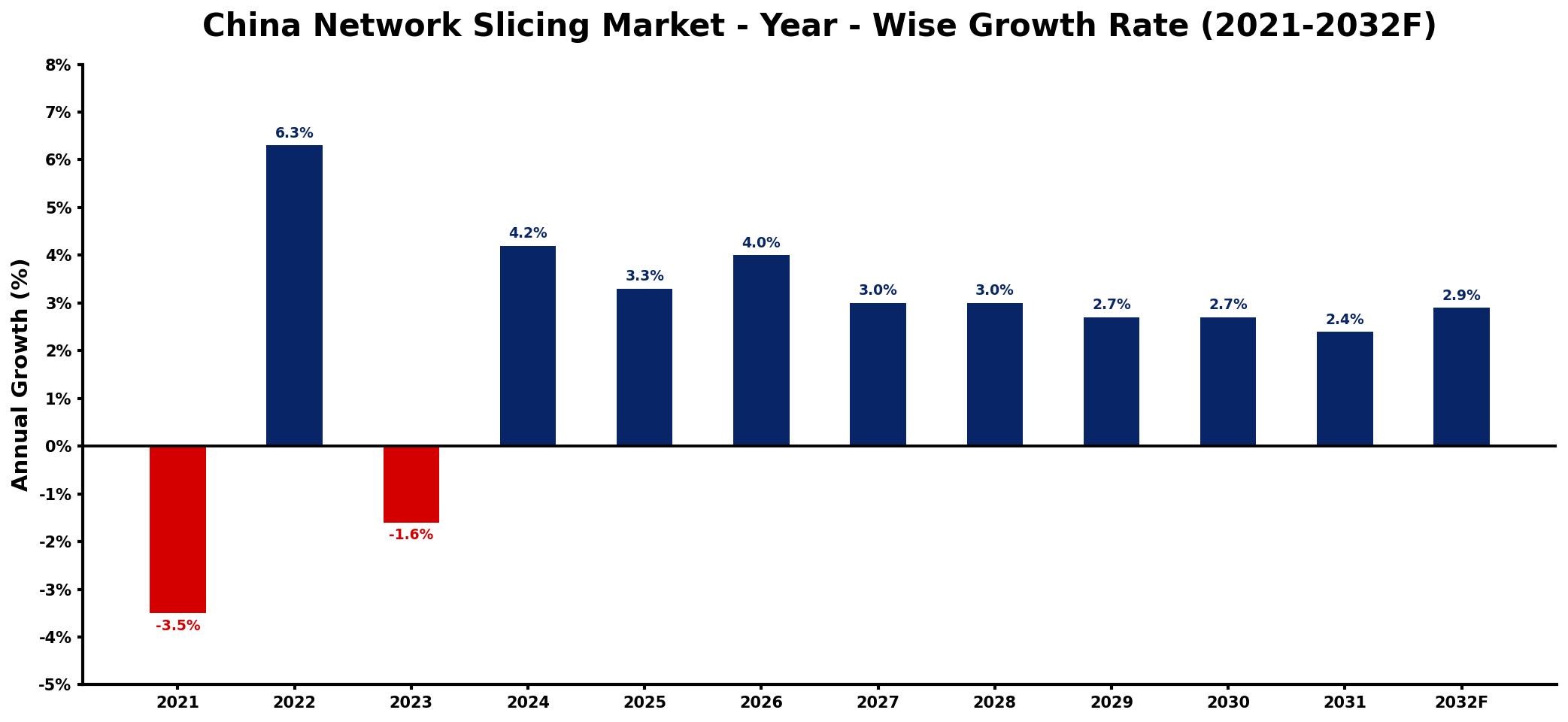
The table below presents the year‑wise growth rates along with the key drivers influencing the market
| Year | Growth Rate | Major Drivers |
| 2021 | -3.5% | reduced enterprise investment in technology |
| 2022 | 6.3% | growing demand for efficient solutions |
| 2023 | -1.6% | reduced domestic production levels |
| 2024 | 4.2% | increased interest in automation technologies |
| 2025 | 3.3% | expansion of digital transformation initiatives |
| 2026 | 4.0% | rising investments in 5G applications |
| 2027 | 3.0% | growing focus on IoT integration |
| 2028 | 3.0% | enhanced emphasis on industry collaboration |
| 2029 | 2.7% | increased demand for tailored services |
| 2030 | 2.7% | growing interest in advanced analytics |
| 2031 | 2.4% | rising need for optimized resources |
| 2032 | 2.9% | improved raw material availability |
Note: Market size estimations and growth projections presented in this report are based on 6Wresearch's proprietary forecasting methodology, utilizing the latest available industry data, government publications, and primary research inputs.
China Network Slicing Market Synopsis
The most significant force shaping the China Network Slicing Market is the accelerating adoption of 5G technology, which provides the necessary infrastructure for efficient network slicing. As telecom providers strive to enhance customer experiences with bespoke network services, the ability to create multiple virtual networks from a single physical infrastructure is proving invaluable.
Another pivotal factor is the ongoing investments from Chinese telecommunications companies in cutting-edge network management solutions. These investments not only facilitate smoother transitions to next-generation network services but also demonstrate a commitment to optimizing network performance through advanced slicing technologies.
China Network Slicing Market Key Takeaways
- The market is buoyed by the integration of advanced 5G technologies, facilitating innovative network services.
- Flexibility and efficiency in network management are key benefits driving adoption among telecom operators.
- Chinese government policies are supportive, promoting advancements and ensuring compliance with industry standards.
- The complexity of deploying network slices represents a substantial challenge for existing infrastructures.
- Continuous improvements in security measures for network slicing are crucial for expanding critical application usage.
Evaluation of Restraints in China Network Slicing Market
The China Network Slicing Market faces several real constraints that hinder its rapid expansion. A significant challenge is the complexity involved in implementing and managing network slices within existing infrastructure, which often results in resource allocation issues and operational inefficiencies. Moreover, security concerns surrounding network slices, particularly in applications vital to public safety or critical services, create hesitance among potential users. These challenges necessitate comprehensive strategies to enhance reliability and trust in network slicing technologies.
China Network Slicing Market Trends
Current trends indicate a strong push towards increased automation in network management processes. This is crucial as the demand for real-time performance monitoring and rapid adjustments to network conditions grows. Additionally, emerging partnerships between technology providers and telecom companies are aimed at fostering innovation in network slicing capabilities, enhancing the overall user experience.
The growing prevalence of Internet of Things (IoT) devices also shapes market demand, with network slicing playing a vital role in efficiently managing the diverse requirements of numerous connected devices. As sectors such as smart cities and industrial automation evolve, the necessity for tailored network solutions will continue to intensify.
China Network Slicing Market Opportunities
Genuine growth opportunities in the China Network Slicing Market lie in targeted investments in advanced slicing technologies. The development of bespoke network solutions tailored to specific industries—such as healthcare, automotive, and entertainment—presents lucrative prospects. Furthermore, with the rising demand for private networks among enterprises, companies that can deliver customized and secure network slices are well-positioned for substantial growth.
Government Initiatives in the China Network Slicing Market
The Chinese government plays an influential role in the network slicing landscape through various regulatory frameworks and initiatives. Policies are aimed at promoting efficient telecommunications and network management practices. Furthermore, public funding is allocated to research and development projects focused on enhancing network slicing technologies. These efforts not only support technological advancements but also ensure that Chinese companies remain competitive on a global scale.
Future Insights of the China Network Slicing Market
As we look toward the future, the China Network Slicing Market is poised for significant evolution from 2026 to 2032. The continued roll-out of 5G infrastructure will expand the capabilities and applications of network slicing, facilitating even more robust service offerings. Anticipated technological advancements in AI and machine learning will also enhance network management efficiency, paving the way for smarter slicing solutions. Overall, the market is set for growth driven by the necessity for customized network experiences and increased operational efficiencies.
China Network Slicing Market Latest Developments (2025 - 2026)
Recent developments in the China Network Slicing Market indicate a trend towards collaborative projects aimed at testing and refining slicing technologies. Telecom operators are exploring new partnerships to optimize slice management solutions, while pilot programs focusing on industry-specific applications are being initiated. These initiatives highlight an industry shift toward practical implementation and a proactive approach to addressing current challenges.
China Network Slicing Market - Key Attractiveness of the Report
- 10 Years of Market Numbers
- Historical Data Starting from 2022 to 2025
- Base Year: 2025
- Forecast Data until 2032
- Key Performance Indicators Impacting the Market
- Major Upcoming Developments and Projects
Key Highlights of the Report:
- China Network Slicing Market Outlook
- Market Size of China Network Slicing Market, 2025
- Forecast of China Network Slicing Market, 2032
- Historical Data and Forecast of China Network Slicing Revenues & Volume for the Period 2022-2032F
- China Network Slicing Market Trend Evolution
- China Network Slicing Market Drivers and Challenges
- China Network Slicing Price Trends
- China Network Slicing Porter's Five Forces
- China Network Slicing Industry Life Cycle
- Historical Data and Forecast of China Network Slicing Market Revenues & Volume By Component for the Period 2022-2032F
- Historical Data and Forecast of China Network Slicing Market Revenues & Volume By Solution for the Period 2022-2032F
- Historical Data and Forecast of China Network Slicing Market Revenues & Volume By Services (Professional & Managed) for the Period 2022-2032F
- Historical Data and Forecast of China Network Slicing Market Revenues & Volume By End User for the Period 2022-2032F
- Historical Data and Forecast of China Network Slicing Market Revenues & Volume By Telecom Operators for the Period 2022-2032F
- Historical Data and Forecast of China Network Slicing Market Revenues & Volume By Enterprises for the Period 2022-2032F
- Historical Data and Forecast of China Network Slicing Market Revenues & Volume By Application for the Period 2022-2032F
- Historical Data and Forecast of China Network Slicing Market Revenues & Volume By Manufacturing for the Period 2022-2032F
- Historical Data and Forecast of China Network Slicing Market Revenues & Volume By Government for the Period 2022-2032F
- Historical Data and Forecast of China Network Slicing Market Revenues & Volume By Automotive for the Period 2022-2032F
- Historical Data and Forecast of China Network Slicing Market Revenues & Volume By Media and Entertainment for the Period 2022-2032F
- China Network Slicing Import Export Trade Statistics
- Market Opportunity Assessment By Component
- Market Opportunity Assessment By End User
- Market Opportunity Assessment By Application
- China Network Slicing Top Companies Market Share
- China Network Slicing Competitive Benchmarking By Technical and Operational Parameters
- China Network Slicing Company Profiles
- China Network Slicing Key Strategic Recommendations






































