China Nitrile Butadiene Rubber Market Top 5 Importing Countries and Market Competition (HHI) Analysis
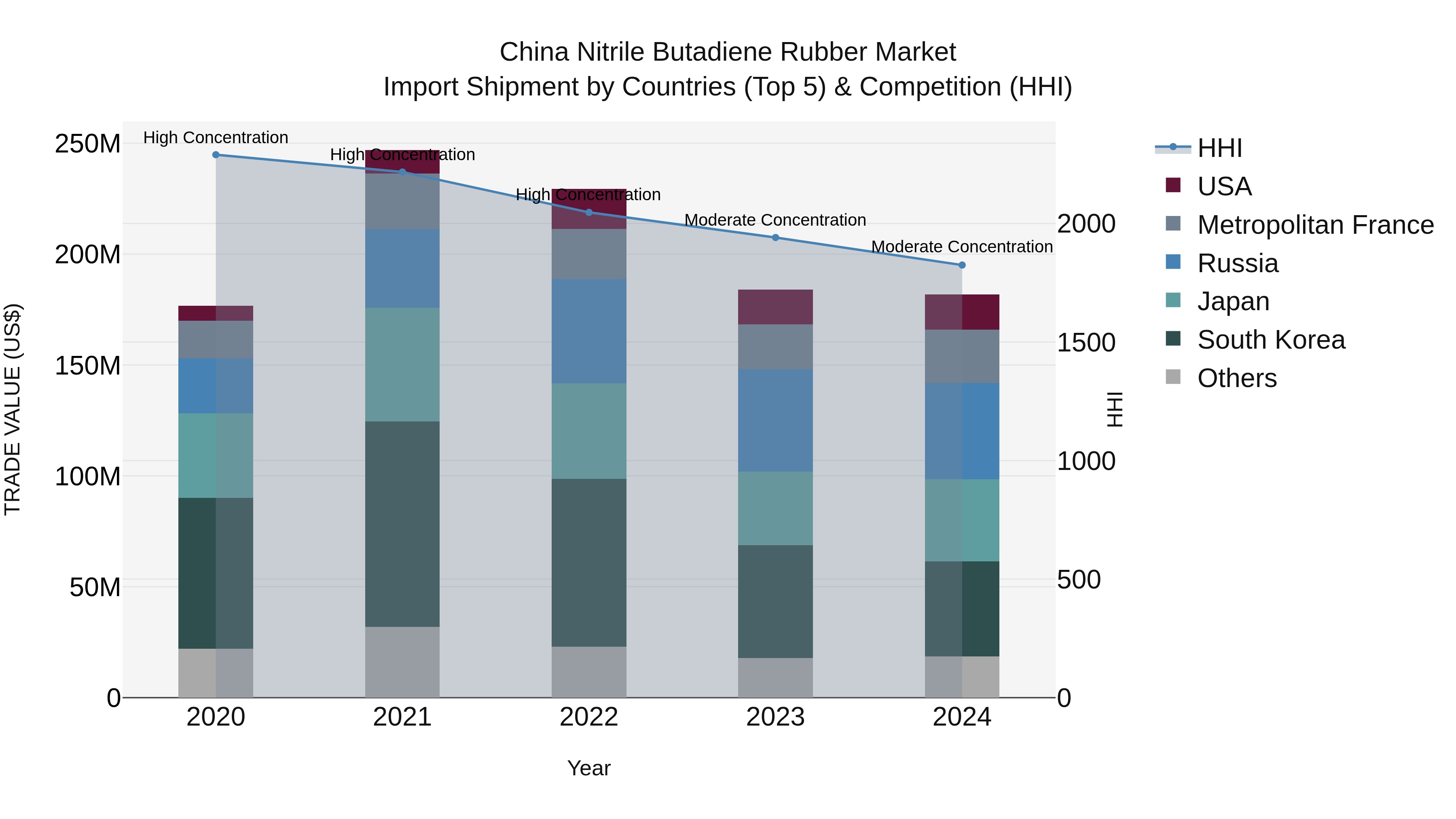
China nitrile butadiene rubber import market in 2024 saw significant contributions from key exporting countries such as Russia, South Korea, Japan, Metropolitan France, and the USA. Despite moderate concentration levels indicated by the Herfindahl-Hirschman Index (HHI), the market displayed steady growth with a compound annual growth rate (CAGR) of 0.72% from 2020 to 2024. However, there was a slight decline in growth rate from 2023 to 2024, with a rate of -1.11%, indicating potential shifts in market dynamics or external factors affecting import trends in the nitrile butadiene rubber sector.
China Nitrile Butadiene Rubber Market Synopsis
The China Nitrile Butadiene Rubber market is witnessing steady growth driven by the increasing demand from industries such as automotive, construction, and healthcare. Nitrile Butadiene Rubber, commonly known as NBR, is a synthetic rubber with excellent oil and chemical resistance properties, making it ideal for manufacturing seals, gaskets, hoses, and gloves. The market is also benefiting from the growing trend towards the use of NBR in various industrial applications due to its durability and versatility. Additionally, government initiatives to promote domestic manufacturing and investments in infrastructure development are further fueling the market growth. Key players in the China Nitrile Butadiene Rubber market include Sinopec, CNPC, and LG Chem among others, focusing on product innovation and strategic partnerships to gain a competitive edge in the market.
China Nitrile Butadiene Rubber Market Trends
The China Nitrile Butadiene Rubber (NBR) market is experiencing several key trends. One significant trend is the increasing demand for NBR in the automotive and industrial sectors due to its excellent oil and chemical resistance properties. Additionally, the growing focus on sustainability and environmental concerns is driving the adoption of eco-friendly and bio-based NBR products in the market. The market is also witnessing a shift towards technological advancements in NBR production processes to enhance product quality and performance. Furthermore, the rising investments in research and development activities to introduce innovative applications of NBR in various end-use industries are contributing to the market`s growth. Overall, the China NBR market is expected to continue expanding driven by these trends.
China Nitrile Butadiene Rubber Market Challenges
The China Nitrile Butadiene Rubber (NBR) market faces several challenges, including fluctuating raw material prices, increasing competition from alternative materials such as natural rubber and ethylene propylene diene monomer (EPDM), and stringent environmental regulations impacting production processes. Additionally, the market is susceptible to global economic trends and trade tensions, which can affect demand and pricing dynamics. Quality control issues and the need for continuous innovation to meet evolving customer requirements also pose challenges for NBR manufacturers in China. Balancing cost efficiency with sustainability initiatives and ensuring consistent supply chain management are crucial considerations for companies operating in this market.
China Nitrile Butadiene Rubber Market Investment Opportunities
The China Nitrile Butadiene Rubber (NBR) market presents several investment opportunities due to increasing demand across various industries such as automotive, construction, and healthcare. With the growing automotive sector in China, NBR is extensively used in manufacturing components like hoses, seals, and gaskets, offering potential for investment in NBR production facilities or companies. Additionally, the construction industry`s reliance on NBR for insulation and sealing applications further boosts investment prospects. The healthcare sector`s increasing use of NBR in medical gloves and equipment also indicates a promising avenue for investment. Overall, investing in the China NBR market can be lucrative given the country`s robust industrial base and the versatile applications of NBR across multiple sectors.
Jordan Agar Market Government Policies
The Chinese government has implemented various policies related to the Nitrile Butadiene Rubber (NBR) market to promote sustainable development and regulate the industry. Some key policies include the promotion of energy efficiency and emission reduction in NBR production processes, as well as the enforcement of environmental protection regulations to minimize pollution. Additionally, the government has also focused on supporting technological innovation and upgrading production capabilities within the NBR industry to enhance competitiveness and quality standards. Furthermore, there have been initiatives to strengthen market supervision, prevent monopolies, and encourage fair competition among NBR manufacturers to foster a healthy market environment. Overall, these policies aim to balance economic growth with environmental concerns and ensure the long-term sustainability of the NBR market in China.
China Nitrile Butadiene Rubber Market Future Outlook
The future outlook for the China Nitrile Butadiene Rubber (NBR) market appears promising due to increasing demand from various end-use industries such as automotive, construction, and healthcare. The growing focus on industrialization and infrastructure development in China is expected to drive the demand for NBR, which is widely used in the manufacturing of automotive parts, cables, hoses, and medical gloves. Additionally, the rising awareness regarding the benefits of NBR, such as its resistance to oil, chemicals, and abrasion, is likely to further propel market growth. However, factors such as volatility in raw material prices and environmental concerns related to the production process may pose challenges to the market expansion. Overall, the China NBR market is anticipated to witness steady growth in the coming years, supported by increasing industrial activities and technological advancements.
Key Highlights of the Report:
- China Nitrile Butadiene Rubber Market Outlook
- Market Size of China Nitrile Butadiene Rubber Market, 2021
- Forecast of China Nitrile Butadiene Rubber Market, 2031
- Historical Data and Forecast of China Nitrile Butadiene Rubber Revenues & Volume for the Period 2018 - 2031
- China Nitrile Butadiene Rubber Market Trend Evolution
- China Nitrile Butadiene Rubber Market Drivers and Challenges
- China Nitrile Butadiene Rubber Price Trends
- China Nitrile Butadiene Rubber Porter's Five Forces
- China Nitrile Butadiene Rubber Industry Life Cycle
- Historical Data and Forecast of China Nitrile Butadiene Rubber Market Revenues & Volume By Product for the Period 2018 - 2031
- Historical Data and Forecast of China Nitrile Butadiene Rubber Market Revenues & Volume By Hoses for the Period 2018 - 2031
- Historical Data and Forecast of China Nitrile Butadiene Rubber Market Revenues & Volume By Belts for the Period 2018 - 2031
- Historical Data and Forecast of China Nitrile Butadiene Rubber Market Revenues & Volume By Cables for the Period 2018 - 2031
- Historical Data and Forecast of China Nitrile Butadiene Rubber Market Revenues & Volume By Molded & Extruded Products for the Period 2018 - 2031
- Historical Data and Forecast of China Nitrile Butadiene Rubber Market Revenues & Volume By Seals & O-rings for the Period 2018 - 2031
- Historical Data and Forecast of China Nitrile Butadiene Rubber Market Revenues & Volume By Rubber Compounds for the Period 2018 - 2031
- Historical Data and Forecast of China Nitrile Butadiene Rubber Market Revenues & Volume By Adhesives & Sealants for the Period 2018 - 2031
- Historical Data and Forecast of China Hoses Nitrile Butadiene Rubber Market Revenues & Volume By Gloves for the Period 2018 - 2031
- Historical Data and Forecast of China Nitrile Butadiene Rubber Market Revenues & Volume By End-Use for the Period 2018 - 2031
- Historical Data and Forecast of China Nitrile Butadiene Rubber Market Revenues & Volume By Automotive for the Period 2018 - 2031
- Historical Data and Forecast of China Nitrile Butadiene Rubber Market Revenues & Volume By Mechanical Engineering for the Period 2018 - 2031
- Historical Data and Forecast of China Nitrile Butadiene Rubber Market Revenues & Volume By Oil & Gas for the Period 2018 - 2031
- Historical Data and Forecast of China Nitrile Butadiene Rubber Market Revenues & Volume By Metallurgy & Mining for the Period 2018 - 2031
- Historical Data and Forecast of China Nitrile Butadiene Rubber Market Revenues & Volume By Construction for the Period 2018 - 2031
- Historical Data and Forecast of China Nitrile Butadiene Rubber Market Revenues & Volume By Medical for the Period 2018 - 2031
- Historical Data and Forecast of China Nitrile Butadiene Rubber Market Revenues & Volume By Others for the Period 2018 - 2031
- China Nitrile Butadiene Rubber Import Export Trade Statistics
- Market Opportunity Assessment By Product
- Market Opportunity Assessment By End-Use
- China Nitrile Butadiene Rubber Top Companies Market Share
- China Nitrile Butadiene Rubber Competitive Benchmarking By Technical and Operational Parameters
- China Nitrile Butadiene Rubber Company Profiles
- China Nitrile Butadiene Rubber Key Strategic Recommendations






































