China Oil and Gas Cloud Applications Market Size & Growth Rate (2026-2032)
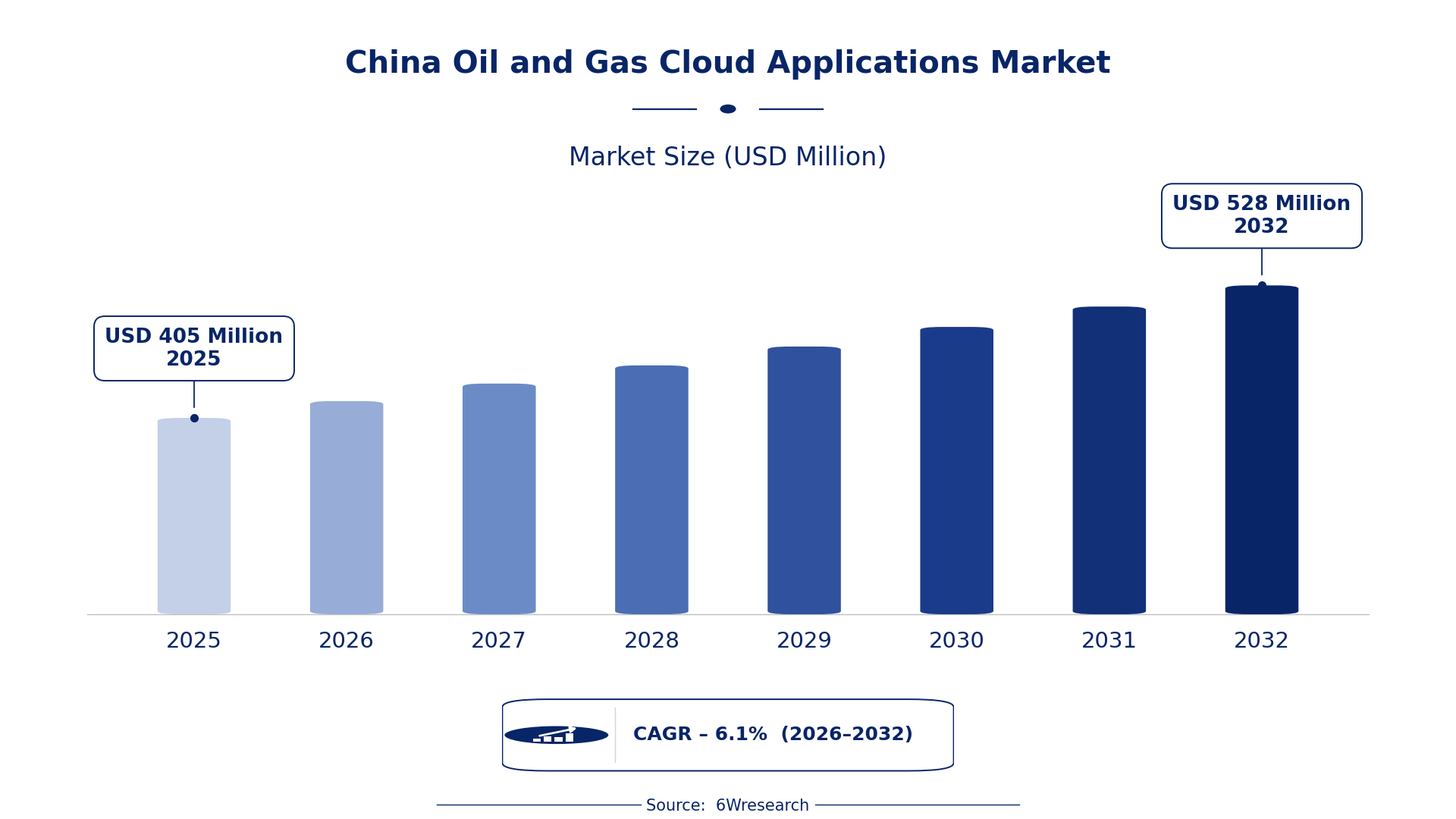
The China Oil and Gas Cloud Applications Market was estimated at USD 405 Million in 2025 and is projected to reach USD 528 Million by 2032, growing at a CAGR of 6.1% from 2026 to 2032.
China Oil and Gas Cloud Applications Market Synopsis
China's oil and gas sector is undergoing a digital transformation, with cloud applications becoming integral to enhancing operational efficiency. Major players in this market are increasingly adopting solutions that enable real-time data analytics, asset management, and remote monitoring, which are essential for competitive advantage.
The demand for these applications is fueled by a pressing need for improved data integration and accessibility. As companies strive to optimize their operations, cloud technologies offer a cost-effective pathway to achieve digital maturity, ultimately reshaping how the oil and gas industry operates in China.
China Oil and Gas Cloud Applications Market Year-wise Growth Rate and Key Drivers
This graph illustrates the annual growth rates of the China Oil and Gas Cloud Applications Market from 2021 to 2032, highlighting a steady upward trajectory and projected expansion over the forecast period.
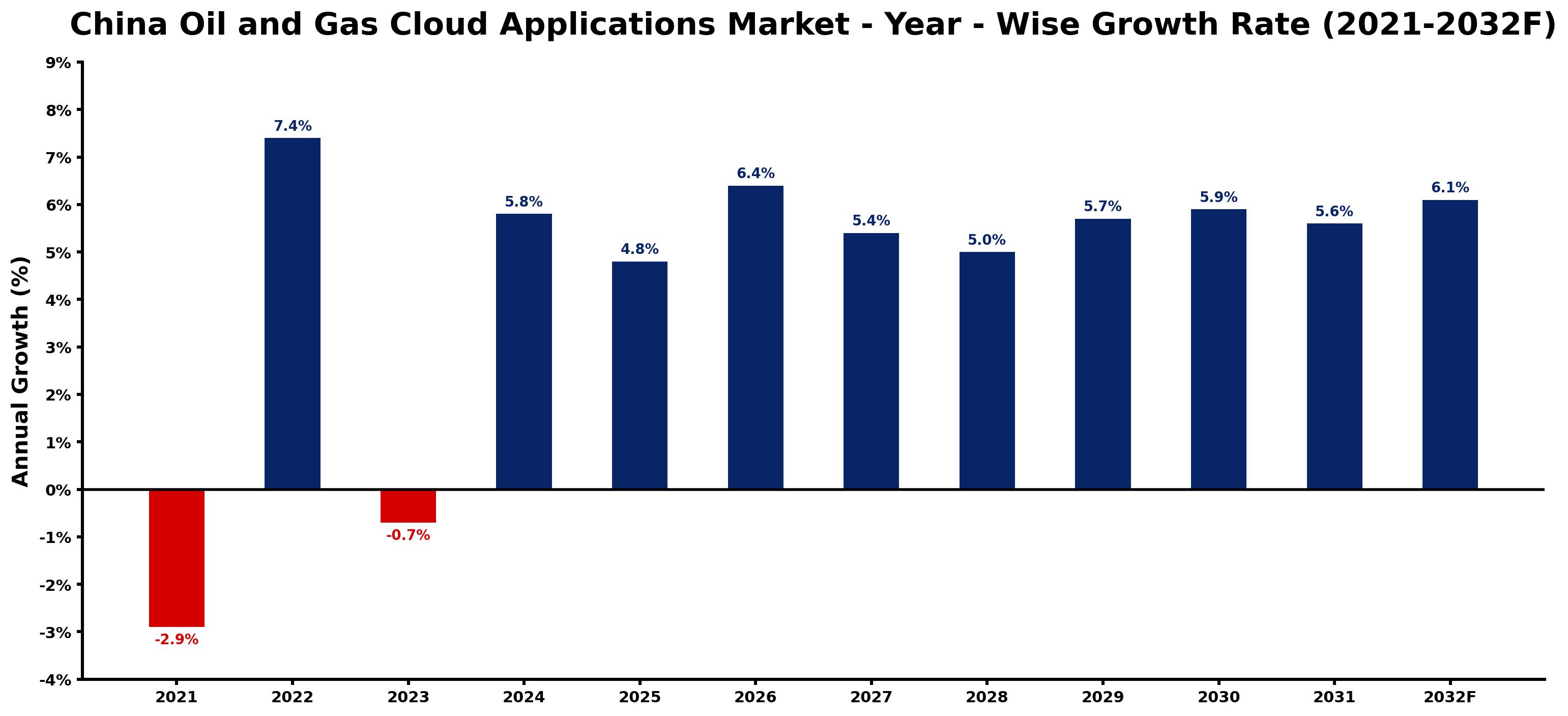
The table below presents the year‑wise growth rates along with the key drivers influencing the market
| Year | Growth Rate | Major Drivers |
| 2021 | -2.9% | National Energy Administration's stricter emissions regulations imposed |
| 2022 | 7.4% | State support for digital transformation in oil sector |
| 2023 | -0.7% | Decreased investment due to ongoing geopolitical tensions affecting imports |
| 2024 | 5.8% | Increased adoption of IoT technologies by oil companies |
| 2025 | 4.8% | Focus on energy efficiency drives cloud application usage |
| 2026 | 6.4% | Government incentives for cloud adoption in energy firms |
| 2027 | 5.4% | Rising data security regulations stimulate cloud solutions |
| 2028 | 5.0% | Growing investment in AI analytics for oil exploration |
| 2029 | 5.7% | Collaboration between tech firms and oil operators expands |
| 2030 | 5.9% | Push for greener technologies increases cloud software demand |
| 2031 | 5.6% | Integration of blockchain for supply chain transparency |
| 2032 | 6.1% | Enhanced predictive maintenance applications adopted widely |
Note: Market size estimations and growth projections presented in this report are based on 6Wresearch's proprietary forecasting methodology, utilizing the latest available industry data, government publications, and primary research inputs.
China Oil and Gas Cloud Applications Market Key Takeaways
Below are some of the specific key takeaways from the market, including:
- The increasing adoption of cloud solutions is a primary driver for market growth.
- Real-time analytics capabilities are revolutionizing decision-making processes.
- Cost savings from cloud applications are attracting investments from industry stakeholders.
- Government policies are promoting technology innovation within the sector.
- Data security and integration challenges remain key concerns for companies.
Evaluation of Restraints in China Oil and Gas Cloud Applications Market
Despite the promising outlook, the China Oil and Gas Cloud Applications Market faces several restraints. A significant challenge is the integration of cloud solutions into existing infrastructure, which can be complex and resource-intensive. Additionally, companies are grappling with data security concerns; the reliance on cloud services raises questions about the reliability and integrity of critical operations. As organizations strive for digital transformation, these factors can impede swift adoption and implementation.
China Oil and Gas Cloud Applications Market Trends
The market is currently witnessing a shift towards advanced data analytics capabilities. Companies are increasingly investing in AI-driven cloud applications that enhance predictive maintenance and operational efficiency. on top of that, the trend of remote monitoring solutions is gaining traction, enabling firms to manage assets from anywhere, a necessity highlighted by recent global disruptions.
The digitalization wave is also prompting collaborations between oil and gas firms and technology providers, leading to innovative cloud-based solutions tailored to the industry's unique requirements. This synergy is essential for addressing the complex demands of modern energy management.
China Oil and Gas Cloud Applications Market Opportunities
There are significant growth opportunities within the China Oil and Gas Cloud Applications Market, particularly in the area of integrated solutions. Companies that can offer comprehensive platforms that combine data management, analytics, and operational tools stand to gain a competitive edge. Additionally, as regulatory frameworks evolve to support digital innovation, firms can explore new business models that leverage cloud capabilities to enhance service delivery and customer engagement.
Government Initiatives in the China Oil and Gas Cloud Applications Market
Government policy is a vital factor influencing the development of the oil and gas cloud applications market in China. The state is actively promoting technology innovation and the integration of cloud services in the energy sector, establishing standards for performance and security that align with industry needs.
- A recent initiative launched in 2025 aims to enhance digital infrastructure across the oil and gas sector, focusing on cloud computing capabilities.
- Current efforts include the rollout of a regulatory framework that mandates improved data security protocols for cloud applications.
- Plans are underway for a public-private partnership expected to foster investment in advanced cloud technologies by 2027.
- The government has introduced funding programs to support research in cloud-based solutions specifically tailored for the energy sector.
Future Insights of the China Oil and Gas Cloud Applications Market
Looking ahead to 2026-2032, the China Oil and Gas Cloud Applications Market is set for substantial growth. As digital transformation continues to gain momentum, companies will increasingly rely on cloud technologies to streamline operations and drive efficiency. The ongoing investment in data analytics and AI integration will enhance operational capabilities, providing firms with tools to respond dynamically to market challenges. With a supportive regulatory environment, the path is clear for innovative solutions to reshape the industry.
China Oil and Gas Cloud Applications Market Latest Developments
In the past year, the China Oil and Gas Cloud Applications Market has seen a surge in activity as companies adapt to new technologies and methodologies. This shift is characterized by significant investments in cloud solutions and strategic partnerships aimed at enhancing operational efficiency.
- A major technology vendor began deploying a new cloud-based asset management system in early 2025, aimed at improving operational oversight.
- In mid-2025, a leading regional operator initiated a project to upgrade its data analytics capabilities using advanced cloud solutions, which is currently underway.
- By late 2026, a public-private initiative is expected to launch, focusing on creating standardized cloud solutions for the oil and gas sector.
- Recently, a consortium of industry players completed a pilot program testing integrated cloud applications for real-time monitoring.
China Oil and Gas Cloud Applications Market - Key Attractiveness of the Report
- 10 Years of Market Numbers
- Historical Data Starting from 2022 to 2025
- Base Year: 2025
- Forecast Data until 2032
- Key Performance Indicators Impacting the Market
- Major Upcoming Developments and Projects
Key Highlights of the Report:
- China Oil and Gas Cloud Applications Market Outlook
- Market Size of China Oil and Gas Cloud Applications Market, 2025
- Forecast of China Oil and Gas Cloud Applications Market, 2032
- Historical Data and Forecast of China Oil and Gas Cloud Applications Revenues & Volume for the Period 2022-2032F
- China Oil and Gas Cloud Applications Market Trend Evolution
- China Oil and Gas Cloud Applications Market Drivers and Challenges
- China Oil and Gas Cloud Applications Price Trends
- China Oil and Gas Cloud Applications Porter's Five Forces
- China Oil and Gas Cloud Applications Industry Life Cycle
- Historical Data and Forecast of China Oil and Gas Cloud Applications Market Revenues & Volume By Component for the Period 2022-2032F
- Historical Data and Forecast of China Oil and Gas Cloud Applications Market Revenues & Volume By Solution for the Period 2022-2032F
- Historical Data and Forecast of China Oil and Gas Cloud Applications Market Revenues & Volume By Services for the Period 2022-2032F
- Historical Data and Forecast of China Oil and Gas Cloud Applications Market Revenues & Volume By Deployment Type for the Period 2022-2032F
- Historical Data and Forecast of China Oil and Gas Cloud Applications Market Revenues & Volume By Private for the Period 2022-2032F
- Historical Data and Forecast of China Oil and Gas Cloud Applications Market Revenues & Volume By Public Cloud for the Period 2022-2032F
- Historical Data and Forecast of China Oil and Gas Cloud Applications Market Revenues & Volume By Operation for the Period 2022-2032F
- Historical Data and Forecast of China Oil and Gas Cloud Applications Market Revenues & Volume By Upstream for the Period 2022-2032F
- Historical Data and Forecast of China Oil and Gas Cloud Applications Market Revenues & Volume By Midstream for the Period 2022-2032F
- Historical Data and Forecast of China Oil and Gas Cloud Applications Market Revenues & Volume By Downstream for the Period 2022-2032F
- China Oil and Gas Cloud Applications Import Export Trade Statistics
- Market Opportunity Assessment By Component
- Market Opportunity Assessment By Deployment Type
- Market Opportunity Assessment By Operation
- China Oil and Gas Cloud Applications Top Companies Market Share
- China Oil and Gas Cloud Applications Competitive Benchmarking By Technical and Operational Parameters
- China Oil and Gas Cloud Applications Company Profiles
- China Oil and Gas Cloud Applications Key Strategic Recommendations






































