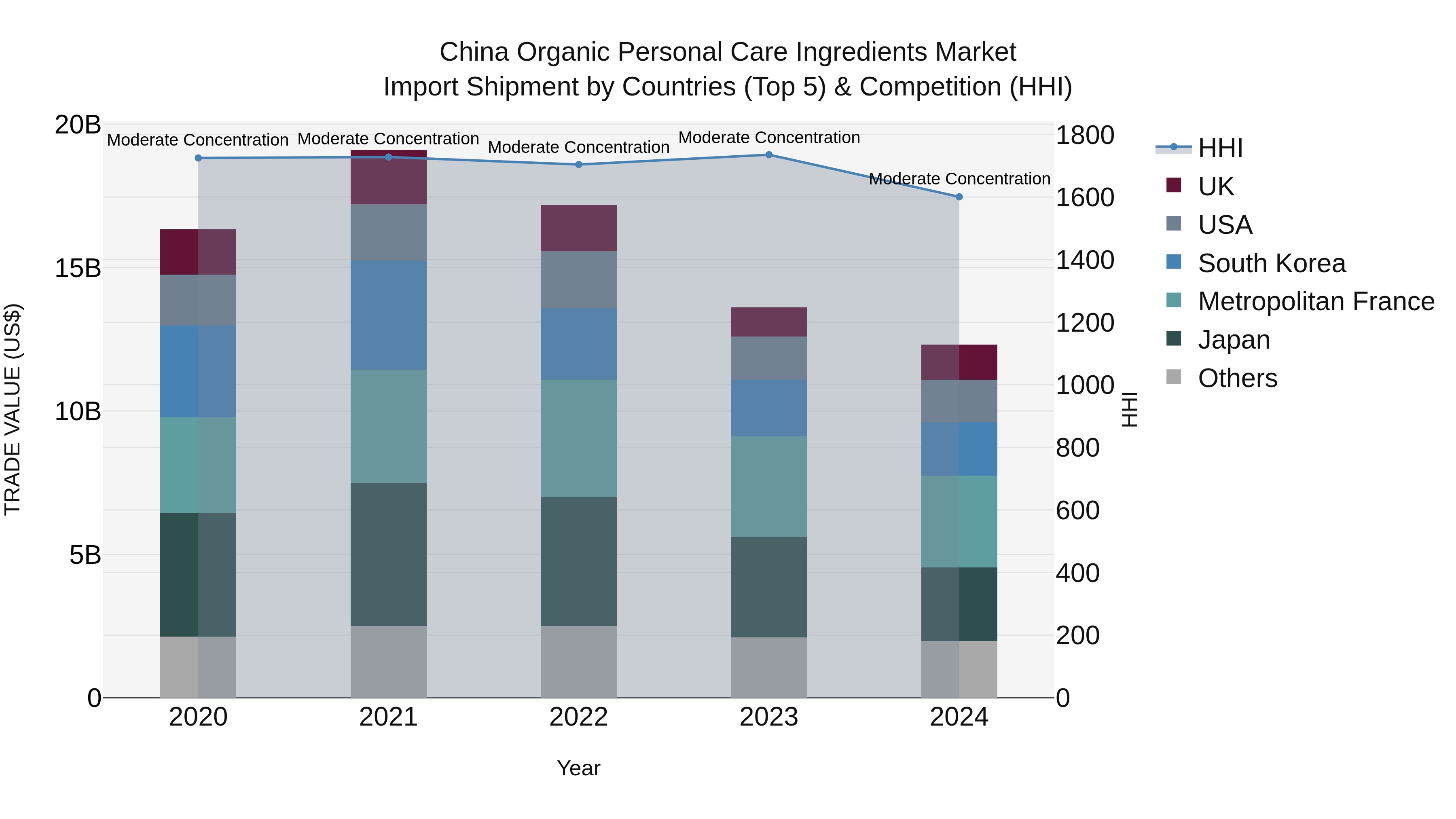
China Organic Personal Care Ingredients Market Top 5 Importing Countries and Market Competition (HHI) Analysis
Despite a decline in the CAGR and growth rate in 2024, China continues to be a significant importer of organic personal care ingredients. The top exporting countries, including Metropolitan France, Japan, South Korea, USA, and UK, highlight the diverse sources of these high-quality products entering the Chinese market. With a moderate concentration level indicated by the HHI, there is still room for further expansion and competition in this sector. Monitoring future trends and consumer preferences will be crucial for stakeholders looking to capitalize on opportunities in China organic personal care ingredients market.
China Organic Personal Care Ingredients Market Overview
The China Organic Personal Care Ingredients Market is experiencing significant growth driven by increasing consumer awareness of natural and organic products. The market is characterized by a rising demand for chemical-free and environmentally friendly personal care products, leading to a growing interest in organic ingredients such as plant extracts, essential oils, and natural preservatives. Key players in the market are focusing on product innovation and sustainability to meet the evolving preferences of Chinese consumers. The market is also witnessing a shift towards clean beauty trends, with a focus on transparency in ingredient sourcing and production processes. Overall, the China Organic Personal Care Ingredients Market is projected to continue its growth trajectory as consumers prioritize health-conscious and eco-friendly choices in their personal care routines.
China Organic Personal Care Ingredients Market Trends and Opportunities
The China Organic Personal Care Ingredients Market is experiencing rapid growth driven by increasing consumer awareness of health and environmental concerns, leading to a shift towards natural and organic products. Key trends include the rising demand for plant-based ingredients, such as botanical extracts and essential oils, as well as the preference for products free from harmful chemicals like parabens and sulfates. Opportunities lie in the development of innovative organic formulations to cater to a diverse range of skincare and haircare needs. With the government`s push for sustainability and green initiatives, there is also potential for companies to capitalize on the growing interest in eco-friendly packaging solutions. Overall, the market presents promising prospects for companies offering high-quality organic personal care ingredients in China`s beauty and cosmetics industry.
China Organic Personal Care Ingredients Market Challenges
In the China Organic Personal Care Ingredients Market, challenges include regulatory complexities due to evolving government standards and certifications for organic products, supply chain issues related to sourcing high-quality organic ingredients, and consumer education about the benefits of organic personal care products. Additionally, competition from non-organic products and pricing disparities pose challenges for organic personal care ingredient suppliers. Building consumer trust in the authenticity and efficacy of organic ingredients in a market where counterfeit products are a concern is another obstacle. Overall, navigating these challenges requires a combination of product innovation, regulatory compliance, and effective marketing strategies to capitalize on the growing demand for organic personal care products in China.
China Organic Personal Care Ingredients Market Drivers
The China Organic Personal Care Ingredients Market is primarily driven by the increasing consumer awareness regarding the harmful effects of synthetic chemicals in personal care products, leading to a growing demand for natural and organic alternatives. Rising disposable incomes and changing lifestyle preferences are also fueling the demand for organic personal care ingredients. Additionally, stringent regulations and certifications promoting organic products in China are pushing manufacturers to incorporate organic ingredients in their formulations. The trend of eco-friendly and sustainable products is further driving the market growth, with consumers seeking products that are not only safer for their skin but also environmentally friendly. Overall, the market is expected to continue expanding as consumers prioritize health, sustainability, and natural ingredients in their personal care products.
China Organic Personal Care Ingredients Market Government Policies
The Chinese government has implemented various policies to regulate the organic personal care ingredients market. These policies include the Organic Products Certification in China, which sets standards for organic products and requires certification for products claiming to be organic. Additionally, the Ministry of Agriculture and Rural Affairs in China has established regulations for the production, processing, and labeling of organic products. The government also provides subsidies and support for organic farming practices to promote the use of organic ingredients in personal care products. Overall, these policies aim to ensure the quality and authenticity of organic personal care ingredients in the Chinese market while promoting sustainable and environmentally friendly practices in the industry.
China Organic Personal Care Ingredients Market Future Outlook
The future outlook for the China Organic Personal Care Ingredients Market appears promising, driven by increasing consumer awareness of the benefits of organic products and a growing emphasis on sustainability. With a rising middle-class population and expanding e-commerce channels, the demand for natural and organic personal care ingredients is expected to surge. Key factors such as the government`s support for organic farming practices and the trend towards clean beauty products will further propel market growth. Industry players are likely to focus on innovation and product development to cater to the evolving preferences of Chinese consumers, leading to a competitive landscape. Overall, the China Organic Personal Care Ingredients Market is poised for substantial expansion in the coming years, presenting lucrative opportunities for both domestic and international suppliers.
Key Highlights of the Report:
- China Organic Personal Care Ingredients Market Outlook
- Market Size of China Organic Personal Care Ingredients Market, 2024
- Forecast of China Organic Personal Care Ingredients Market, 2031
- Historical Data and Forecast of China Organic Personal Care Ingredients Revenues & Volume for the Period 2021- 2031
- China Organic Personal Care Ingredients Market Trend Evolution
- China Organic Personal Care Ingredients Market Drivers and Challenges
- China Organic Personal Care Ingredients Price Trends
- China Organic Personal Care Ingredients Porter's Five Forces
- China Organic Personal Care Ingredients Industry Life Cycle
- Historical Data and Forecast of China Organic Personal Care Ingredients Market Revenues & Volume By Type for the Period 2021- 2031
- Historical Data and Forecast of China Organic Personal Care Ingredients Market Revenues & Volume By Organic for the Period 2021- 2031
- Historical Data and Forecast of China Organic Personal Care Ingredients Market Revenues & Volume By Natural for the Period 2021- 2031
- Historical Data and Forecast of China Organic Personal Care Ingredients Market Revenues & Volume By Product for the Period 2021- 2031
- Historical Data and Forecast of China Organic Personal Care Ingredients Market Revenues & Volume By Natural surfactants for the Period 2021- 2031
- Historical Data and Forecast of China Organic Personal Care Ingredients Market Revenues & Volume By Emollients for the Period 2021- 2031
- Historical Data and Forecast of China Organic Personal Care Ingredients Market Revenues & Volume By Active ingredients for the Period 2021- 2031
- Historical Data and Forecast of China Organic Personal Care Ingredients Market Revenues & Volume By Sugar polymers for the Period 2021- 2031
- Historical Data and Forecast of China Organic Personal Care Ingredients Market Revenues & Volume By Natural preservatives for the Period 2021- 2031
- Historical Data and Forecast of China Organic Personal Care Ingredients Market Revenues & Volume By Others for the Period 2021- 2031
- Historical Data and Forecast of China Organic Personal Care Ingredients Market Revenues & Volume By Application for the Period 2021- 2031
- Historical Data and Forecast of China Organic Personal Care Ingredients Market Revenues & Volume By Skin care for the Period 2021- 2031
- Historical Data and Forecast of China Organic Personal Care Ingredients Market Revenues & Volume By Hair care for the Period 2021- 2031
- Historical Data and Forecast of China Organic Personal Care Ingredients Market Revenues & Volume By Oral care for the Period 2021- 2031
- Historical Data and Forecast of China Organic Personal Care Ingredients Market Revenues & Volume By Cosmetics for the Period 2021- 2031
- Historical Data and Forecast of China Organic Personal Care Ingredients Market Revenues & Volume By Others for the Period 2021- 2031
- China Organic Personal Care Ingredients Import Export Trade Statistics
- Market Opportunity Assessment By Type
- Market Opportunity Assessment By Product
- Market Opportunity Assessment By Application
- China Organic Personal Care Ingredients Top Companies Market Share
- China Organic Personal Care Ingredients Competitive Benchmarking By Technical and Operational Parameters
- China Organic Personal Care Ingredients Company Profiles
- China Organic Personal Care Ingredients Key Strategic Recommendations






































