China Parachute Market Size, Share & Growth Rate
The China Parachute Market was estimated at USD 209 Million in 2025 and is projected to reach USD 240 Million by 2032, growing at a CAGR of 2.0% from 2026 to 2032. This growth trajectory is primarily fueled by the modernization efforts within the military sector, alongside a burgeoning interest in recreational parachuting activities among the middle-class population. Enhanced safety protocols and technological advancements are also contributing to this positive outlook, creating a fertile ground for both military and civilian applications.
China Parachute Market Year-wise Growth Rate and Key Drivers
This graph highlights how the China Parachute Market has steadily grown over the years, supported by major growth factors.
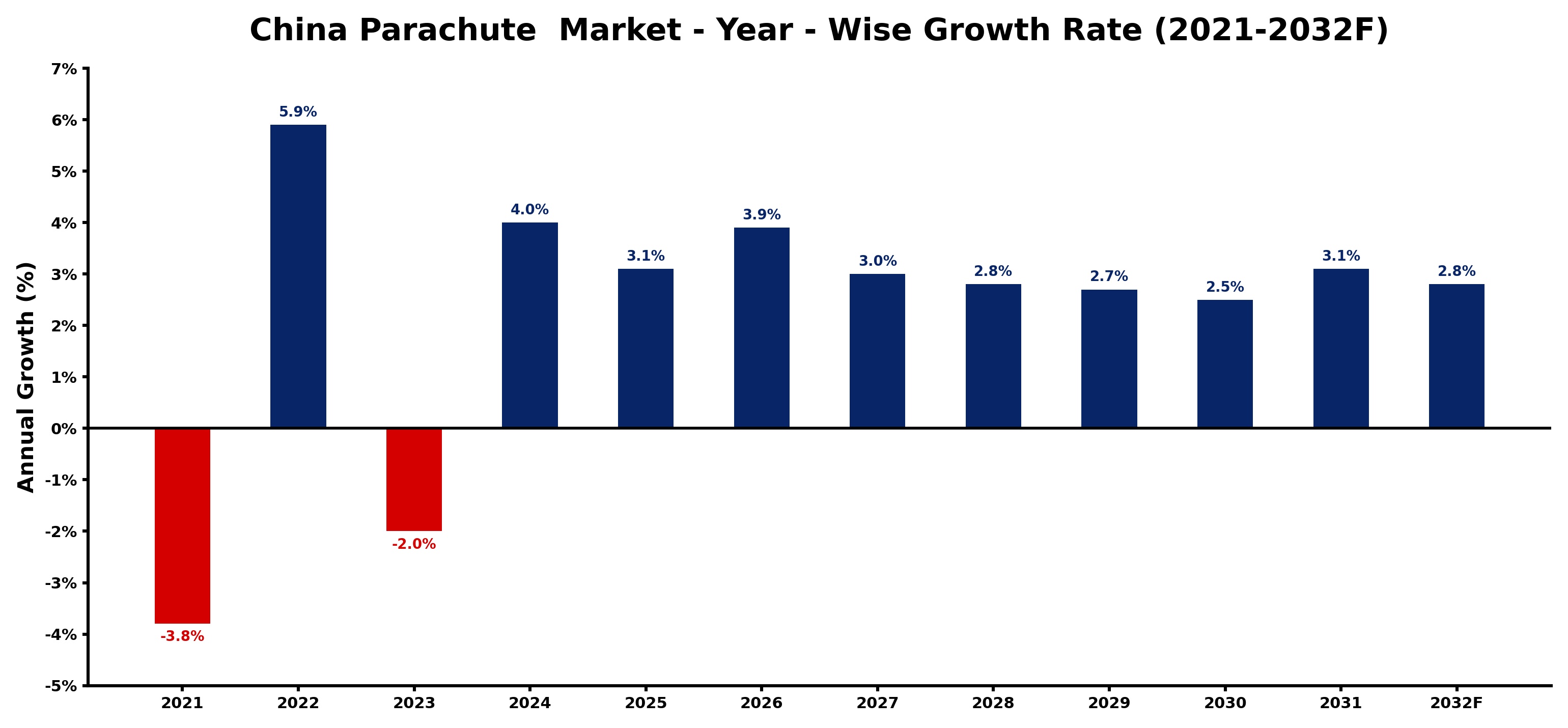
The table below presents the year‑wise growth rates along with the key drivers influencing the market
| Year | Growth Rate | Major Drivers |
| 2021 | -3.8% | Increasing adoption of advanced technologies |
| 2022 | 5.9% | Expansion of transportation and logistics networks |
| 2023 | -2.0% | Growing urbanization and commercial development |
| 2024 | 4.0% | Expansion of transportation and logistics networks |
| 2025 | 3.1% | Growing urbanization and commercial development |
| 2026 | 3.9% | Increasing smart city development projects |
| 2027 | 3.0% | Increasing smart city development projects |
| 2028 | 2.8% | Expansion of manufacturing activities |
| 2029 | 2.7% | Expansion of manufacturing activities |
| 2030 | 2.5% | Growing urbanization and commercial development |
| 2031 | 3.1% | Growing renewable energy integration projects |
| 2032 | 2.8% | Increasing industrial automation investments |
Note - Market size estimations and growth projections presented in this report are based on 6Wresearch’s advanced forecasting approach, validated with industry datasets as of June 2026.
China Parachute Market Synopsis
Recent trends indicate that the China Parachute Market is on the rise, propelled by a growing fascination with adventure sports and outdoor recreational activities. Skydiving and paragliding are gaining traction, especially among the younger, more affluent demographics, contributing to a dynamic shift in consumer behavior.
Furthermore, advancements in parachute technology are addressing safety and performance concerns, which are paramount for both military and civilian users. With a focus on lightweight materials and innovative features like GPS tracking and automatic deployment systems, the market is poised for significant expansion.
China Parachute Market Key Takeaways
- Strong growth driven by military modernization and civilian interest in adventure sports.
- Technological innovations are enhancing safety and performance features in parachuting equipment.
- Regulatory frameworks are shaping manufacturing and sales practices in the market.
- A rising middle-class population is expanding the potential consumer base for recreational parachuting.
- Investment opportunities exist in manufacturing, technology development, and training services.
Evaluation of Restraints in China Parachute Market
Despite its promising outlook, the China Parachute Market faces notable restraints. Strict government regulations regarding manufacturing and the sale of parachuting equipment create hurdles for market entrants and can slow innovation. Additionally, intense competition among both domestic and international players intensifies price pressures, compelling companies to differentiate their products continuously. Consumer trust remains critical, necessitating stringent adherence to quality control and safety standards, which can further challenge manufacturers in an already demanding landscape.
China Parachute Market Trends
Current trends show a significant shift towards higher quality and technologically advanced parachute systems. Features such as integrated GPS tracking, improved safety mechanisms, and designs that enhance user experience are increasingly becoming standard. The enthusiasm for extreme sports in China has led to a corresponding demand for parachute systems that accommodate both novice and experienced users, thus driving product diversification.
Moreover, there is a rising trend towards environmental sustainability, with manufacturers exploring eco-friendly materials and production processes. This trend not only appeals to environmentally conscious consumers but also aligns with global efforts to reduce the environmental impact of industrial activities.
China Parachute Market Opportunities
The investment landscape for the China Parachute Market is ripe with opportunities, particularly in manufacturing and technology. With the continuous growth in adventure sports, there is a pressing need for high-quality parachuting gear that meets safety and performance benchmarks. Collaborations with military and aviation authorities can yield lucrative contracts, and the development of innovative parachute systems can attract substantial investments. Additionally, the establishment of training programs aimed at enhancing parachuting skills presents a unique avenue for market expansion.
Government Initiatives in the China Parachute Market
The Chinese government has introduced stringent regulations governing the manufacturing and sale of parachutes to ensure safety and quality standards are consistently met. The State Administration for Market Regulation plays a pivotal role in overseeing certification processes, thereby safeguarding consumer interests. Import regulations are also strictly enforced to maintain product integrity within the market. These initiatives aim to foster a reliable parachute market, promoting safe practices for both military and civilian users.
Future Insights of the China Parachute Market
Looking ahead to 2026-2032, the China Parachute Market is expected to continue its growth trajectory, driven by the dual forces of military demand and recreational interest. As disposable incomes rise, more individuals are anticipated to engage in adventure sports, further expanding the consumer base. Technological advancements, particularly in creating lightweight and durable parachutes, will enhance user experience and safety. Overall, the market is well-positioned to meet the evolving needs of diverse users, securing its place as a key player in the global parachute industry.
China Parachute Market Latest Developments (May 2025 - June 2026)
Recent developments in the China Parachute Market indicate a flurry of activity aimed at innovation and market expansion. Manufacturers are increasingly integrating advanced technologies into their parachute systems, such as automated deployment mechanisms and data analytics capabilities. Additionally, partnerships between adventure sports organizations and parachute manufacturers are on the rise, enhancing the training and safety measures available to recreational parachuters. This evolving landscape reflects the growing importance of safety and performance, driving continual advancements in the sector.
China Parachute Market - Key Attractiveness of the Report
- 10 Years of Market Numbers
- Historical Data Starting from 2022 to 2025
- Base Year: 2025
- Forecast Data until 2032
- Key Performance Indicators Impacting the Market
- Major Upcoming Developments and Projects
Key Highlights of the Report:
- China Parachute Market Outlook
- Market Size of China Parachute Market, 2025
- Forecast of China Parachute Market, 2032
- Historical Data and Forecast of China Parachute Revenues & Volume for the Period 2022-2032F
- China Parachute Market Trend Evolution
- China Parachute Market Drivers and Challenges
- China Parachute Price Trends
- China Parachute Porter's Five Forces
- China Parachute Industry Life Cycle
- Historical Data and Forecast of China Parachute Market Revenues & Volume By Type for the Period 2022-2032F
- Historical Data and Forecast of China Parachute Market Revenues & Volume By Round Parachute for the Period 2022-2032F
- Historical Data and Forecast of China Parachute Market Revenues & Volume By Cruciform Parachute for the Period 2022-2032F
- Historical Data and Forecast of China Parachute Market Revenues & Volume By Ram Air Parachute for the Period 2022-2032F
- Historical Data and Forecast of China Parachute Market Revenues & Volume By Other Types for the Period 2022-2032F
- Historical Data and Forecast of China Parachute Market Revenues & Volume By Application for the Period 2022-2032F
- Historical Data and Forecast of China Parachute Market Revenues & Volume By Military for the Period 2022-2032F
- Historical Data and Forecast of China Parachute Market Revenues & Volume By Cargo for the Period 2022-2032F
- Historical Data and Forecast of China Parachute Market Revenues & Volume By Other Applications for the Period 2022-2032F
- China Parachute Import Export Trade Statistics
- Market Opportunity Assessment By Type
- Market Opportunity Assessment By Application
- China Parachute Top Companies Market Share
- China Parachute Competitive Benchmarking By Technical and Operational Parameters
- China Parachute Company Profiles
- China Parachute Key Strategic Recommendations






































