China Perchloroethylene Market Size, Share & Growth Rate
The China Perchloroethylene Market was estimated at USD 208 Million in 2025 and is projected to reach USD 239 Million by 2032, growing at a CAGR of 2.0% from 2026 to 2032. This growth trajectory is largely fueled by rising demand across key sectors, including textiles and dry cleaning, where perchloroethylene serves as an essential solvent. Furthermore, the shift towards more eco-friendly alternatives and compliance with stringent environmental regulations is also shaping the market landscape.
China Perchloroethylene Market Year-wise Growth Rate and Key Drivers
This graph highlights how the China Perchloroethylene Market has steadily grown over the years, supported by major growth factors.
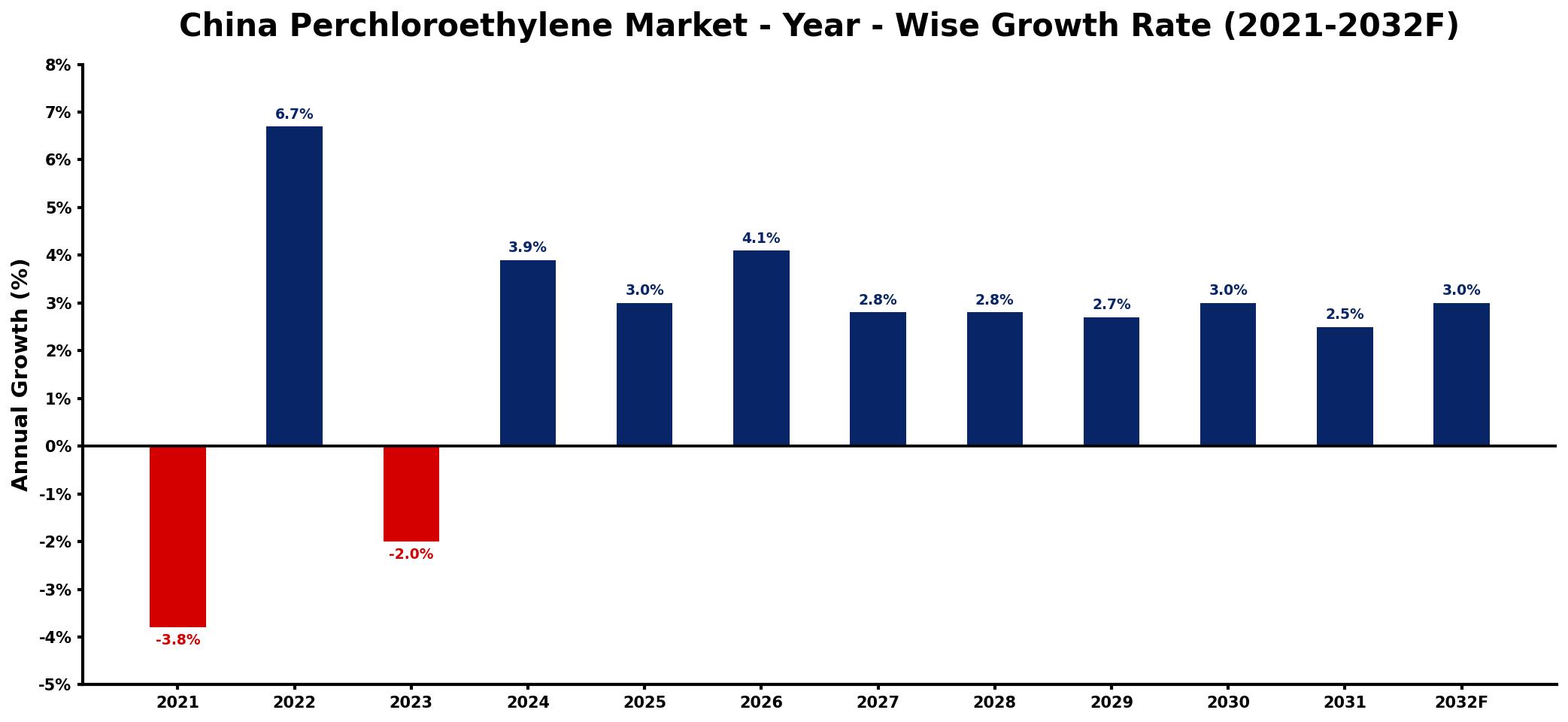
The table below presents the year‑wise growth rates along with the key drivers influencing the market
| Year | Growth Rate | Major Drivers |
| 2021 | -3.8% | Decreased industrial cleaning activities |
| 2022 | 6.7% | Growing demand for dry cleaning |
| 2023 | -2.0% | Reduced manufacturing facility operations |
| 2024 | 3.9% | Expansion of textile production sector |
| 2025 | 3.0% | Increased investments in automotive |
| 2026 | 4.1% | Rising demand for solvent applications |
| 2027 | 2.8% | Growth in electronics manufacturing sector |
| 2028 | 2.8% | Surge in chemical processing industries |
| 2029 | 2.7% | Increasing need for degreasing agents |
| 2030 | 3.0% | increased production capacity utilization |
| 2031 | 2.5% | Rising focus on sustainable practices |
| 2032 | 3.0% | increased capital investment inflows |
Note: Market size estimations and growth projections presented in this report are based on 6Wresearch's proprietary forecasting methodology, utilizing the latest available industry data, government publications, and primary research inputs.
China Perchloroethylene Market Synopsis
In recent years, the China Perchloroethylene Market has witnessed consistent demand growth, primarily driven by its significant applications in industries such as textiles and metal degreasing. This solvent is renowned for its effective cleaning capabilities, contributing to its status as a go-to solution for both industrial and commercial purposes.
Moreover, environmental sustainability is taking center stage as manufacturers adapt to stricter regulations and consumer preferences. As a result, industry stakeholders are increasingly focusing on developing safer, high-quality alternatives, signaling a pivotal shift in market dynamics.
China Perchloroethylene Market Key Takeaways
- Steady growth is projected due to demand from textiles, dry cleaning, and metal degreasing sectors.
- Increasing focus on environmentally sustainable production practices is reshaping the market landscape.
- Manufacturers are innovating to enhance product quality while reducing toxicity levels.
- Consolidation among companies indicates a competitive effort to strengthen market presence.
- Continued regulatory pressures are driving the adoption of greener alternatives.
Evaluation of Restraints in China Perchloroethylene Market
The China Perchloroethylene Market faces several limitations that could affect its growth trajectory. Stringent environmental regulations are imposing stricter emission standards, prompting a transition away from traditional practices. This shift often requires significant investment in technology and process improvements. Moreover, the emergence of alternative solvents threatens to disrupt market demand, compelling manufacturers to innovate continuously. In addition, supply chain vulnerabilities—stemming from raw material shortages or logistical challenges—can hinder operational efficiency and profitability.
China Perchloroethylene Market Trends
Current trends in the China Perchloroethylene Market reveal a strong inclination towards sustainability. Manufacturers are increasingly adopting energy-efficient production methods in response to regulatory pressures, seeking to minimize their environmental footprint. Concurrently, there is a notable rise in awareness surrounding the health risks associated with perchloroethylene exposure, prompting industries to explore safer alternatives. Innovations aimed at improving the safety profile of perchloroethylene are also gaining traction, underscoring a commitment to product quality and consumer safety.
China Perchloroethylene Market Opportunities
The future holds substantial opportunities for investment in the China Perchloroethylene Market, primarily due to robust demand in textile and dry cleaning industries. The governments supportive policies advocating for the adoption of environmentally friendly chemicals further enhance prospects. Companies focusing on developing innovative, less toxic alternatives are likely to attract considerable interest from investors. Moreover, as industries adapt to changing regulatory landscapes, those at the forefront of sustainable practices will find themselves well-positioned for growth.
Government Initiatives in the China Perchloroethylene Market
The Chinese government has been proactive in regulating the Perchloroethylene market by establishing comprehensive policies aimed at reducing environmental pollution. These include stringent emission standards for production facilities and guidelines to manage the supply of perchloroethylene in the domestic market. Efforts are also being made to encourage the development of alternative chemical solutions, which aligns with the broader national agenda of promoting sustainability and public health.
Future Insights of the China Perchloroethylene Market
The outlook for the China Perchloroethylene Market appears optimistic through 2026-2032. The anticipated growth will be driven by continued industrial demand and an increasing commitment to environmental sustainability. As technological advancements pave the way for safer production processes and product innovations, companies that embrace these changes will likely lead the market. However, potential economic fluctuations and raw material price volatility may introduce challenges that stakeholders need to navigate effectively.
China Perchloroethylene Market Latest Developments (2025 - 2026)
Recent developments within the China Perchloroethylene Market reflect a concerted effort among manufacturers to enhance their product offerings while adhering to evolving environmental regulations. Increased collaboration between industries and academic institutions has led to innovative solutions aimed at reducing the toxicity associated with traditional perchloroethylene. Additionally, ongoing discussions surrounding regulatory frameworks indicate a proactive approach to integrating sustainability into production practices.
China Perchloroethylene Market - Key Attractiveness of the Report
- 10 Years of Market Numbers
- Historical Data Starting from 2022 to 2025
- Base Year: 2025
- Forecast Data until 2032
- Key Performance Indicators Impacting the Market
- Major Upcoming Developments and Projects
Key Highlights of the Report:
- China Perchloroethylene Market Outlook
- Market Size of China Perchloroethylene Market, 2025
- Forecast of China Perchloroethylene Market, 2032
- Historical Data and Forecast of China Perchloroethylene Revenues & Volume for the Period 2022-2032F
- China Perchloroethylene Market Trend Evolution
- China Perchloroethylene Market Drivers and Challenges
- China Perchloroethylene Price Trends
- China Perchloroethylene Porter's Five Forces
- China Perchloroethylene Industry Life Cycle
- Historical Data and Forecast of China Perchloroethylene Market Revenues & Volume By Type for the Period 2022-2032F
- Historical Data and Forecast of China Perchloroethylene Market Revenues & Volume By Ethylene Oxychlorination for the Period 2022-2032F
- Historical Data and Forecast of China Perchloroethylene Market Revenues & Volume By Acetylene Method for the Period 2022-2032F
- Historical Data and Forecast of China Perchloroethylene Market Revenues & Volume By Ethylene Direct Chlorination for the Period 2022-2032F
- Historical Data and Forecast of China Perchloroethylene Market Revenues & Volume By End-use for the Period 2022-2032F
- Historical Data and Forecast of China Perchloroethylene Market Revenues & Volume By Dry Cleaning Agent for the Period 2022-2032F
- Historical Data and Forecast of China Perchloroethylene Market Revenues & Volume By Solvent for the Period 2022-2032F
- Historical Data and Forecast of China Perchloroethylene Market Revenues & Volume By Others for the Period 2022-2032F
- China Perchloroethylene Import Export Trade Statistics
- Market Opportunity Assessment By Type
- Market Opportunity Assessment By End-use
- China Perchloroethylene Top Companies Market Share
- China Perchloroethylene Competitive Benchmarking By Technical and Operational Parameters
- China Perchloroethylene Company Profiles
- China Perchloroethylene Key Strategic Recommendations






































