China Pest Control Products Market Summary
The china pest control products market was estimated at USD 96 Million in 2025 and is projected to reach USD 111 Million by 2032, growing at a CAGR of 4.1% from 2026 to 2032.
China Pest Control Products Market Year-wise Growth Rate and Key Drivers
This graph highlights how the China Pest Control Products Market has steadily grown over the past five years, supported by major growth factors.
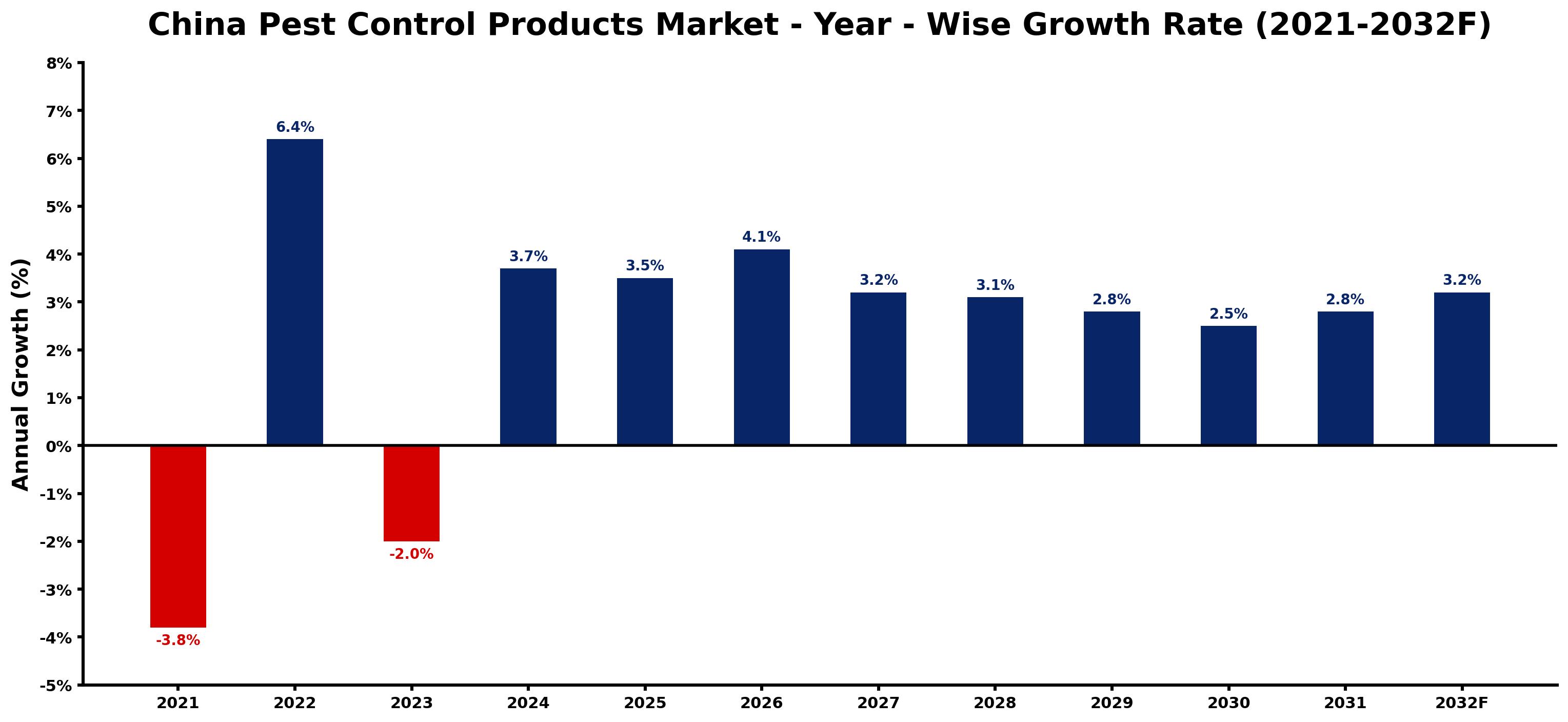
The table below presents the year wise growth rates along with the key drivers influencing the market
| Year | Growth Rate | Major Drivers |
| 2021 | -3.8% | Increased concerns over environmental impacts led to heightened scrutiny and reduced demand for chemical pest control solutions. |
| 2022 | 6.4% | Consumer awareness campaigns emphasized the importance of pest prevention in households. |
| 2023 | -2.0% | Increased awareness of environmental concerns led consumers to seek alternative, ecofriendly pest management solutions. |
| 2024 | 3.7% | Urbanization led to increasing pest management challenges for densely populated regions. |
| 2025 | 3.5% | Enhanced distribution networks improved accessibility of pest control products in rural areas. |
| 2026 | 4.1% | Technological improvements in product formulations resulted in more effective pest control solutions. |
| 2027 | 3.2% | Rising disposable income allowed households to invest in professional pest control services. |
| 2028 | 3.1% | Household renovation projects spurred demand for specialized pest prevention solutions. |
| 2029 | 2.8% | Entry of international brands intensified competition, driving product innovation and quality. |
| 2030 | 2.5% | Integration of smart technology into pest control products attracted tech-savvy consumers. |
| 2031 | 2.8% | Increased urban landscaping projects required advanced pest management solutions for public spaces. |
| 2032 | 3.2% | Collaboration between local governments and pest control companies improved community awareness. |
Note - Market size estimations and growth projections presented in this report are based on 6Wresearch's advanced forecasting approach, validated with industry datasets as of June 2026.
China Pest Control Products Market Synopsis
The China Pest Control Products Market is projected to reach 4.1% and witness significant growth during the forecast period (2026-2032). This robust growth trajectory is primarily fueled by the increasing urbanization across the nation, which has heightened the demand for effective solutions to manage pest-related issues. Urban areas, with their dense populations and infrastructure, are particularly vulnerable to pest infestations, making pest control products essential for maintaining public health and safety. Furthermore, a growing awareness among consumers regarding the detrimental effects of pests such as rodents, insects, and birds has further stimulated market demand.
China Pest Control Products Market Growth Drivers
Several key factors are driving the expansion of the China Pest Control Products Market. As cities expand and populations grow, the prevalence of pests increases, necessitating more comprehensive pest management solutions.
- The rise in urbanization has resulted in a greater demand for pest control services, as urban dwellers are more exposed to pest-related risks.
- Increased consumer awareness about the health implications of pest infestations has prompted individuals and businesses alike to invest in pest control products.
- Technology advancements in pest control methods have led to more effective and environmentally friendly solutions, appealing to a broader customer base.
- Rising disposable incomes in China allow consumers to allocate more funds towards pest control, supporting market growth.
- Integration of pest control practices into property management services is becoming standard, thereby increasing overall consumption of pest control products.
China Pest Control Products Market Trends and Opportunities
The China Pest Control Products Market is witnessing a range of trends and opportunities that are shaping its future. The increasing urban population not only amplifies the need for pest control but also drives innovation within the market.
- There is a noticeable trend towards the use of biodegradable and eco-friendly pest control solutions, reflecting a shift in consumer preferences towards sustainability.
- Integration of smart technology in pest control solutions, such as IoT-enabled devices for monitoring pest activities, is emerging as an exciting opportunity for growth.
- The growing agricultural sector in China is also presenting opportunities for pest control products tailored specifically for crop protection.
- Online retail platforms are becoming increasingly popular for purchasing pest control products, enhancing accessibility for consumers.
- Educational campaigns on pest management are being launched, creating further awareness and stimulating demand in both residential and commercial sectors.
China Pest Control Products Market Challenges and Restraints
Despite the promising growth outlook, the China Pest Control Products Market faces several challenges and restraints that could hinder its expansion.
- Strict regulatory policies on chemical usage in pest control can limit the availability of certain products, affecting market options for consumers.
- The adverse effects of climate change, such as extreme weather, may disrupt pest populations and alter pest control needs.
- Competition from traditional pest control methods, particularly among less affluent consumers, could pose a challenge to higher-tech products.
- The potential for product misuse and resulting health risks may lead to a public distrust of certain pest control solutions.
- The increasing cost of raw materials for manufacturing pest control products can impact profit margins for companies operating within the sector.
China Pest Control Products Market Government Investment and Initiatives
The Chinese government plays an influential role in the development of the pest control products market through various investments and initiatives aimed at public health and environmental sustainability. Government policies are increasingly focused on promoting safer pest control methods to protect citizens' health.
- Regulatory frameworks are being established to ensure that pest control products are safe for both users and the environment, facilitating market growth.
- Financial incentives are provided to companies that invest in research and development of eco-friendly pest control technologies.
- Public health campaigns initiated by the government emphasize the importance of pest management in urban areas, thereby increasing consumer awareness.
- Government programs aimed at eradicating major pest problems in agriculture are driving demand for specialized pest control solutions.
- Collaborative efforts between government bodies and research institutions focus on developing innovative pest management strategies to combat evolving pest challenges.
China Pest Control Products Market Latest Developments (May 2025 - June 2026)
Recent developments in the China Pest Control Products Market reflect a dynamic and rapidly evolving industry landscape. Companies are increasingly prioritizing innovation and sustainability in their offerings.
- There has been a noticeable increase in the introduction of natural and organic pest control products, aligning with consumer demand for safer options.
- Pest control firms are investing in R&D to enhance the efficacy and safety of their products, particularly in the context of urban pest challenges.
- Partnerships between pest control companies and technology firms have emerged, leading to the development of advanced pest monitoring systems.
- Regulatory changes have prompted a shift towards more stringent safety protocols, influencing product formulation and handling practices.
- Market players are emphasizing digital marketing strategies to reach a wider audience, reflecting the shift towards online purchasing behaviors.
China Pest Control Products Market - Key Attractiveness of the Report
- 10 Years of Market Numbers
- Historical Data Starting from 2022 to 2025
- Base Year: 2025
- Forecast Data until 2032
- Key Performance Indicators Impacting the Market
- Major Upcoming Developments and Projects
Key Highlights of the Report:
- China Pest Control Products Market Outlook
- Market Size of China Pest Control Products Market, 2025
- Forecast of China Pest Control Products Market, 2032F
- Historical Data and Forecast of China Pest Control Products Revenues & Volume for the Period 2022-2032F
- China Pest Control Products Market Trend Evolution
- China Pest Control Products Market Drivers and Challenges
- China Pest Control Products Price Trends
- China Pest Control Products Porter's Five Forces
- China Pest Control Products Industry Life Cycle
- Historical Data and Forecast of China Pest Control Products Market Revenues & Volume By Type for the Period 2022-2032F
- Historical Data and Forecast of China Pest Control Products Market Revenues & Volume By Chemical for the Period 2022-2032F
- Historical Data and Forecast of China Pest Control Products Market Revenues & Volume By Mechanical for the Period 2022-2032F
- Historical Data and Forecast of China Pest Control Products Market Revenues & Volume By Biological for the Period 2022-2032F
- Historical Data and Forecast of China Pest Control Products Market Revenues & Volume By Others for the Period 2022-2032F
- Historical Data and Forecast of China Pest Control Products Market Revenues & Volume By Pest type for the Period 2022-2032F
- Historical Data and Forecast of China Pest Control Products Market Revenues & Volume By Insects for the Period 2022-2032F
- Historical Data and Forecast of China Pest Control Products Market Revenues & Volume By Termites for the Period 2022-2032F
- Historical Data and Forecast of China Pest Control Products Market Revenues & Volume By Rodents for the Period 2022-2032F
- Historical Data and Forecast of China Pest Control Products Market Revenues & Volume By Others for the Period 2022-2032F
- Historical Data and Forecast of China Pest Control Products Market Revenues & Volume By Application for the Period 2022-2032F
- Historical Data and Forecast of China Pest Control Products Market Revenues & Volume By Commercial for the Period 2022-2032F
- Historical Data and Forecast of China Pest Control Products Market Revenues & Volume By Residential for the Period 2022-2032F
- Historical Data and Forecast of China Pest Control Products Market Revenues & Volume By Agriculture for the Period 2022-2032F
- Historical Data and Forecast of China Pest Control Products Market Revenues & Volume By Industrial for the Period 2022-2032F
- Historical Data and Forecast of China Pest Control Products Market Revenues & Volume By Others for the Period 2022-2032F
- China Pest Control Products Import Export Trade Statistics
- Market Opportunity Assessment By Type
- Market Opportunity Assessment By Pest type
- Market Opportunity Assessment By Application
- China Pest Control Products Top Companies Market Share
- China Pest Control Products Competitive Benchmarking By Technical and Operational Parameters
- China Pest Control Products Company Profiles
- China Pest Control Products Key Strategic Recommendations






































