China Pharmaceutical Packaging Market Summary
The china pharmaceutical packaging market was estimated at USD 162 Million in 2025 and is projected to reach USD 188 Million by 2032, growing at a CAGR of 4.5% from 2026 to 2032.
China Pharmaceutical Packaging Market Year-wise Growth Rate and Key Drivers
This graph highlights how the China Pharmaceutical Packaging Market has steadily grown over the past five years, supported by major growth factors.
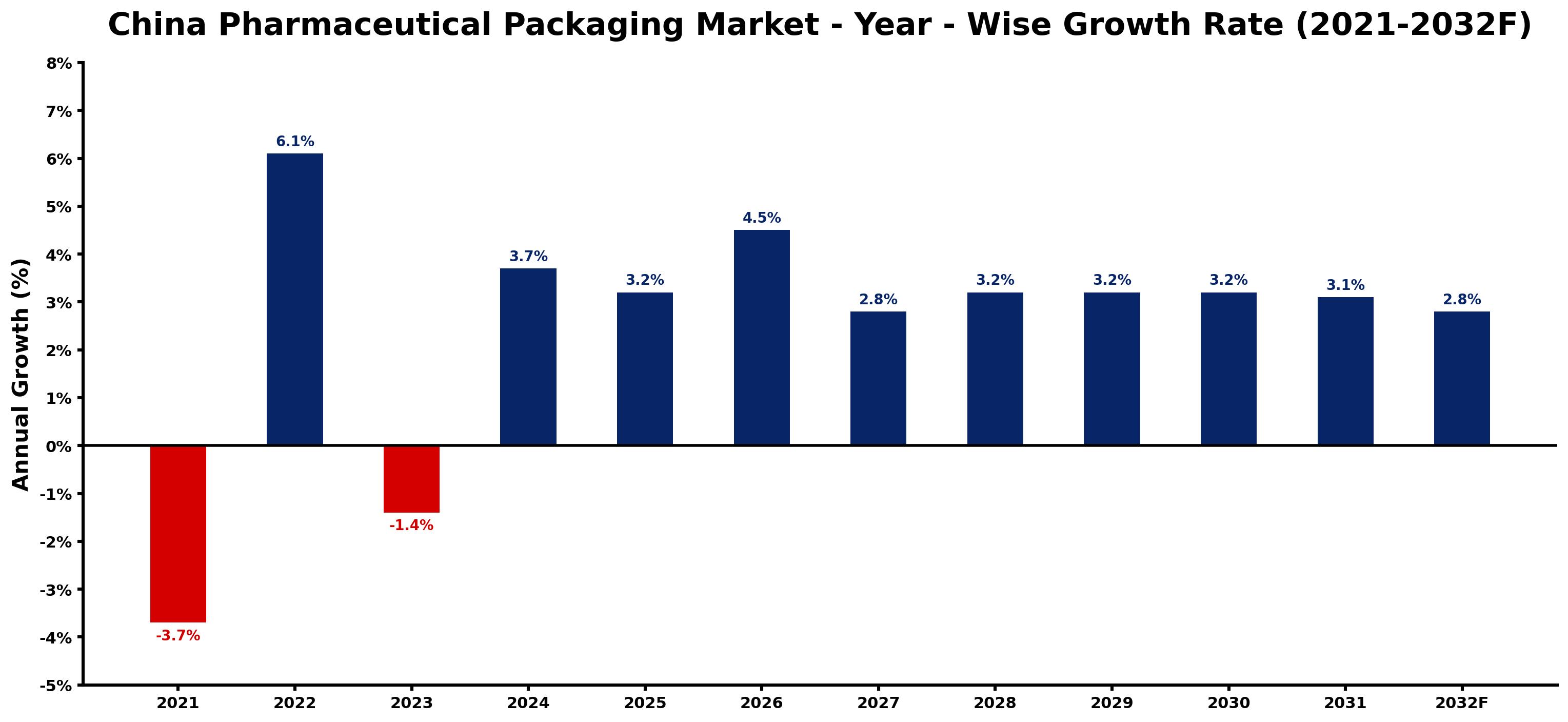
The table below presents the year wise growth rates along with the key drivers influencing the market
| Year | Growth Rate | Major Drivers |
| 2021 | -3.7% | Intensifying global supply chain disruptions hindered timely delivery of packaging materials, impacting production schedules. |
| 2022 | 6.1% | Innovations in tamper-evident packaging enhance safety, attracting major pharmaceutical investments. |
| 2023 | -1.4% | Increased competition from alternative packaging solutions led to diminished demand for traditional pharmaceutical packaging options. |
| 2024 | 3.7% | Rising healthcare spending in China boosts the need for diverse pharmaceutical packaging options. |
| 2025 | 3.2% | Increased emphasis on supply chain transparency drives demand for traceable packaging solutions. |
| 2026 | 4.5% | Technological integration in production processes improves packaging efficiency and reduces costs. |
| 2027 | 2.8% | Consumer preference for personalized medication fosters the development of customizable packaging. |
| 2028 | 3.2% | Growing health awareness leads to higher demand for over-the-counter pharmaceutical products. |
| 2029 | 3.2% | The aging population in China necessitates specialized packaging for senior-friendly medications. |
| 2030 | 3.2% | Collaborations between packaging firms and biotech companies enhance product innovation and differentiation. |
| 2031 | 3.1% | Global supply chain stabilization contributes to improved availability of packaging materials. |
| 2032 | 2.8% | Digital technologies in packaging, like QR codes, provide consumers with valuable product information. |
Note - Market size estimations and growth projections presented in this report are based on 6Wresearch's advanced forecasting approach, validated with industry datasets as of June 2026.
China Pharmaceutical Packaging Market Synopsis
The China Pharmaceutical Packaging Market is projected to reach 4.5% and witness significant growth during the forecast period (2026-2032). This growth is primarily driven by increasing healthcare expenditure, a rapidly aging population, and the rising demand for pharmaceutical products. The landscape of this market is characterized by a diverse range of packaging solutions, including bottles, vials, blister packs, ampoules, and labels, provided by both domestic and international manufacturers. In light of evolving consumer preferences and stringent regulations, sustainability and innovation are becoming pivotal trends shaping the future of packaging in this sector.
China Pharmaceutical Packaging Market Growth Drivers
Several critical factors are fueling the growth of the China Pharmaceutical Packaging Market. First, the surging healthcare expenditure in China reflects increased investment in the pharmaceutical sector, necessitating robust packaging solutions to ensure product integrity and consumer safety. Second, an aging population is driving demand for chronic disease medications, escalating the need for efficient and safe packaging. Third, the growing global focus on eco-friendly practices is prompting manufacturers to integrate sustainable materials into their offerings. Fourth, regulatory compliance and the adoption of advanced packaging technologies are essential to meet quality standards. Finally, the rising preference for personalized medicine and packaging solutions is compelling manufacturers to innovate continually.
China Pharmaceutical Packaging Market Trends and Opportunities
Key trends are emerging in the China Pharmaceutical Packaging Market, indicating a shift towards more sophisticated solutions. As consumers become increasingly environmentally conscious, demand for eco-friendly and sustainable packaging materials is on the rise. Additionally, smart packaging technologies, including RFID tags and tamper-evident features, are gaining traction to bolster product safety and traceability. The adoption of innovative packaging designs that enhance user experience is increasingly important as companies look to differentiate themselves in a competitive landscape. Furthermore, the need for personalized packaging tailored to individual preferences is growing, providing significant opportunities for market players.
China Pharmaceutical Packaging Market Challenges and Restraints
Despite the positive growth outlook, several challenges hinder the progress of the China Pharmaceutical Packaging Market. Stringent regulations governing packaging materials impose compliance costs and complexity for manufacturers, impacting profitability. The prevalence of counterfeit drugs necessitates advanced packaging technologies, yet implementation can be costly and logistically challenging. Fluctuating raw material prices pose additional hurdles, as manufacturers must balance cost management with sustainable practices. Additionally, the intense competition within the pharmaceutical sector requires continuous innovation and differentiation in packaging solutions to meet evolving market needs. Addressing these challenges requires strategic investment in technology and a comprehensive understanding of regulatory landscapes.
China Pharmaceutical Packaging Market Investment Opportunities
The growth trajectory of the China Pharmaceutical Packaging Market presents a host of investment opportunities. With the increasing importance of innovative and sustainable packaging solutions, investors can explore specialized segments such as child-resistant and tamper-evident packaging, which are essential for ensuring consumer safety. The adoption of smart packaging technologies, including temperature-controlled solutions for biopharmaceuticals, represents a lucrative investment area. Collaborating with local manufacturers or focusing on research and development to create customized packaging solutions tailored to the specific needs of the Chinese market could provide significant advantages. Overall, the expanding pharmaceutical sector offers various avenues for investment in advanced packaging solutions.
China Pharmaceutical Packaging Market Government Investment and Initiatives
The Chinese government has instituted multiple policies aimed at regulating and promoting the pharmaceutical packaging market. Central to these initiatives are the Good Manufacturing Practice (GMP) standards that mandate strict quality control for packaging materials. The government's commitment to environmental sustainability has led to incentives for the use of eco-friendly packaging solutions, aligning with broader efforts to mitigate plastic waste. Furthermore, regulatory frameworks have been established to enhance transparency in labeling and packaging, ultimately safeguarding consumer interests. These government policies emphasize the need for compliance with quality standards and underscore the importance of environmental protection within the pharmaceutical packaging sector.
China Pharmaceutical Packaging Market Latest Developments (May 2025 - June 2026)
Recent developments in the China Pharmaceutical Packaging Market from May 2025 to June 2026 have illustrated a clear trend towards increased adoption of sustainable and innovative packaging technologies. Companies are embracing advancements in smart packaging solutions, focusing on enhanced security features and user engagement. Collaborative efforts between technology providers and packaging manufacturers are becoming more prevalent, resulting in the introduction of novel materials and designs. Regulatory bodies are also intensifying their enforcement of packaging standards, further reinforcing compliance as a critical component of market operations. Overall, the recent period highlights the industry's responsiveness to both consumer demands and regulatory requirements, setting the stage for a dynamic future.
China Pharmaceutical Packaging Market - Key Attractiveness of the Report
- 10 Years of Market Numbers
- Historical Data Starting from 2022 to 2025
- Base Year: 2025
- Forecast Data until 2032
- Key Performance Indicators Impacting the Market
- Major Upcoming Developments and Projects
Key Highlights of the Report:
- China Pharmaceutical Packaging Market Outlook
- Market Size of China Pharmaceutical Packaging Market, 2025
- Forecast of China Pharmaceutical Packaging Market, 2032F
- Historical Data and Forecast of China Pharmaceutical Packaging Revenues & Volume for the Period 2022-2032F
- China Pharmaceutical Packaging Market Trend Evolution
- China Pharmaceutical Packaging Market Drivers and Challenges
- China Pharmaceutical Packaging Price Trends
- China Pharmaceutical Packaging Porter's Five Forces
- China Pharmaceutical Packaging Industry Life Cycle
- Historical Data and Forecast of China Pharmaceutical Packaging Market Revenues & Volume By Material Types for the Period 2022-2032F
- Historical Data and Forecast of China Pharmaceutical Packaging Market Revenues & Volume By Plastics & Polymers for the Period 2022-2032F
- Historical Data and Forecast of China Pharmaceutical Packaging Market Revenues & Volume By Paper & Paperboard for the Period 2022-2032F
- Historical Data and Forecast of China Pharmaceutical Packaging Market Revenues & Volume By Glass for the Period 2022-2032F
- Historical Data and Forecast of China Pharmaceutical Packaging Market Revenues & Volume By Aluminum Foil for the Period 2022-2032F
- Historical Data and Forecast of China Pharmaceutical Packaging Market Revenues & Volume By Others for the Period 2022-2032F
- Historical Data and Forecast of China Pharmaceutical Packaging Market Revenues & Volume By Product Types for the Period 2022-2032F
- Historical Data and Forecast of China Pharmaceutical Packaging Market Revenues & Volume By Primary Pharmaceutical Packaging for the Period 2022-2032F
- Historical Data and Forecast of China Pharmaceutical Packaging Market Revenues & Volume By Secondary Pharmaceutical Packaging for the Period 2022-2032F
- Historical Data and Forecast of China Pharmaceutical Packaging Market Revenues & Volume By Tertiary Pharmaceutical Packaging for the Period 2022-2032F
- Historical Data and Forecast of China Pharmaceutical Packaging Market Revenues & Volume By End-users for the Period 2022-2032F
- Historical Data and Forecast of China Pharmaceutical Packaging Market Revenues & Volume By Pharmaceutical Manufacturing for the Period 2022-2032F
- Historical Data and Forecast of China Pharmaceutical Packaging Market Revenues & Volume By Retail Pharmacy for the Period 2022-2032F
- Historical Data and Forecast of China Pharmaceutical Packaging Market Revenues & Volume By Contract Packaging for the Period 2022-2032F
- Historical Data and Forecast of China Pharmaceutical Packaging Market Revenues & Volume By Institutional Pharmacy for the Period 2022-2032F
- Historical Data and Forecast of China Pharmaceutical Packaging Market Revenues & Volume By Others for the Period 2022-2032F
- China Pharmaceutical Packaging Import Export Trade Statistics
- Market Opportunity Assessment By Material Types
- Market Opportunity Assessment By Product Types
- Market Opportunity Assessment By End-users
- China Pharmaceutical Packaging Top Companies Market Share
- China Pharmaceutical Packaging Competitive Benchmarking By Technical and Operational Parameters
- China Pharmaceutical Packaging Company Profiles
- China Pharmaceutical Packaging Key Strategic Recommendations






































