China Physiotherapy Equipment Market Summary
The china physiotherapy equipment market was estimated at USD 87 Million in 2025 and is projected to reach USD 101 Million by 2032, growing at a CAGR of 4.7% from 2026 to 2032.
China Physiotherapy Equipment Market Year-wise Growth Rate and Key Drivers
This graph highlights how the China Physiotherapy Equipment Market has steadily grown over the past five years, supported by major growth factors.
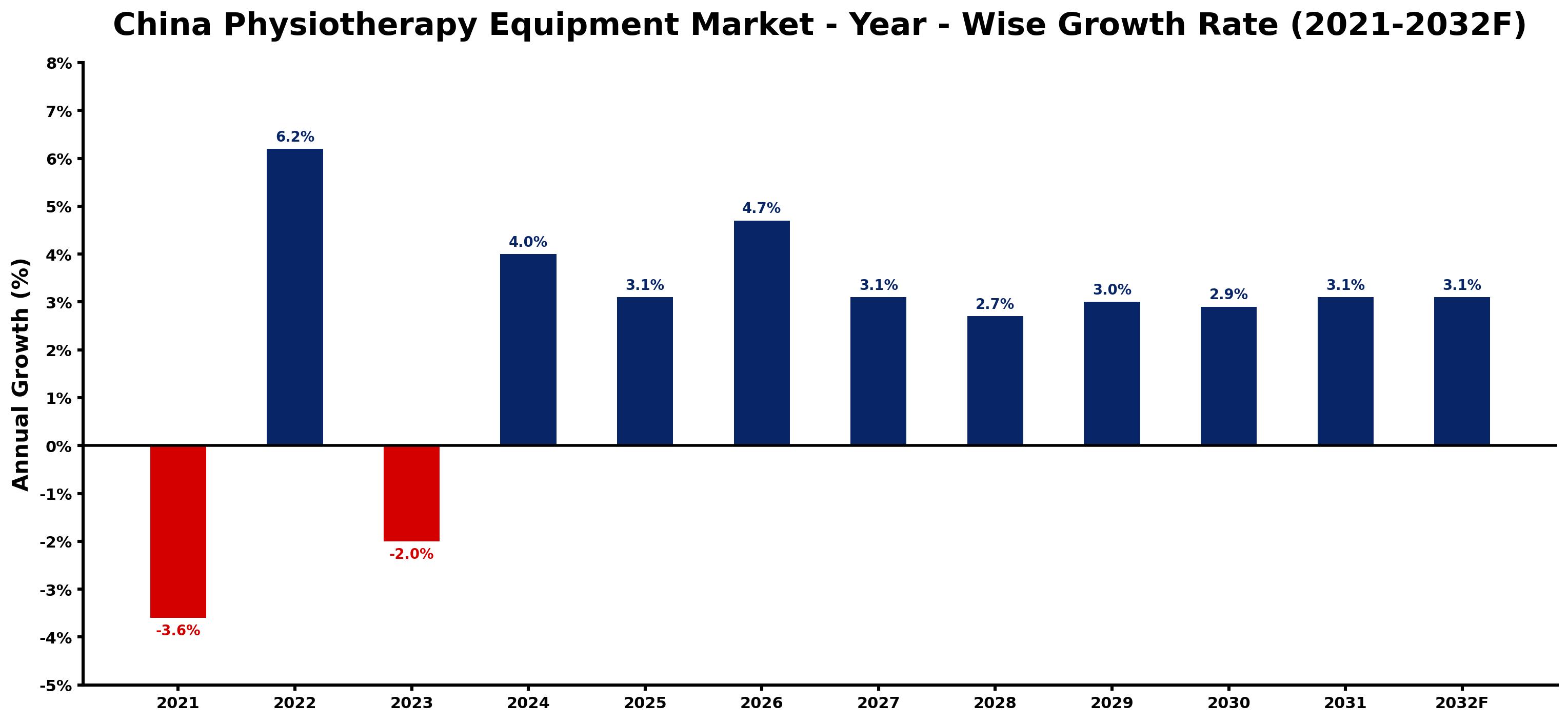
The table below presents the year wise growth rates along with the key drivers influencing the market
| Year | Growth Rate | Major Drivers |
| 2021 | -3.6% | Increased competition from lowcost alternatives undermined the sales of premium physiotherapy equipment. |
| 2022 | 6.2% | Increased awareness around physical health has prompted more consumers to seek therapy solutions. |
| 2023 | -2.0% | Increased competition from lowcost alternatives diminished demand for premium physiotherapy equipment in 2023. |
| 2024 | 4.0% | Insurance coverage expansions are enhancing accessibility to physiotherapy services nationwide. |
| 2025 | 3.1% | Urbanization trends are creating higher demand for outpatient rehabilitation facilities and equipment. |
| 2026 | 4.7% | Collaboration between physiotherapy suppliers and hospitals is improving service quality and efficiency. |
| 2027 | 3.1% | Growing elderly population is driving consistent demand for physiotherapy treatments and equipment. |
| 2028 | 2.7% | Focus on preventive healthcare is influencing investments in physiotherapy and wellness solutions. |
| 2029 | 3.0% | Integration of telehealth platforms with physiotherapy is enhancing patient reach and convenience. |
| 2030 | 2.9% | Increased focus on sports rehabilitation is expanding market opportunities for specialized equipment. |
| 2031 | 3.1% | Sustainability trends are prompting manufacturers to adopt eco-friendly practices in production. |
| 2032 | 3.1% | Emerging startups are introducing innovative products, creating dynamic competition in the market. |
Note - Market size estimations and growth projections presented in this report are based on 6Wresearch's advanced forecasting approach, validated with industry datasets as of June 2026.
China Physiotherapy Equipment Market Synopsis
The China Physiotherapy Equipment Market is projected to reach 4.7% and witness significant growth during the forecast period (2026-2032). Over recent years, the market has seen an upturn driven by increasing awareness of physiotherapy treatments and advancements in equipment technology. This growth trajectory can be attributed to the rising prevalence of chronic diseases, which necessitate effective physiotherapeutic interventions for rehabilitation and recovery.
China Physiotherapy Equipment Market Growth Drivers
The expansion of the China physiotherapy equipment market is fueled by several key drivers:
- The rising incidence of chronic conditions such as obesity, diabetes, and arthritis in the Chinese population is creating a heightened demand for physiotherapy services, resulting in greater utilization of sophisticated equipment.
- Ongoing technological innovations in physiotherapy tools, such as electrical stimulation devices and ultrasound machines, are enhancing treatment effectiveness and efficiency, thereby attracting more healthcare providers to invest in advanced equipment.
- An increasing geriatric demographic necessitates extensive physiotherapy services, as older individuals often require rehabilitation for mobility issues and post-surgical care, which drives market demand for relevant equipment.
- Growing healthcare expenditure by both public and private sectors in China is facilitating the adoption of state-of-the-art physiotherapy technologies across hospitals, clinics, and rehabilitation centers.
- Heightened public awareness regarding the benefits of physiotherapy for recovery and pain management is encouraging patients to seek treatment, thus driving demand for physiotherapy equipment.
China Physiotherapy Equipment Market Trends and Opportunities
Several trends are shaping the China physiotherapy equipment market:
- The integration of telehealth services within physiotherapy practices is becoming more prevalent, allowing patients improved access to treatment while expanding the market for remote physiotherapy equipment.
- A shift towards preventive healthcare is promoting the development of physiotherapy equipment designed for injury prevention and performance enhancement, which is gaining traction in both athletic and general health contexts.
- The emergence of smart physiotherapy devices equipped with IoT capabilities allows for real-time monitoring of patient progress, creating opportunities for more personalized therapy regimens.
- Collaborative development initiatives between research institutions and healthcare providers are anticipated to yield innovative physiotherapy technologies that address specific healthcare challenges.
- Sustainability practices in manufacturing physiotherapy equipment are becoming increasingly important, presenting opportunities for companies to differentiate their products and appeal to environmentally-conscious consumers.
China Physiotherapy Equipment Market Challenges and Restraints
Despite its growth potential, the China physiotherapy equipment market faces several challenges:
- A lack of uniform regulations governing the use and effectiveness of physiotherapy equipment can lead to inconsistent treatment standards across facilities.
- Limited reimbursement policies in certain regions may hinder adoption rates among healthcare providers due to the associated costs of purchasing advanced equipment.
- The rapid pace of technology advancement often necessitates continual investment in upgrades, which can be a financial burden for smaller clinics and rehabilitation facilities.
- Insufficient training and skill development among physiotherapy practitioners regarding new technologies can result in underutilization of advanced equipment, affecting overall treatment efficacy.
- Intense competition in the market may lead to price wars, which could negatively impact profit margins for manufacturers and suppliers of physiotherapy equipment.
China Physiotherapy Equipment Market Government Investment and Initiatives
The Chinese government has been proactive in promoting healthcare advancements, which includes substantial investments in the physiotherapy sector:
- Government initiatives aimed at improving healthcare access for all citizens are driving demand for physiotherapy services and equipment, particularly in underserved regions.
- Public spending on healthcare infrastructure, including physiotherapy clinics and rehabilitation centers, is expected to increase, facilitating the integration of advanced physiotherapy equipment.
- Incentives aimed at domestic manufacturing of healthcare equipment are also being implemented to encourage local production, which may enhance supply chain efficiency within the physiotherapy equipment market.
- Government partnerships with educational institutions are fostering skill development programs for healthcare professionals, ensuring that practitioners are adept at utilizing modern physiotherapy technologies.
- Regulatory frameworks for physiotherapy practices are being established to ensure equipment safety and efficacy, thereby enhancing public trust in physiotherapeutic devices.
China Physiotherapy Equipment Market Latest Developments (May 2025 - June 2026)
Between May 2025 and June 2026, the China physiotherapy equipment market witnessed several noteworthy developments:
- Innovations in minimally invasive physiotherapy devices have emerged, showing promise for enhancing patient experience and recovery times.
- The demand for portable and home-use physiotherapy equipment has surged, driven by consumer preferences for accessible rehabilitation options.
- Collaborations between technology firms and healthcare providers were increasingly common, focusing on integrating artificial intelligence into physiotherapy equipment for improved patient outcomes.
- Seminars and conferences on physiotherapy innovation have proliferated, enabling knowledge sharing and networking opportunities among industry stakeholders.
- Increased focus on evidence-based practice in physiotherapy has prompted discussions around the standardization of treatment protocols and equipment use.
China Physiotherapy Equipment Market - Key Attractiveness of the Report
- 10 Years of Market Numbers
- Historical Data Starting from 2022 to 2025
- Base Year: 2025
- Forecast Data until 2032
- Key Performance Indicators Impacting the Market
- Major Upcoming Developments and Projects
Key Highlights of the Report:
- China Physiotherapy Equipment Market Outlook
- Market Size of China Physiotherapy Equipment Market, 2025
- Forecast of China Physiotherapy Equipment Market, 2032F
- Historical Data and Forecast of China Physiotherapy Equipment Revenues & Volume for the Period 2022-2032F
- China Physiotherapy Equipment Market Trend Evolution
- China Physiotherapy Equipment Market Drivers and Challenges
- China Physiotherapy Equipment Price Trends
- China Physiotherapy Equipment Porter's Five Forces
- China Physiotherapy Equipment Industry Life Cycle
- Historical Data and Forecast of China Physiotherapy Equipment Market Revenues & Volume By Product Types for the Period 2022-2032F
- Historical Data and Forecast of China Physiotherapy Equipment Market Revenues & Volume By Equipment for the Period 2022-2032F
- Historical Data and Forecast of China Physiotherapy Equipment Market Revenues & Volume By Accessories for the Period 2022-2032F
- Historical Data and Forecast of China Physiotherapy Equipment Market Revenues & Volume By Application? for the Period 2022-2032F
- Historical Data and Forecast of China Physiotherapy Equipment Market Revenues & Volume By Musculoskeletal Applications for the Period 2022-2032F
- Historical Data and Forecast of China Physiotherapy Equipment Market Revenues & Volume By Neurological Applications for the Period 2022-2032F
- Historical Data and Forecast of China Physiotherapy Equipment Market Revenues & Volume By Cardiovascular & Pulmonary Applications for the Period 2022-2032F
- Historical Data and Forecast of China Physiotherapy Equipment Market Revenues & Volume By Pediatric Applications for the Period 2022-2032F
- Historical Data and Forecast of China Physiotherapy Equipment Market Revenues & Volume By Gynecological Applications for the Period 2022-2032F
- Historical Data and Forecast of China Physiotherapy Equipment Market Revenues & Volume By Other? for the Period 2022-2032F
- Historical Data and Forecast of China Physiotherapy Equipment Market Revenues & Volume By End-user for the Period 2022-2032F
- Historical Data and Forecast of China Physiotherapy Equipment Market Revenues & Volume By Physiotherapy & Rehabilitation Centers for the Period 2022-2032F
- Historical Data and Forecast of China Physiotherapy Equipment Market Revenues & Volume By Hospitals for the Period 2022-2032F
- Historical Data and Forecast of China Physiotherapy Equipment Market Revenues & Volume By Home Care Settings for the Period 2022-2032F
- Historical Data and Forecast of China Physiotherapy Equipment Market Revenues & Volume By Physician Offices for the Period 2022-2032F
- Historical Data and Forecast of China Physiotherapy Equipment Market Revenues & Volume By Others for the Period 2022-2032F
- China Physiotherapy Equipment Import Export Trade Statistics
- Market Opportunity Assessment By Product Types
- Market Opportunity Assessment By Application?
- Market Opportunity Assessment By End-user
- China Physiotherapy Equipment Top Companies Market Share
- China Physiotherapy Equipment Competitive Benchmarking By Technical and Operational Parameters
- China Physiotherapy Equipment Company Profiles
- China Physiotherapy Equipment Key Strategic Recommendations






































