China Playground Equipment Market Size, Share & Growth Rate
The China Playground Equipment Market was estimated at USD 133 Million in 2025 and is projected to reach USD 153 Million by 2032, growing at a CAGR of 2.0% from 2026 to 2032. This growth is primarily fueled by rapid urbanization and a rising middle-class population, which have led to increased disposable incomes and a heightened awareness regarding child development. As urban areas expand, more communities are prioritizing the development of outdoor play spaces, further driving the demand for diverse and engaging playground equipment.
China Playground Equipment Market Year-wise Growth Rate and Key Drivers
This graph highlights how the China Playground Equipment Market has steadily grown over the years, supported by major growth factors.
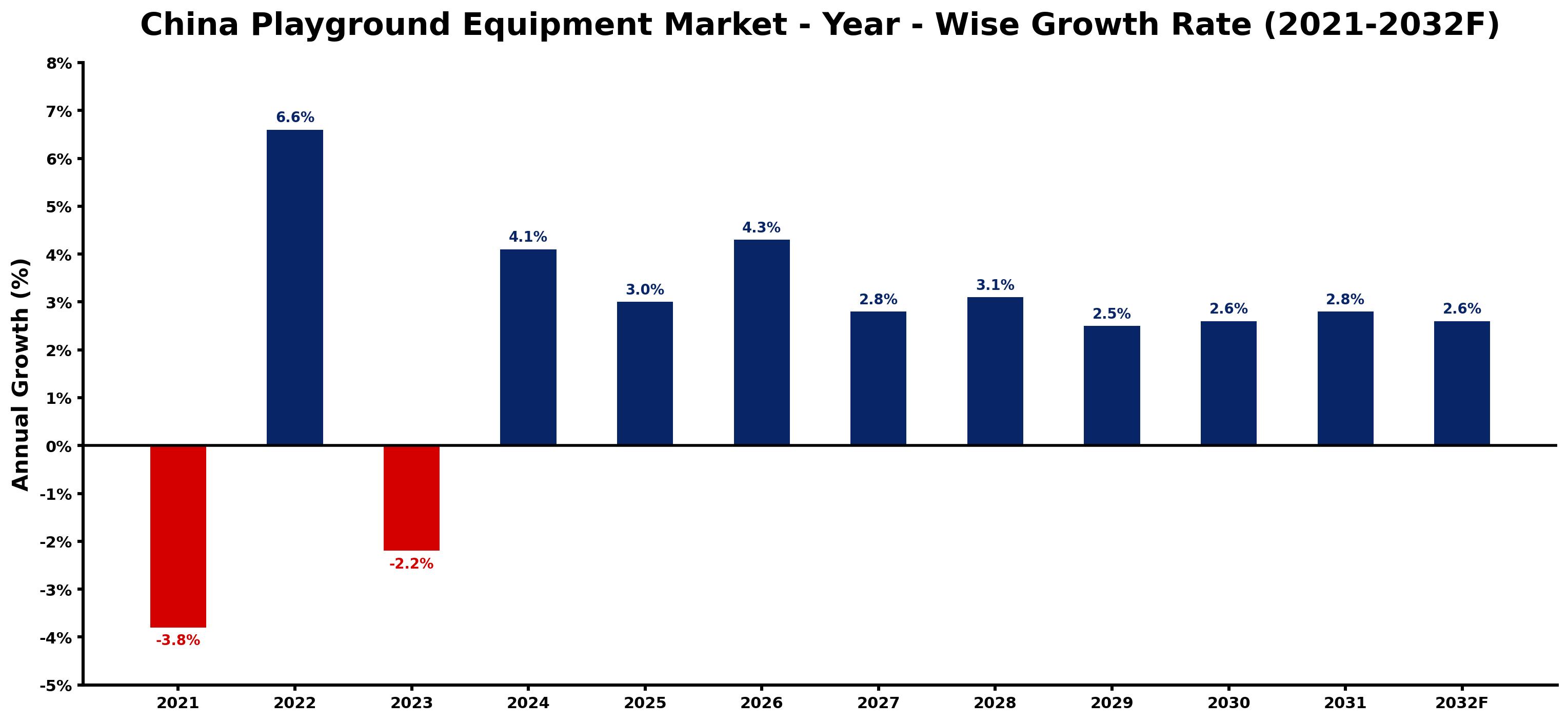
The table below presents the year‑wise growth rates along with the key drivers influencing the market
| Year | Growth Rate | Major Drivers |
| 2021 | -3.8% | Increasing adoption of advanced technologies |
| 2022 | 6.6% | Rising electricity demand across industries |
| 2023 | -2.2% | Growing renewable energy integration projects |
| 2024 | 4.1% | Growing renewable energy integration projects |
| 2025 | 3.0% | Growing renewable energy integration projects |
| 2026 | 4.3% | Expansion of manufacturing activities |
| 2027 | 2.8% | Government infrastructure modernization initiatives |
| 2028 | 3.1% | Growing renewable energy integration projects |
| 2029 | 2.5% | Expansion of commercial construction activities |
| 2030 | 2.6% | Increasing adoption of advanced technologies |
| 2031 | 2.8% | Growing renewable energy integration projects |
| 2032 | 2.6% | Expansion of manufacturing activities |
Note - Market size estimations and growth projections presented in this report are based on 6Wresearch’s advanced forecasting approach, validated with industry datasets as of June 2026.
China Playground Equipment Market Synopsis
The strongest force shaping the China Playground Equipment Market today is the growing recognition of outdoor play's critical role in childhood development. Increasingly, parents and educators are advocating for outdoor activities, prompting local governments to invest in modern playgrounds to enhance children's well-being.
Simultaneously, safety and sustainability have emerged as core concerns within this sector. Manufacturers are compelled to implement stringent safety standards while also seeking eco-friendly materials, aligning product offerings with evolving consumer preferences focused on health and environmental consciousness.
China Playground Equipment Market Key Takeaways
- The market is characterized by high competition among domestic and international players offering innovative playground solutions.
- Technological advancements, including interactive and smart playground systems, are reshaping the consumer experience.
- Eco-friendly materials are becoming increasingly important, reflecting a growing commitment to sustainability.
- Government initiatives are crucial in promoting outdoor play spaces, resulting in enhanced demand for playground equipment.
- Customization and themed designs are gaining traction, catering to a diverse range of consumer preferences.
Evaluation of Restraints in China Playground Equipment Market
While the market showcases remarkable potential, several restraints hinder its progress. Intense competition among local and global players intensifies price pressures, often leading to reduced profit margins. Additionally, adherence to strict safety regulations necessitates continuous innovation and quality control, which can prove challenging. Economic fluctuations may also impact investment and spending on recreational infrastructure, particularly in rural areas, where demand may not be as robust. The complexity of supply chains adds another layer of difficulty, as manufacturers strive to balance quality, availability, and cost-effectiveness.
China Playground Equipment Market Trends
Emerging trends in the China Playground Equipment Market highlight a significant shift toward technology integration. Interactive play systems, augmented reality features, and smart playgrounds are becoming commonplace, enhancing engagement levels among children. Moreover, safety remains a pivotal aspect of design, driving manufacturers to adopt higher-quality materials while adhering to evolving safety standards. The growing preference for themed and customizable play areas caters to diverse user needs, offering unique recreational experiences tailored to specific age groups.
China Playground Equipment Market Opportunities
Investment opportunities abound in the China Playground Equipment Market, particularly in the realm of innovative and interactive designs. The demand for sensory-rich playgrounds and inclusive structures is on the rise, reflecting a shift toward catering to varied developmental needs. Additionally, there is a notable market for sustainable playground equipment crafted from recycled materials. Partnerships with local developers and government bodies to create customized solutions can drive differentiation, establishing a foothold in a competitive environment.
Government Initiatives in the China Playground Equipment Market
Chinese government policies play a vital role in shaping the Playground Equipment Market. Regulatory bodies, such as the General Administration of Quality Supervision, Inspection and Quarantine (AQSIQ), enforce stringent safety standards to safeguard children using these facilities. Furthermore, the State Administration for Market Regulation (SAMR) actively monitors the industry to ensure compliance, fostering a market environment that prioritizes child safety and quality. These initiatives help bolster consumer confidence and drive growth in the playground equipment sector.
Future Insights of the China Playground Equipment Market
Looking ahead to 2026-2032, the China Playground Equipment Market is poised for consistent growth. Factors driving this trajectory include ongoing urbanization, an expanding middle class with higher disposable incomes, and increasing government support for outdoor play initiatives. However, companies must remain vigilant against competitive pressures and the need for innovation. As consumer preferences evolve, manufacturers who prioritize safety, sustainability, and advanced technological features will likely lead the market, carving out substantial opportunities for growth and development.
China Playground Equipment Market Latest Developments (May 2025 - June 2026)
The China Playground Equipment Market has witnessed a surge in activity, focusing on the development of eco-friendly and interactive playground solutions. Companies are increasingly adopting advanced materials and integrating smart technology into their products. Local governments are enhancing investments in recreational infrastructure, with several new projects underway aimed at creating engaging outdoor environments for children. Innovations in design are also a priority, with customized and themed playgrounds capturing consumer interest across various demographics.
China Playground Equipment Market - Key Attractiveness of the Report
- 10 Years of Market Numbers
- Historical Data Starting from 2022 to 2025
- Base Year: 2025
- Forecast Data until 2032
- Key Performance Indicators Impacting the Market
- Major Upcoming Developments and Projects
Key Highlights of the Report:
- China Playground Equipment Market Outlook
- Market Size of China Playground Equipment Market, 2025
- Forecast of China Playground Equipment Market, 2032
- Historical Data and Forecast of China Playground Equipment Revenues & Volume for the Period 2022-2032F
- China Playground Equipment Market Trend Evolution
- China Playground Equipment Market Drivers and Challenges
- China Playground Equipment Price Trends
- China Playground Equipment Porter's Five Forces
- China Playground Equipment Industry Life Cycle
- Historical Data and Forecast of China Playground Equipment Market Revenues & Volume By Product for the Period 2022-2032F
- Historical Data and Forecast of China Playground Equipment Market Revenues & Volume By Monkey Bars for the Period 2022-2032F
- Historical Data and Forecast of China Playground Equipment Market Revenues & Volume By Sandbox for the Period 2022-2032F
- Historical Data and Forecast of China Playground Equipment Market Revenues & Volume By Climbing Equipment for the Period 2022-2032F
- Historical Data and Forecast of China Playground Equipment Market Revenues & Volume By Swings and Slides for the Period 2022-2032F
- Historical Data and Forecast of China Playground Equipment Market Revenues & Volume By Balance Equipment for the Period 2022-2032F
- Historical Data and Forecast of China Playground Equipment Market Revenues & Volume By Motion and Spinning for the Period 2022-2032F
- Historical Data and Forecast of China Playground Equipment Market Revenues & Volume By Others for the Period 2022-2032F
- Historical Data and Forecast of China Playground Equipment Market Revenues & Volume By Application for the Period 2022-2032F
- Historical Data and Forecast of China Playground Equipment Market Revenues & Volume By Commercial Playgrounds for the Period 2022-2032F
- Historical Data and Forecast of China Playground Equipment Market Revenues & Volume By Adult Outdoor Fitness Equipment for the Period 2022-2032F
- Historical Data and Forecast of China Playground Equipment Market Revenues & Volume By Theme Play Systems for the Period 2022-2032F
- Historical Data and Forecast of China Playground Equipment Market Revenues & Volume By Others for the Period 2022-2032F
- China Playground Equipment Import Export Trade Statistics
- Market Opportunity Assessment By Product
- Market Opportunity Assessment By Application
- China Playground Equipment Top Companies Market Share
- China Playground Equipment Competitive Benchmarking By Technical and Operational Parameters
- China Playground Equipment Company Profiles
- China Playground Equipment Key Strategic Recommendations






































