China Ploughing and Cultivating Machinery Market Size, Share & Growth Rate
The China Ploughing and Cultivating Machinery Market was estimated at USD 243 Million in 2025 and is projected to reach USD 281 Million by 2032, growing at a CAGR of 2.1% from 2026 to 2032. This upward trajectory is primarily driven by the nation's ongoing commitment to modernizing its agricultural practices, which hinges on enhancing efficiency and productivity. The adoption of innovative technologies, coupled with government support, is paving the way for substantial growth in this sector.
China Ploughing and Cultivating Machinery Market Year-wise Growth Rate and Key Drivers
This graph highlights how the China Ploughing and Cultivating Machinery Market has steadily grown over the years, supported by major growth factors.
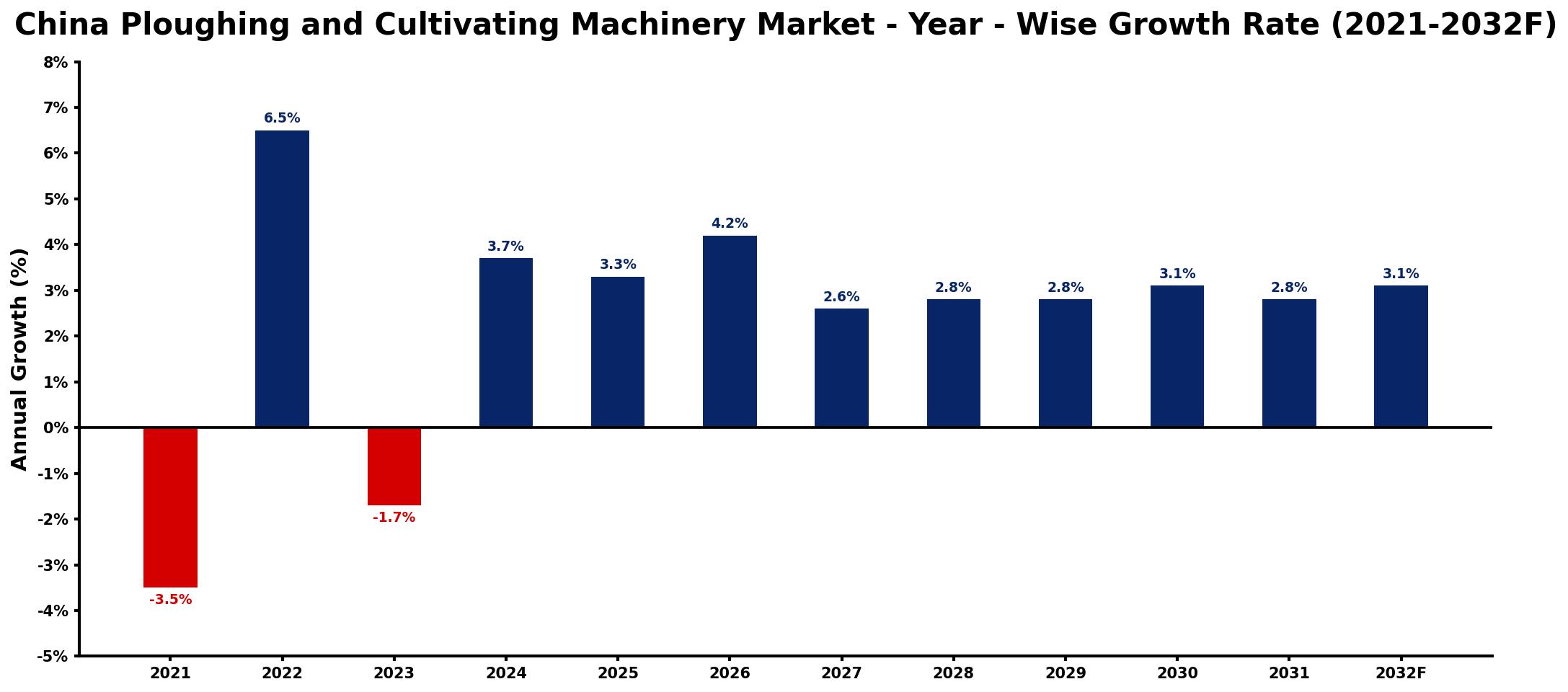
The table below presents the year‑wise growth rates along with the key drivers influencing the market
| Year | Growth Rate | Major Drivers |
| 2021 | -3.5% | Agricultural investment levels decrease significantly |
| 2022 | 6.5% | Rural development funding increases substantially |
| 2023 | -1.7% | Market interest in automation wanes |
| 2024 | 3.7% | Government incentives drive sector growth |
| 2025 | 3.3% | Sustainable farming practices gain traction |
| 2026 | 4.2% | Technological advancements enhance productivity |
| 2027 | 2.6% | Export opportunities expand for manufacturers |
| 2028 | 2.8% | Consumer preferences shift towards efficiency |
| 2029 | 2.8% | Infrastructure improvements support agriculture |
| 2030 | 3.1% | Research initiatives foster innovation growth |
| 2031 | 2.8% | Partnerships strengthen industry collaboration |
| 2032 | 3.1% | Market diversification opens new avenues |
Note: Market size estimations and growth projections presented in this report are based on 6Wresearch's proprietary forecasting methodology, utilizing the latest available industry data, government publications, and primary research inputs.
China Ploughing and Cultivating Machinery Market Synopsis
Recent advancements in the China Ploughing and Cultivating Machinery Market have set the stage for a transformative shift in agricultural operations. With the integration of precision farming and automation, farmers are now empowered to enhance productivity while minimizing labor costs.
Looking ahead, the market is poised for further expansion. As the Chinese government continues to promote agricultural mechanization through various incentives and support schemes, the demand for sophisticated machinery is expected to rise, aligning with the broader trends of sustainability and smart farming.
China Ploughing and Cultivating Machinery Market Key Takeaways
- The market is on a growth trajectory, projected to reach USD 281 Million by 2032.
- Government support through subsidies and incentives is a major growth driver.
- Technological innovations such as GPS and automation are reshaping farming practices.
- There is a clear trend towards sustainable and eco-friendly agricultural machinery.
- Competitive dynamics are influenced by both domestic and international manufacturers.
Evaluation of Restraints in China Ploughing and Cultivating Machinery Market
While the market shows significant promise, several factors are acting as restraints. The intense competition between domestic manufacturers and international players puts pressure on pricing and innovation timelines. Additionally, fluctuating raw material costs and a complex regulatory landscape pose challenges for manufacturers attempting to maintain profitability. The need for constant technological advancements further compounds these issues, as companies strive to meet the rapidly evolving demands of Chinese farmers.
China Ploughing and Cultivating Machinery Market Trends
The current landscape of the China Ploughing and Cultivating Machinery Market is characterized by a definitive shift towards advanced technology adoption. Precision agriculture is becoming mainstream, with a rising preference for machinery that integrates remote control capabilities and GPS-guided navigation. Additionally, there's a growing emphasis on digital solutions that leverage data analytics to enhance decision-making processes on the farm. This trend aligns well with the broader movement towards sustainable farming, wherein optimizing resource usage and reducing environmental impacts are paramount.
China Ploughing and Cultivating Machinery Market Opportunities
Investment opportunities abound within the China Ploughing and Cultivating Machinery Market, especially in the realm of technology-driven innovations. With farmers increasingly seeking machinery that enhances efficiency and sustainability, there is a substantial demand for advanced products tailored to diverse agricultural needs. Companies that provide comprehensive after-sales services, spare parts, and maintenance solutions can significantly benefit. Furthermore, investing in sustainable technologies that align with environmental regulations will be crucial in capitalizing on future growth avenues.
Government Initiatives in the China Ploughing and Cultivating Machinery Market
The Chinese government has implemented numerous initiatives to bolster the Ploughing and Cultivating Machinery Market. These include offering subsidies for agricultural machinery purchases and tax incentives for manufacturers within the sector. By promoting modern agricultural practices, the government is encouraging innovation and efficiency. Further measures include establishing standards for machinery quality and safety, as well as organizing training programs aimed at equipping farmers with essential skills.
Future Insights of the China Ploughing and Cultivating Machinery Market
Looking ahead, the China Ploughing and Cultivating Machinery Market appears well-positioned for significant growth from 2026 to 2032. As the mechanization of agriculture becomes increasingly prevalent, farmers are expected to adopt advanced solutions that enhance productivity and sustainability. The demand for powerful machinery tailored to larger farm operations is likely to rise, especially in response to labor shortages. Overall, the market is on track to evolve and modernize in alignment with global agricultural trends, setting the stage for future advancements.
China Ploughing and Cultivating Machinery Market Latest Developments (2025 - 2026)
In recent months, the market has witnessed a notable increase in R&D activities, focusing on smarter and more efficient machinery options. Companies are actively exploring collaborations to enhance product offerings, particularly in the fields of automation and data integration. Additionally, there has been a growing interest in sustainable solutions, with manufacturers working to align their technologies with environmental standards and consumer preferences. These developments indicate a robust and responsive market that is adapting to both challenges and opportunities.
China Ploughing and Cultivating Machinery Market - Key Attractiveness of the Report
- 10 Years of Market Numbers
- Historical Data Starting from 2022 to 2025
- Base Year: 2025
- Forecast Data until 2032
- Key Performance Indicators Impacting the Market
- Major Upcoming Developments and Projects
Key Highlights of the Report:
- China Ploughing and Cultivating Machinery Market Outlook
- Market Size of China Ploughing and Cultivating Machinery Market, 2025
- Forecast of China Ploughing and Cultivating Machinery Market, 2032
- Historical Data and Forecast of China Ploughing and Cultivating Machinery Revenues & Volume for the Period 2022-2032F
- China Ploughing and Cultivating Machinery Market Trend Evolution
- China Ploughing and Cultivating Machinery Market Drivers and Challenges
- China Ploughing and Cultivating Machinery Price Trends
- China Ploughing and Cultivating Machinery Porter's Five Forces
- China Ploughing and Cultivating Machinery Industry Life Cycle
- Historical Data and Forecast of China Ploughing and Cultivating Machinery Market Revenues & Volume By Type for the Period 2022-2032F
- Historical Data and Forecast of China Ploughing and Cultivating Machinery Market Revenues & Volume By Ploughs for the Period 2022-2032F
- Historical Data and Forecast of China Ploughing and Cultivating Machinery Market Revenues & Volume By Harrows for the Period 2022-2032F
- Historical Data and Forecast of China Ploughing and Cultivating Machinery Market Revenues & Volume By Others for the Period 2022-2032F
- Historical Data and Forecast of China Ploughing and Cultivating Machinery Market Revenues & Volume By Application for the Period 2022-2032F
- Historical Data and Forecast of China Ploughing and Cultivating Machinery Market Revenues & Volume By Soil Loosening for the Period 2022-2032F
- Historical Data and Forecast of China Ploughing and Cultivating Machinery Market Revenues & Volume By Clod Size Reduction for the Period 2022-2032F
- Historical Data and Forecast of China Ploughing and Cultivating Machinery Market Revenues & Volume By Clod Sorting for the Period 2022-2032F
- Historical Data and Forecast of China Ploughing and Cultivating Machinery Market Revenues & Volume By Others for the Period 2022-2032F
- China Ploughing and Cultivating Machinery Import Export Trade Statistics
- Market Opportunity Assessment By Type
- Market Opportunity Assessment By Application
- China Ploughing and Cultivating Machinery Top Companies Market Share
- China Ploughing and Cultivating Machinery Competitive Benchmarking By Technical and Operational Parameters
- China Ploughing and Cultivating Machinery Company Profiles
- China Ploughing and Cultivating Machinery Key Strategic Recommendations






































