China Policy Management in Telecom Market Size & Growth Rate (2026-2032)
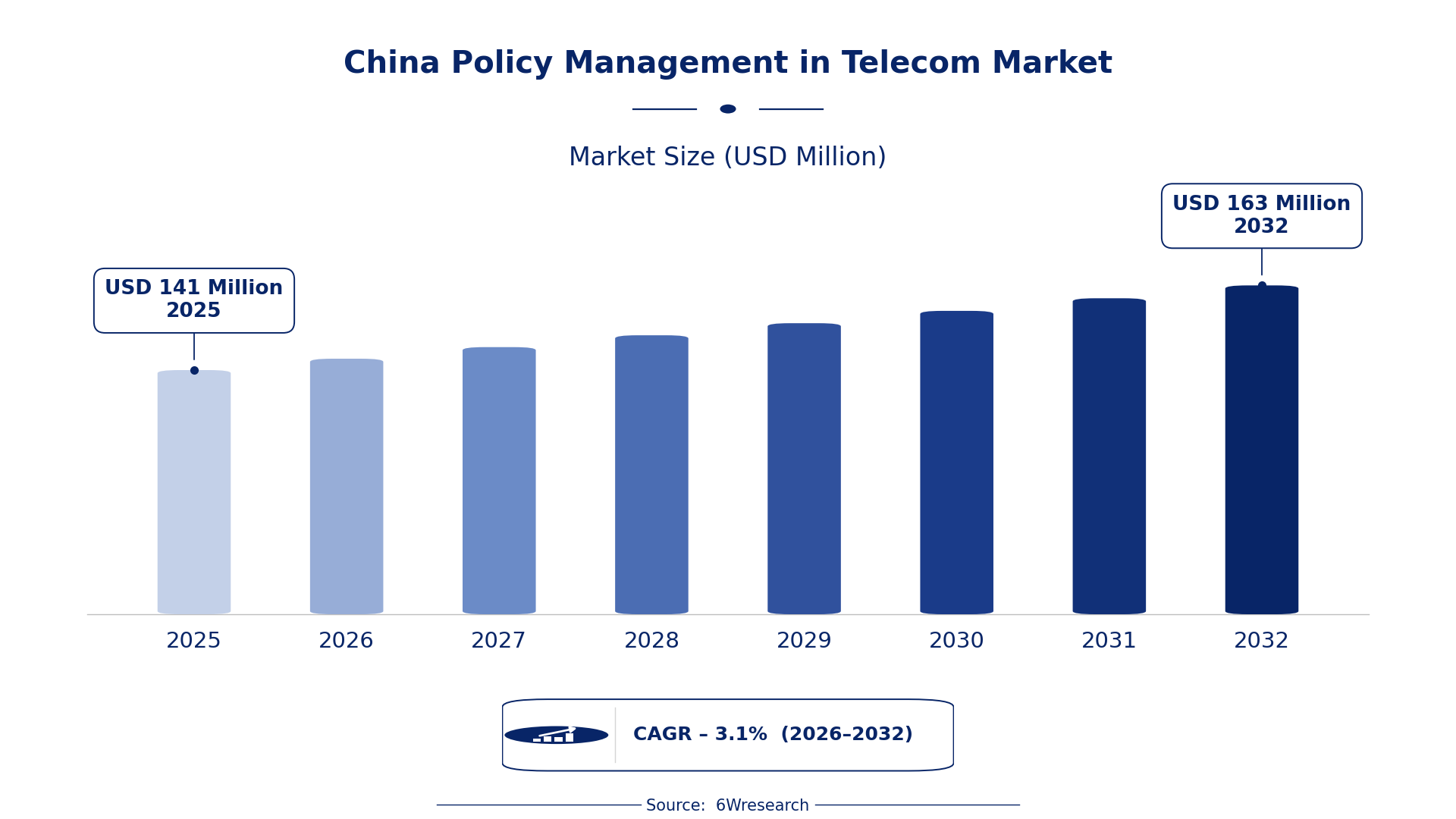
The China Policy Management in Telecom Market was estimated at USD 141 Million in 2025 and is projected to reach USD 163 Million by 2032, growing at a CAGR of 3.1% from 2026 to 2032.
China Policy Management in Telecom Market Synopsis
The telecom sector in China is undergoing a profound transformation, with policy management systems becoming indispensable tools for operators. Increasing demands for service quality and customer satisfaction drive the need for advanced solutions that effectively manage and enforce policies governing data usage and network performance.
As competition intensifies, Chinese telecom providers are investing significantly in innovative technologies. This focus on policy management not only enhances operational efficiency but also plays a crucial role in ensuring compliance with regulatory requirements. In essence, the market is positioned for steady growth as it adapts to both technological advancements and evolving consumer expectations.
China Policy Management in Telecom Market Year-wise Growth Rate and Key Drivers
This graph illustrates the annual growth rates of the China Policy Management in Telecom Market from 2021 to 2032, highlighting a steady upward trajectory and projected expansion over the forecast period.
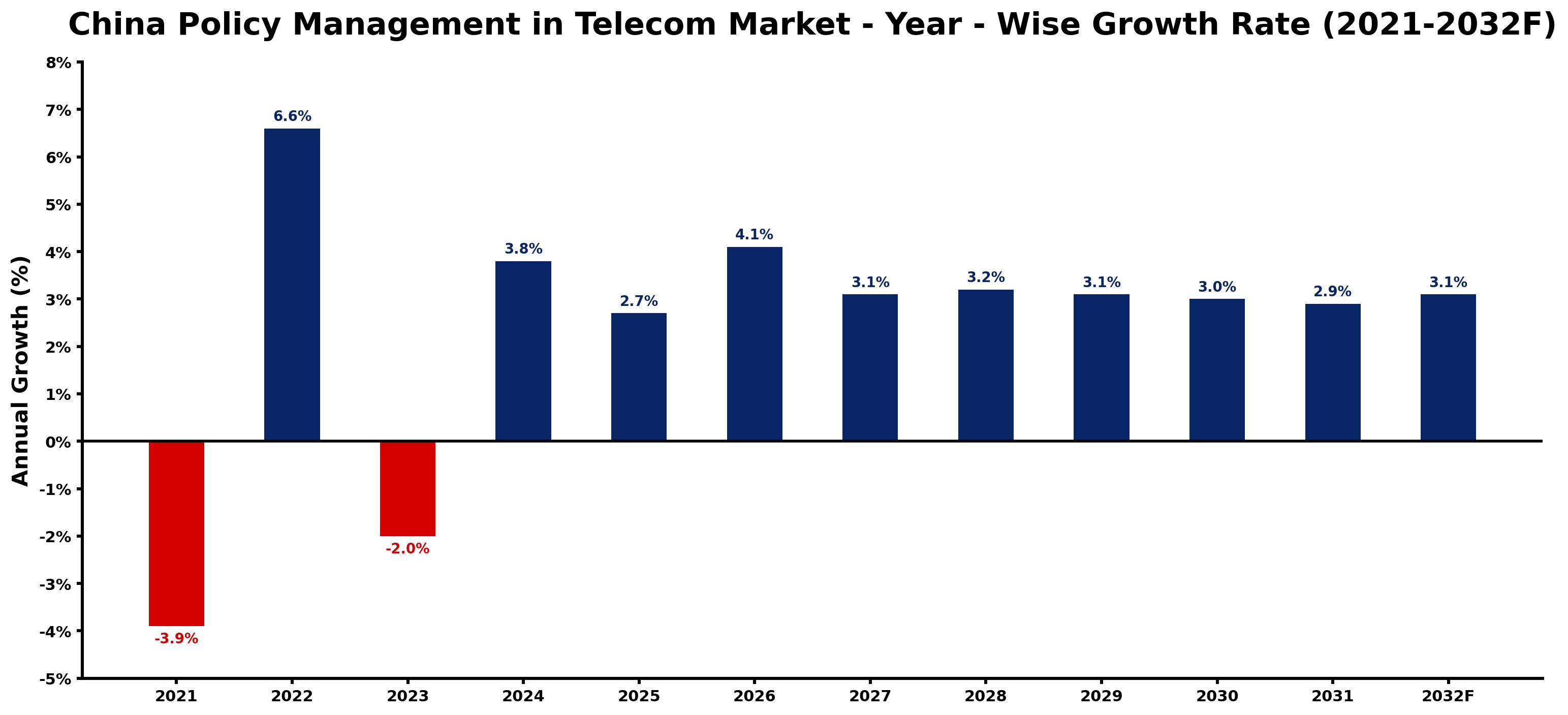
The table below presents the year‑wise growth rates along with the key drivers influencing the market
| Year | Growth Rate | Major Drivers |
| 2021 | -3.9% | China's MII halted new telecom investment approvals |
| 2022 | 6.6% | 5G rollout supported by the Ministry of Industry |
| 2023 | -2.0% | Telecom user churn increased due to economic uncertainties |
| 2024 | 3.8% | National cybersecurity policy boosts telecom regulatory framework |
| 2025 | 2.7% | Increased digital adoption among urban populations drives demand |
| 2026 | 4.1% | Government incentives for rural telecom infrastructure expansion |
| 2027 | 3.1% | Enhanced data protection laws foster consumer trust in telecom |
| 2028 | 3.2% | Investment in AI-driven telecom services by state-owned enterprises |
| 2029 | 3.1% | Telecom subsidies aimed at promoting middle-class connectivity |
| 2030 | 3.0% | Regulatory support for e-commerce through better telecom policies |
| 2031 | 2.9% | Collaborations with tech startups advancing telecom innovations |
| 2032 | 3.1% | Policy shifts encouraging foreign investment in telecom sector |
Note: Market size estimations and growth projections presented in this report are based on 6Wresearch's proprietary forecasting methodology, utilizing the latest available industry data, government publications, and primary research inputs.
China Policy Management in Telecom Market Key Takeaways
Below are some of the specific key takeaways from the market, including:
- The growing emphasis on customer experience is pushing telecom operators to adopt advanced policy management solutions.
- Regulatory compliance remains a fundamental challenge for operators as policies evolve.
- Technological integration is critical for the successful implementation of policy management systems.
- There is a clear trend towards leveraging automation and analytics to enhance policy enforcement.
- Government incentives are playing a crucial role in advancing technology adoption within the market.
Evaluation of Restraints in China Policy Management in Telecom Market
The policy management market in China's telecom industry faces hurdles that hinder its potential. One primary challenge is the complex regulatory environment; compliance with stringent government standards can consume substantial resources and attention. Additionally, integrating new technologies into existing infrastructures poses a considerable obstacle, often requiring significant time and capital investment. Operators need to navigate these complexities while attempting to enhance customer satisfaction and service delivery.
China Policy Management in Telecom Market Trends
Several trends are currently shaping the China Policy Management in Telecom Market. The move towards 5G technology is spurring demand for sophisticated policy management systems that can handle increased data traffic and service quality expectations. Automation is becoming a norm, allowing for real-time policy enforcement and service optimization. Furthermore, the use of artificial intelligence in analytics is facilitating predictive policy management, leading to improved customer experiences and operational efficiencies.
China Policy Management in Telecom Market Opportunities
Opportunities abound in the China Policy Management in Telecom Market, particularly as operators seek to enhance service delivery. Investments in next-generation policy management solutions present a chance for vendors to align their offerings with the needs of telecom companies. Additionally, as the government ramps up support for digital transformation initiatives, telecom providers can capitalize on this momentum to improve infrastructure and service capabilities, ultimately driving growth and customer loyalty.
Government Initiatives in the China Policy Management in Telecom Market
Government actions play a substantial role in shaping the dynamics of the policy management sector within China's telecom market. The Chinese authorities are focusing on regulations that ensure compliance and enhance the sector's efficiency. As telecom providers implement these regulations, they benefit from improved frameworks that foster better service delivery and data management practices.
- A regulatory framework introduced in 2025 mandating billing transparency has improved consumer trust and accountability in the telecom sector.
- A national digital infrastructure upgrade programme is currently underway, enhancing network capabilities across urban and rural areas.
- Plans for a public-private initiative expected to expand telecom infrastructure access by 2028 are being developed, aimed at bridging the digital divide.
- Recent guidelines established for data security and network management have prompted telecom companies to invest in more robust policy management systems.
Future Insights of the China Policy Management in Telecom Market
Looking ahead to 2026-2032, the China Policy Management in Telecom Market is on a trajectory of steady growth. As 5G technology becomes more prevalent, operators will increasingly rely on policy management systems to navigate the complexities associated with higher data volumes. Furthermore, the alignment of government initiatives with industry goals will likely foster a more favorable environment for technological advancements, positioning the market for sustained investment and innovation.
China Policy Management in Telecom Market Latest Developments
In the past year, the China Policy Management in Telecom Market has seen notable activity. Operators are actively pursuing innovations that enhance their policy management capabilities, driven by both consumer demand and regulatory requirements. The increasing integration of advanced analytics and automation is particularly evident as companies strive to improve service quality and compliance.
- A leading regional operator launched an upgraded policy management system in early 2025, aimed at enhancing data usage efficiency and customer engagement.
- An initiative began in mid-2025 and remains underway, focusing on the implementation of AI-driven policy management tools to enhance operational responsiveness.
- A major technology vendor is set to introduce a new analytics platform designed to optimize policy enforcement, with rollout expected in Q4 2026.
- A comprehensive training programme for telecom staff on new compliance regulations was completed in late 2025, improving regulatory adherence across the sector.
China Policy Management in Telecom Market - Key Attractiveness of the Report
- 10 Years of Market Numbers
- Historical Data Starting from 2022 to 2025
- Base Year: 2025
- Forecast Data until 2032
- Key Performance Indicators Impacting the Market
- Major Upcoming Developments and Projects
Key Highlights of the Report:
- China Policy Management in Telecom Market Outlook
- Market Size of China Policy Management in Telecom Market, 2025
- Forecast of China Policy Management in Telecom Market, 2032
- Historical Data and Forecast of China Policy Management in Telecom Revenues & Volume for the Period 2022-2032F
- China Policy Management in Telecom Market Trend Evolution
- China Policy Management in Telecom Market Drivers and Challenges
- China Policy Management in Telecom Price Trends
- China Policy Management in Telecom Porter's Five Forces
- China Policy Management in Telecom Industry Life Cycle
- Historical Data and Forecast of China Policy Management in Telecom Market Revenues & Volume By Network for the Period 2022-2032F
- Historical Data and Forecast of China Policy Management in Telecom Market Revenues & Volume By Fixed for the Period 2022-2032F
- Historical Data and Forecast of China Policy Management in Telecom Market Revenues & Volume By Wireless for the Period 2022-2032F
- Historical Data and Forecast of China Policy Management in Telecom Market Revenues & Volume By Component for the Period 2022-2032F
- Historical Data and Forecast of China Policy Management in Telecom Market Revenues & Volume By Solutions for the Period 2022-2032F
- Historical Data and Forecast of China Policy Management in Telecom Market Revenues & Volume By Services for the Period 2022-2032F
- Historical Data and Forecast of China Policy Management in Telecom Market Revenues & Volume By Deployment for the Period 2022-2032F
- Historical Data and Forecast of China Policy Management in Telecom Market Revenues & Volume By Cloud for the Period 2022-2032F
- Historical Data and Forecast of China Policy Management in Telecom Market Revenues & Volume By On-Premises for the Period 2022-2032F
- China Policy Management in Telecom Import Export Trade Statistics
- Market Opportunity Assessment By Network
- Market Opportunity Assessment By Component
- Market Opportunity Assessment By Deployment
- China Policy Management in Telecom Top Companies Market Share
- China Policy Management in Telecom Competitive Benchmarking By Technical and Operational Parameters
- China Policy Management in Telecom Company Profiles
- China Policy Management in Telecom Key Strategic Recommendations






































