China POS Security Market Size & Growth Rate (2026-2032)
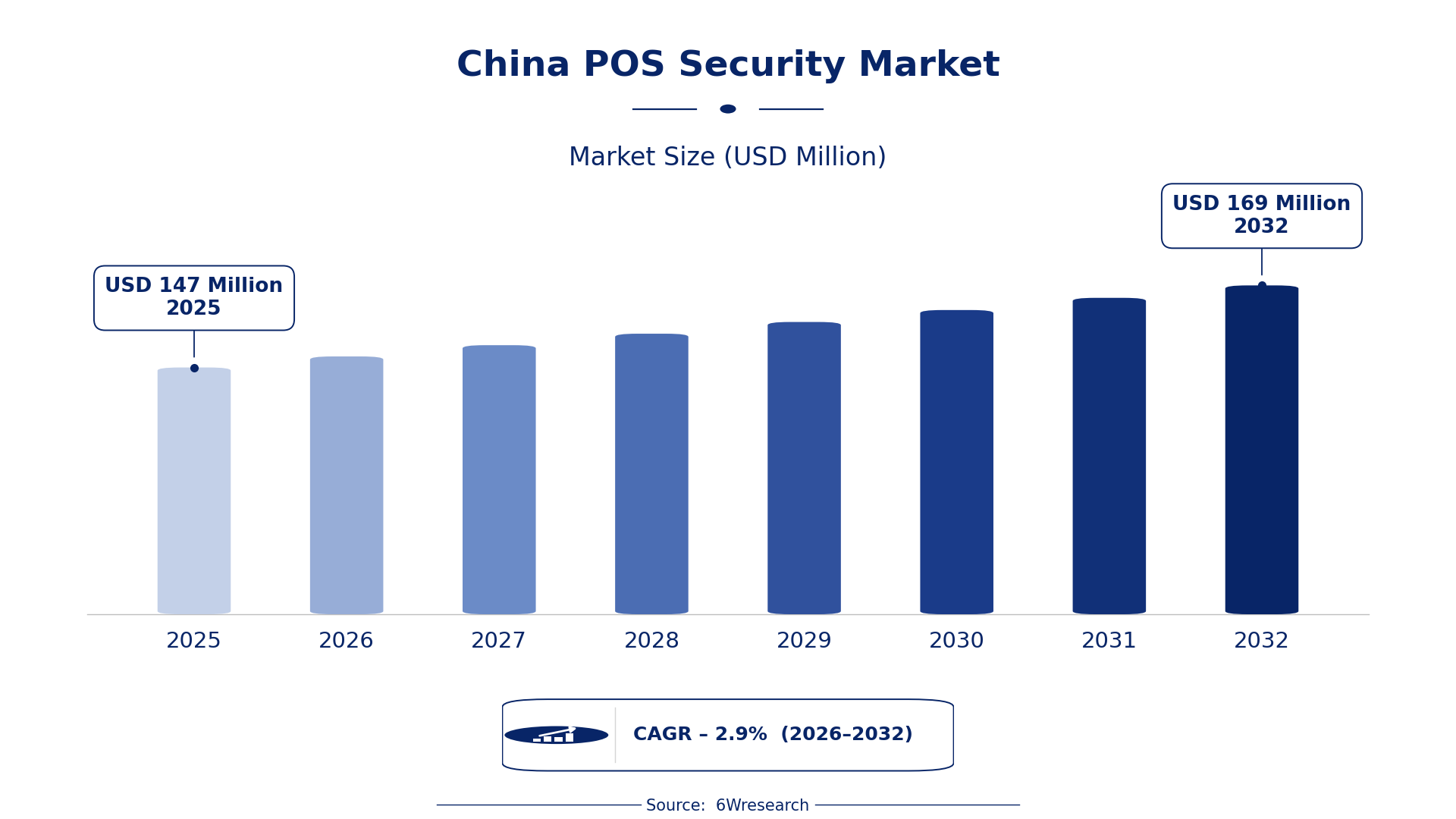
The China POS Security Market was estimated at USD 147 Million in 2025 and is projected to reach USD 169 Million by 2032, growing at a CAGR of 2.9% from 2026 to 2032.
China POS Security Market Synopsis
The escalating adoption of digital payment solutions in China is driving an urgent demand for sophisticated POS security measures. With key sectors such as retail and hospitality increasingly reliant on electronic transactions, the emphasis on protecting consumer data is reaching new heights.
The threat landscape is becoming increasingly hostile, marked by rising incidents of data breaches and cyberattacks targeting point-of-sale systems. In response, businesses are investing heavily in advanced security technologies like encryption and biometric authentication, reflecting a growing commitment to securing sensitive transaction data.
China POS Security Market Year-wise Growth Rate and Key Drivers
This graph illustrates the annual growth rates of the China POS Security Market from 2021 to 2032, highlighting a steady upward trajectory and projected expansion over the forecast period.
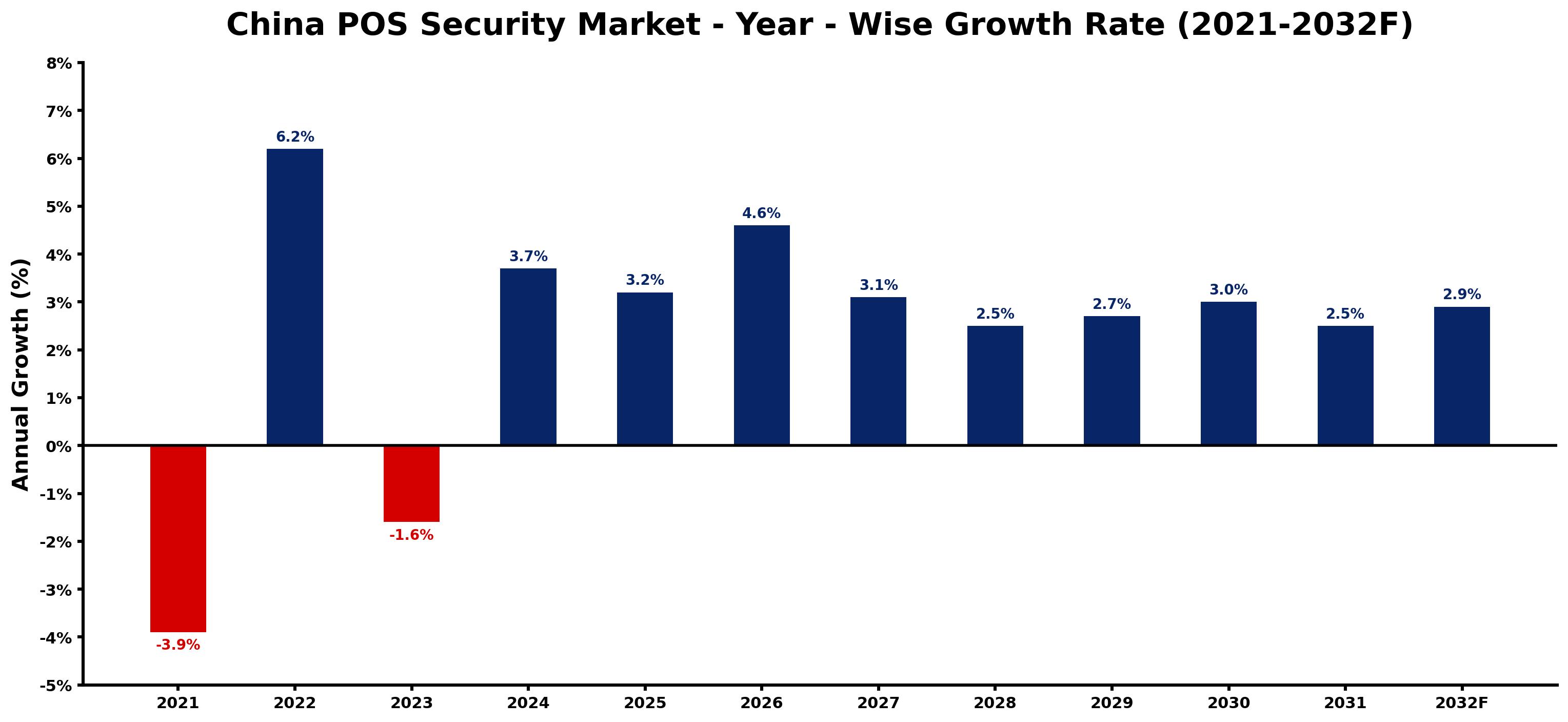
The table below presents the year‑wise growth rates along with the key drivers influencing the market
| Year | Growth Rate | Major Drivers |
| 2021 | -3.9% | Increased scrutiny from China Cybersecurity Administration regulations. |
| 2022 | 6.2% | Increased e-commerce transactions driving POS security investments. |
| 2023 | -1.6% | Decline in retail sales due to COVID-19 lockdowns. |
| 2024 | 3.7% | Strengthened cybersecurity regulations by the People's Bank of China. |
| 2025 | 3.2% | Growing consumer preference for secure mobile payment solutions. |
| 2026 | 4.6% | Implementation of national standards for payment terminal security. |
| 2027 | 3.1% | Rising incidents of fraud boosting demand for robust solutions. |
| 2028 | 2.5% | Adoption of biometric authentication in retail environments increasing. |
| 2029 | 2.7% | Integration of AI technology enhancing transaction security features. |
| 2030 | 3.0% | Government initiatives promoting digital currency demand expanded security. |
| 2031 | 2.5% | Retail sector growth necessitating advanced POS protective measures. |
| 2032 | 2.9% | Increased focus on data privacy regulations heightening security needs. |
Note: Market size estimations and growth projections presented in this report are based on 6Wresearch's proprietary forecasting methodology, utilizing the latest available industry data, government publications, and primary research inputs.
China POS Security Market Key Takeaways
Below are some of the specific key takeaways from the market, including:
- The increasing prevalence of cyber threats is pushing businesses towards more secure payment infrastructures.
- Innovative security technologies like biometric authentication are becoming essential for POS systems.
- Investment in advanced encryption methods is on the rise as companies aim to protect customer data.
- Stringent regulatory requirements are compelling businesses to prioritize compliance in their POS security strategies.
- The potential for growth remains strong as digital payment systems continue to permeate various sectors.
Evaluation of Restraints in China POS Security Market
Despite its growth trajectory, the China POS security market faces significant restraints. The sophistication of cyber threats is on the rise, posing a constant challenge for businesses striving to secure their systems. Compliance complexities add another layer of difficulty, as varying regulations demand tailored approaches across different sectors.
Additionally, the absence of standardized security protocols leads to inconsistencies, especially for businesses relying on legacy systems. As mobile payment technologies gain traction, they introduce new vulnerabilities, requiring organizations to evolve their security measures continually.
China POS Security Market Trends
Several trends are shaping the China POS security market, notably the rise of encryption technologies. As digital payment methods become the norm, the focus on protecting sensitive financial data intensifies. Biometric methods, including fingerprint and facial recognition, are increasingly incorporated to enhance system access security.
Artificial intelligence and machine learning algorithms are also gaining traction, as they help in detecting fraudulent activities in real time. Businesses are not just responding to existing threats but are also proactively developing robust security frameworks to meet evolving regulatory demands.
China POS Security Market Opportunities
With rising digital payment usage, the China POS security market holds substantial investment opportunities. Companies focused on encryption technologies and secure payment gateways are well-positioned to benefit from this growing demand. Emerging technologies like AI and blockchain also promise to redefine the security landscape, providing avenues for innovation and investment.
As the threat of financial fraud escalates, businesses will increasingly look for comprehensive security solutions tailored to the Chinese market, creating fertile ground for strategic investments.
Government Initiatives in the China POS Security Market
Government policies play a crucial role in shaping the China POS security market. These initiatives focus on enhancing data protection and establishing compliance frameworks for businesses handling sensitive payment information. Regulatory bodies are actively working to mitigate cyber risks and foster a secure payment environment across the country.
- A regulatory framework introduced in 2025 mandates the use of stringent encryption standards for all POS systems.
- A cybersecurity awareness campaign launched in late 2025 aims to educate businesses about the importance of data protection.
- A national digital infrastructure upgrade program is currently underway to improve security measures across all payment platforms.
- Future initiatives are planned to enhance cooperation between private sectors and law enforcement agencies to combat cybercrime effectively.
Future Insights of the China POS Security Market
Looking ahead to 2026-2032, the China POS security market is set to experience notable advancements driven by the escalating demand for secure digital payment methods. The adoption of new technologies will continue to redefine security protocols, as organizations prioritize protecting customer data against an increasingly aggressive cyber threat landscape.
Investment in security measures is likely to increase as businesses aim to comply with evolving regulatory requirements, paving the way for significant growth in this sector. The future appears bright, with companies recognizing that robust POS security not only mitigates risks but also fosters consumer trust.
China POS Security Market Latest Developments
The past year has seen considerable movement within the China POS security market, with businesses accelerating their investments in security measures to counteract evolving threats. As digital payment systems grow, the urgency for more secure transaction methods has led to increased innovation and collaboration among stakeholders.
- A major technology vendor launched a state-of-the-art biometric authentication system in Q3 2025, enhancing security for POS transactions.
- Ongoing development of advanced encryption solutions is underway, driven by a key regional operator seeking to bolster consumer data protection.
- A partnership between several fintech firms was formed in early 2026 to develop a unified approach towards payment security standards.
- Research initiatives that began in mid-2025 aim to explore the potential of blockchain technology in enhancing POS security measures.
China POS Security Market - Key Attractiveness of the Report
- 10 Years of Market Numbers
- Historical Data Starting from 2022 to 2025
- Base Year: 2025
- Forecast Data until 2032
- Key Performance Indicators Impacting the Market
- Major Upcoming Developments and Projects
Key Highlights of the Report:
- China POS Security Market Outlook
- Market Size of China POS Security Market, 2025
- Forecast of China POS Security Market, 2032
- Historical Data and Forecast of China POS Security Revenues & Volume for the Period 2022-2032F
- China POS Security Market Trend Evolution
- China POS Security Market Drivers and Challenges
- China POS Security Price Trends
- China POS Security Porter's Five Forces
- China POS Security Industry Life Cycle
- Historical Data and Forecast of China POS Security Market Revenues & Volume By Offering for the Period 2022-2032F
- Historical Data and Forecast of China POS Security Market Revenues & Volume By Solutions for the Period 2022-2032F
- Historical Data and Forecast of China POS Security Market Revenues & Volume By Services for the Period 2022-2032F
- Historical Data and Forecast of China POS Security Market Revenues & Volume By Organization Size for the Period 2022-2032F
- Historical Data and Forecast of China POS Security Market Revenues & Volume By SMEs for the Period 2022-2032F
- Historical Data and Forecast of China POS Security Market Revenues & Volume By Large Enterprises for the Period 2022-2032F
- Historical Data and Forecast of China POS Security Market Revenues & Volume By Vertical for the Period 2022-2032F
- Historical Data and Forecast of China POS Security Market Revenues & Volume By Retail for the Period 2022-2032F
- Historical Data and Forecast of China POS Security Market Revenues & Volume By Restaurants for the Period 2022-2032F
- Historical Data and Forecast of China POS Security Market Revenues & Volume By Hospitality for the Period 2022-2032F
- China POS Security Import Export Trade Statistics
- Market Opportunity Assessment By Offering
- Market Opportunity Assessment By Organization Size
- Market Opportunity Assessment By Vertical
- China POS Security Top Companies Market Share
- China POS Security Competitive Benchmarking By Technical and Operational Parameters
- China POS Security Company Profiles
- China POS Security Key Strategic Recommendations






































