China Potassium chlorate Market Size, Share & Growth Rate
The China Potassium chlorate Market was estimated at USD 174 Million in 2025 and is projected to reach USD 200 Million by 2032, growing at a CAGR of 2.0% from 2026 to 2032. This growth can be attributed to the robust demand for potassium chlorate across various industries, notably fireworks and chemical manufacturing. As urbanization and infrastructure development continue to accelerate, the market is poised for sustained expansion, benefiting from the rising consumption of safety matches and oxidizing agents.
China Potassium chlorate Market Year-wise Growth Rate and Key Drivers
This graph highlights how the China Potassium chlorate Market has steadily grown over the years, supported by major growth factors.
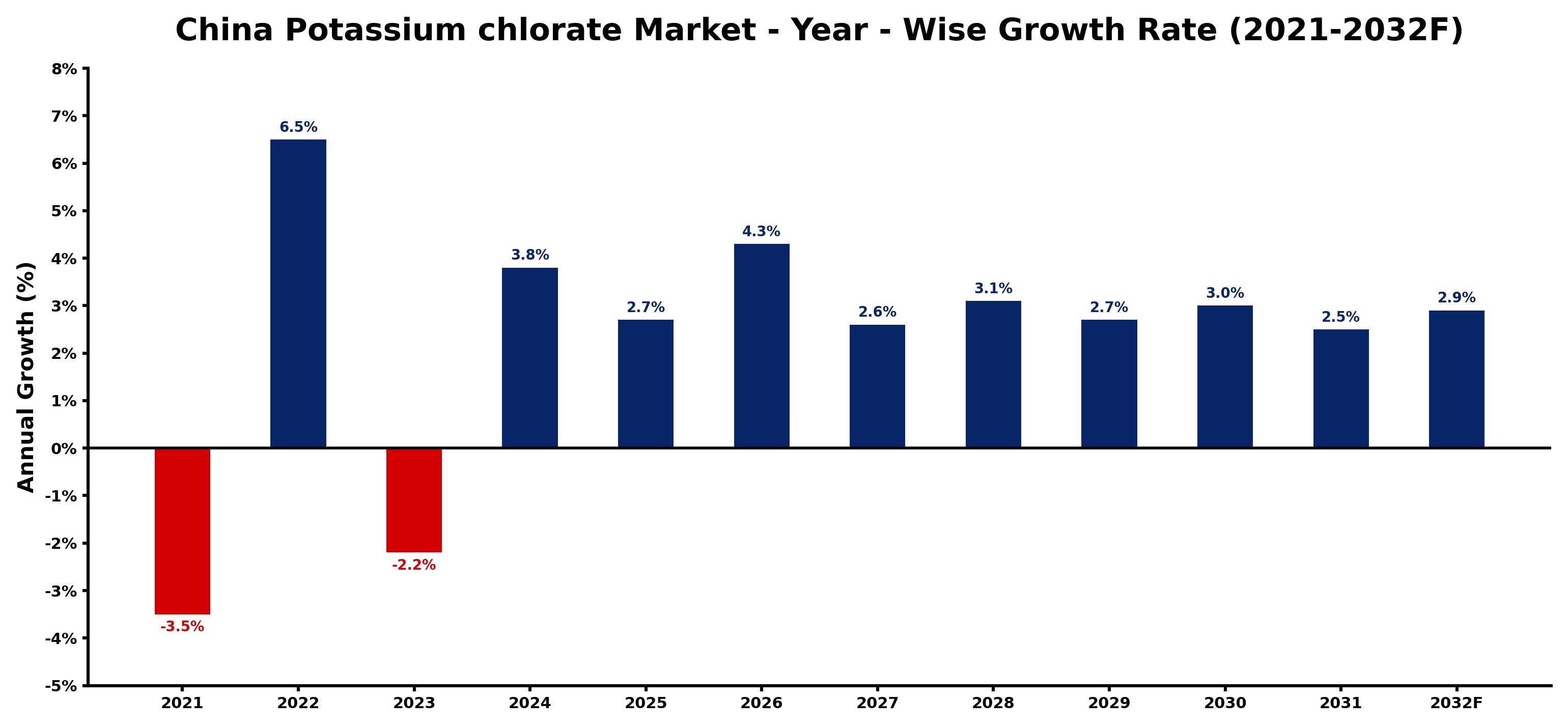
The table below presents the year‑wise growth rates along with the key drivers influencing the market
| Year | Growth Rate | Major Drivers |
| 2021 | -3.5% | Manufacturing slowdowns decreased potassium chlorate production capacity utilization |
| 2022 | 6.5% | Technological advancements boosted potassium chlorate manufacturing efficiency and output |
| 2023 | -2.2% | Reduced agricultural output decreased potassium chlorate production requirements |
| 2024 | 3.8% | Domestic chemical manufacturing expansion boosted potassium chlorate production capacity |
| 2025 | 2.7% | Production facilities upgrade boosts potassium chlorate manufacturing capacity |
| 2026 | 4.3% | Improved chemical manufacturing technologies enhanced potassium chlorate production efficiency |
| 2027 | 2.6% | Potassium chlorate production scaling supports expanding agricultural chemical manufacturing |
| 2028 | 3.1% | Production expansion in potassium chlorate plants boosts regional supply capacity |
| 2029 | 2.7% | Innovative technology adoption boosted potassium chlorate production efficiency |
| 2030 | 3.0% | Demand recovery in pulp and paper drives potassium chlorate production |
| 2031 | 2.5% | Local manufacturers invest in advanced processes for potassium chlorate production |
| 2032 | 2.9% | Higher industrial manufacturing efficiency boosts potassium chlorate demand |
Note - Market size estimations and growth projections presented in this report are based on 6Wresearch’s advanced forecasting approach, validated with industry datasets as of June 2026.
China Potassium chlorate Market Synopsis
Currently, the China potassium chlorate market is characterized by its pivotal role in several high-demand sectors, including fireworks, matches, and agricultural applications. The continued growth in the construction and chemical sectors further underlines the increasing relevance of potassium chlorate as both a manufacturing input and a key player in industrial processes.
With advancements in technology and production methodologies, market participants are continuously exploring innovative ways to enhance efficiency and sustainability. As the industry evolves, the focus on compliance with environmental regulations becomes critical, influencing both production practices and market dynamics.
China Potassium chlorate Market Key Takeaways
- The market is experiencing growth driven by the expanding fireworks and safety match industries.
- China is a leading global producer, impacting the competitive landscape significantly.
- Advancements in agricultural techniques are bolstering potassium chlorate's use as a herbicide.
- Regulatory pressures are shaping production practices, urging investments in environmentally friendly processes.
- Future growth is projected to hinge on urbanization trends and industrialization initiatives.
Evaluation of Restraints in China Potassium chlorate Market
Despite its growth potential, the China potassium chlorate market faces several constraints that could impede its full expansion. The most pressing issue is the stringent regulatory environment, which compels manufacturers to elevate safety and environmental standards. These regulations often translate into increased operational costs and necessitate investment in advanced technologies. Additionally, fluctuations in raw material prices and competitive pressure from both domestic and international players further complicate the market landscape. Companies must navigate these challenges effectively to sustain their market positions and drive profitability.
China Potassium chlorate Market Trends
A key trend in the China potassium chlorate market is the rising demand from the fireworks and match manufacturing sectors, which are seeing sustained growth due to both local consumption and export activities. The ongoing urbanization and enhanced construction activities are amplifying the need for potassium chlorate as an essential component in safety matches. Moreover, the agricultural sector's adoption of potassium chlorate as a herbicide is becoming increasingly prominent, reflecting broader trends in agricultural modernization and crop management practices.
China Potassium chlorate Market Opportunities
The potential for investment in the China potassium chlorate market is notable, particularly in production technologies that emphasize sustainability. There is a clear opportunity for developing facilities focused on eco-friendly manufacturing processes that meet the stringent regulatory standards. Furthermore, as consumer preferences shift towards high-quality products, suppliers who can offer premium-grade potassium chlorate may find lucrative market niches. The ongoing expansion of industrial applications also presents a fertile ground for innovation and growth.
Government Initiatives in the China Potassium chlorate Market
The Chinese government plays a crucial role in shaping the potassium chlorate market through a series of regulatory measures and policies. The Chemicals Management Regulations outline stringent standards for production, storage, and transportation, reflecting the government's commitment to ensuring safety and environmental protection. Additionally, the government has implemented import and export restrictions to maintain quality control and combat illegal trading practices. These initiatives are designed to promote sustainable development while ensuring the responsible use of potassium chlorate within the industry.
Future Insights of the China Potassium chlorate Market
Looking ahead to 2026-2032, the China potassium chlorate market is expected to maintain a moderate growth trajectory. The influence of demographic factors such as population growth and urbanization will continue to drive demand across various applications. Enhanced production techniques and a focus on sustainability are likely to further boost the market's appeal, although regulatory challenges may pose limitations. Overall, the future landscape appears positive, presenting numerous opportunities for strategic investments and technological advancements.
China Potassium chlorate Market Latest Developments (May 2025 - June 2026)
Recent industry developments indicate a growing emphasis on sustainable practices within the potassium chlorate market. Companies are increasingly investing in cleaner production technologies to align with regulatory demands and consumer preferences. Additionally, there has been a notable shift towards enhancing safety measures in production and distribution processes, reflecting a broader commitment to quality and environmental stewardship. These trends are shaping the competitive dynamics of the market as stakeholders adapt to evolving conditions.
China Potassium chlorate Market - Key Attractiveness of the Report
- 10 Years of Market Numbers
- Historical Data Starting from 2022 to 2025
- Base Year: 2025
- Forecast Data until 2032
- Key Performance Indicators Impacting the Market
- Major Upcoming Developments and Projects
Key Highlights of the Report:
- China Potassium chlorate Market Outlook
- Market Size of China Potassium chlorate Market, 2025
- Forecast of China Potassium chlorate Market, 2032
- Historical Data and Forecast of China Potassium chlorate Revenues & Volume for the Period 2022-2032F
- China Potassium chlorate Market Trend Evolution
- China Potassium chlorate Market Drivers and Challenges
- China Potassium chlorate Price Trends
- China Potassium chlorate Porter's Five Forces
- China Potassium chlorate Industry Life Cycle
- Historical Data and Forecast of China Potassium chlorate Market Revenues & Volume By Product type for the Period 2022-2032F
- Historical Data and Forecast of China Potassium chlorate Market Revenues & Volume By Pharmaceutical Grade for the Period 2022-2032F
- Historical Data and Forecast of China Potassium chlorate Market Revenues & Volume By Chemical Grade for the Period 2022-2032F
- Historical Data and Forecast of China Potassium chlorate Market Revenues & Volume By End-use for the Period 2022-2032F
- Historical Data and Forecast of China Potassium chlorate Market Revenues & Volume By Explosives for the Period 2022-2032F
- Historical Data and Forecast of China Potassium chlorate Market Revenues & Volume By Matches for the Period 2022-2032F
- Historical Data and Forecast of China Potassium chlorate Market Revenues & Volume By Disinfectants for the Period 2022-2032F
- Historical Data and Forecast of China Potassium chlorate Market Revenues & Volume By Bleaches for the Period 2022-2032F
- Historical Data and Forecast of China Potassium chlorate Market Revenues & Volume By Medical for the Period 2022-2032F
- China Potassium chlorate Import Export Trade Statistics
- Market Opportunity Assessment By Product type
- Market Opportunity Assessment By End-use
- China Potassium chlorate Top Companies Market Share
- China Potassium chlorate Competitive Benchmarking By Technical and Operational Parameters
- China Potassium chlorate Company Profiles
- China Potassium chlorate Key Strategic Recommendations






































