China Print Label Market Top 5 Importing Countries and Market Competition (HHI) Analysis
China print label import shipments in 2024 saw a diverse range of top exporting countries including the USA, Japan, Hong Kong, and Taiwan. Despite the low concentration indicated by the Herfindahl-Hirschman Index (HHI), the industry experienced a negative Compound Annual Growth Rate (CAGR) of -5.97% from 2020 to 2024. Furthermore, the growth rate in 2024 dropped significantly by -9.79% compared to the previous year. These statistics suggest challenges in the market that may require strategic adjustments and innovations to drive growth in the print label import sector in China.
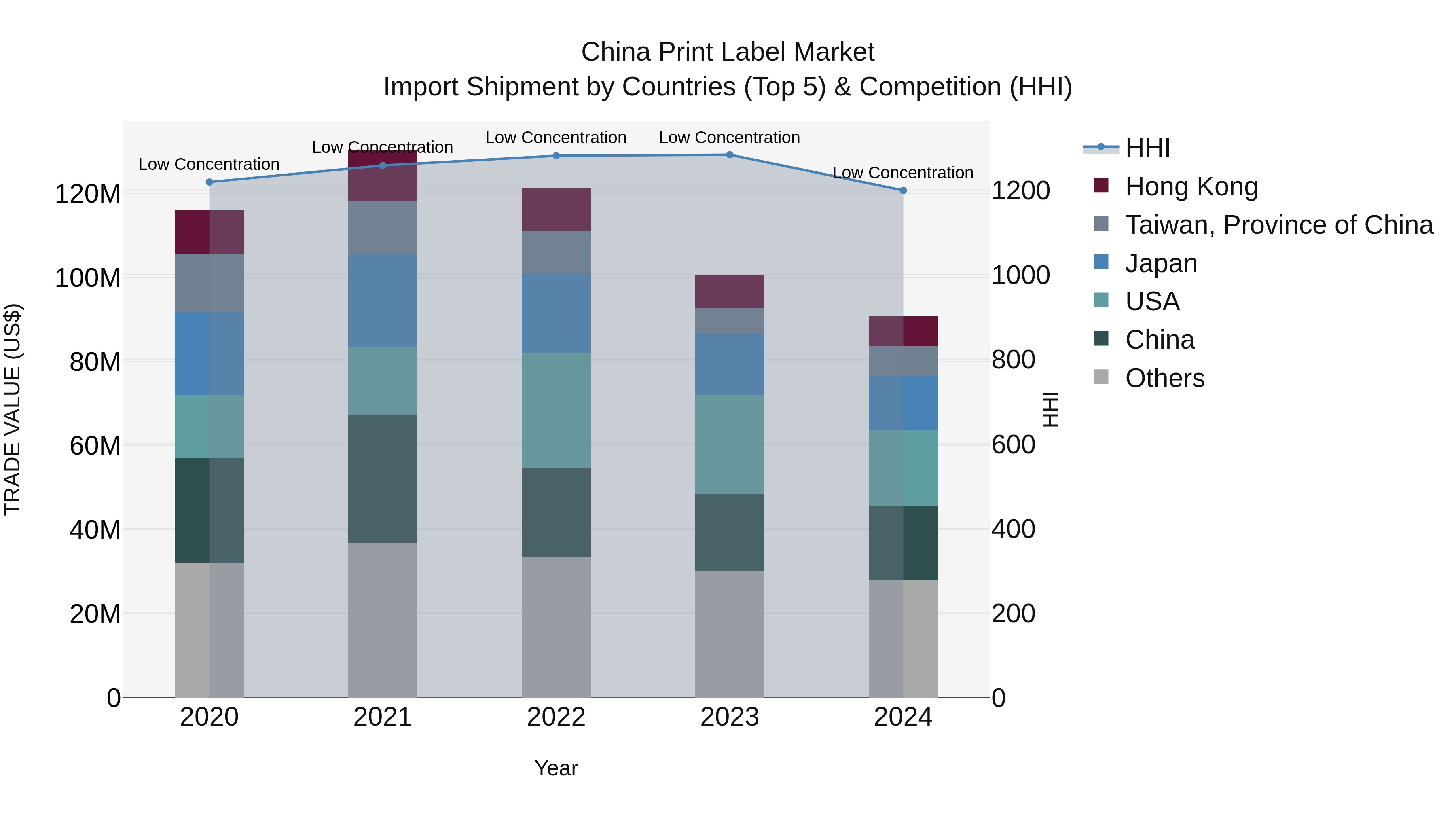
China Print Label Market Overview
The China Print Label Market is experiencing significant growth driven by the increasing demand for product labeling in various industries such as food and beverage, pharmaceuticals, and retail. With a rapidly expanding economy and rising consumer awareness, there is a growing emphasis on brand recognition and product differentiation, fueling the demand for high-quality print labels. Technological advancements in printing techniques, such as digital printing and RFID labeling, are also contributing to the market growth by enabling more customization and efficiency in label production. Additionally, stringent regulations regarding product labeling and packaging in China are further boosting the demand for print labels that comply with safety and quality standards. Overall, the China Print Label Market is poised for continued expansion as companies seek innovative labeling solutions to meet evolving consumer needs.
China Print Label Market Trends
The China Print Label Market is witnessing several key trends, including a growing demand for sustainable and eco-friendly labels as consumers become more environmentally conscious. Digital printing technology is gaining popularity due to its flexibility and cost-effectiveness, allowing for shorter print runs and customization options. Smart labels incorporating RFID technology are also on the rise, enabling improved inventory management and brand authentication. Additionally, there is an increasing focus on anti-counterfeiting measures in the market, driving the adoption of security features such as holographic elements and QR codes. Overall, the China Print Label Market is evolving towards more innovative and technologically advanced solutions to meet the changing needs of consumers and businesses alike.
China Print Label Market Challenges
The China Print Label Market faces several challenges, including intense competition among domestic and international players, rising raw material costs, and stringent regulations on environmental protection and product safety. Additionally, the market is witnessing a shift towards digital printing technologies, necessitating investments in new equipment and workforce training to remain competitive. Counterfeiting and piracy issues also pose challenges in maintaining brand authenticity and consumer trust. Furthermore, the market is experiencing evolving consumer preferences and demands for more sustainable and innovative labeling solutions, requiring companies to adapt quickly to changing trends and technologies to stay ahead in the competitive landscape. Overall, navigating these challenges requires strategic planning, innovation, and a strong understanding of market dynamics in the China Print Label Market.
China Print Label Market Investment Opportunities
The China Print Label Market offers several investment opportunities worth exploring. With the increasing demand for packaged consumer goods in China, the demand for printed labels is also on the rise. Investing in companies that specialize in manufacturing high-quality, innovative, and eco-friendly printed labels could be lucrative. Additionally, there is a growing trend towards personalized and customized labels, providing a niche market for investors to explore. Furthermore, advancements in technology, such as digital printing and smart labels, present exciting opportunities for investors looking to capitalize on the evolving landscape of the print label industry in China. Overall, investing in companies that cater to the diverse needs of the Chinese market and stay ahead of industry trends could yield significant returns in the dynamic China Print Label Market.
China Print Label Market Government Policy
The China Print Label Market is subject to various government policies aimed at regulating labeling practices and ensuring consumer protection. The Chinese government enforces strict regulations concerning the accuracy and clarity of information displayed on product labels to prevent misleading claims and safeguard consumer interests. Additionally, there are rules governing the use of specific labeling materials, such as environmentally friendly options, to promote sustainability. The government also monitors compliance with labeling standards to maintain market transparency and fair competition among industry players. Overall, government policies in China emphasize the importance of accurate, informative, and compliant product labeling practices within the Print Label Market to uphold consumer rights and promote industry integrity.
China Print Label Market Future Outlook
The China Print Label Market is poised for significant growth in the coming years, driven by increasing demand across various industries such as food and beverage, pharmaceuticals, and consumer goods. Technological advancements in printing techniques and materials are expected to enhance the quality and customization capabilities of print labels, meeting the evolving needs of consumers and manufacturers. Additionally, the growing e-commerce sector in China is likely to further boost the demand for print labels for packaging and branding purposes. With a focus on sustainability and eco-friendly solutions, the market is also anticipated to witness a rise in demand for recyclable and biodegradable label materials. Overall, the China Print Label Market is projected to experience steady expansion and innovation, presenting opportunities for both domestic and international players in the industry.
Key Highlights of the Report:
- China Print Label Market Outlook
- Market Size of China Print Label Market, 2021
- Forecast of China Print Label Market, 2031
- Historical Data and Forecast of China Print Label Revenues & Volume for the Period 2018 - 2031
- China Print Label Market Trend Evolution
- China Print Label Market Drivers and Challenges
- China Print Label Price Trends
- China Print Label Porter's Five Forces
- China Print Label Industry Life Cycle
- Historical Data and Forecast of China Print Label Market Revenues & Volume By Print Process for the Period 2018 - 2031
- Historical Data and Forecast of China Print Label Market Revenues & Volume By Offset lithography for the Period 2018 - 2031
- Historical Data and Forecast of China Print Label Market Revenues & Volume By Gravure for the Period 2018 - 2031
- Historical Data and Forecast of China Print Label Market Revenues & Volume By Flexography for the Period 2018 - 2031
- Historical Data and Forecast of China Print Label Market Revenues & Volume By Screen for the Period 2018 - 2031
- Historical Data and Forecast of China Print Label Market Revenues & Volume By Letterpress for the Period 2018 - 2031
- Historical Data and Forecast of China Print Label Market Revenues & Volume By Electrophotography for the Period 2018 - 2031
- Historical Data and Forecast of China Print Label Market Revenues & Volume By Inkjet for the Period 2018 - 2031
- Historical Data and Forecast of China Print Label Market Revenues & Volume By Label Format for the Period 2018 - 2031
- Historical Data and Forecast of China Print Label Market Revenues & Volume By Wet-glue labels for the Period 2018 - 2031
- Historical Data and Forecast of China Print Label Market Revenues & Volume By Pressure-sensitive labels for the Period 2018 - 2031
- Historical Data and Forecast of China Print Label Market Revenues & Volume By Linerless labels for the Period 2018 - 2031
- Historical Data and Forecast of China Print Label Market Revenues & Volume By Multi-part tracking labels for the Period 2018 - 2031
- Historical Data and Forecast of China Print Label Market Revenues & Volume By In-mold labels for the Period 2018 - 2031
- Historical Data and Forecast of China Print Label Market Revenues & Volume By Sleeves for the Period 2018 - 2031
- Historical Data and Forecast of China Print Label Market Revenues & Volume By End-User for the Period 2018 - 2031
- Historical Data and Forecast of China Print Label Market Revenues & Volume By Food for the Period 2018 - 2031
- Historical Data and Forecast of China Print Label Market Revenues & Volume By Beverage for the Period 2018 - 2031
- Historical Data and Forecast of China Print Label Market Revenues & Volume By Healthcare for the Period 2018 - 2031
- Historical Data and Forecast of China Print Label Market Revenues & Volume By Cosmetics for the Period 2018 - 2031
- Historical Data and Forecast of China Print Label Market Revenues & Volume By Household for the Period 2018 - 2031
- Historical Data and Forecast of China Print Label Market Revenues & Volume By Industrial for the Period 2018 - 2031
- Historical Data and Forecast of China Print Label Market Revenues & Volume By Logistics for the Period 2018 - 2031
- Historical Data and Forecast of China Print Label Market Revenues & Volume By Other for the Period 2018 - 2031
- China Print Label Import Export Trade Statistics
- Market Opportunity Assessment By Print Process
- Market Opportunity Assessment By Label Format
- Market Opportunity Assessment By End-User
- China Print Label Top Companies Market Share
- China Print Label Competitive Benchmarking By Technical and Operational Parameters
- China Print Label Company Profiles
- China Print Label Key Strategic Recommendations






































