China Printed Electronics Market Size, Share & Growth Rate
The China Printed Electronics Market was estimated at USD 234 Million in 2025 and is projected to reach USD 268 Million by 2032, growing at a CAGR of 2.0% from 2026 to 2032. This growth trajectory is fueled by advancements in printing technologies that enable the production of flexible displays and sensors, as well as the burgeoning demand for wearable technology. Moreover, the versatility and cost-effectiveness of printed electronics are captivating various sectors, creating a fertile ground for innovation and expansion.
China Printed Electronics Market Year-wise Growth Rate and Key Drivers
This graph highlights how the China Printed Electronics Market has steadily grown over the years, supported by major growth factors.
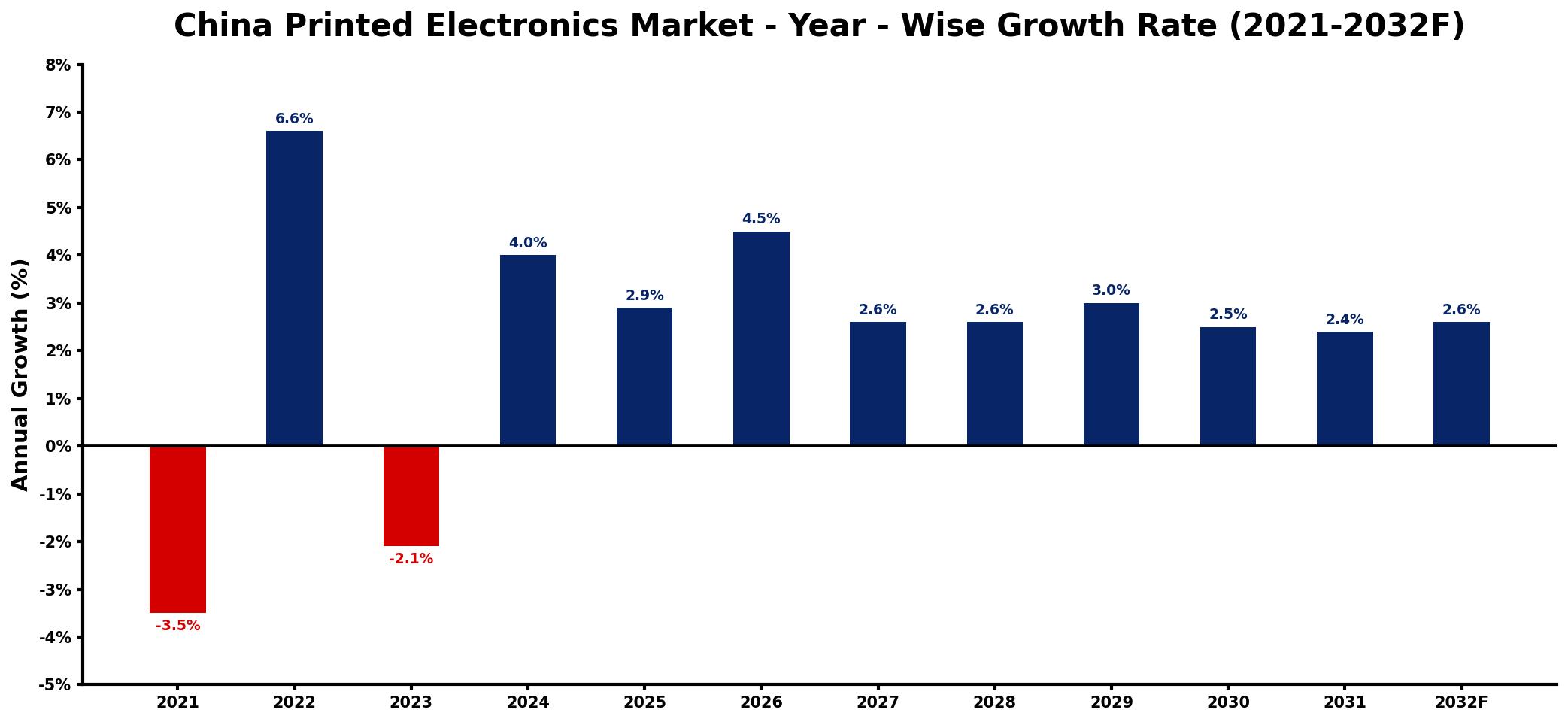
The table below presents the year‑wise growth rates along with the key drivers influencing the market
| Year | Growth Rate | Major Drivers |
| 2021 | -3.5% | falling export shipment volumes |
| 2022 | 6.6% | increased demand for innovative solutions |
| 2023 | -2.1% | reduced consumer spending on technology |
| 2024 | 4.0% | expansion of renewable energy applications |
| 2025 | 2.9% | growth in smart packaging solutions |
| 2026 | 4.5% | rising interest in sustainable materials |
| 2027 | 2.6% | enhanced focus on wearable technology |
| 2028 | 2.6% | increased applications in healthcare monitoring |
| 2029 | 3.0% | growing adoption in automotive sector |
| 2030 | 2.5% | increased overall sector activity |
| 2031 | 2.4% | increased investment in research initiatives |
| 2032 | 2.6% | growing demand for flexible displays |
Note: Market size estimations and growth projections presented in this report are based on 6Wresearch's proprietary forecasting methodology, utilizing the latest available industry data, government publications, and primary research inputs.
China Printed Electronics Market Synopsis
The strongest force currently shaping the China Printed Electronics Market is the rapid integration of flexible and wearable electronics into consumer lifestyles. As the demand for lightweight, adaptable electronic devices surges, manufacturers are leveraging innovative printing techniques to meet these evolving consumer needs.
Furthermore, the market is experiencing a significant boost from government initiatives aimed at establishing stringent standards and encouraging technological advancements. This proactive approach not only fosters innovation but also ensures that the printed electronics produced meet the safety and performance benchmarks required for various applications.
China Printed Electronics Market Key Takeaways
- The market is driven by increasing applications in consumer electronics and wearable technology.
- Government policies play a crucial role in promoting technology innovation and setting industry standards.
- Cost-effective production methods and lightweight characteristics are key advantages of printed electronics.
- Manufacturers are investing heavily in research and development to overcome technological challenges.
- Flexibility and adaptability of printed electronics are crucial for future market expansion.
Evaluation of Restraints in China Printed Electronics Market
Despite its promising growth, the China Printed Electronics Market is not without its challenges. One primary restraint is the high cost of materials and the substantial investment needed for research and development. As technologies evolve, staying competitive demands continual innovation, which can strain resources for many producers. Additionally, the regulatory landscape surrounding printed electronics is becoming increasingly stringent, further complicating compliance for manufacturers. These factors collectively contribute to a cautious market outlook for some stakeholders.
China Printed Electronics Market Trends
Several trends are currently influencing the China Printed Electronics Market. The shift towards sustainable production methods is gaining traction, as manufacturers seek to reduce their environmental impact. Concurrently, there is a growing interest in integrating IoT functionalities within printed electronics, enhancing their appeal in smart applications. Furthermore, as customization demands rise, the market is witnessing innovations in printing techniques that allow for greater design flexibility and efficiency.
China Printed Electronics Market Opportunities
Opportunities within the China Printed Electronics Market are abundant, particularly in the healthcare and automotive sectors. The increasing demand for smart medical devices and health monitoring solutions presents a lucrative avenue for growth. Additionally, the automotive industrys push towards lightweight materials and smart functionality in vehicles can drive significant investment in printed electronics. Businesses that focus on harnessing the latest printing technologies and material science advancements stand to benefit immensely.
Government Initiatives in the China Printed Electronics Market
Government policy is a critical component shaping the future of the printed electronics market in China. The government is focused on establishing performance standards and promoting industry development through incentives that encourage technological innovation. Programs aimed at enhancing the capabilities of printed electronics not only address safety and efficiency but also target environmental impacts. These initiatives are essential for maintaining competitive advantages in a rapidly evolving global landscape.
Future Insights of the China Printed Electronics Market
Looking ahead to the period between 2026 and 2032, the China Printed Electronics Market is poised for steady growth, driven by ongoing technological advancements and increased consumer demand for innovative electronic solutions. As the integration of printed electronics expands across multiple sectors, there will likely be significant developments in material science and production techniques. This evolution will position the market not only as a vital player in China's electronics landscape but also as a key contributor to global trends in electronics manufacturing.
China Printed Electronics Market Latest Developments (2025 - 2026)
Recent industry developments have underscored a shift towards more sustainable practices within the printed electronics market. Companies are increasingly investing in eco-friendly materials and energy-efficient printing methods. Additionally, collaborative efforts between academia and industry are fostering innovative research projects that promise to advance the capabilities of printed electronics, paving the way for new applications in the future.
China Printed Electronics Market - Key Attractiveness of the Report
- 10 Years of Market Numbers
- Historical Data Starting from 2022 to 2025
- Base Year: 2025
- Forecast Data until 2032
- Key Performance Indicators Impacting the Market
- Major Upcoming Developments and Projects
Key Highlights of the Report:
- China Printed Electronics Market Outlook
- Market Size of China Printed Electronics Market, 2025
- Forecast of China Printed Electronics Market, 2032
- Historical Data and Forecast of China Printed Electronics Revenues & Volume for the Period 2022-2032F
- China Printed Electronics Market Trend Evolution
- China Printed Electronics Market Drivers and Challenges
- China Printed Electronics Price Trends
- China Printed Electronics Porter's Five Forces
- China Printed Electronics Industry Life Cycle
- Historical Data and Forecast of China Printed Electronics Market Revenues & Volume By Material for the Period 2022-2032F
- Historical Data and Forecast of China Printed Electronics Market Revenues & Volume By Ink for the Period 2022-2032F
- Historical Data and Forecast of China Printed Electronics Market Revenues & Volume By Substrate for the Period 2022-2032F
- Historical Data and Forecast of China Printed Electronics Market Revenues & Volume By Technology for the Period 2022-2032F
- Historical Data and Forecast of China Printed Electronics Market Revenues & Volume By Screen for the Period 2022-2032F
- Historical Data and Forecast of China Printed Electronics Market Revenues & Volume By Inkjet for the Period 2022-2032F
- Historical Data and Forecast of China Printed Electronics Market Revenues & Volume By Flexographic for the Period 2022-2032F
- Historical Data and Forecast of China Printed Electronics Market Revenues & Volume By Gravure for the Period 2022-2032F
- Historical Data and Forecast of China Printed Electronics Market Revenues & Volume By Device for the Period 2022-2032F
- Historical Data and Forecast of China Printed Electronics Market Revenues & Volume By Displays for the Period 2022-2032F
- Historical Data and Forecast of China Printed Electronics Market Revenues & Volume By Photovoltaic for the Period 2022-2032F
- Historical Data and Forecast of China Printed Electronics Market Revenues & Volume By Lighting for the Period 2022-2032F
- Historical Data and Forecast of China Printed Electronics Market Revenues & Volume By RFID for the Period 2022-2032F
- Historical Data and Forecast of China Printed Electronics Market Revenues & Volume By Others for the Period 2022-2032F
- China Printed Electronics Import Export Trade Statistics
- Market Opportunity Assessment By Material
- Market Opportunity Assessment By Technology
- Market Opportunity Assessment By Device
- China Printed Electronics Top Companies Market Share
- China Printed Electronics Competitive Benchmarking By Technical and Operational Parameters
- China Printed Electronics Company Profiles
- China Printed Electronics Key Strategic Recommendations






































