China Proactive Services Market Size & Growth Rate (2026-2032)
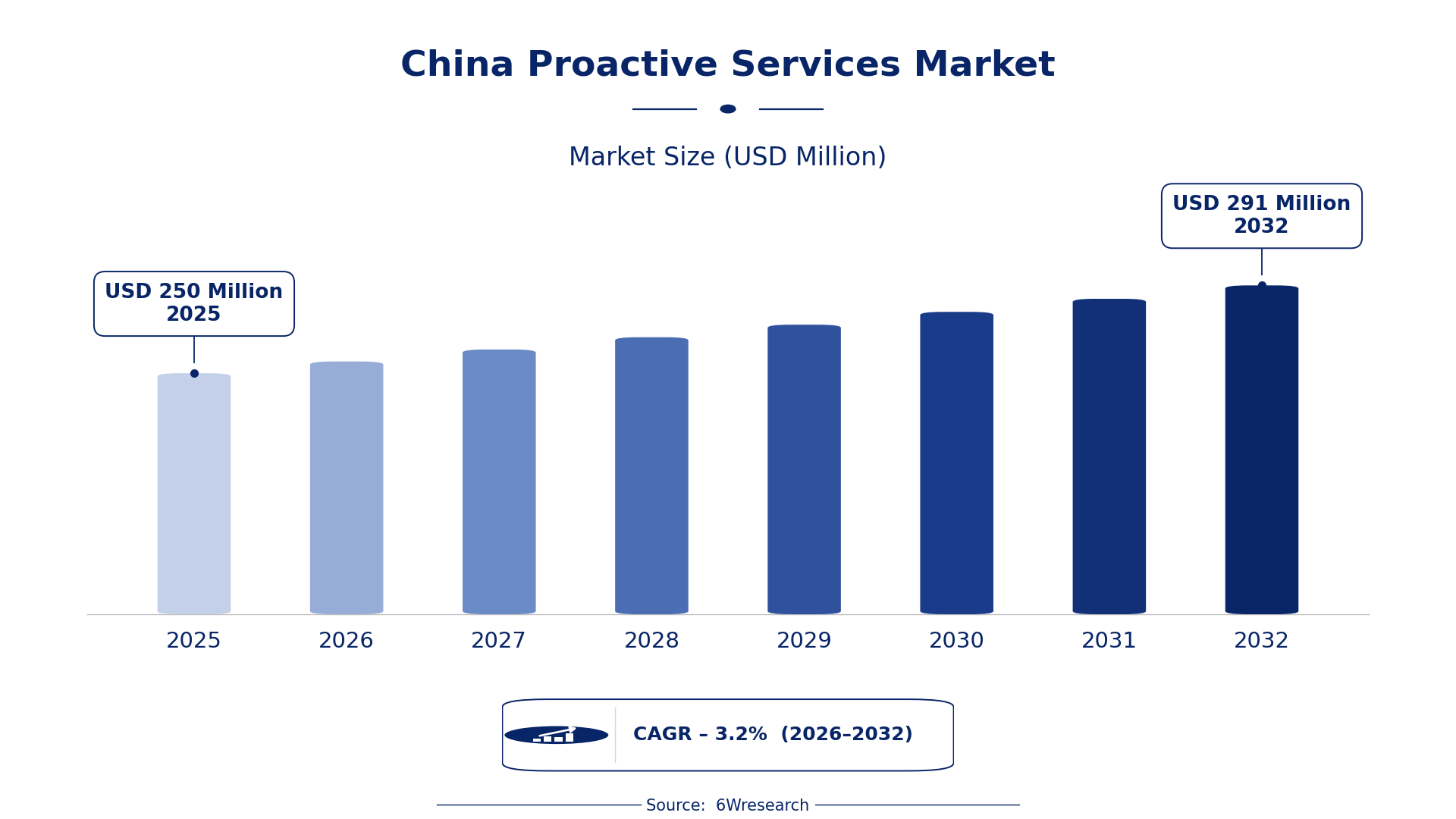
The China Proactive Services Market was estimated at USD 250 Million in 2025 and is projected to reach USD 291 Million by 2032, growing at a CAGR of 3.2% from 2026 to 2032.
China Proactive Services Market Synopsis
The demand for proactive services in China is skyrocketing as organizations recognize the value of anticipating issues before they escalate. Industries such as manufacturing and healthcare are particularly active in adopting solutions like predictive maintenance and real-time monitoring, driven by the necessity to optimize operations and minimize downtime.
With a mix of local and international providers, the competitive landscape is intensifying. Companies are pouring resources into research and development to introduce innovative offerings tailored to the unique challenges faced by Chinese businesses, ensuring they remain agile in a dynamic market environment.
China Proactive Services Market Year-wise Growth Rate and Key Drivers
This graph illustrates the annual growth rates of the China Proactive Services Market from 2021 to 2032, highlighting a steady upward trajectory and projected expansion over the forecast period.
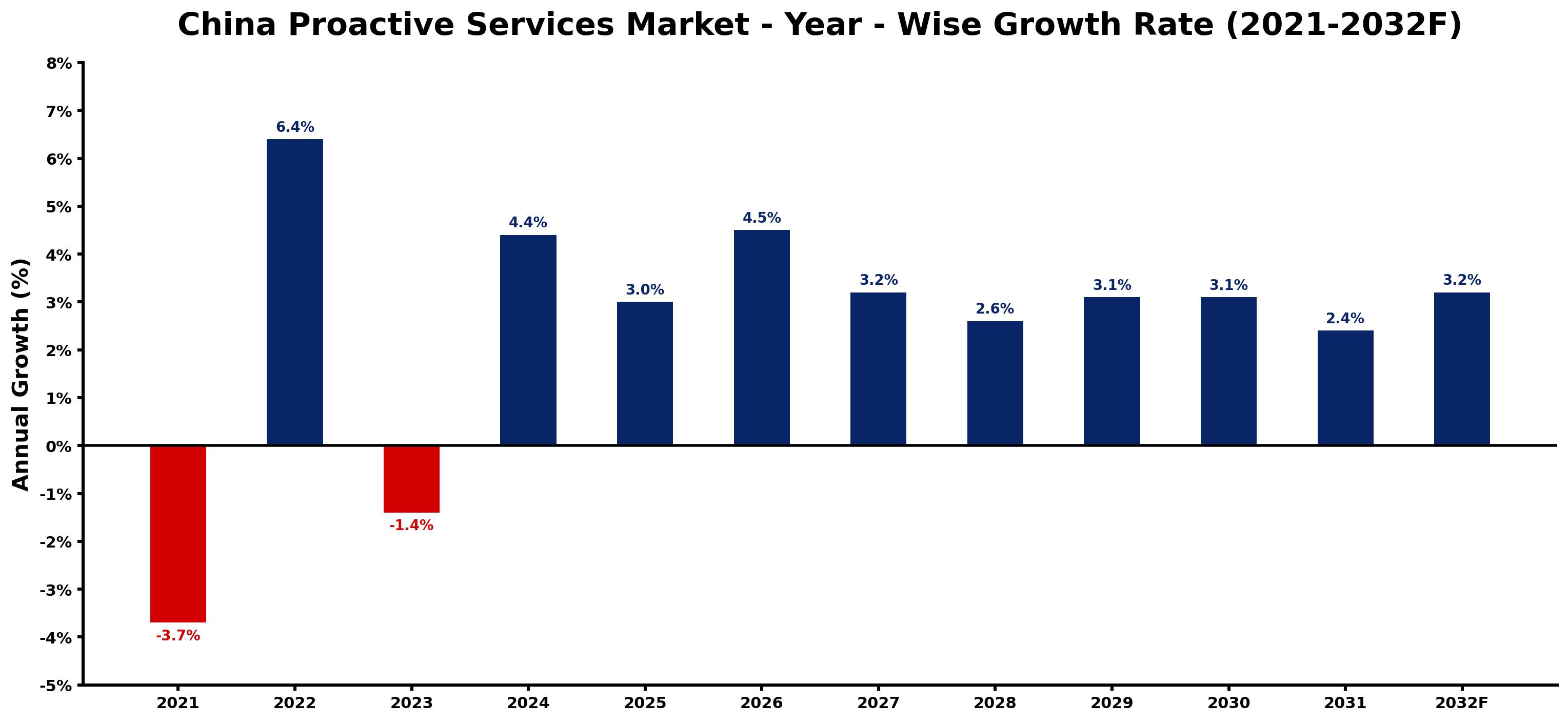
The table below presents the year‑wise growth rates along with the key drivers influencing the market
| Year | Growth Rate | Major Drivers |
| 2021 | -3.7% | Increased data privacy regulations from the Cybersecurity Administration |
| 2022 | 6.4% | Government health initiatives boost demand for wellness services. |
| 2023 | -1.4% | Decreased spending on IT services amid economic uncertainty |
| 2024 | 4.4% | Rising middle-class spending increases proactive service demand. |
| 2025 | 3.0% | Increased urbanization accelerates need for fitness solutions. |
| 2026 | 4.5% | Growing elder care sector drives proactive health services. |
| 2027 | 3.2% | Government digital health policies enhance service accessibility. |
| 2028 | 2.6% | Burgeoning telehealth trends reshape consumer service preferences. |
| 2029 | 3.1% | Local environmental policies promote sustainable wellness initiatives. |
| 2030 | 3.1% | Adoption of AI in health services enhances client engagement. |
| 2031 | 2.4% | Integration of preventive health programs with local communities. |
| 2032 | 3.2% | Consumer awareness campaigns enhance proactive health service uptake. |
Note: Market size estimations and growth projections presented in this report are based on 6Wresearch's proprietary forecasting methodology, utilizing the latest available industry data, government publications, and primary research inputs.
China Proactive Services Market Key Takeaways
Below are some of the specific key takeaways from the market, including:
- Growing adoption of AI-powered solutions is transforming customer service dynamics.
- Investment in predictive maintenance is on the rise, especially in the manufacturing sector.
- Data privacy regulations are shaping how services are delivered and data is managed.
- Significant opportunities exist for startups focusing on innovative proactive service solutions.
- The government is actively supporting the growth of the proactive services market through various initiatives.
Evaluation of Restraints in China Proactive Services Market
Several key restraints are limiting the potential of the China Proactive Services Market. One major factor is the intense competition among service providers, leading to price wars that squeeze margins. on top of that, as technology evolves rapidly, companies face continuous pressure to innovate. Data security and privacy concerns also loom large, particularly given the stringent regulations in place regarding data protection. Navigating this fragmented market, filled with both local and international players, adds to the complexity that companies must manage to succeed.
China Proactive Services Market Trends
A notable trend in the China Proactive Services Market is the shift towards AI-driven customer service platforms. Businesses are integrating chatbots and predictive analytics to enhance customer interactions, anticipating needs before they arise. This technological push is aimed at boosting customer satisfaction while also reducing operational costs.
Additionally, there’s an increasing emphasis on personalized and omnichannel experiences. Companies are striving to deliver consistent and engaging interactions across multiple platforms, reflecting the evolving expectations of today’s consumers.
China Proactive Services Market Opportunities
The market is brimming with investment opportunities, particularly in technology-driven solutions that enhance efficiency and customer experiences. Key areas for growth include predictive maintenance technologies, AI analytics tools, and proactive customer service platforms. With the ongoing digital transformation across sectors, the demand for services that can preemptively address issues is rising sharply. Investors looking to capitalize on this trend should consider supporting innovative firms that are leading the charge in proactive service offerings.
Government Initiatives in the China Proactive Services Market
The Chinese government is actively fostering the growth of the Proactive Services Market through a combination of support for innovation and regulatory frameworks. This commitment reflects a broader strategy to enhance industry efficiency and consumer trust. Policies designed to promote research and development in key sectors are crucial for establishing a competitive environment that encourages proactive service adoption.
- A national initiative launched in early 2025 focuses on promoting predictive maintenance in the manufacturing sector.
- Current efforts include the rollout of a digital infrastructure upgrade program aimed at enhancing real-time monitoring capabilities across industries.
- Planned legislation is expected to introduce new data protection measures by 2026, ensuring heightened consumer confidence in proactive services.
- Ongoing support for public-private partnerships is designed to drive innovation in proactive customer service solutions.
- Recent regulatory frameworks have been established to facilitate the integration of AI technologies in proactive service delivery.
Future Insights of the China Proactive Services Market
Looking ahead to 2026-2032, the China Proactive Services Market is set for substantial growth. The increasing digitization across industries, coupled with the rising adoption of advanced technologies like IoT and AI, will significantly propel the demand for proactive solutions. Companies are increasingly recognizing that proactive strategies not only enhance operational efficiency but also help mitigate costs associated with reactive maintenance. With ongoing governmental support for innovation, the market is likely to see continued expansion, particularly in predictive maintenance and asset performance management.
China Proactive Services Market Latest Developments
Recent activity in the China Proactive Services Market indicates a strong push towards technological advancement and service innovation. Over the past year, numerous initiatives have been launched, emphasizing the importance of proactive service offerings in enhancing operational efficiency.
- A leading regional operator unveiled a new AI-based predictive maintenance solution in Q1 2025, designed to reduce operational downtime in industrial settings.
- In mid-2025, a major technology vendor initiated a project focused on integrating remote monitoring capabilities for healthcare facilities, enhancing patient care.
- A public-private partnership is currently underway, aimed at expanding the reach of proactive customer service platforms across various sectors by late 2026.
- An initiative to standardize data privacy practices for proactive services was launched in early 2025 and is expected to improve consumer trust by mid-2026.
- Upcoming plans include a rollout of an omnichannel customer engagement framework expected to begin in the second half of 2026, designed to streamline interactions.
China Proactive Services Market - Key Attractiveness of the Report
- 10 Years of Market Numbers
- Historical Data Starting from 2022 to 2025
- Base Year: 2025
- Forecast Data until 2032
- Key Performance Indicators Impacting the Market
- Major Upcoming Developments and Projects
The Chinese government has initiated several policies to foster growth in the proactive services market, including support for R&D and a national digital infrastructure upgrade program aimed at enhancing service delivery.
Key Highlights of the Report:
- China Proactive Services Market Outlook
- Market Size of China Proactive Services Market, 2025
- Forecast of China Proactive Services Market, 2032
- Historical Data and Forecast of China Proactive Services Revenues & Volume for the Period 2022-2032F
- China Proactive Services Market Trend Evolution
- China Proactive Services Market Drivers and Challenges
- China Proactive Services Price Trends
- China Proactive Services Porter's Five Forces
- China Proactive Services Industry Life Cycle
- Historical Data and Forecast of China Proactive Services Market Revenues & Volume By Application for the Period 2022-2032F
- Historical Data and Forecast of China Proactive Services Market Revenues & Volume By Network Management for the Period 2022-2032F
- Historical Data and Forecast of China Proactive Services Market Revenues & Volume By Customer Experience Management for the Period 2022-2032F
- Historical Data and Forecast of China Proactive Services Market Revenues & Volume By Data Center Management for the Period 2022-2032F
- Historical Data and Forecast of China Proactive Services Market Revenues & Volume By Cloud Management for the Period 2022-2032F
- Historical Data and Forecast of China Proactive Services Market Revenues & Volume By Application Management for the Period 2022-2032F
- Historical Data and Forecast of China Proactive Services Market Revenues & Volume By Device / Endpoint Management for the Period 2022-2032F
- Historical Data and Forecast of China Proactive Services Market Revenues & Volume By Service for the Period 2022-2032F
- Historical Data and Forecast of China Proactive Services Market Revenues & Volume By Managed Services for the Period 2022-2032F
- Historical Data and Forecast of China Proactive Services Market Revenues & Volume By Technical Support for the Period 2022-2032F
- Historical Data and Forecast of China Proactive Services Market Revenues & Volume By Design and Consulting for the Period 2022-2032F
- Historical Data and Forecast of China Proactive Services Market Revenues & Volume By Technology Type for the Period 2022-2032F
- Historical Data and Forecast of China Proactive Services Market Revenues & Volume By Big Data Analytics for the Period 2022-2032F
- Historical Data and Forecast of China Proactive Services Market Revenues & Volume By Business Intelligence for the Period 2022-2032F
- Historical Data and Forecast of China Proactive Services Market Revenues & Volume By Machine Intelligence for the Period 2022-2032F
- Historical Data and Forecast of China Proactive Services Market Revenues & Volume By Organization Size for the Period 2022-2032F
- Historical Data and Forecast of China Proactive Services Market Revenues & Volume By Small and Medium-sized Enterprises (SMEs) for the Period 2022-2032F
- Historical Data and Forecast of China Proactive Services Market Revenues & Volume By Large enterprises for the Period 2022-2032F
- Historical Data and Forecast of China Proactive Services Market Revenues & Volume By Vertical for the Period 2022-2032F
- Historical Data and Forecast of China Proactive Services Market Revenues & Volume By Banking, Financial Services, and Insurance (BFSI) for the Period 2022-2032F
- Historical Data and Forecast of China Proactive Services Market Revenues & Volume By Telecommunication for the Period 2022-2032F
- Historical Data and Forecast of China Proactive Services Market Revenues & Volume By Retail for the Period 2022-2032F
- Historical Data and Forecast of China Proactive Services Market Revenues & Volume By Healthcare for the Period 2022-2032F
- Historical Data and Forecast of China Proactive Services Market Revenues & Volume By Government and Defense for the Period 2022-2032F
- Historical Data and Forecast of China Proactive Services Market Revenues & Volume By Media and Entertainment for the Period 2022-2032F
- Historical Data and Forecast of China Proactive Services Market Revenues & Volume By Others for the Period 2022-2032F
- China Proactive Services Import Export Trade Statistics
- Market Opportunity Assessment By Application
- Market Opportunity Assessment By Service
- Market Opportunity Assessment By Technology Type
- Market Opportunity Assessment By Organization Size
- Market Opportunity Assessment By Vertical
- China Proactive Services Top Companies Market Share
- China Proactive Services Competitive Benchmarking By Technical and Operational Parameters
- China Proactive Services Company Profiles
- China Proactive Services Key Strategic Recommendations






































